
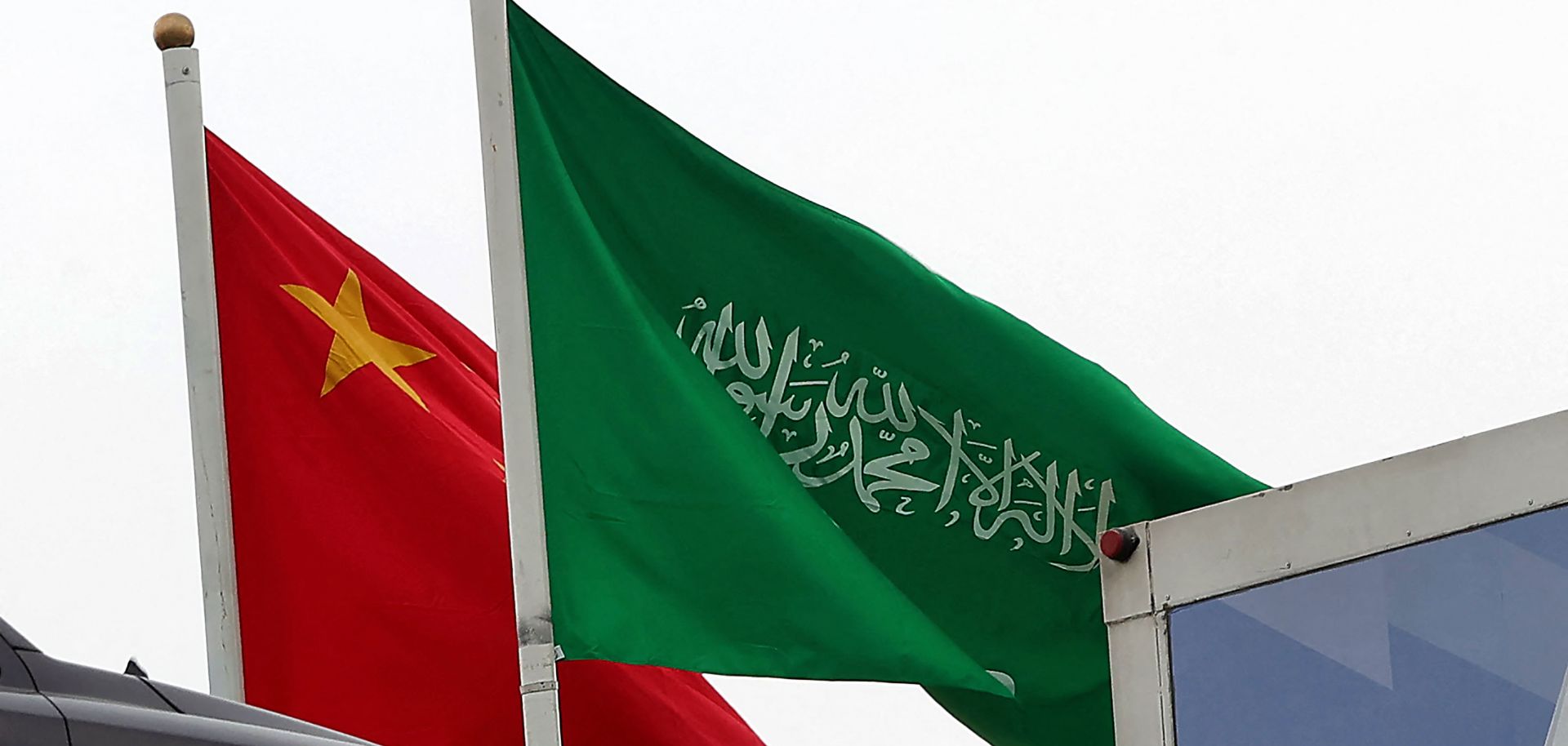
The Chinese and Saudi flags wave on a street in Riyadh on Dec. 7, 2022, ahead of Chinese President Xi Jinping's three-day visit to the Saudi capital.
Chinese President Xi Jinping's trip to Saudi Arabia highlights the two countries' deepening economic, defense, cultural and educational ties, which could grant both sides greater freedom in foreign policy as Riyadh and Beijing each look for ways to withstand U.S. pressure. On Dec. 8, Chinese President Xi Jinping began a three-day trip to Saudi Arabia to kick off what he called ''a new era'' in Saudi-Chinese relations, which have been deepening since China began economic reforms in the 1980s. During the visit, Xi and Saudi King Salman signed a ''comprehensive strategic partnership agreement'' in which the two heads of state committed to holding biannual meetings and increasing their countries' cultural and tourism ties. The meeting yielded various deals to increase cooperation in fields spanning technology, education, energy and economic development as well. Xi also participated in a China-Gulf Cooperation Council (GCC) summit on Dec. 9, where he pledged to use China's currency (the yuan) more to purchase China's oil and gas exports from the region, which are typically priced in U.S. dollars. The high-profile visit comes against the backdrop of strained Saudi-U.S. relations after the kingdom helped lead an OPEC+ production cut in October against Washington's advisement. China's relations with the United States have also hit new lows amid growing tensions over Taiwan.
- During their recent meeting, Xi and King Salman signed memoranda of understanding to ''align'' China's Belt and Road Initiative with Saudi Arabia's Vision 2030 diversification plan, increase cooperation on hydrogen energy, teach the Chinese language in Saudi public schools, and have the Chinese tech giant support cloud computing and build high-tech complexes in Saudi cities.
- The Saudi visit marks Xi's second trip to the Arab Gulf region since the Chinese leader assumed office in 2012. In 2018, the Chinese president traveled to neighboring United Arab Emirates, where he deepened strategic ties with the otherwise U.S.-aligned Arab Gulf state. The United Arab Emirates also has purchased Chinese Wing Loon II drones and utilizes Huawei's telecommunications technology in its 5G network, despite U.S. objections that such Chinese-made equipment could be used to spy on U.S. military technology.
China's Interest in the Arab Gulf
The Persian Gulf has been crucial in fueling China's economic development over the past 40 years. After the end of the Cold War, the region emerged as a key transport hub for Chinese goods to the West, as well as a key source of energy exports to support China's industrialization. To protect these economic interests, Beijing has sought to strengthen its ties with the Persian Gulf's major powers over the years — including Saudi Arabia, whose ballistic missile program China helped launch in the 1980s after the United States refused to supply the kingdom with similar systems for fear of sparking a regional arms race. But this has also seen China become closer to Saudi Arabia's top regional rival, Iran (in 2021, China was the largest single purchaser of Iran's otherwise heavily sanctioned oil exports). Today, China and Arab Gulf states have both remained largely neutral in the ongoing Russo-Ukrainian war, where their interests lie with energy market stability and retaining working ties with both Moscow and the West. But Beijing's continued partnership with Tehran will complicate its ability to deepen its security ties with Arab Gulf countries that have been targeted by Iranian aggression, including Saudi Arabia and the United Arab Emirates.
Beijing and Riyadh have many reasons to more closely align. But Saudi-U.S. ties run deep (especially in the military sphere), and China does not appear prepared to replace them anytime soon. China's non-interventionist approach to foreign policy deters it from forming permanent alliances abroad that could entangle Beijing in far-flung conflicts. Under this ideology, Beijing has shown little interest in taking sides in the Arab Gulf's rivalries. And China is unlikely to change that long-held policy to help defend Saudi Arabia from Iran or Iran's various regional proxies (including Yemeni Houthi rebels). China also hasn't signaled any desire to compete with the entrenched U.S.-Saudi defense partnership (in 2021, Washington sold $1.3 billion worth of weapons to the kingdom; China, by contrast, sold only $40 million of arms to Riyadh that year). The United States, meanwhile, is still actively attempting to address Saudi defense concerns and retain the two countries' close military partnership — as evidenced by Washington's recent push to create a regional integrated air defense network to deter Houthi and Iranian attacks on the kingdom, as well as the United States' move to drop threats to sanction Saudi Crown Prince Mohammed bin Salman for the 2018 assassination of Jamal Khashoggi. For now, Saudi Arabia's military will thus remain heavily dependent on the United States to protect against regional threats.
- Saudi Arabia's military is dependent on American military hardware and training. Its air force's fleet of U.S. F-15 and C-130 fighter jets is particularly essential to the kingdom's ongoing military intervention in Yemen. Saudi officers also have decades of training in U.S. military culture and the English language, which is hard to quickly replace. But Saudi Arabia has begun showing interest in expanding its drone capabilities in recent years, which are being built from the ground up and are thus not as reliant on the United States.
But over time, Saudi Arabia and China's deepening relationship could eventually help both countries become more militarily and economically independent. Although they will take a long time to develop, expanded China-Saudi military ties are seemingly the natural next step in their evolving relationship — especially given Saudi Arabia's ongoing interest in building defense partners beyond the United States, which has also recently seen Ridyah reach out to its former rival, Turkey, to purchase its TB2 Bayraktar drones. Unlike the United States, China is unlikely to attach end-use requirements to military equipment sold to Saudi Arabia. A deeper defense partnership with Beijing would thus give Riyadh's military more options to carry out controversial operations abroad — like drone strikes in Yemen, which have previously sparked criticism and arms sale freezes from Washington. Beyond the security realm, Saudi Arabia will likely also seek China's help in developing a civilian nuclear program, which would support the kingdom's transition from hydrocarbons. Chinese investment and technologies will aid in Saudi Arabia's Vision 2030 economic diversification program as well, which is geared toward establishing Saudi economic independence from oil sales. China, for its part, would gain improved relations with a major energy supplier and transit hub (China imported 17.4% of its oil from Saudi Arabia in 2021). For Beijing, this could become particularly important in helping alleviate Western economic pressure if tensions over Taiwan escalate into sanctions, a military confrontation, or an outright war.
- The United Arab Emirates has already leveraged its growing ties with China for greater military freedom from the United States. UAE forces have been using Chinese-made drones to conduct airstrikes in Yemen against Iran-backed Houthi rebels. In 2018, the United Arab Emirates also reportedly used a Chinese-made Blue Arrow 7 missile to kill Houthi leader Saleh al-Samad.
- Saudi Arabia has resisted cutting ties with Russia over its invasion of Ukraine, as it favors energy market stability and ties with Russia over joining the West's sanctions campaign that would harm Riyadh's economy. This neutrality is buttressed by a state-led Saudi nationalism that prioritizes Saudi interests among the public. China appears to be betting that Saudi Arabia's neutrality on the Ukraine war could be replicated in a potential U.S.-China conflict, with Ridyah continuing to maintain ties with Beijing despite U.S. pressure.
