
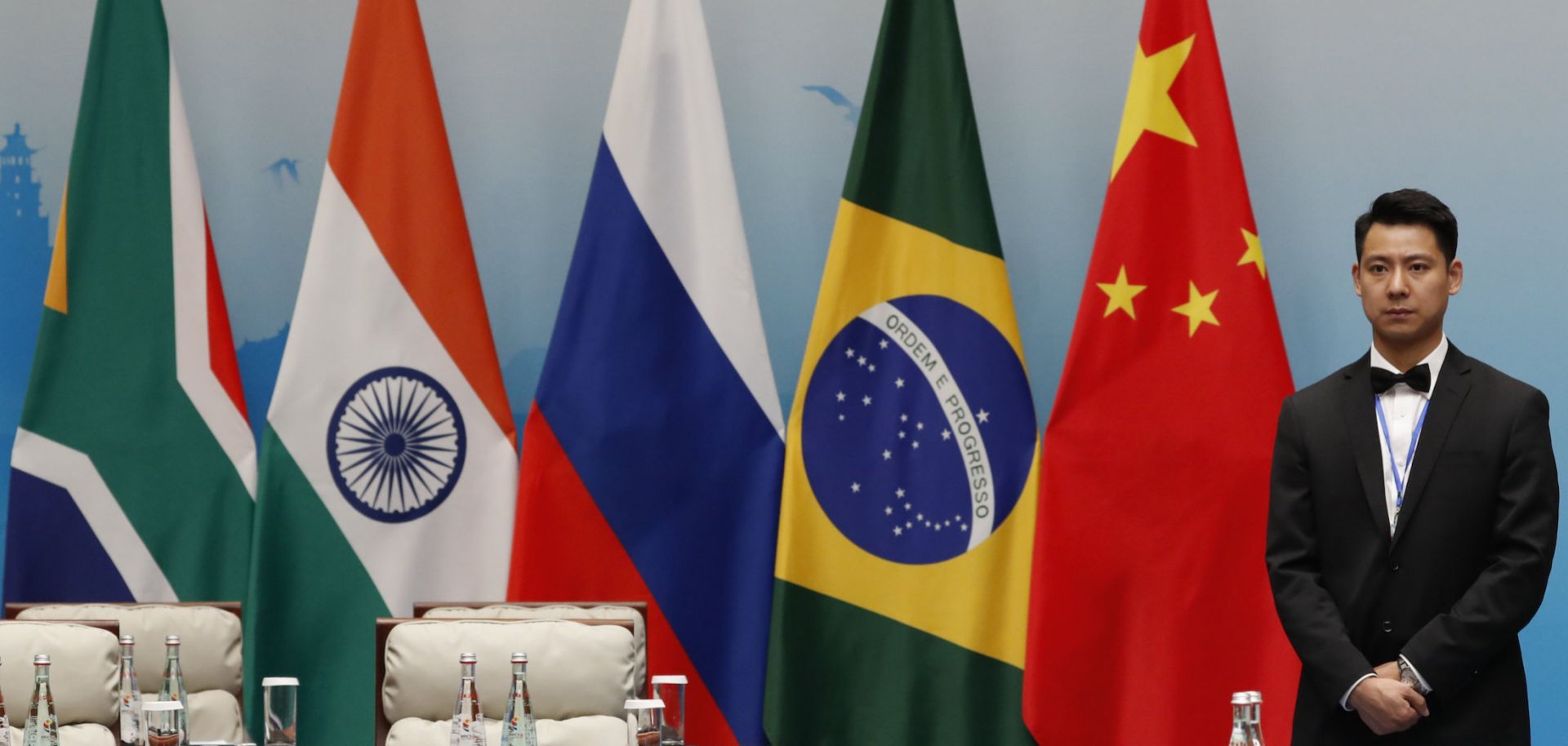
An attendant stands next to South African, Indian, Russian, Brazilian and Chinese flags during a BRICS summit in Xiamen, China, on Sept. 4, 2017.
The expansion of the BRICS group of developing nations would increase its economic and political heft as a non-Western forum, but internal disagreements would ultimately still limit the bloc's ability to become as influential as the Group of Seven (G-7). The foreign ministers of Brazil, Russia, India, China and South Africa — known collectively as ''BRICS'' — will meet in Cape Town, South Africa, on June 2-3 to discuss the bloc's enlargement and consider other countries' applications for membership. In April, South Africa's BRICS ambassador said that 19 countries had expressed an interest in joining the alliance, with 13 formally asking to join and the other six doing so informally. Countries known to have expressed an interest in becoming a BRICS member include Algeria, Argentina, Bahrain, Egypt, Indonesia, Iran, Saudi Arabia and the United Arab Emirates.
- In 2022, the year that China hosted the BRICS summit, Beijing formally proposed that the bloc start the expansion process and create procedures and criteria to do so.
- The term ''BRIC'' was first coined in 2001 by then-Goldman Sachs economist Jim O'Neil to describe the countries he viewed as the top economic growth engines outside the Western world. Those original four countries — Brazil, Russia, India, China — eventually formalized into a bloc, holding their first summit in 2009. The alliance has since only added one other member, with South Africa joining in 2010 — adding an ''S'' to the end of the group's name.
Rising Chinese and Russian strategic competition with the West, and China's desire to expand BRICS to increase its economic and political power, are driving the bloc to expand its membership. China and Russia appear to view the BRICS as a non-Western counterweight to the G-7, which is the main political forum for Western countries to shape diplomatic and economic policies. In recent years, the G-7 (which includes Canada, France, Germany, Italy, Japan, the United Kingdom and the United States, as well as the European Union as a ''non-enumerated member'') has significantly expanded its sanctions on Russia and taken a more aggressive stance to curb climate change, which Russia's 2022 invasion of Ukraine has only since accelerated. This, among other key Western policies, that have irked both Beijing and Moscow, which are now seeking to find a similar forum for non-Western countries that share some of their views on certain issues, such as climate change and the need to reduce the West's grip on international finance. Of the existing blocs where China and Russia are members, but Western countries are not, BRICS is the only one that is global and makes the most sense as a vehicle for such discussions. BRICS' expansion is also a natural evolution as the once Western-led world order becomes increasingly multipolar. Amid this global geopolitical shift, non-Western countries are increasingly looking for ways to deepen their economic and political ties with each other, as evidenced by their growing interest in joining BRICS.
- The West is pushing non-Western countries to adopt timelines to phase out fossil fuels and transition to net zero emissions on a similar timeframe as highly developed countries. Countries like China and India say that this is unfair, arguing that the West should instead bear the brunt of reducing emissions and paying for climate change since Western countries have historically been the world's largest carbon emitters.
- Beijing and Moscow also oppose the aggressive use of sanctions by the United States (and G-7 more broadly) that force companies globally – including Russian and Chinese companies – into compliance by threatening to cut them off from the U.S. and/or European financial systems.
It's only a matter of time before BRICS accepts new members, as many of the countries that have expressed an interest in joining would clearly benefit the bloc. Saudi Arabia and the United Arab Emirates are particularly likely to eventually join BRICS, as it would enable the bloc to finally expand into the Middle East. Bringing the two Arab Gulf states into the fold, which both have large sovereign wealth funds for investment, would also give BRICS more members that are major outbound investors, as China is currently the only member that isn't mainly an investment recipient. From Beijing's perspective, the addition of two major oil producers to the bloc could help secure China's access to future energy supplies and increase global energy security as well. Egypt, one of Africa's largest economies with a population of over 100 million, is another attractive candidate. The same can be said for Indonesia, which lies at the heart of Southeast Asia – another region where BRICS currently has no members, which is also poised to increasingly become a destination for Western investment and global manufacturing supply chains. Kazakhstan has expressed an interest in joining BRICS as well, which would enable the bloc to expand into Central Asia — a region that serves as a vital crossroads for China's Belt and Road Initiative. Such an expansion into the Middle East, North Africa and/or Southeast Asia could quickly add trillion(s) of dollars of GDP to the bloc and many millions more people, bringing its overall size on par with the G-7.
- According to the International Monetary Fund, G-7 nations' combined GDP amounted to about $44 trillion in 2022, while BRICS members' combined GDP amounted to about $26 trillion.
An enlarged BRICS would enhance and increase the capacity for BRICS-related institutions to become viable alternatives to Western institutions, though likely only in a limited fashion. Arguably, the two most effective institutions that the five current BRICS members have created are the New Development Bank (NDB), which is meant to be analogous to the World Bank as a development bank, and the Contingent Reserve Arrangement (CRA), which is meant to be analogous to the International Monetary Fund (IMF) as a way to respond to any short-term balance of payments pressures. But since China is currently the only member that's a major overseas investor, there is limited ability for BRICS to scale up these mechanisms without Beijing being the de facto guarantor or main facilitator of increasing their scope. Adding countries like the United Arab Emirates and Saudi Arabia to the BRICS mechanisms as full participants would increase their size to make them more competitive with Western-backed institutions. Already, this is starting to occur with the NDB, with Bangladesh, Egypt and the United Arab Emirates becoming the first non-BRICS members to join the bank in 2021 (albeit at much smaller shares than the bloc's current members). However, in order for the NDB and CRA to be effective alternatives to their Western-led counterparts, their size will need to increase, particularly as the NDB is just one of about a dozen such multilateral development banks in the world.
- On May 2, Brazilian President Luiz Inacio Lula da Silva said he had begun discussions with the NDB (which is currently chaired by former Brazilian President Dilma Rousseff) to amend the bank's internal rules and allow for debt-ridden Argentina to receive financing or loans from the NDB as a way ''to remove [the IMF's] knife from Argentina's neck.'' The announcement illustrates how BRICS leaders will likely seek to expand the influence of these institutions, even if in practice their efforts are less impactful.
Expanding BRICS can also help boost trade in non-Western currencies, as well as support a possible BRICS currency. But these efforts will still represent only a limited threat to the U.S. dollar's status and create limited ways of bypassing Western currencies. One of the areas where BRICS countries are aligned is in reducing the dominance of the U.S. dollar and the West in international trade finance and global reserves, including potentially the creation of an alternative BRICS-backed reserve currency. Western countries (particularly the United States) have been able to exploit this dominance through sanctions policies that cut off or threaten to cut off companies from the international financial system. This vulnerability has increasingly become a concern in Beijing and Moscow as the West sanctions Russia for the war in Ukraine and China considers potential sanctions retaliation if it attacks Taiwan. However, efforts to expand trade settlement in local currencies as a way to bypass the dollar face limitations. For one, several BRICS currencies are not very strong or not easily convertible, making them undesirable for banks and companies to hold on their balance sheets. For example, even though Russia has been trying to boost yuan usage in its trade with China, Moscow has been less keen on boosting its usage of the Indian rupee due to concerns about the rupee's limited convertibility; Russia's large trade surplus with India would have also led to significant rupee accumulation. Most trade within the bloc is also China-centric as bilateral trade between BRICS countries not involving China is relatively limited, making any shift toward using the yuan more of a bilateral issue — and one that faces constraints due to China's unwillingness to introduce its own reforms to increase yuan convertibility. Broadening out BRICS can help increase some of the non-China-centric trade. But China's large economy is the main appeal of joining BRICS for countries like Saudi Arabia and the United Arab Emirates that want to deepen economic ties with China, giving them little incentive to cooperate on broader de-dollarization beyond some trade with China. Moreover, the United Arab Emirates and Saudi Arabia have shown little willingness to completely break with tradition and sell most of their oil in other currencies than the dollar, and have also seen how China has previously sought to manipulate prices denominated in yuan in other commodities. Selling more oil in yuan would be problematic as both countries peg their currencies to the dollar and increasing yuan accumulation would face many of the same risks for them that rupee accumulation would for India in terms of the yuan's relatively limited convertibility.
- As of December 2022, 58.4% of the world's foreign exchange reserves were held in U.S. dollars as of December 2022. This percentage has steadily declined since the euro's introduction in 1999, when the dollar's share of global foreign exchange reserves stood at 71%. Still, even as the U.S. currency's share has slowly declined, the share of non-Western countries remains extremely low. The Chinese yuan, for example, accounted for just 2.7% of global foreign exchange reserves as of December 2022.
- Citing Indian officials, Reuters reported on May 4 that Russia and India had suspended talks on settling bilateral trade in rupees after months of negotiations. Russian officials were concerned that rupee accumulation — which would have occurred due to Russia's large trade surplus with India — was ''not desirable'' due to the rupee not being fully convertible and India only representing 2% of global trade.
- According to the latest annual trade data available in U.N. databases, China accounted for the vast majority of trade within BRICS. Trade with China represented 84% of Brazil's trade with BRICS countries; that number was 73% for India, 86% for Russia and 67% for South Africa.
- There is new political momentum to create a BRICS reserve currency — a proposal that has been on the table for more than a decade — that would be similar to the IMF's special drawing rights (SDR) and be based on a basket of BRICS currencies. However, such a currency would still face volatility concerns due to its underlying currencies being less ''safe'' than the main Western currencies backing the SDR. It thus remains to be seen the extent to which other countries would be willing to use a BRICS reserve currency.
Climate change and the energy transition are areas where BRICS cooperation may increase significantly. The addition of Saudi Arabia, the United Arab Emirates, Indonesia and Algeria — all of which are major oil and gas producers and/or coal consumers — could turn BRICS into a major player in climate negotiations by having its members take a shared position. The bloc would have not only the world's two largest coal consumers (India and China) but the largest two non-Western oil producers (Russia and Saudi Arabia). It would also have a group of other smaller, fossil fuel-dependent countries (including Algeria, South Africa, Indonesia, and Brazil) that all see Western pressure to accelerate the energy transition as unfair. India, backed by China, is reportedly already pushing for the G-20 to back ''multiple pathways'' for the energy transition at the September summit in New Delhi. Multiple pathways would enable countries to not put a specific date on phasing coal or other fossil fuel use, which is what Western countries are advocating. Moreover, the United Arab Emirates, which is hosting this year's U.N. climate summit, has tried to shift debates away from phasing out fossil fuels to phasing out ''fossil fuel emissions,'' which would enable oil, gas and coal to be consumed for longer, even if abated through new carbon capture and storage technologies. BRICS thus has the potential to be a vehicle for like-minded countries to take a different stance than the West on climate issues in a more unified way and drive their shared viewpoint in negotiations at the international level, like at U.N. conferences and other major multilateral forums.
But as BRICS grows, so too will internal disagreements over various policies, particularly on non-climate and-economic matters, which will limit the bloc's cohesiveness. The current five BRICS members share similar views on issues like reducing the West's financial dominance or boosting climate finance for developing countries. However, South Africa, Brazil and India do not share China and Russia's anti-United States and -West views to the same degree. In particular, India's own rivalry with China places it firmly in the U.S. military sphere of influence. And while it may court Chinese investment for economic purposes, Brazil also has deep economic ties with the United States and does not view Washington as a strategic rival. These internal contradictions have limited BRICS cooperation in the past and the bloc's enlargement would only magnify them in the future. Saudi Arabia, the United Arab Emirates and Indonesia, for example, are deeply tied to the U.S. security apparatus, which could impede cooperation on security matters if these three countries joined BRICS. Iran, another potential BRICS candidate, shares Russia and China's deep animosity toward the United States and its Western allies. But Iran is also Saudi Arabia's largest regional rival, which could also drive internal disputes if both countries became BRICS members. Ultimately, the entry of these (and other) countries would not limit cooperation in areas of mutual interest, which include many economic and financial issues that are particularly pertinent to the Global South. It would, however, severely restrict BRICS cooperation as a unified political forum that can rival the G-7, whose members all share a core set of values and beliefs that will keep the G-7 more unified than BRICS could ever be — expanded or not.
