
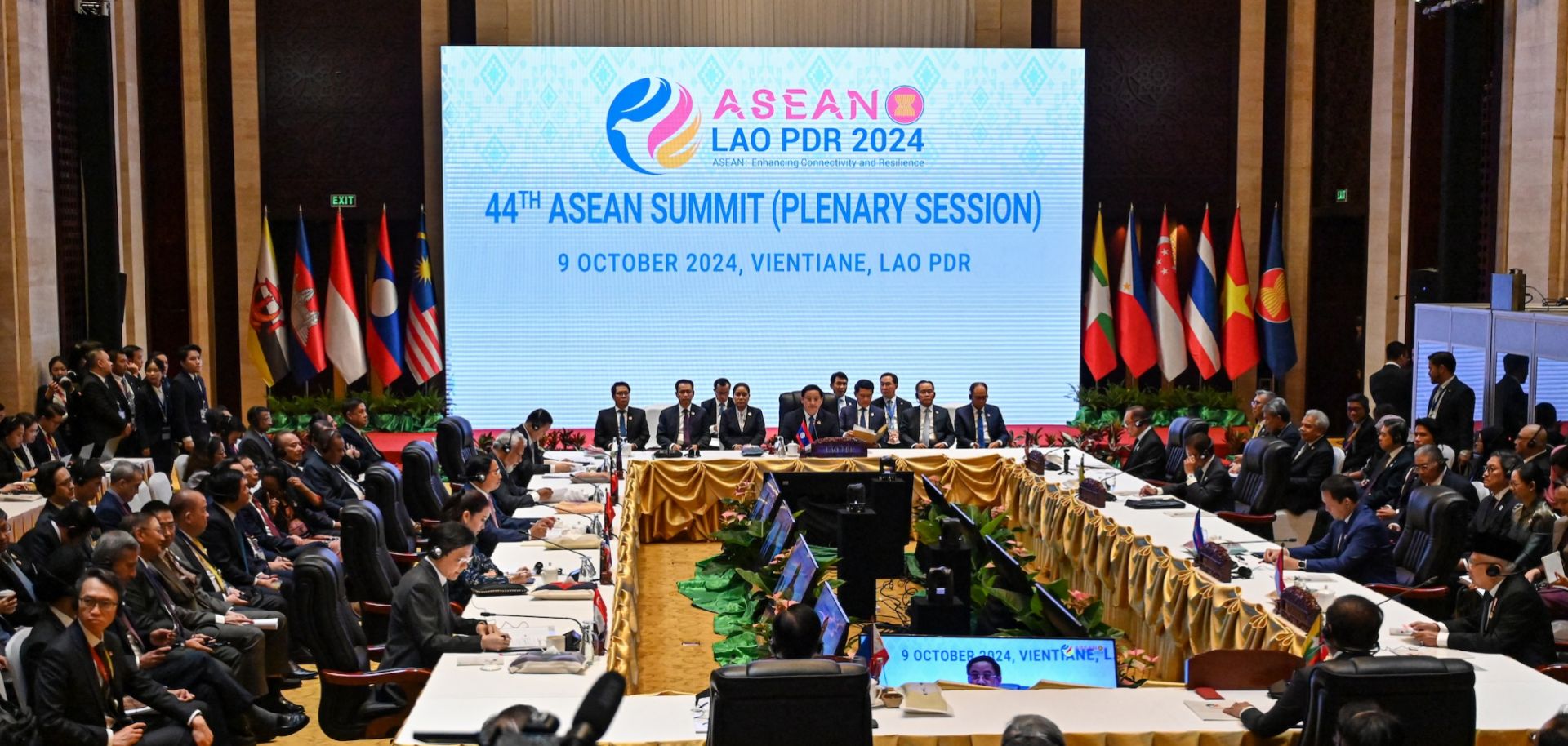
The recent Association of Southeast Asian Nations (ASEAN) summit approved plans for greater digital and economic integration, but comprehensive implementation will prove challenging across the bloc's divergent economies, and continued inaction on key geopolitical issues risks undermining ASEAN's larger goal of centralizing regional issues within itself. From Oct. 6-11, the annual ASEAN summit convened in Vientiane, Laos. Little progress was made on the grouping's highest profile and most contentious issues, namely the disputed South China Sea and the ongoing war in Myanmar. However, the summit yielded several key agreements facilitating ASEAN economic integration in digitalization, green finance, dispute resolution processes and policy harmonization, with progress on several more, including the ASEAN Digital Economy Framework Agreement, updates to ASEAN Plan of Action for Energy Cooperation, and an upgraded ASEAN Comprehensive Investment Agreement.
- The South China Sea remains arguably the most contentious issue for ASEAN, and it was a prominent discussion topic during the summit. The Philippines and Vietnam pressed for stronger collective action regarding China's territorial claims and assertive actions in the maritime region. The Philippines also called to finalize the South China Sea code of conduct, which has stalled since 2002. However, no movement was made on the issue, with host and chair Laos, along with Cambodia, advocating for a more conciliatory approach with China.
- The war in Myanmar also featured prominently during summit discussions, though ASEAN's response remains hampered by internal disagreements and structural limitations.
The flurry of deals will enhance ASEAN's digital economy and cross-border intra-bloc trade while appealing to foreign investors with modernized dispute resolution processes. The focus on investment liberalization will also improve intra-ASEAN investment flows, fostering greater economic integration and resilience against external economic shocks.
- The ASEAN Digital Economy Framework Agreement, or DEFA, will enhance e-commerce and digital trade within ASEAN by standardizing digital regulations, facilitating cross-border data flows and addressing cybersecurity challenges. This will bolster the region's small- and medium-sized enterprises by facilitating cross-border market access and exchanges, while also deepening ASEAN's integration into global supply chains by allowing businesses to connect with international suppliers and markets more efficiently. DEFA thus has the potential to not only strengthen intra-ASEAN trade but also attract foreign direct investment and promote regional economic integration. The summit saw new agreements on interoperable digital infrastructure, putting the DEFA on track for full implementation in 2025.
- The upgrade to the ASEAN Comprehensive Investment Agreement, or ACIA, expands the number of sectors covered by the agreement (particularly to digital and emerging technologies), which eases regulatory burdens. It also reinforces fair and equitable treatment for foreign investors, protection against expropriation, further commitments to national treatment and most-favored-nation status (meaning foreign investors are legally protected from discriminatory treatment relative to their local counterparts). The update improves the ACIA's dispute resolution mechanisms as well, including a modern arbitration framework that brings ASEAN more in line with international standards in this area, which is important given legal frameworks in many ASEAN countries remain relatively underdeveloped and poorly enforced, posing a constraint on foreign investment. Together, these changes thus signal a strong commitment to making ASEAN more attractive to foreign investors.
- The ASEAN Plan of Action for Energy Cooperation targets increased collaboration on renewable energy projects and regional grid integration to address energy security challenges and support ASEAN's ambitious sustainability goals. The agreement, now in its 2021-2025 phase, was augmented to enhance the region's capabilities in carbon capture, utilization and storage while highlighting how energy security has become a pressing concern within ASEAN, driven by rapid economic development while simultaneously pursuing ambitious decarbonization goals.
- The summit also yielded various green and sustainable finance initiatives that complement ASEAN's decarbonization efforts by encouraging environmentally sustainable investments, which are critical for financing large-scale renewable energy projects and green infrastructure.
- All of these deals are further geared to fully implement the bloc's Regional Comprehensive Economic Partnership trade agreement, or RCEP. Finalized in 2020, the RCEP is ASEAN's most ambitious trade bloc and the world's largest, spanning 15 countries that together comprise nearly a third of global GDP. The signatories include the 10 ASEAN members, as well as China, Japan, South Korea, Australia and New Zealand. While all 15 countries have ratified the RCEP, each of the initiatives signed at the 2024 summit will help move ASEAN toward the pact's full implementation, which requires degrees of legal and regulatory harmonization, tariff and non-tariff barrier reductions, improved dispute resolution mechanisms and capacity-building tools for less economically developed member countries, among other measures.
More broadly, the agreements signed at the summit reflect ASEAN's increasing focus on economic integration amid the bloc's continued paralysis on pressing security matters. Since its implementation in 2015, the ASEAN Economic Community agreement has served as the foundation for the grouping's efforts to harmonize trade regulations, reduce barriers to investment, and facilitate freer movement of goods, services and capital. These efforts seek to position ASEAN as a key player in the rapidly evolving global digital economy by helping member states tap into emerging growth sectors while becoming manufacturing powerhouses in their own right, particularly taking advantage of manufacturing moving in from nearby China amid the U.S.-China competition. In such economic areas, ASEAN has proven to be an effective forum, as evidenced by the deals reached at the 2024 annual summit. However, the grouping has proven ineffective at handling security crises due to ASEAN countries' divergent alignments regarding China and the bloc's foundational tenet of non-interference in its members' internal affairs — a dynamic that was also on full display at this year's summit. The South China Sea remains a critical issue, with tensions over territorial disputes and China's growing assertiveness straining intra-ASEAN unity. The grouping's members failed yet again to make any headway on the topic. An aspired code of conduct in the South China Sea has been under discussion for 22 years, with China's unwillingness for such a document to be legally binding remaining the key sticking point. ASEAN otherwise has no mechanism to compel China to change its behavior in the disputed waterway, and even if it did, countries not impacted by the territorial dispute like Thailand and Laos would feel less inclined to use such a mechanism and risk alienating China for little national benefit. Additionally, ASEAN has continuously failed to mediate the ongoing armed conflict in Myanmar despite a peace plan being adopted back in 2021 by both ASEAN and the Myanmar junta. The junta has done little to abide by the agreement, and ASEAN, again, has no mechanism to compel a change in behavior, and member states would be hesitant to undermine the bloc's non-interference principle even if it did. Given these structural constraints that preempt action on security matters, ASEAN has maintained its previously established priority of economic integration, with recent summits (including this year's) underscoring commitments to digitalization, investment liberalization and green finance.
- ASEAN member Myanmar has been engulfed in civil war since the country's military coup in 2021. The crisis has become a litmus test for ASEAN's principle of non-interference and its effectiveness as a regional mediator; it has upheld the former but has failed concerning the latter.
- During this year's summit, Malaysian Prime Minister Anwar Ibrahim was particularly vocal about the humanitarian situation in Myanmar. Anwar called for a more assertive ASEAN approach, urging the bloc to explore alternatives to the peace plan the bloc signed with Myanmar's military junta in 2021 if the plan continues to fail. He also proposed considering greater international engagement or punitive actions, such as targeted sanctions against Myanmar's military leadership, to pressure the junta into complying with the peace plan. But while Singapore voiced informal support, no other member state formally backed this proposal. Nonetheless, Malaysia will be the ASEAN rotating chair in 2025, and these remarks indicate that Malaysia will seek to use this leadership position to be more proactive on the issue, possibly by seeking to alter the bloc's norms.
Nonetheless, economic disparities and other challenges remain in realizing the full potential of these agreements, while geopolitical tensions will test the bloc's broader credibility. Disparities in economic development among ASEAN member states will hinder the effectiveness and timeliness of the agreements' implementation, particularly in areas such as digital transformation and green finance — meaning less robust economies, like those of Cambodia, Laos and Myanmar, will benefit relatively less. Capacity-building efforts and technical assistance will be needed to help less economically developed countries effectively participate, and divergences in member states' capacities mean deeper integration, like an aspired common market, is not likely to materialize for the foreseeable future. Moreover, for political reasons, some governments will likely delay or not fully implement certain provisions. ASEAN countries could, for example, slow walk enforcing the updated dispute resolution mechanisms in the ACIA if they deem that more impartial arbitration rules would inhibit their state-sponsored institutions, like state-owned enterprises. Additionally, geopolitical tensions, particularly the strategic rivalry between the United States and China, will complicate ASEAN's efforts to both maintain its neutrality and be deemed credible as a mediator, with the latter especially threatening to undermine the bloc's larger goal of becoming the central actor in the region as countries will simply forego the forum in security contexts if it cannot demonstrate an ability to be geopolitically consequential in its own neighborhood.
- All 10 ASEAN member states, as well as eight key partners (including Australia, China, India, Japan, New Zealand, Russia, South Korea and the United States), also participated in the East Asia Summit on Oct. 11, which is an annual strategic dialogue held in tandem with annual ASEAN summits. The East Asia Summit draws high-profile figures, including heads of state and top-ranking diplomats (such as Japanese Prime Minister Shigeru Ishiba and U.S. Secretary of State Antony Blinken), and focuses on security issues in the region, but it is limited to being a talk shop that does not produce security policy.
