
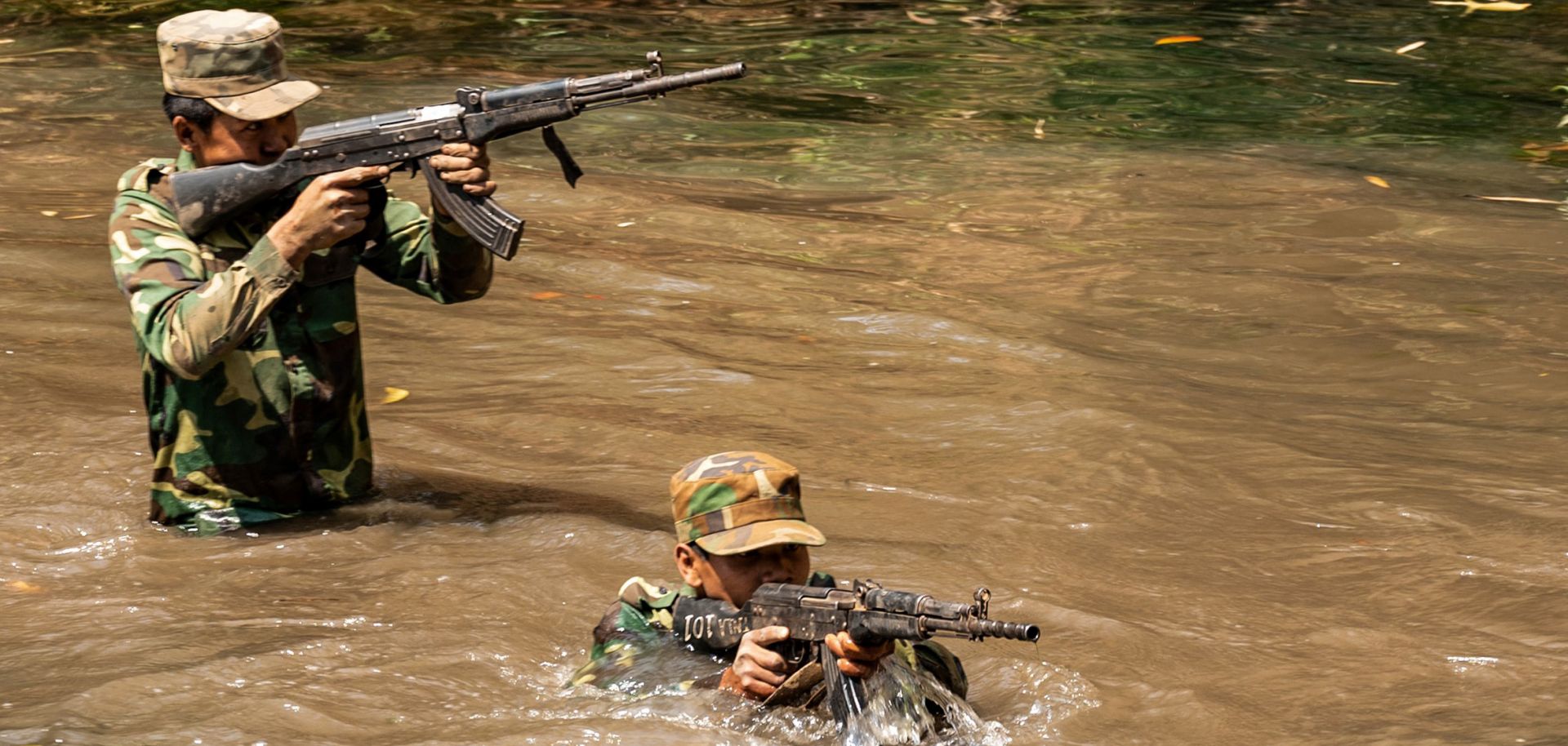
In Myanmar, the resistance's push into the country's interior will further destabilize the business environment and threaten the military government's long-term survival, but the military's ability to hold out in well-defended positions means its collapse remains unlikely for the foreseeable future. In recent weeks, rebel forces have made further territorial gains in Myanmar and carried out a string of notable attacks. Most significantly, armed anti-junta resistance groups launched airstrikes Sept. 3 on several locations in Mandalay, Myanmar, the country's second-largest city. Accounts of what transpired conflict, but according to the most commonly reported series of events, rockets hit army positions inside the Mandalay Palace compound, which hosts the Central Military Command of the governing junta (known as the Tatmadaw), and nearby structures, causing minor damage and wounding one civilian. The Tatmadaw on Sept. 3 responded that select civilians should arm themselves in the city as part of militias — a significant shift because while pro-government militias have always existed on paper, until now they have not actually had fighters.
- Armed conflict erupted in Myanmar following a military coup against the democratically elected government in February 2021. Resistance to the new regime began as civil disobedience before swelling into near-nationwide armed conflict in the subsequent months, primarily characterized by the partnership between the People's Defense Forces (or PDF, the armed wing of the government-in-exile, or National Unity Government) and allied ethnic armed organizations.
- The PDF led the Sept. 3 attack with support from allied ethnic armed organizations.
- By organizing and arming civilian militias, the junta appears to be preparing for more intense resistance, especially as opposition forces push deeper into urban centers like Mandalay. This shift underscores the growing threat posed by resistance forces and the increasing militarization of all sides in Myanmar's escalating civil conflict.
- Arming civilians in Mandalay follows the implementation of conscription measures in February requiring men aged 18 to 35 to enlist.
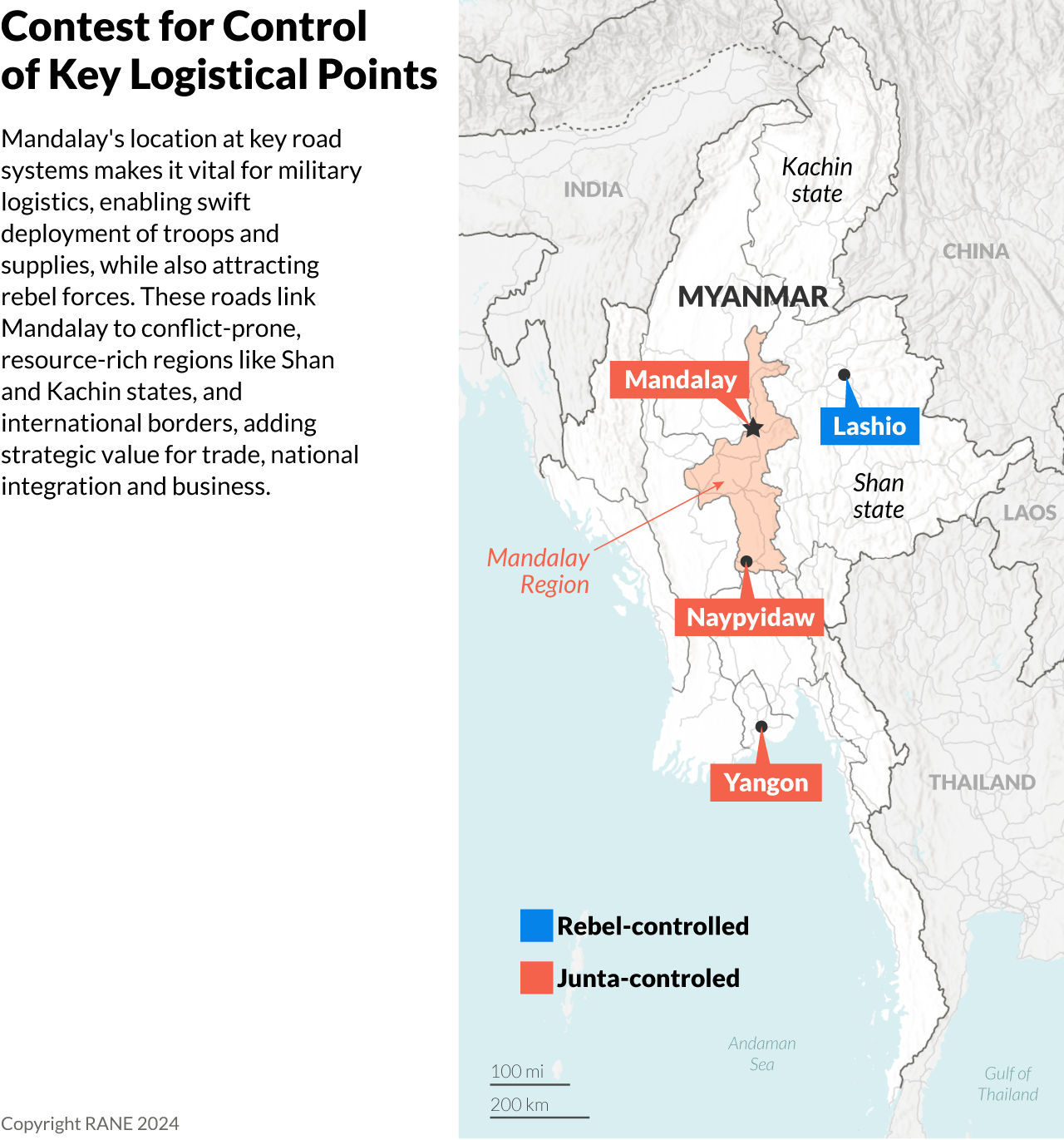
The attack comes amid a larger resistance offensive in the Mandalay Region and the broader interior of Myanmar. The larger Mandalay Region administrative zone (akin to a state or province) is a key strategic, economic and cultural hub located in the heart of the country's interior. Resistance forces have begun focusing on weakening junta control over Myanmar's interior, the only part of the country where the junta retains substantial territorial control. Myanmar's main roads meet in the interior, connecting it to the major urban centers of Naypyidaw and Yangon. Since the devastating success of the rebel-led Operation 1027 that began in October 2023 and saw the junta lose substantial territory, resistance forces have continued to capture territory and are now pushing into Myanmar's interior, including the larger Mandalay Region. The turning point came Aug. 3, when resistance forces captured the city of Lashio in northern Shan state, denying the junta a key position between the interior and the ethnic armed organizations-dominated rural periphery while also opening up the larger China-Myanmar Economic Corridor — a more than 1,000-milelong (about 1,600 kilometerlong) infrastructure development connecting China to Myanmar's urban centers and providing access to the Bay of Bengal — to resistance forces. From here, resistance forces have pushed slowly into the greater Mandalay Region, capturing territory in the region's north while pushing on to the city of Mandalay farther south, as seen from the Sept. 3 airstrikes on the city.
- Operation 1027 is an ongoing coordinated military offensive by the Three Brotherhood Alliance, a coalition of ethnic militias in northern Shan and western Rakhine states. The operation has led to vast territorial losses for the junta, disrupting its supply lines and cratering its morale. The offensive led to the junta's conscription measures in February, but this so far largely has failed to slow rebel territorial gains.
Attacks on major cities threaten the remaining foreign businesses in Myanmar, as well as critical infrastructure like telecommunications and electricity generation, while transportation and logistics in the interior are set to become increasingly difficult amid rebel attacks and junta countermeasures. The rebel offensive in Mandalay Region is already taking a toll on the few remaining foreign businesses in the country, as they are overwhelmingly concentrated in or around Myanmar's largest three cities. For example, in August, Singapore's Sembcorp Industries temporarily halted operations for 10 days in the city of Myingyan near the city of Mandalay, where the disruption to its major gas-fired power plant brought about electricity shortages. Meanwhile, Japanese corporations such as Mitsubishi, Marunbeni, Sumitomo and Toyota have either permanently closed operations or instituted temporary suspensions in Mandalay Region in recent months. Singaporean and Japanese companies have also taken measures in Yangon and Naypyidaw — despite these cities not being as vulnerable as the city of Mandalay — to protect staff and business operations, demonstrating that these companies view the situation as increasingly precarious. As the rebel offensive persists, the junta is likely to implement increased security measures throughout the interior that constrain movement, including stricter entry controls and intensified random inspections of vehicles and individuals. The further formalization of pro-junta civilian militias will likely form part of these efforts. The Tatmadaw could also impose localized communication blackouts and launch retaliatory military airstrikes in areas around Mandalay, all of which would exacerbate personal safety risks and make the area increasingly untenable for business, especially if rebel attacks become more frequent and sophisticated. Even when targeting Tatmadaw locations like army posts, rebel attacks will carry a high risk of causing collateral damage that could lead to temporary closures, reduced operating hours and other disruptions for both businesses and public services, and likely to lead to panic buying — which could cause shortages of essential supplies, including fuel. More broadly, battles for control of key supply routes threaten to disrupt or shut down large swaths of Myanmar's transportation and logistics networks.
- Mandalay's location at the crossroads of key road systems makes it strategically important for military logistics, enabling rapid deployment of troops and supplies to conflict zones. This simultaneously makes it easier for Tatmadaw forces to defend, but also more attractive to rebel groups.
- These important roads link the city of Mandalay with key regions — such as Shan and Kachin states, both of which are critical for resource extraction and are hotspots of ethnic conflict — and international borders, giving them key strategic value in terms of trade and business. In addition to the China-Myanmar Economic Corridor, the region includes the Yangon-Mandalay Expressway, which facilitates movement between Myanmar's two largest cities and commercial centers. The region's logistical networks are also critical for national integration efforts, a key aspiration for a country with divergent ethnic enclaves frequently in conflict.
While resistance forces are unlikely to take the city of Mandalay for the foreseeable future, their push into the interior threatens the junta's survival in the long term, though the coming months will likely see consistent resistance gains, not knockout blows. By targeting symbolic and strategically important locations, such as air and army bases — of which Mandalay Region has many — and military convoys, resistance forces aim to disrupt military operations and weaken the junta's stronghold in Myanmar's interior, and not necessarily capture the strategically important city of Mandalay. Indeed, despite suffering substantial battlefield losses over the past 11 months, the junta retains superior firepower and fortifications that make taking Mandalay (as well as the other major urban centers of Yangon and Naypyidaw) particularly challenging for the relatively lightly armed resistance forces. So a junta collapse scenario remains unlikely in the coming months given its ability to hold out in well-fortified urban positions (particularly in the capital Naypyidaw, which was constructed as a defensive citadel for this exact scenario), but the risk will increase over time given the trajectory of rebel gains and control over supply routes. Nonetheless, and particularly given the Aug. 3 capture of Lashio, resistance forces now have control over key supply routes, with the offensive in Mandalay Region designed to seize even more. Ultimately, the resistance will attempt to use such control to starve out the junta from the urban centers without the need to capture them militarily, but this type of siege probably would not have a swift resolution even if resistance forces make further territorial gains in the coming months. Nonetheless, the Tatmadaw now faces an unprecedented level of insurgency in Mandalay Region and the interior more broadly, one that poses an existential threat to it despite its control of well-fortified cities if this trend of rebel gains can endure for an extended period (years might be required). As such, attacks on the city of Mandalay are likely to become more frequent even if they remain relatively small-scale along the lines of the Sept. 3 attack. But even if the rebels fail to take the city, the offensive in Mandalay Region will likely further destabilize the interior, home to the country's major urban centers and commercial hubs. With resistance forces intensifying their attacks and seizing even more territory, the military is likely to respond with harsher crackdowns on real and perceived dissent, airstrikes and increased civilian militias and intensifying conscription in urban areas. These will exacerbate the humanitarian crisis arising from the conflict, causing more civilian casualties and displacement, particularly into neighboring Bangladesh, India and Thailand, though it would also force the junta into an even less favorable position and stymie its ability to carry out a promised census and subsequent elections in 2025.
- Prior to the Sept. 3 attack, resistance forces engaged in high-profile assaults and airstrikes in the Mandalay Region from May through August.
- Naypyidaw and Yangon have also seen similar small-scale one-off attacks such as bombings and assassinations, which remain risks in those cities, albeit lower risks than the city of Mandalay faces at present.
- China is the chief foreign arms provider for the junta, another reason why the junta is probably not on the brink of collapse. A change in Chinese policy, such as ceasing its provision of arms, would alter this forecast. But this is unlikely given Beijing's desire to retain influence with a wide variety of factions in Myanmar with the potential to emerge from the fight victorious or with expanded power bases.
