
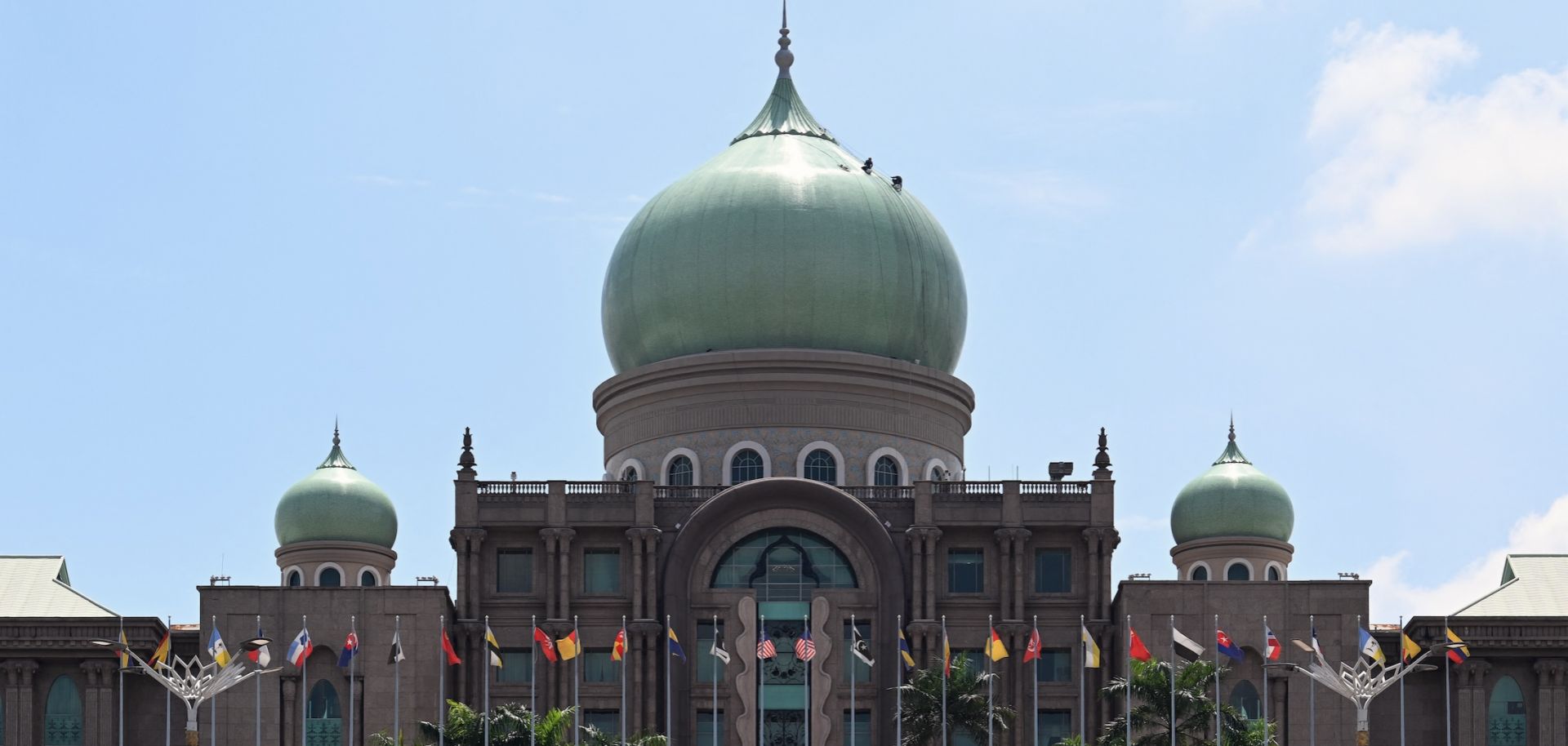
Recent political developments secured the Malaysian government's supermajority in parliament, increasing political stability, likely boosting foreign investment, and strengthening the country's foreign policy and diplomatic influence. On July 9, Malaysian parliamentary Speaker Johari Abdul Ghani ruled that six opposition lawmakers expelled from the Malaysian United Indigenous Party, or Bersatu, in June for supporting Prime Minister Anwar Ibrahim do not have to vacate their seats. The decision came despite Malaysia's unanimously supported 2022 constitutional amendments, which require lawmakers who leave their parties to vacate their seats, thereby necessitating byelections to replace them. In this case, the ruling signifies that there will be no byelections, guaranteeing the government will maintain its supermajorities in both houses of the bicameral legislature — at least for now. However, the opposition will likely challenge the ruling in court, arguing the decision is unconstitutional and a partisan betrayal of the anti-party hopping legislation.
- Individual defections caused the collapse of two of the last three governments, prompting lawmakers to unanimously approve a ban on the practice in 2022 to ensure political stability. However, collective coalition defections and party defections from coalitions are still legal and remain a risk to monitor.
- Though the law is clear that those who quit their parties of their own volition will lose their seats, involuntary expulsions are more legally ambiguous.
- In addition to criticism from the opposition, non-partisan organizations, such as electoral reform group Bersih, have criticized the July 9 ruling as politically motivated.
- The unity government holds 153 out of 222 seats in the upper chamber, the House of Representatives, and 55 of 64 seats in the lower chamber, the Nation's Hall (commonly called the Senate). These supermajorities enable the government to pass legislation more smoothly, despite an adamantly unsupportive opposition.
Anwar's unity government comes amid a broader period of political instability in Malaysia, marked by government collapses and characterized by internal ideological tensions and low popularity. Malaysia's November 2022 general election resulted in a hung parliament, the first in the country's history, with Anwar's center-left Pakatan Harapan coalition, also known by its Malay acronym PH or in English as the Alliance of Hope, winning the most seats but falling short of an outright majority. Subsequent negotiations, brokered by then-King Sultan Abdullah Sultan Ahmad Shah, led to the formation of a unity government headed by Anwar's PH that included PH's traditional rival, the Barisan Nasional coalition, or BN, along with several smaller parties. This coalition secured supermajorities in both houses. However, Anwar's ideologically heterogeneous unity government is characterized by a few elements of instability that make it susceptible to potential defections. PH, a more liberal coalition espousing multiculturalism, has fundamental disagreements with BN, which emphasizes policies favoring Malaysia's ethnic Malay and Muslim majority. Moreover, BN is more ideologically similar to the ascendant opposition coalition Perikatan Nasional, or PN, which saw the largest gains in the 2022 election and has effectively eclipsed BN as the standard bearer for Malay ethnonationalism. Should BN decide to quit the unity government (for instance, if it believes it would be better off politically joining PN as the opposition), Anwar's administration would lose its majority in the Senate and maintain only a narrow, simple majority in the House, a state of affairs in which further defections would collapse the government. Finally, the government is unpopular among the ethnic Malay majority, and due to the slow pace of promised reforms, Anwar's favorability has waned among his own multiethnic base. Critics also perceive Anwar's administration as illegitimate, arguing that it was appointed by the king rather than elected.
- The dominant party in BN is the United Malay National Organization, or UMNO, which led every Malaysian government from independence in 1957 to 2018, when Malaysia entered its current period of political instability.
- After BN's historic defeat in 2018 at the hands of PH, no government has survived for even two years of their five-year parliamentary term, a stark contrast to the preceding era in which no government failed to complete a term. Each of the seven pre-2018 prime ministers served from five to 22 years.
- Party defections from the ruling coalition collapsed the PH government in 2020, bringing about a PN government that collapsed in 2021 over the prime minister's handling of the COVID-19 pandemic. BN subsequently regained the premiership until 2022, when the prime minister dissolved parliament and called snap elections, resulting in another BN defeat and marking the shortest government in Malaysia's history.
- PH is composed of four member parties. Its largest party, the Democratic Action Party, holds four upper chamber and 40 lower chamber seats. Anwar's People's Justice Party holds eight upper chamber and 31 lower chamber seats. PH's two smaller parties have 11 and three combined seats in the upper and lower chambers, respectively. The July 9 ruling also effectively means six additional seats for PH of the expelled Bersatu members, who are now independents.
- BN is composed of four member parties. UMNO, the dominant party, holds 17 upper chamber and 26 lower chamber seats. BN's three smaller parties each hold one to three seats combined across both chambers.
- PN is composed of six member parties, dominated by the Pan-Malaysian Islamic Party, or PAS, and Bersatu. PAS holds six upper chamber and 43 lower chamber seats; Bersatu holds two upper chamber and 25 lower chamber seats. Only one of PN's four other member parties holds a single seat in the upper chamber.
However, current political conditions will bolster the staying power of Anwar's unity government, which is increasingly likely to complete its term in office. Despite several potential drivers of instability affecting Anwar's large coalition, from its low popularity to its internal ideological tensions, the unity government is now more likely to remain stable and complete its term, which is due to end in 2027. BN Chair and now-Deputy Prime Minister Ahmad Zahid Hamidi's January 2023 decision to purge UMNO of dissenting members who criticized the party's partnership with erstwhile archrival PH (a gradual process that is now complete) reduces the likelihood that BN's 30 House members and 23 senators will leave the government. BN could still defect, and the parliament speaker's decision not to vacate the seats of the six expelled members of parliament could encourage individual defections in contravention of anti-party hopping laws. However, this scenario is increasingly unlikely as BN leadership deepens its relationship with PH and as new elections would likely drive votes from the country's ethnic Malay majority further away to PN. Moreover, hypothetical individual defectors leaving the government coalition would not likely be afforded the same protections against the legal consequences of party hopping as those who have supported the unity government, and would risk losing their seats. Finally, while growing steadily in recent years, support for opposition coalition PN has likely plateaued. This is because while it remains the most popular coalition among the ethnic Malay majority, in the short-to-medium term, PN will continue to struggle to grow its support among non-Malay ethnic minorities, who make up around one-third of Malaysia's total population (most significantly represented by the country's mostly non-Muslim Chinese and Indian communities).
- Anwar's base is largely dissatisfied with failures to follow through on campaign promises to lower the cost of living, marked by rising fuel prices and currency depreciation. He has also faced backlash for accommodating former rival BN's Malay-centric identitarianism and shielding the coalition's leadership from ongoing corruption scandals.
- In January 2023, UMNO (BN's dominant political party) expelled and suspended, respectively, two of its most influential leaders, both former government ministers who were critical of the party's direction. This led to several subsequent expulsions in the following months and the party's rank-and-file gradually falling in line behind UMNO leader Ahmad Zahid — who has a personal stake in the government given it shields him from a corruption scandal — and Anwar.
- In addition to Malay ethnonationalism, PN's political brand features a strong Islamist component that BN lacks, which endears it to much of the majority population but significantly constrains the possibility of non-Malay, non-Muslim support.
- Though Malaysia's ethnic Malay majority is a growing demographic while the Chinese and Indian minority populations are shrinking with lower birth rates, PN relying on demographic trends to secure support is a long-term strategy that will not aid its political prospects in the short term.
A full term for Anwar would provide political stability by breaking with the country's trend of short-lived governments and guarantee significant continuity with recent foreign and economic policy initiatives, including plans to attract foreign direct investment in high-growth sectors like semiconductors. Through the remainder of his term, Anwar will continue to prioritize attracting foreign direct investment in emerging technology sectors, particularly focusing on moving Malaysia's well-established semiconductor testing, packaging and assembly sector up the manufacturing value chain to wafer fabrication. He will also continue implementing revamped tax policies, with recent adjustments already leading to a projected $700 million in additional annual revenue. Anwar's government is also revising Malaysia's blanket fuel subsidies that drain the public purse and stabilizing fiscal policy by limiting debt, despite the country's enduring challenges such as high living costs and a weak currency. From a foreign policy perspective, Anwar will continue focusing on three main priorities: the Association of Southeast Asian Nations, the Middle East and U.S.-China competition. When the rotating ASEAN chair passes to Malaysia in 2025, Anwar will seek to forward the so-called ASEAN centrality doctrine that aspires for the bloc to emerge as an independent geopolitical pole in an increasingly multipolar world. Meanwhile, Anwar will sustain his efforts to deepen Malaysia's ties with the broader Muslim world in the Middle East. This will likely see his administration continue to foster ASEAN-Gulf Cooperation Council collaboration, as well as voice ardent support for the Palestinian militant group Hamas amid the ongoing Israel-Hamas war, which enhances Malaysia's standing as a leader among Muslim nations, particularly in contrast to Arab nations that have recently normalized relations with Israel. Finally, Anwar will continue Malaysia's subtle tilt toward China but remain formally unaligned in the broader U.S.-China competition. These foreign policy initiatives elevate Malaysia's international standing, particularly in the Muslim world, while closer alignment with China will provide for greater trade and investment opportunities in sectors like agriculture, tourism, infrastructure development and green technology. However, the same initiatives could also complicate Malaysia's relations with the United States, which will make Washington more inclined to cooperate with Malaysia's neighbors like Indonesia, the Philippines and Vietnam, meaning Malaysia will benefit comparatively less from Washington's desrisking strategies and industrial supply chain realignment initiatives.
- In May, Anwar unveiled Malaysia's National Semiconductor Strategy which, among other things, allocates $5.3 billion over 10 years to train local engineers in fabrication. For example, German-based Infineon Technologies AG will invest up to $5.5 billion over the next five years to build the world's largest 200-millimeter silicon carbide power fabrication plant in Malaysia.
- Along with Indonesia, Malaysia under Anwar has been the most vocal ASEAN opponent of the Myanmar junta, meaning its ASEAN chairmanship would see the bloc be more active in negotiating an end to the conflict.
- Anwar's support for Hamas has been consistent, full-throated and unapologetic. He is arguably the militant group's largest international supporter.
- In his first 12 months in office, Anwar visited Turkey, Egypt, the United Arab Emirates and Saudi Arabia, as well as attended various forums, including the emergency Organization of Islamic Cooperation meeting and the ASEAN-Gulf Cooperation Council summit. The Middle East is his most frequently visited region after Southeast Asia.
- Anwar has held numerous high-level meetings with senior Chinese officials, including Foreign Minister Wang Yi, Prime Minister Li Qiang and President Xi Jinping. He traveled to China twice in 2023 and has publicly and repeatedly invited Xi to visit Malaysia. Conversely, he has not held any meetings with senior U.S. officials, nor has he visited Washington or invited the U.S. president to Malaysia. Moreover, in stark contrast to his Philippine and Vietnamese counterparts, Anwar has been accommodating to China in the South China Sea.
