
Editor's Note: This article is the fifth installment in an ongoing RANE series on the shifting patterns of global trade. The first installment provided a broad overview of the geopolitical and economic implications of these shifts. The second examined how recent changes to U.S. trade and tariff policies will affect nearshoring trends in Canada, Latin America and the Caribbean. The third assessed how rising tensions between Israel, the United States and Iran could impact shipping in the Strait of Hormuz. The fourth installment assessed how U.S. reciprocal tariffs will have major economic and political impacts on Japan and South Korea, particularly as both East Asian countries prepare for summer elections.
India's future trade strategy will blend offensive goals, such as boosting exports in services, textiles and pharmaceuticals, with defensive tactics like protecting agriculture from liberalization, while pursuing free trade agreements that secure market access for key industries, safeguard domestic interests and selectively resist stronger intellectual property protections. India's post-independence economic philosophy has historically shaped its trade profile. Following 1947, Indian policymakers prioritized economic self-reliance, implementing stringent restrictions on foreign ownership of Indian companies and imposing high trade barriers to shield domestic industries from external competition. Combined with rigid regulations, these protectionist measures curtailed trade openness, discouraged foreign investment and contributed to a lack of competitiveness across key sectors. Over time, inefficiencies deepened, reinforced by weak infrastructure and governance challenges. A turning point came in 1991, when a balance of payments crisis forced India to embark on a period of liberalization, reducing tariffs, opening up to foreign direct investment and easing regulatory constraints placed under the License Raj. This regulatory and licensing regime dominated from the 1950s to the early 1990s. This transition more fully integrated India into the global economy, as foreign investment rose and international firms expanded their presence. However, India's trade posture has remained mixed even after these reforms. While the country actively pursues trade agreements and seeks foreign investment in targeted sectors, it continues to apply protective policies, especially in agriculture and certain manufacturing industries. While Indian industry has demonstrated competitiveness in sectors like pharmaceuticals, IT services and automotive components, structural barriers, such as complex regulations and infrastructure deficits, continue to constrain broader participation in high-value global markets. More critically, limited foreign competition due to high import barriers has hindered productivity growth.
- Under India's License Raj, businesses were required to obtain official permission for almost any activity, including launching operations, increasing output or importing materials. Though intended to encourage economic self-sufficiency, safeguard local industries and promote equitable regional growth, the system often led to red tape, inefficiency and restricted private enterprise.
- India remains one of the world's fastest-growing economies, even as growth has slowed from over 8% during 2021-23 to a projected 6.2% in 2025. Additionally, inflation is likely to stay close to the central bank's 4% target, and India's fiscal, debt and international financial positions remain stable and manageable, even with government debt above 80% of GDP. This is due to sustained economic growth, a large domestic investor base, ample foreign exchange reserves and prudent debt management. India is less vulnerable to global financial shocks than many other countries because it has lower exposure to international trade and capital flows. Furthermore, India's current account deficit is small and mainly financed by stable foreign direct investment rather than more volatile portfolio flows.
- In 2023, trade accounted for 46% of India's GDP. Exports contributed about 22% of GDP, with commercial services — such as IT and business services — making up 40% of those exports. India's top exports include petroleum products, gems and jewellery, pharmaceuticals, engineering goods, and textiles, while key imports include crude oil, gold, electronics, machinery and coal. Major export destinations include the United Kingdom, the United States, the Netherlands, China, Saudi Arabia, Singapore, Bangladesh, Germany and Italy. The top import sources, meanwhile, are China, Russia, the United Arab Emirates, the United States and Saudi Arabia.
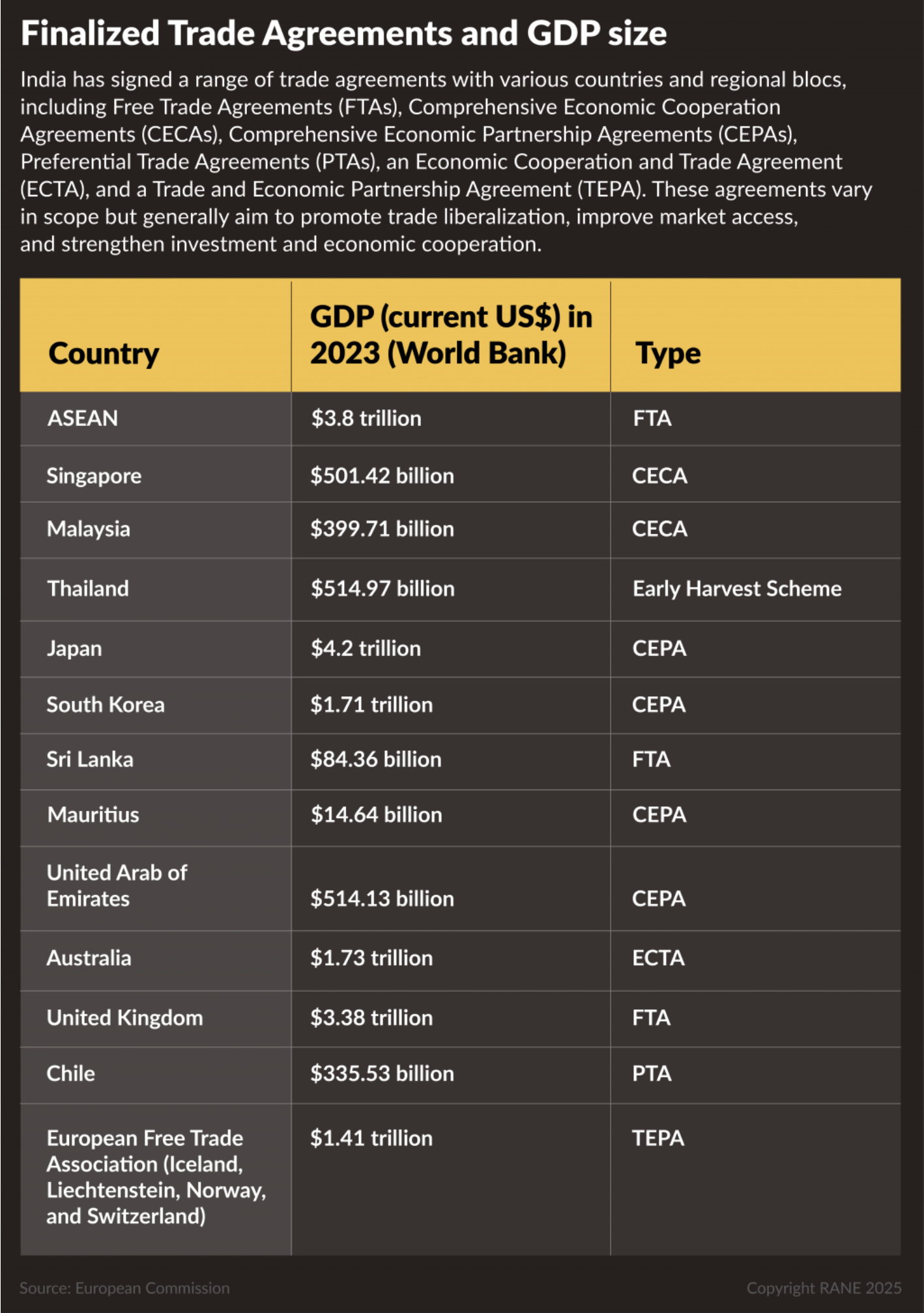
India's growing focus on free trade agreements reflects its strategic ambition to become a central player in global supply chains and a competitive alternative to China in the evolving geopolitical and economic landscape. India has over 10 active bilateral free trade agreements (FTAs) and is currently negotiating several others to strengthen its bilateral and regional trade relationships. This renewed focus on FTAs reflects a broader strategic shift, as India seeks to position itself as a key alternative manufacturing hub amid rising geopolitical uncertainty and global efforts to diversify supply chains away from China. Western firms, in particular, are looking to reduce dependence on China, and India's large labor force and expanding infrastructure make it an attractive destination, despite ongoing regulatory and logistical constraints. The Indian government sees FTAs as tools to boost trade, modernize the Indian economy, enhance competitiveness and integrate more effectively into global value chains. At the same time, India is reassessing its investment treaties and preferential trade agreements to ensure they better reflect evolving economic priorities, balancing openness to foreign investment with the need to protect national interests.
- This renewed push also comes in the wake of U.S. President Donald Trump's April 2 announcement to impose sweeping "reciprocal" tariffs on nearly all U.S. trading partners, including a proposed 27% tariff on Indian exports. The Trump administration justified the move by citing what it described as India's unfair trade practices, including longstanding market access barriers faced by U.S. exporters and a $46 billion trade surplus in India's favor. If enacted, the proposed tariffs would deal a significant blow to several of India's major export sectors, such as pharmaceuticals, gems and jewelry, potentially dampening export-led growth and adding urgency to India's efforts to secure trade arrangements.
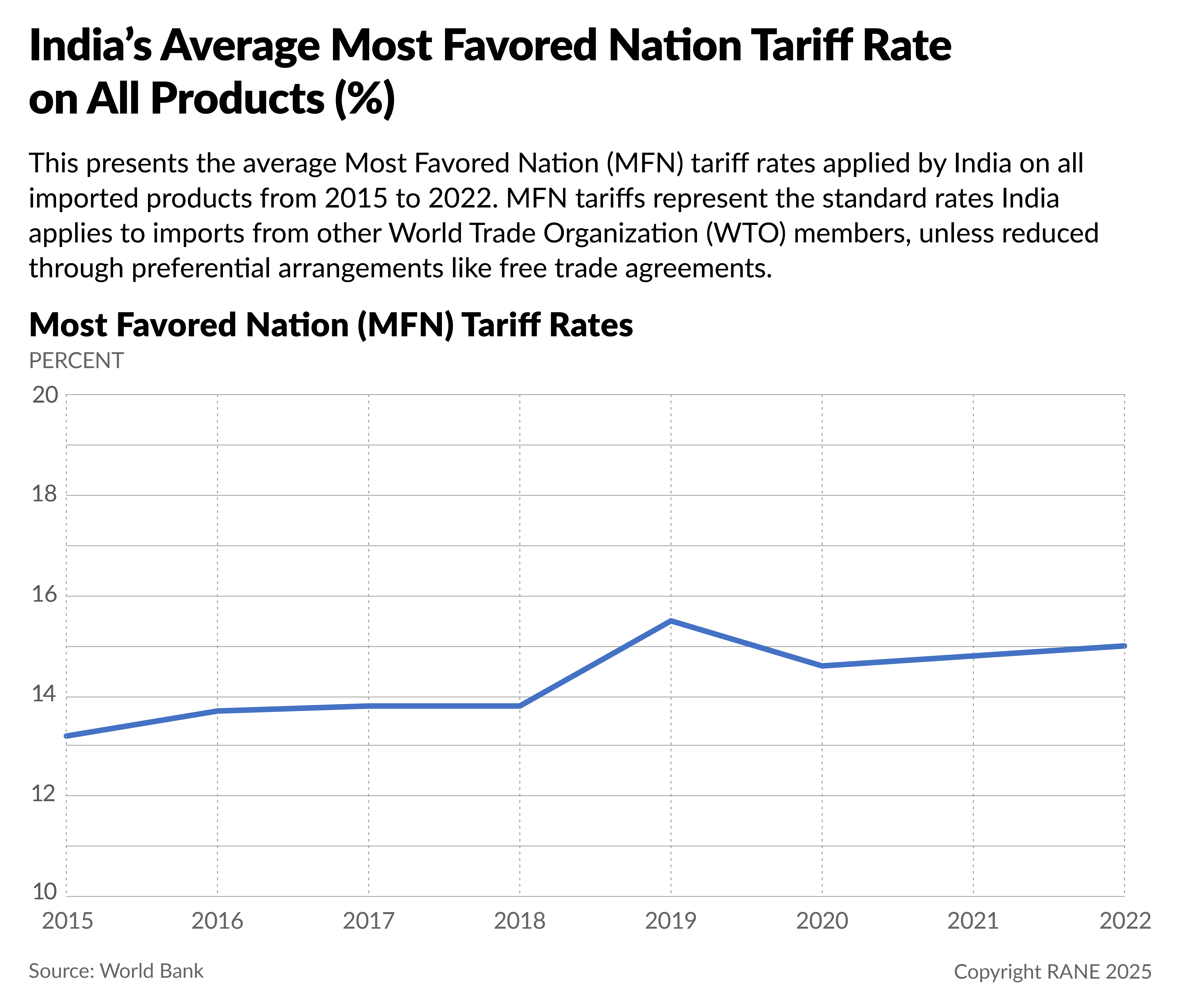
Despite its ongoing push to negotiate new FTAs, India will likely maintain a cautious and protectionist stance on agriculture in future trade negotiations, excluding sensitive products like dairy and rice from tariff reductions, though external pressure may prompt limited, phased concessions. Agriculture stands at the core of India's defensive interests. The sector contributes about 18% to GDP and employs nearly 45% of the labor force, making it both economically crucial and politically sensitive. High tariffs, often above 30%, on agricultural products such as dairy, cereals and rice highlight the government's intent to shield domestic producers from global competition, particularly from heavily subsidized exporters like the United States and the European Union. This protectionist stance is rooted in concerns over food security, rural livelihoods and the structural weaknesses of India's fragmented, undercapitalized farming sector. As a result, India will likely remain firm in excluding sensitive farm goods — like dairy, rice and pulses — from tariff reductions and broadly in FTA negotiations, a position that has complicated talks with multiple partners. While India managed to avoid significant agricultural concessions in its FTA with the United Kingdom by offering concessions in other areas, growing pressure from the Trump administration for market access may eventually force India to reconsider limited tariff concessions as part of broader trade deals with the United States. Nonetheless, India will likely continue excluding key agricultural items from FTA talks while potentially negotiating phased or limited market access for select agrarian goods.
- India ranks among the world's leading agricultural exporters, with its export basket including core products like dairy and poultry, marine items such as shrimp and fish, and various plantation crops. Rice is the leading export, accounting for over 20% of total agricultural exports, followed by spices, pulses and wheat. Key destinations for Indian agricultural exports include the United States, Bangladesh, China, the United Arab Emirates and Indonesia.
- Tensions around liberalization were thrown into sharp relief during Prime Minister Narendra Modi's 2020 farm reforms, which aimed to open agricultural markets to private investment. The reforms bypassed state-run procurement systems and sparked a massive year-long protest led by farmers from Punjab, Haryana and western Uttar Pradesh, who feared losing price protections and falling under corporate control. The government's eventual repeal of the laws in 2021 marked a significant political retreat and reaffirmed the volatility of agricultural reform.
While the pharmaceutical sector is a key export and central to India's free trade ambitions, the country is likely to remain selective in negotiations, pushing back against stronger IP provisions that could jeopardize its generics industry and the production of affordable medicines. India's pharmaceutical sector is an example of how India blends defensive trade priorities with protectionism and selective liberalization. Contributing about 1.72% to India's GDP, the pharmaceutical sector's strength lies in low-cost drug replication, making India the world's largest supplier of generic medicines — accounting for 20% of global volume and around 60% of global vaccine demand. Developed countries have increasingly incorporated TRIPS+ provisions — World Trade Organization-based intellectual property rules — into trade agreements for pharmaceutical products, including measures like extended patent terms, data exclusivity, and limits on compulsory licensing. However, India has consistently resisted these efforts because they threaten its domestic generics industry and could delay access to affordable medicines. Furthermore, India continues to impose tariffs on many imported medicines, typically ranging from 10% to 20%. These tariffs are intended to protect domestic manufacturers and promote local production as part of the Atmanirbhar Bharat (self-reliant India) campaign. Beyond producing generics, India is expanding into higher-value segments such as biosimilars, vaccines and Custom Research Manufacturing. These forward-looking moves aim to deepen India's role in global pharmaceutical supply chains beyond low-cost production, signaling a strategic push toward diversification. Given the importance of protecting its thriving generic drug industry, India will likely resist pressures from countries like the United States or the European Union in free trade negotiations, which typically advocate for stronger IP protections. These provisions, such as extended patent durations, restrictions on generic drug production and data exclusivity, could undermine India's current model of affordable medicine production by delaying market entry for generics and increasing production costs. In future FTAs, India will likely continue advocating for strong safeguards to protect its generics industry while being open to negotiations that allow for market access without compromising public health goals.
India's manufacturing push is an offensive strategy aimed at boosting exports and reducing import dependence. However, progress has been slowed by infrastructure bottlenecks, high logistics costs and bureaucratic inefficiencies, while its trade policy seeks to balance global integration with protectionist measures to support domestic industries. India's manufacturing push is driven largely by an offensive strategy to expand its role in global supply chains and reduce reliance on imports in key sectors. Programs like "Make in India" and the Production-Linked Incentive (PLI) schemes aim to attract foreign investment and boost exports in industries such as electronics, automobiles, pharmaceuticals and renewable energy. These priorities are echoed in India's trade negotiations, where greater market access for manufactured goods remains a key demand. However, progress has been uneven. Manufacturing's share of GDP has slightly declined from 16% in 2020 to around 14% in 2025, and the sector faces persistent challenges, including infrastructure bottlenecks, high logistics costs, and a mismatch between workforce skills and industry needs. Though central to India's industrial policy, the PLI scheme has struggled with implementation. According to a March 2024 Reuters report, the government has decided not to extend the $23 billion scheme, citing bureaucratic inefficiencies and delays in disbursing incentives. Although sectors like pharmaceuticals and mobile phones saw strong uptake — claiming 94% of incentives between April and October 2024 — firms produced only $151.93 billion in goods, just 37% of the initial target. Less than 8% of the allocated funds had been disbursed by early 2025. This sluggish rollout has discouraged investment and dampened momentum in sectors the government is keen to scale. While future efforts may focus on more targeted capital reimbursements in strategic areas like electronics, textiles and automotive components, the broader challenge remains: without cutting red tape and ensuring timely execution, which the government is unlikely to do in the short to medium term, India's bid to become a global manufacturing hub will remain constrained. Additionally, India's trade strategy reflects a tension between seeking new markets abroad and protecting domestic industries at home. While it pursues export opportunities through FTAs, especially in goods and services, it often maintains a cautious, sometimes protectionist stance domestically, using tariff barriers and regulatory measures to shield sectors seen as vulnerable to foreign competition.
- On April 25, it was reported that Apple plans to assemble most of the iPhones it sells in the United States in India by the end of 2026. The move follows rising trade tensions between the United States and China, which have prompted Apple to speed up its shift away from China to reduce exposure to tariffs and geopolitical risks. With just over 40 million iPhones assembled in India during the fiscal year ending in March 2025, Apple aims to double its output to meet the target of sourcing more than 80 million iPhones from India. This reflects India's effort to capitalize on global companies seeking alternatives to China amid geopolitical tensions and trade risks — a core goal of its "Make in India" initiative. By offering a stable environment and lower production costs, India is offensively positioning itself as a major global manufacturing hub, particularly in high-value electronics. The move also aligns with India's push to reduce its import dependency, boost self-reliance, create domestic jobs and build resilient supply chains.
India's services sector and textiles are central to its offensive trade strategy, with trade negotiations likely to focus on expanding global market access, facilitating the movement of Indian workers and upgrading production capabilities to enhance its position as a major exporter. India's services sector, accounting for more than 50% of the nation's GDP, is central to its offensive trade strategy, driven largely by its competitive edge in IT, business process outsourcing and financial services. Built on the foundation of a large, skilled and relatively low-cost workforce, its services sector gives India an advantage in global markets. As it pursues future trade agreements, India is likely to push for expanded access to foreign service markets, especially by seeking recognition of Indian qualifications and easing rules around the temporary movement of professionals. Additionally, India will likely continue to negotiate provisions in its free trade agreements to ease visa restrictions and facilitate the movement of Indian professionals across borders. However, securing such commitments will likely prove difficult, as many countries remain cautious and restrictive on labor mobility. India's textiles sector is another pillar of its offensive trade strategy, which contributes around 2% to India's GDP. As a major global exporter of garments and fabrics, India benefits from low production costs, a broad range of textile products and an extensive manufacturing base. To expand its footprint in international markets, especially in developed economies, India will likely prioritize securing lower tariffs and better market access for its exports in future trade agreements. It may also push for preferential trade terms and technological collaboration to upgrade its production capabilities. These efforts are intended to raise export volumes, enhance product competitiveness, and drive long-term growth in a sector that is both labor-intensive and economically significant.
India is actively broadening its trade network through numerous FTAs, aiming to secure greater market access for key export sectors like textiles and pharmaceuticals, while simultaneously implementing defensive measures to shield sensitive industries like agriculture from extensive liberalization. India's FTA with the United Kingdom, signed on May 6 after nearly three years of negotiations, reflects New Dehli's strategy of balancing offensive and defensive trade interests. Offensively, India secured greater market access for labor-intensive sectors such as textiles, leather, auto parts, engineering goods, pharmaceuticals, gems and jewellery, and IT services — industries central to India's export diversification and job creation goals. While details of the FTA remain limited, reports suggest it could potentially boost India's pharmaceutical exports — indicating that the deal may offer market access without imposing stricter intellectual property protections that India has consistently opposed. This is bolstered by statements from the United Kingdom's Association of the British Pharmaceutical Industry (ABPI) criticizing the newly signed FTA over the lack of intellectual property protections. On the defensive front, apart from some meat products like lamb and salmon, India remained firm on excluding sensitive sectors from deeper liberalization, such as dairy and agricultural products. As India moves forward with trade diversification, it is likely to replicate this approach, maximizing export gains in services and textiles while offering limited concessions on agriculture.
- Under the FTA, India will halve tariffs on U.K. whisky and gin from 150% to 75%, offering a significant boost to Britain's Scotch whisky industry. Automotive tariffs on British cars will also be reduced to 10% under a specified quota, down from the current rate of over 100%. Additional U.K. exports set to benefit from lower Indian tariffs include cosmetics, aerospace components, lamb, medical devices, salmon, electrical machinery, soft drinks, chocolate and biscuits.
- On May 7, the ABPI expressed disappointment that the deal fails to address longstanding concerns about intellectual property protections for U.K. life sciences companies in the Indian market, particularly the absence of regulatory data protection.
India's flexibility on issues such as labor mobility and carbon border taxes could pave the way for progress in other trade talks, particularly with the European Union. One of India's key offensive priorities in the FTA negotiations is securing more favorable terms for the movement of its professionals, particularly in the IT and healthcare sectors. However, in a global context where immigration is a politically sensitive issue, especially in many developed countries, India's push for greater overseas mobility for its workers will likely face resistance from its trading partners. While the United Kingdom maintained that immigration policy was non-negotiable, India did manage to secure a three-year exemption from social security contributions for short-term workers, a limited but notable outcome under the Double Contribution Convention, which prevents dual payments across jurisdictions. Another unresolved flashpoint was the United Kingdom's proposed Carbon Border Adjustment Mechanism (CBAM), a tax on carbon-intensive imports slated to begin in January 2027. India raised strong objections, citing concerns about competitiveness, added costs and disguised protectionism, particularly for sectors like steel, aluminum and fertilizers. Although India sought a carve-out based on its developing country status, the issue was ultimately deferred. While the Indian government has stated that it will continue negotiating for an exception, this is unlikely to result in India exiting the FTA. Its exclusion from the final deal reflects a strategic compromise as India chose to conclude the broader trade agreement while continuing bilateral discussions on complex provisions like CBAM. India's flexibility on these issues could signal a more pragmatic negotiating posture in future trade talks. Since similar sticking points, particularly around labor mobility, regulatory standards and sustainability provisions, have stalled progress in the India-EU FTA, the U.K. deal may pave the way for renewed momentum and a possible breakthrough in those negotiations. Broadly, India's approach to future free trade agreements and trade diversification is likely to center on positioning itself as a key global economic player while protecting sensitive domestic industries. It will likely prioritize deals with countries offering substantial market access in sectors like information technology, pharmaceuticals and textiles, where India maintains a strong competitive edge, while deprioritizing agreements with large agricultural exporters that may demand greater access to India's protected farm sector.
- The three-year exemption from social security payments applies to Indian professionals temporarily working in the United Kingdom. Typically, these workers have to pay into both India's and the United Kingdom's social security systems, even though they will not stay long enough to benefit from the U.K. system. This exemption, agreed under the Double Contribution Convention, lets them avoid paying into the U.K. system during their assignment. While the United Kingdom maintained that immigration policy was not open to negotiation in the FTA talks, this outcome fulfills one of India's key demands and reduces costs for both Indian professionals and the firms that send them abroad.
- According to India's Global Trade Research Initiative, iron, steel and aluminium products made up 27% of India's total exports to the European Union in 2022, totaling $8.2 billion. According to the U.S. International Trade Administration, the United Kingdom made up 4.4% of India's total steel exports in 2023.
