
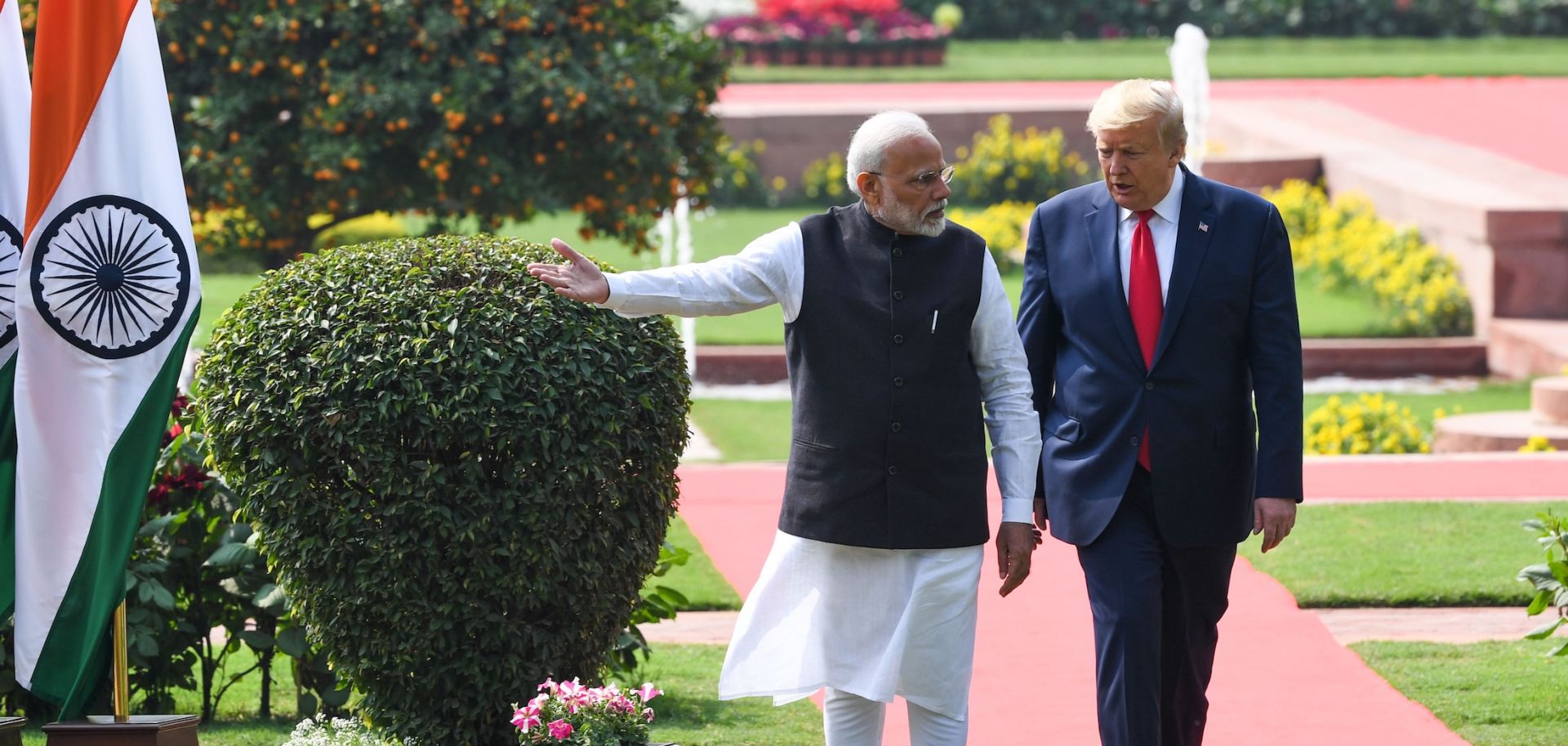
The South Asia strategy of U.S. President-elect Donald Trump will likely center around trade, countering China and strengthening regional security through partnerships with India, Bangladesh and Sri Lanka; U.S.-Pakistan tensions will also likely rise due to Islamabad's growing ties with Beijing and potentially its support for anti-India militants. Trump's return to the White House in 2025 will likely result in some degree of continuity in the United States' South Asia policy, as the "free and open Indo-Pacific" framework, introduced in 2017 during the first Trump administration, enjoys bipartisan support and has become a core driver of U.S. policy in Asia more broadly. As a result, the incoming Trump administration will continue to focus on countering China's influence and strengthening regional security partnerships. However, Trump will likely change some aspects of the U.S. approach to South Asia, especially on a bilateral level. Unlike its predecessor, the Trump administration will likely place less emphasis on democratic values and human rights, focusing instead on more transactional relationships centered on trade, security and defense cooperation. This is underscored by Trump's pledges to reduce U.S. trade deficits and forge partnerships that deliver tangible benefits, particularly for the U.S. economy and in defense and strategic positioning.
- In 2017, then-President Trump launched his Indo-Pacific framework, which focused on countering China's influence and ensuring regional security through partnerships with key allies including Japan, India, Australia and Southeast Asian nations; the framework also extended to other South Asian countries like Bangladesh, Pakistan, Sri Lanka and the Maldives. In 2022, the outgoing administration of U.S. President Joe Biden unveiled its "Indo-Pacific strategy," which reinforced Trump's vision of a free and open Indo-Pacific.
India's trade surplus with the United States increases the risk of reciprocal tariffs, which would raise costs for both U.S. consumers and India's export sectors, though negotiations could secure concessions to mitigate these effects. In line with the Trump administration's goals to strengthen domestic industries, boost local employment and promote technological self-sufficiency, the incoming president has pledged to impose tariffs on countries with trade surpluses against the United States. Considering India's trade surplus of $30 billion out of the nearly $120 billion that U.S.-India trade reached in 2023, this pledge puts Indian exports at risk. While higher tariffs would likely increase costs for U.S. consumers, they would also reduce U.S. demand for Indian sectors that heavily depend on the U.S. market, including pharmaceuticals, textiles and IT services. However, the United States will likely primarily focus tariffs on China, Mexico, Canada and the European Union due to their comparatively larger trade surpluses and high volumes of goods in key sectors such as technology, electronics, auto and machinery, which are central to U.S. trade policy concerns. India's main exports, such as textiles and pharmaceuticals, do not carry the same strategic weight, making a compromise more likely. For instance, India could offer measures to address the trade imbalance, such as increasing purchases of U.S. energy products (like crude oil and liquefied natural gas) and defense equipment, which would support U.S. exports while aligning with India's growing energy and defense needs. Meanwhile, a 60% tariff on Chinese goods could create opportunities for Indian exports and attract U.S. companies seeking to diversify their supply chains, opening doors for India in sectors like semiconductors and electronics. However, a challenge could arise if the Trump administration imposes tariffs on Chinese components used in India's engineering and electronics exports, potentially slowing growth in these areas.
- During his presidential campaign, Trump pledged to impose broad-based tariffs of 10% to 20% on all goods entering the United States. India and the United States have a history of trade tensions, with Trump previously referring to India as a "tariff king." In his first term, the Trump administration imposed tariffs on steel and aluminum from India in 2018 and ended the country's preferential trade status under the Generalized System of Preferences, under which businesses in beneficiary countries can export some products to the United States duty-free. In response, India raised tariffs on certain U.S. goods.
- Meanwhile, the new U.S. government will likely tighten regulations of H-1B and L-1 visas (which allow foreigners to work in the United States, particularly in specialized fields like technology, engineering and business), restricting the flow of Indian professionals to the United States. Tightening visa regulations and Trump's preference for local hiring by U.S. companies could limit opportunities for Indian professionals, particularly in the tech sector. This reduced access to U.S. job markets could lead to lower remittances, which would decrease a crucial source of income for many families in India. Additionally, U.S. companies outsourcing to India could face higher operational costs due to stricter compliance measures and potentially increased tariffs on IT services.
Under Trump, the United States will want India to play a more significant role in regional security to counterbalance China's influence in the Indo-Pacific, leading to deeper defense cooperation and expanded joint military exercises to boost maritime security. The Trump administration will likely pressure India to align more closely with regional U.S. policies, particularly as both seek to counterbalance China. The designations of Rep. Mike Waltz as national security advisor and Sen. Marco Rubio as secretary of state are early indicators of this push. Waltz, a hardliner on China, served on the House China Task Force, which influences U.S. policies to counter China's global influence. Rubio has also advocated for a stronger U.S.-India security partnership, particularly through enhanced defense cooperation. Thus, both will likely advocate for a more assertive U.S. approach to China, strengthening defense and strategic ties with India as part of that broader strategy. This strategic partnership may involve U.S. requests for increased Indian investment and arms purchases, as well as expanded maritime collaboration and joint naval exercises in the South China Sea. For India, concerns over China's assertive actions in the Indo-Pacific and the Indian Ocean region are key drivers of this defense collaboration. The two countries will likely increase joint efforts to monitor Chinese submarine activity in the Indian Ocean region, which could benefit India, especially given past Chinese aggression along the Himalayan border.
- India has multiple defense agreements pending with the United States that cover advanced military technology and joint projects to modernize its armed forces and deepen defense relations. For instance, GE Aerospace and Hindustan Aeronautics Ltd. are discussing the coproduction in India of GE F414 jet engines, which are slated for Tejas Mark 2 fighter jets. This joint production and technology-sharing endeavor would mark a notable step forward in U.S.-India defense collaboration.
- During Trump's previous term, the India-U.S. strategic partnership reached significant milestones, with key defense agreements like the Basic Exchange and Cooperation Agreement, Communications Compatibility and Security Agreement, and Logistics Exchange Memorandum of Agreement coming into effect. These agreements enhanced cooperation in intelligence sharing, logistics and overall security collaboration between New Delhi and Washington.
- Waltz serves as co-chair of the bipartisan Congressional Caucus on India, which strengthens diplomatic and cultural ties between the United States and the South Asian country, and he played a significant role in arranging Indian Prime Minister Narendra Modi's 2023 Capitol Hill address. Rubio, a strong proponent of a robust U.S.-India partnership, introduced the U.S.-India Defense Cooperation Act in July to the Senate. This bill outlines support for India's defense against regional threats and calls for enhanced collaboration in areas like technology, space and economic investment. The bill further proposed that India receive a status similar to key U.S. allies, such as Japan, Israel and NATO members, especially regarding access to advanced technology transfers.
While U.S.-Pakistan relations have improved in recent years, bilateral ties will likely be strained by Pakistan's partnership with China and support for militant groups, as well as U.S. support for Israel. During much of the first Trump administration, the United States maintained fairly tense relations with Pakistan driven largely by U.S. frustrations with Islamabad's support for the Afghan Taliban and other militant groups that endangered regional U.S. interests. These frustrations ultimately prompted the White House to cut military aid to Pakistan and threaten additional punitive measures. U.S.-Pakistan relations have since improved and this time around will likely benefit from U.S. troops' absence from Afghanistan, Pakistan's severe frustration with the Afghan Taliban, and U.S. and Pakistani concern with Afghanistan-based militant groups like Islamic State Khorasan Province. That said, the two countries will continue to diverge on a number of issues. As the United States is set to intensify its strategic competition with Beijing, Pakistan's "all-weather friendship" with China and its importance to China's infrastructure-focused Belt and Road Initiative will risk growing into a more prominent sticking point, drawing U.S. scrutiny and making it harder for Pakistan to balance its ties between the two rivals. Additionally, Pakistan's support for militants fighting India and its broader inconsistency as a counterterrorism partner will likely drive challenges to U.S.-Pakistan relations, especially should U.S.-India ties further strengthen. Meanwhile, the United States' support for Israel — which appears poised to grow under Trump — will also fuel tensions with Pakistan, given the latter's long-standing support for Palestinians and its opposition to Israel's military operations in Gaza, the West Bank and Lebanon. These tensions risk limiting further improvements in bilateral ties while sustaining the potential for more punitive U.S. measures on Pakistan, like trade restrictions.
- Illustrating prior tensions, the Trump administration criticized Pakistan regularly in 2018, with Trump tweeting early that year that the United States had "foolishly" given Pakistan billions of dollars in aid for years while Islamabad gave "us nothing but lies & deceit, thinking of our leaders as fools…No more!" By the fall of that year, the United States had suspended some $1.3 billion in aid to Pakistan and ended a long-standing military training program between the two countries, accusing Pakistan of failing to take "decisive action" against militants and support broader "South Asia Strategy."
Finally, the United States will likely adopt a more transactional approach to Bangladesh and Sri Lanka, focusing on stemming China's regional influence and countering violent extremism. Bangladesh and Sri Lanka appear unlikely to be among the United States’ top foreign policy priorities. That said, Bangladesh and Sri Lanka are undergoing political transitions that risk complicating their relations with the United States, with Bangladeshis recently ousting a long-standing leader India viewed as a close partner and Sri Lankans having elected a Marxist-leaning president reputedly sympathetic to China. Bangladesh's economic challenges and ongoing instability under the interim administration will fuel appeals for U.S. support, particularly aid, but Trump's general aversion to providing foreign financial support and Bangladesh's more limited ability to offer inducements due to economic constraints may limit the closeness of ties. In addition, these political transitions open the door to either South Asian country leaning more on China than in previous years, which could further raise tensions with the United States. However, there remain shared security concerns that will likely foster some cooperation. Instability in Bangladesh has reportedly enabled violent extremist activity, including by militants linked to groups like al Qaeda and the Islamic State, which are intent on attacking Indian and Western interests. Sri Lankan police also recently arrested three individuals for allegedly plotting to attack a local Israeli-run Jewish center, an effort the United States later said was linked to Iran. Intelligence sharing and other cooperation on threats like these may thus offer modest respite from the broader pressures on relations fueled by U.S. competition with China. That Trump's administration will likely also deemphasize concerns over human rights abuses and violations of democratic norms probably will further ease tensions.
- Trump and Bangladesh's current interim leader, Chief Adviser Muhammad Yunus, have historically viewed each other disfavorably. After Trump's 2016 win, Yunus — who was then head of the micro-finance Grameen Bank — said the election result was shocking, criticizing Trump for his allegedly divisive rhetoric and support for "wall building." He further urged Trump to "look at the world in a more generous way so that [he] can build bridges." Trump later reportedly inquired about Yunus' whereabouts when a Bangladeshi delegation visited Washington, saying, "I heard he donated to see me lose."
- This time around, Yunus seems intent on fostering more amicable relations with Trump and the United States. A day after the Nov. 5 U.S. election, Yunus wrote him a congratulatory letter, saying, "I am confident that under your stewardship, the United States will thrive and continue to inspire others…I look forward to working together to further strengthen our partnership and foster sustainable development."
- Bangladesh's Awami League, the party of ousted Prime Minister Sheikh Hasina, also published a congratulatory letter to Trump following his 2024 victory. The letter referred to Hasina as "President of the Bangladesh Awami League, (Prime Minister)" and said she was committed "to working together again to advance bilateral and multilateral interests," despite her reported resignation and escape to India in August. Responding to a journalist's question on Nov. 7, the spokesperson for India's Ministry of External Affairs affirmed India considers Hasina "a former prime minister" and not a prime minister in exile.
