
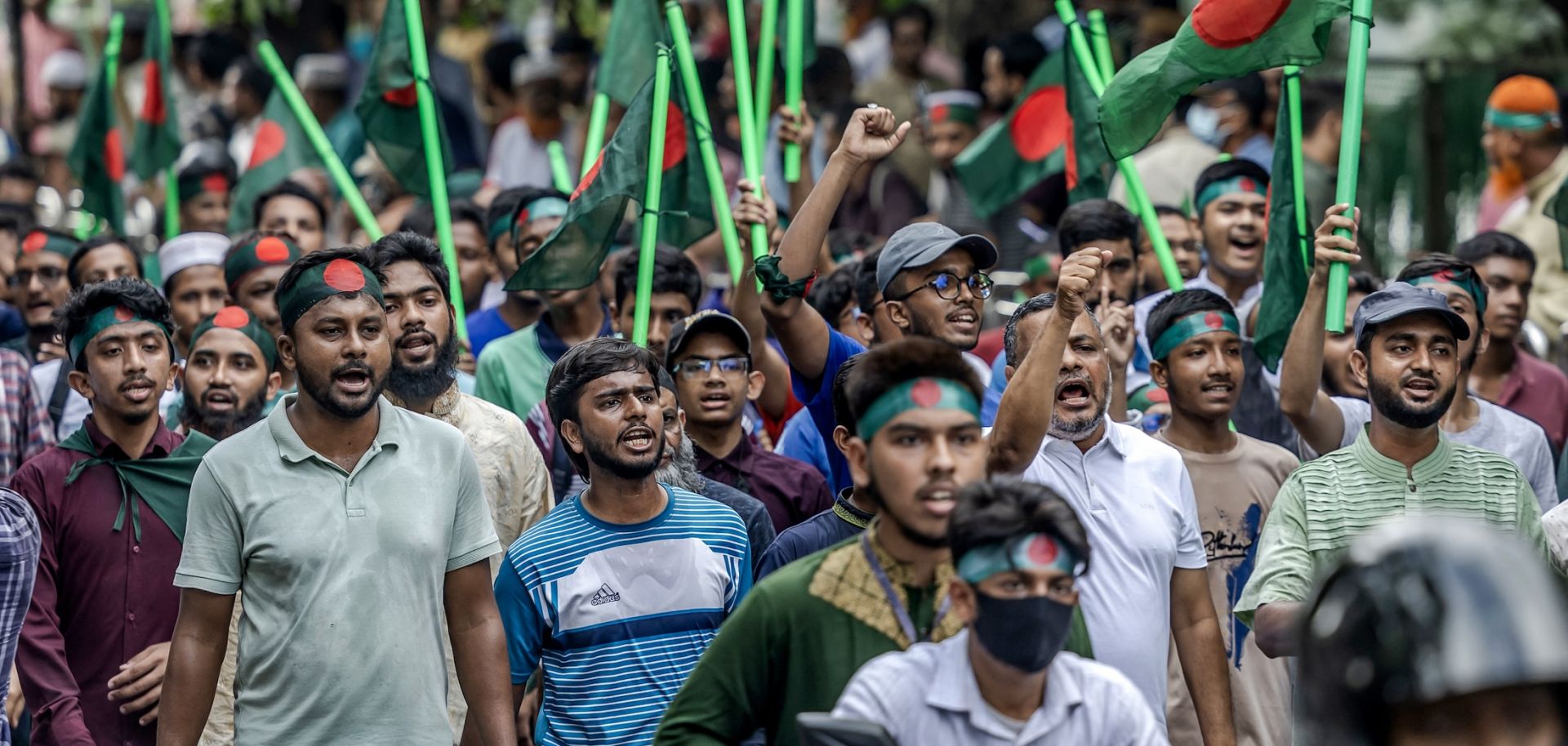
In Bangladesh, improving security will not eliminate the high risk of additional violence and protests in the coming weeks, while policy uncertainty and severe political tensions in the coming months will continue to threaten the operating environment for businesses. In the nearly three weeks since mass anti-government protests forced Prime Minister Sheikh Hasina to flee the country Aug. 5, Bangladesh has experienced increased crime, including looting and robberies, as well as sporadic protests. Targeted attacks against law enforcement, government officials and supporters of Hasina's Awami League party, as well as Hindus and Indian nationals — who have been targeted by those aggrieved with India's yearslong support for Hasina and by Islamist extremists — have also occurred. The temporary collapse of the country's police, which helped lead deadly crackdowns during Hasina's final weeks in office, facilitated the lawlessness after most officers went into hiding to avoid retributory violence. The military has meanwhile struggled to restore order, with its resources strained even after calling up auxiliary forces, and its soldiers reportedly apprehensive about cracking down on unlawful activity — likely because forceful crackdowns on protesters are what inflamed popular grievances and ultimately led to Hasina's ouster. To fill the security vacuum, students in some parts of the country (including in the capital of Dhaka) have assumed some official responsibilities, like traffic control and conducting patrols to deter or respond to crime. But these students have often lacked the experience to effectively fulfill their new roles. Following assurances from the interim government, police officers have reportedly slowly begun returning to work since Aug. 12, which authorities claim has driven gradual improvements in law and order — though media reports suggest instability lingers.
- Student-led protests surged in July in opposition to a June court ruling that effectively reinstated a quota system for government jobs, which critics claimed limited employment opportunities and provided special privileges for Hasina's supporters. Subsequent weeks saw authorities and Awami League supporters crack down heavily on demonstrators, resulting in hundreds being killed and thousands of others injured or arrested. The intensity of the crackdowns severely inflamed popular grievances and ultimately expanded protests into a broader anti-government movement that by Aug. 5 resulted in Hasina's ouster.
- While Bangladeshi authorities claim misinformation and concerted disinformation (particularly from Indian sources) have exaggerated the threat to Hindus in recent weeks, local media and civil society groups have reported upward of 200 attacks against Hindus and other religious minorities (targeting individuals and properties like businesses and religious sites) across 52 of Bangladesh's 64 districts in the wake of Hasina's ouster.
The eruption of criminality, protests and targeted attacks after an interim government headed by Nobel laureate Muhammad Yunus was sworn in Aug. 8 illustrates the steep challenges the provisional authority faces. Yunus, who student protesters had specifically sought to lead the interim government, has repeatedly said violence undermines protesters' aspirations for democratic reforms. Harsh crackdowns during the Awami League's decade-plus in power have fueled intense popular anti-government grievances — especially among the political opposition, which included the Awami League's rival Bangladesh Nationalist Party, as well as Islamists — overcoming appeals for calm. This has driven many to engage in retributory violence against those they deem responsible for, or supportive of, Hasina's rule. Meanwhile, though Bangladesh's economy grew under Hasina, it has in recent years experienced challenges like persistently high inflation and declining foreign exchange reserves that have intensified the hardships many Bangladeshis face. Recent weekslong protests and subsequent lingering unrest have worsened the country's economic challenges by driving prolonged disruptions to local business operations, including from the country's crucial ready-made garment sector.
- Bangladesh's army chief and president jointly ushered in an interim government headed by Yunus along with other technocrats and members of various opposition parties. Hasina's Awami League was conspicuously sidelined from discussions regarding the interim authority's formation. It has since been allowed limited political influence and has maintained a relatively low profile, largely due to fears of violence or other retribution.
- The president of the Dhaka-based Foreign Investors' Chamber of Commerce and Industry estimated in late July — before unrest peaked in early August and culminated in Hasina's ouster — that business disruptions from weeks of protests and authorities’ efforts to stem unrest have resulted in upward of $10 billion in economic losses.
- The International Monetary Fund has forecast that Bangladesh's foreign exchange reserves will dwindle even further from their current $24.8 billion to $19 billion in 2025. Bangladesh's low dollar reserves have limited its ability to import fuel, driving more frequent power cuts that have intensified Bangladeshis' struggles to get by and worsened disruptions to the operations of factories and businesses.
While authorities are likely capable of gradually restoring law and order, lingering shortages of security resources, popular grievances, and authorities' hesitance to engage in new crackdowns portend additional targeted violence, sporadic protests and criminality in the coming weeks. Interim government officials have said they will initially focus on restoring law and order before pursuing other priorities. Though the unrest that erupted since Hasina's ouster has been more limited than at the height of anti-government protests in early August — which at one point saw some 100 people killed in a single day — it probably will take weeks for authorities to fully and durably restore law enforcement capacity and begin to repair relations between police and the public. During this time, Bangladeshi authorities likely will also remain under pressure to limit their use of force and abstain from imposing restrictions, like curfews or internet and mobile service suspensions — to avoid inflaming anti-government sentiment and to limit further disruptions to business operations. Against this backdrop, simmering popular grievances portend at least some additional attacks against law enforcement, Awami League officials and supporters, as well as Hindus. The country's continuing economic challenges will also incentivize further opportunistic criminality like robberies and looting. Authorities' use of deadly force, imposition of restrictions or other actions perceived as authoritarian would all risk retriggering larger scale, violent and potentially prolonged unrest. Beyond personal safety risks, renewed unrest would also reintensify disruptions to business operations and travel in various parts of the country. Disruptions would be particularly severe in and around major cities like the capital of Dhaka as well as strategically important areas like the port city of Chittagong, which often see larger protests and which authorities are more likely to prioritize in attempting to restore order.
- Local media reports indicate a number of firearms were looted when police across the country abandoned their posts, suggesting lingering risks of violent crime and deadly attacks.
- Demonstrating how tensions and momentum for political change will threaten sporadic flare-ups of unrest, protests erupted days after Hasina's ouster against several top Supreme and High Court judges who activists accused of having supported the former Awami League government. The demonstrations successfully pressured Chief Justice Obaidul Hassan and five other top judges into stepping down Aug. 10.
- Recent unrest and anti-Hindu violence in Bangladesh have also reportedly driven hundreds of refugees to flee the country into Northeast India in recent weeks. This will at least temporarily heighten humanitarian and security concerns along the Bangladesh-India border, and is particularly likely to burden Northeast Indian states.
Even as security gradually improves, the coming months will likely see policy uncertainty, political tensions and risks of renewed unrest lead to a precarious operating environment for businesses. While the interim government and military probably will prioritize ensuring security and restoring investor confidence to facilitate economic activity, provisional authorities have also expressed their intent to pursue more expansive responsibilities. To achieve activists' goals of paving the way for free and fair elections and a new, less authoritarian government, authorities would likely need to pursue sweeping reforms. Among other things, they probably will aim to reduce the power of the prime minister and spread authority more evenly throughout the government, as well as establish more checks and balances. This will also likely necessitate enhancing the independence of security services to limit the potential for their being weaponized against political opponents. But activists do not appear unified on precisely how to pursue these goals and what should be delegated to the interim authority versus an eventual elected government. Beyond fueling uncertainty regarding policy and the duration of the interim government's tenure, such disagreements will also contribute to tensions among those now tasked with shaping Bangladesh's political future. Any splits among the student-led movement risk not merely creating paralysis within the interim government, but also threatening new rounds of social unrest. Meanwhile, many activists have also pushed the provisional government to hold those deemed responsible for killings and other repression under Hasina to account, measures for which government and military officials have expressed support. This, plus the Awami League's exclusion from the provisional administration, will fuel political tensions. It also raises the risk that the Awami League eventually will use unrest to combat an authority it perceives as illegitimate and a tool for victims of Hasina's rule to undertake political retribution. So regardless of potential near-term improvements in Bangladesh's security, policy uncertainty, severe political tensions and the consequent potential for resurgent unrest will all remain risks to business operations.
- The risks of a return to larger scale unrest will likely increase the longer the interim government remains in power and puts off fresh elections. While many activists have pushed for the authority to pursue reforms that probably will take time to implement, a prolonged period in power for the unelected interim government would eventually give rise to fears regarding a return to authoritarian and/or military rule.
