
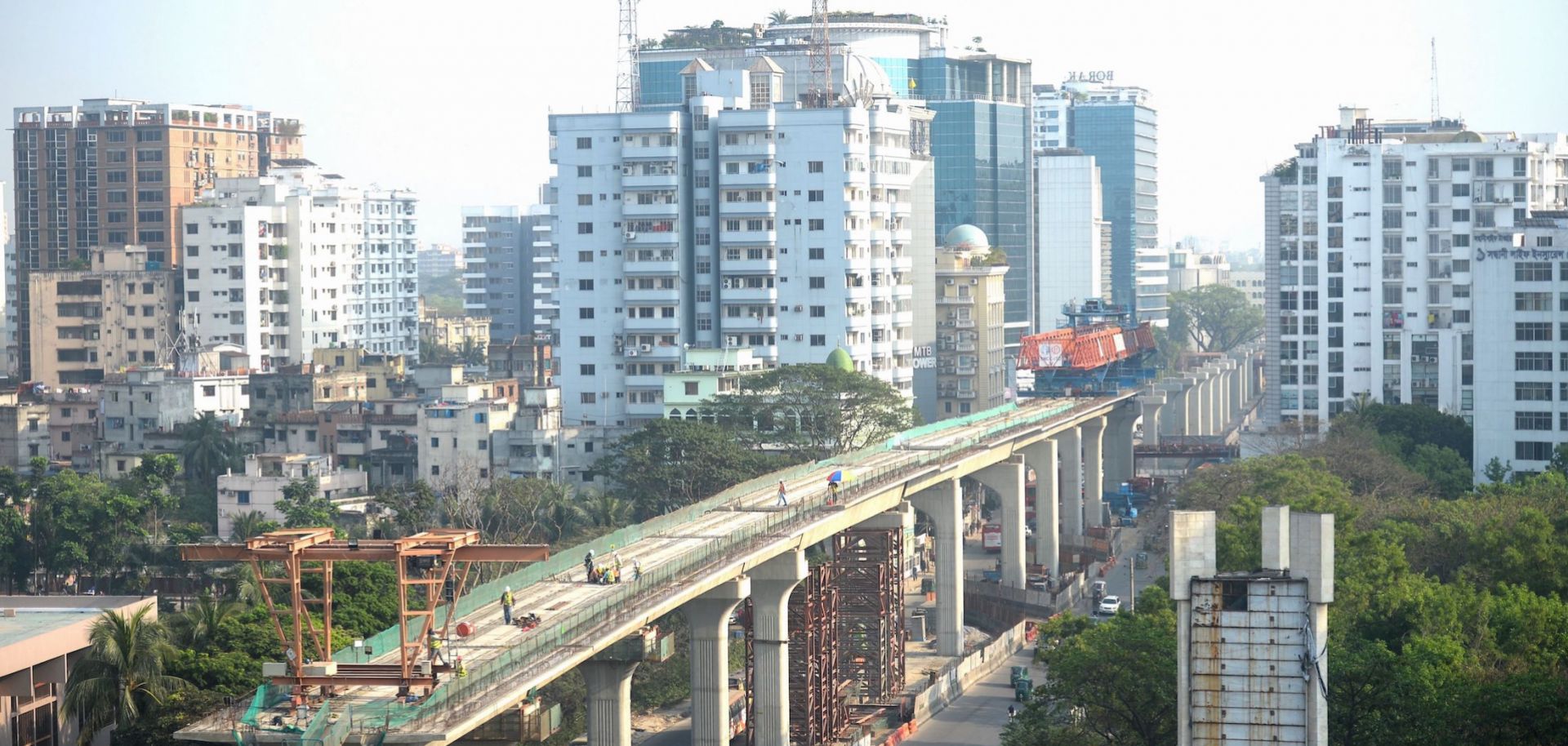
A general view shows the ongoing construction of the Dhaka Metro Rail project in Dhaka, Bangladesh, on March 16, 2021.
Compared with most of its regional peers, Bangladesh is better positioned to withstand the economic and political fallout from skyrocketing global food and energy prices. The current crisis has, however, revealed the country's vulnerability to external market shocks, which could slow economic growth in the medium term. After being hit hard by the COVID-19 pandemic, Bangladesh's economy started to show some signs of life in 2021 amid the easing of lockdown measures. But the fallout from the ongoing war in Ukraine has plunged Bangladesh back into crisis in recent months. Rising global prices for food and energy (of which Bangladesh is a net importer) have quickly eaten into the country's foreign exchange reserves and have increased its current account deficit, forcing the government to implement various austerity measures to shore up its dwindling finances. Growing fears of a looming global recession have also reduced demand for Bangladesh's garment exports — a key driver behind the vast economic growth the country has seen over the past 20 years. The increase in global economic uncertainty has fueled domestic inflation and the depreciation of the Bangladeshi taka as well. The government's inability to adequately finance fuel imports, meanwhile, has disrupted electricity production, resulting in widespread power outages that have added to the chaos in recent weeks.
- Bangladesh's foreign exchange reserves stood at $36.9 billion on Sept. 22, down from $46.3 billion a year ago. In the same period, the value of the Bangladeshi currency has also decreased by 26%, to 107.65 takas per one U.S. dollar.
- In August, inflation in Bangladesh reached a nine-year high of 7.8%. The government also hiked the fuel prices by 50% in July on account of high international prices. This is increasing the cost of living in the country and the cost of inputs in its export-oriented economy.
- Load-shedding or scheduled power cuts were imposed in July as high global fuel prices forced Bangladeshi authorities to impose a moratorium on LNG imports and suspend the operation of diesel-generated power plants. Schools and workplaces have also been required to cut operation times to save energy. The government also imposed restrictions on luxury imports to manage the worsening current account deficit situation and alleviate downward pressure on the country's foreign exchange reserves.
- Construction at several infrastructure projects categorized by the government as ''low priority'' has been temporarily halted until Bangladesh's financial situation improves.
Bangladesh will be able to manage the current crisis thanks to assistance from the International Monetary Fund (IMF), continuing remittances, low external debt levels and political stability. As Bangladesh's debt burden is sustainable, it is not vulnerable to a debt default like Sri Lanka. Additionally, since the lifting of COVID-19 restrictions around the world, a large number of Bangladeshi nationals have moved abroad for work, which has resulted in an increase in remittances in recent months that will keep supporting foreign exchange reserves. The government has also taken preemptive steps to tackle its declining foreign exchange reserves and widening current account deficit by approaching the IMF in July, which makes an assistance deal likely. These factors mean that while the short-term impacts of high inflation will be gravely felt, the government's preparedness will likely prevent an economic meltdown and ensure political stability.
- Bangladesh's external debt-to-GDP ratio is about 30%, compared with Sri Lanka's 119%. The Bangladeshi government also has no immediate debt payments as large repayment obligations will start from 2025-2027 for large-scale infrastructure projects.
- Bangladesh's account deficit reached 4.2% of GDP in June.
- The IMF responded positively to Bangladesh's request for a roughly $4 billion loan in July, stating that it will work with Dhaka to design a program.
- The United Nations categorizes Bangladesh as a ''least developed economy,'' or LDC, which makes the country eligible for several loans and financial aid packages from multilateral agencies. India has also expressed readiness to work with Dhaka in case of food shortages or potential insecurity.
- The Bangladeshi government announced incentives for remittances coming from Bangladeshi workers outside the country. Remittances from millions of migrant laborers (mainly in countries like Saudi Arabia, Oman, the United Arab Emirates, Qatar, Kuwait and Singapore) have recorded steady growth in 2022. In the first two months of the financial year 2022-23 (July and August), the expatriates sent a total of $4.13 billion, compared with the $3.68 billion they sent during the same period last year. Remittances generate about 6% of Bangladesh's GDP. Countries like Malaysia have also approached the government to employ Bangladeshi workers.
Bangladesh's food and energy crises are likely to stabilize in the coming months. The government expects food prices in the country to ease amid plans to ramp up rice and wheat imports in the months ahead. Improved stockpiles of such staple grains will facilitate social food programs for the poor and help keep prices from further escalating. Bangladesh's energy crisis will likely also abate, as production from new coal power plants in the country, combined with increased coal imports from India, is expected to add about 3000 megawatts to Bangladesh's electric grid by December (increasing the country's power capacity by about 20%). However, on the off chance that unforeseen circumstances delay these plans and power shortages continue, it could lead to a volatile social and political situation in the country.
- In late August, the credit ratings agency Standard & Poor's said it expects the Bangladeshi economy to remain resilient as external de-stabilizing factors subside over the next year.
- The Bangladeshi government inked a deal with Russia to import about 500,000 tonnes of wheat, likely to be delivered in January. It is also in talks with India, which was Bangladesh's biggest wheat supplier before New Delhi banned all grain exports in May, to potentially resume shipments. Dhaka is planning to buy 1 million tonnes of rice from India, Vietnam and Myanmar as well.
- The government slashed duties on rice shipments from 25% to 15.25% in August to aid importers.
- Three new coal power plants in Bangladesh — the Maitree Super Thermal Power Plant (1234 MW), the Banskhali Power Plant (1224 MW) and the Barisal Electric Power Co. plant (307 MW) — are expected to come online in December. Beginning in December, the Godda Power project in India's Jharkhand state is also expected to resume exporting about 1600MW worth of electricity to Bangladesh.
In the meantime, inflation and the high cost of living will continue to fuel opposition protests, but the unrest is unlikely to seriously threaten the Bangladeshi government's hold on power. In recent weeks, student groups and opposition political parties, including the Bangladesh Nationalist Party (BNP), have organized protests against high inflation and food and fuel shortages. The current discontent, however, is unlikely to pose a serious threat to Prime Minister Sheikh Hasina's government ahead of the country's next general election, which is scheduled for late 2023. For one, the alliance led by Hasina's ruling Awami League party remains widely popular and holds a commanding majority in the country's parliament. The BNP by contrast, which is the main opposition party, controls only a handful of parliamentary seats after it boycotted Bangladesh's 2014 general election over accusations of repression. The BNP's controversial history of inciting violence during election periods — along with the myriad corruption charges its leader, former Prime Minister Khaleda Zia, is currently being investigated for — has also severely eroded voters' overall confidence in the party. Given its internal leadership struggles and eroding public appeal, the BNP will only stand a chance of winning the next election if it forms a coalition with other opposition parties like the Jatiya Party, which at this point seems unlikely. Still, high inflation and demands for wage increases will probably remain the critical issues for mobilizing people and opposition parties against the government, which could result in more protests in the lead-up to next year's vote.
- The government led by Awami League under Prime Minister Sheikh Hasina has been in power since winning Bangladesh's 2008 national election. The so-called Grand Alliance led by the Awami League, which consists of mostly left-leaning political parties, currently controls 300 seats in the country's 350-seat parliament. The Jatiya Party has the second-largest presence in the legislature with 26 seats, followed by the BNP with only seven seats.
Despite its relatively stable economic outlook, Bangladesh will likely experience slow growth in the medium term due to mounting global uncertainty. Inflation in major economies and the subsequent slowdown in global trade demand is negatively affecting Bangladesh's crucial garment sector as countries scale back their export orders. In addition, the current energy crisis will lead to disruptions and losses for Bangladeshi manufacturers, as high prices and electricity shortages force factory operators to scale back production. Additionally, government funding shortages, coupled with the country's depreciating local currency, will likely delay many of the development projects currently under construction due to added costs and more urgent priorities for public spending.
- Fears of a coming recession in major markets like the United States and the European Union have dampened demand for Bangladesh's garment exports, which account for 12% of the country's GDP. The rising cost of energy and other manufacturing inputs have further eaten into the bottom lines of Bangladeshi garment makers.
- Industries like textile, steel and electronics have seen a 20-25% decline in output since energy supply disruptions in Bangladesh began in July.
The crisis has also exposed the vulnerability of Bangladesh's energy sector, which will likely hamper the country's economic competitiveness in the medium-to-long term. Although Bangladesh celebrated 100% electrification coverage in March 2022, the disruptions in global LNG supplies and other fuels due to high prices have exposed vulnerabilities in the sector. Natural gas generates more than 50% of the country's electricity. However, domestic gas production has been falling for several months. The divergence of natural gas in the international market to Europe and high prices in the spot market has also prevented Bangladesh from securing LNG supplies, resulting in severe shortages that forced the government to impose power cuts. The government's plans to boost the country's power generation capacity over the next five years also rely heavily on fossil fuels, particularly coal. This will make Bangladesh all the more vulnerable to volatility in the international coal market in the future as well, further raising the potential for electricity shortages that could endanger the country's economic performance.
- Dhaka has recorded a shortfall in domestic gas production in recent months. 1,035 million cubic feet of gas has been supplied to the power plants as compared to the demand of 2252 mcf.
- The Bangladeshi government has proposed an ambitious energy plan that sets out to increase the country's installed power capacity by 45% by 2026, driven largely by expanding fossil fuels like LNG and coal. In the coming year, Bangladesh's estimated coal capacity is expected to grow from 8% to about 17%. While the price of coal has also risen in international markets, compared with LNG, it has remained affordable.
