
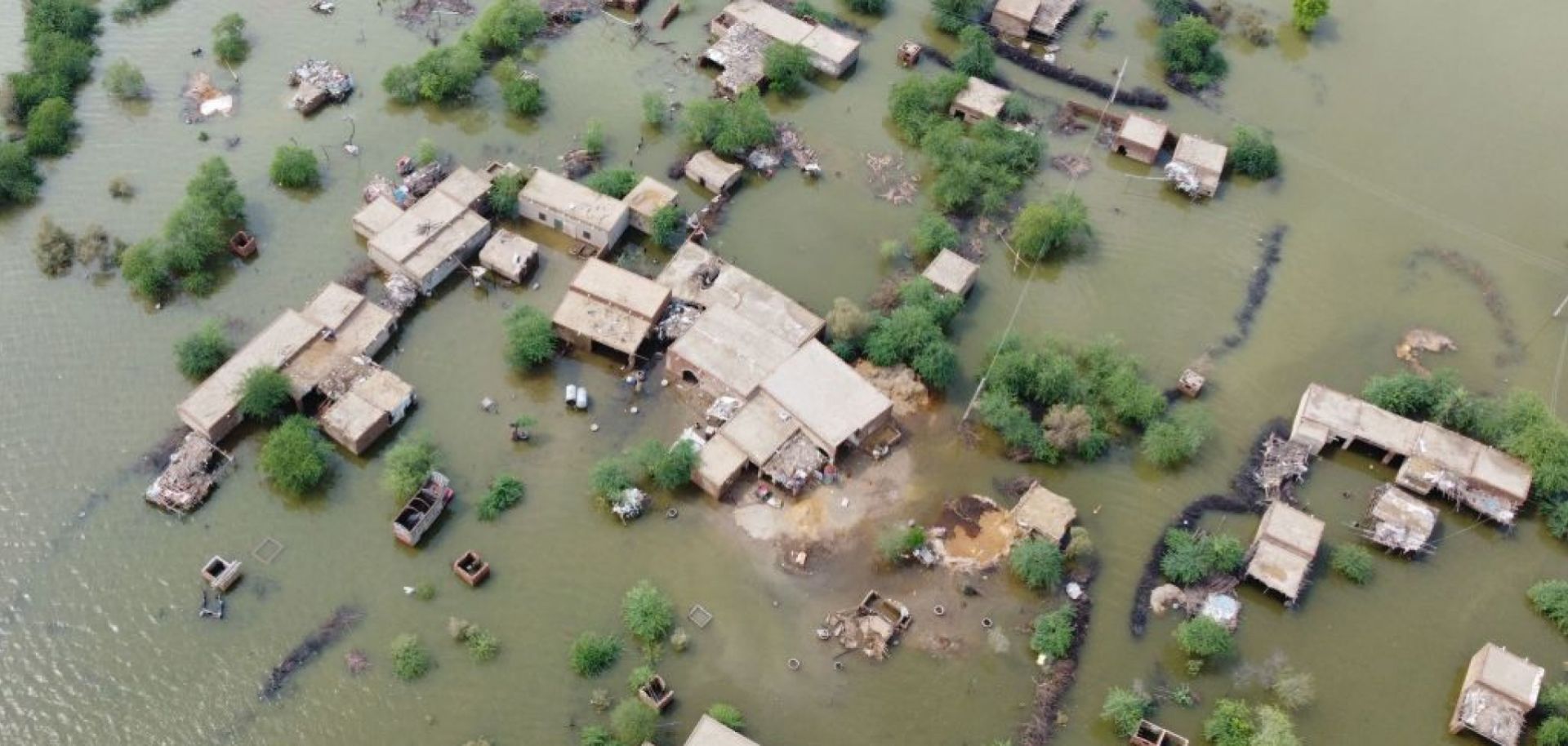
A flooded residential area on Aug. 30, 2022, in Dera Allah Yar town after heavy monsoon rains in Jaffarabad district, Balochistan.
Unprecedented flooding and associated economic losses will worsen Pakistan's economic and political challenges, and potentially raise the risk of militant activity in certain areas. Pakistan is facing an unprecedented flooding disaster, with most of its provinces experiencing significantly higher than average monsoon rainfall in 2022. Inadequate physical infrastructure and poor disaster preparedness have exacerbated the crisis.
- Three of Pakistan's four provinces, Sindh, Balochistan and Khyber Pakhtunkhwa, have been severely impacted by the flooding. As of Aug. 29, Pakistan's National Disaster Management Authority reports that about 30 million people have been displaced, almost 950,000 houses have been destroyed and more than 1,100 people have been killed. Meanwhile, more than 3,450 kilometers (approximately 2,140 miles) of roads, nearly 150 bridges and more than 170 shops have been damaged.
- The province of Balochistan was completely cut off from other parts of the country when flooding closed or destroyed important roads and bridges.
- Even though heavy rains have stopped in most parts of the country, the forecast calls for more heavy rainfall in September, which could lead to more damage.
- The military has deployed in flood-affected areas for rescue and relief operations.
Ongoing floods come as Pakistan faces a severe economic crisis and brewing instability, and as underlying militant risks persist despite cease-fire negotiations between the government and Tehrik-i-Taliban Pakistan. On Aug. 29, the International Monetary Fund approved a resumption of its $1.17 billion bailout program after the government led by Prime Minister Shehbaz Sharif, who took office in April and has since enacted various fiscal measures like increasing fuel, electricity and tax rates and secured foreign financial assistance. Despite this financial lifeline, Islamabad still faces an array of major economic challenges, ranging from foreign exchange reserves at historically low levels ( or only enough to cover about a month of imports), high inflation (approximately 25% in July) and a growing current account deficit (currently at about $17.4 billion). Meanwhile, political polarization is growing as former Prime Minister Imran Khan, who was removed from office after a no-confidence vote in April and replaced by long-time rival Sharif, gains popularity. Khan's inflammatory anti-government rhetoric coupled with the country's economic challenges have created great uncertainty in the political landscape and increased the risk of unrest. Meanwhile, although the frequency of TTP attacks has fallen due to ongoing negotiations and a potential cease-fire, sporadic attacks by Islamic State Khorasan Province and other militants have continued, primarily against security personnel in Khyber Pakhtunkhwa.
- On top of other challenges, a shortage of liquefied natural gas means that the country has faced power cuts in several regions that have hampered economic activity and drawn popular ire.
- In recent weeks, Saudi Arabia and Qatar pledged financial support for the ailing Pakistani economy, helping Islamabad satisfy the IMF demand that Pakistan secure external support to fill its financing gap assessed at $4 billion.
- The government's attempts, with the military's support, to block Khan's political ascent through legal investigations and other institutional means have raised the risk of widespread social unrest. Authorities have opened an investigation into Khan for allegedly violating anti-terror laws, sparking protests by his supporters; tensions between the two camps could rise if authorities arrest Khan or take other measures to prevent his political activities.
- The Afghan Taliban is currently mediating between the TTP and Islamabad, but a deal has not been finalized and the TTP members who reject negotiating with the government might carry out attacks in Pakistan on their own. Unconfirmed local reports also suggest the TTP may be using local militants as proxies to carry out sporadic attacks against Pakistani security forces in a bid to avoid blowback from Islamabad.
The economic damage of the floods will complicate the government's ongoing efforts to bring economic relief, which could bolster Khan's popularity and cause more political instability. Militants may take advantage of the crisis and exploit the likely slow pace of rehabilitation and resettlement efforts to recruit or conduct attacks. Despite the recent deal with the IMF, cash-strapped Pakistan's dependence on foreign aid will grow, as its precarious finances give it little ability to effectively respond to the flooding crisis. Economic growth will likely be truncated due to the impact of floods, deterring much-needed economic investment in the country. Damaged crops will lead to lower yields of important agricultural exports like rice and cotton, worsening food insecurity and endangering the livelihoods of millions of the country's people. The economic problems and the constraints on the government in dealing with them could bolster Khan's popularity at the expense of Sharif, leading to anti-government protests and potentially to early elections. While near-term security threats are driven by mass displacement, poorly organized and uneven governmental development assistance or redevelopment activity (especially in the restive provinces of Balochistan and Khyber Pakhtunkhwa) will likely motivate separatist groups like Balochistan Liberation Army, the TTP and the Islamic State to exploit popular suffering to draw recruits and increase their attacks against the government and the military.
- Pakistani Planning Minister Ahsan Iqbal on Aug. 30 said redevelopment costs after unprecedented floods could amount to $10 billion.
- The TTP on Aug. 26 released a statement criticizing the government's inadequate relief response and blaming it for popular suffering.
- On Aug. 3, six commanders died in what Baloch insurgents said was their downing of an army helicopter during flood relief operations. Regardless of whether an accident caused the crash as the army argues, further flood cleanup operations will carry similar security risks.
