
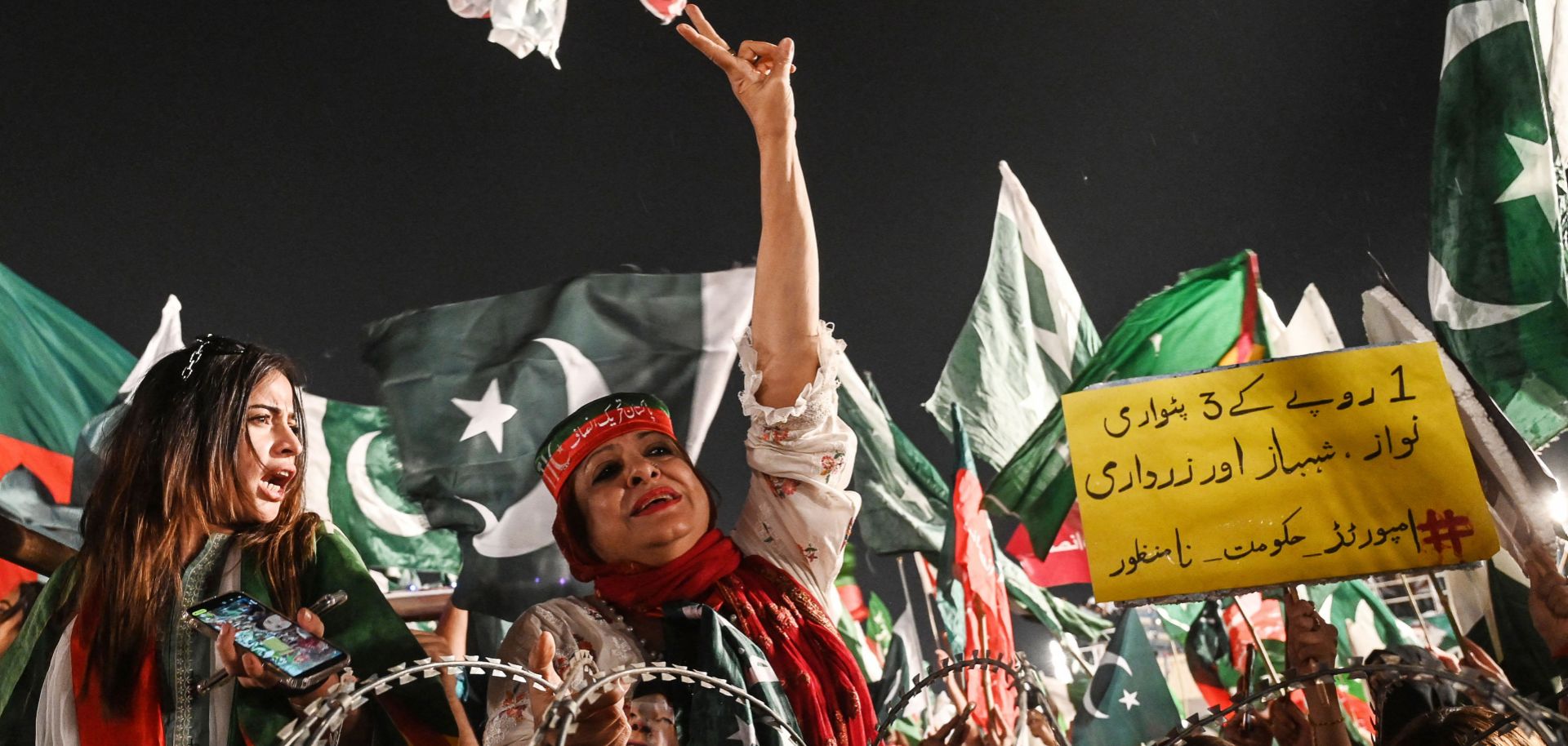
Supporters of former Prime Minister Imran Khan's party, Pakistan Tehreek-e-Insaf (PTI), are seen at a rally in Lahore, Pakistan, on April 21, 2022.
In Pakistan, former Prime Minister Imran Khan's resurgence is increasing political instability and threatening to disrupt the government's efforts to introduce economic reforms and resurrect its agreement with the International Monetary Fund (IMF). Only months after being deposed, Khan is making a political comeback. His party, the Pakistan Tehreek-i-Insaf party (PTI), won 15 of the 20 seats up for grabs in a byelection in the populous Punjab province on July 17. Current Prime Minister Shehbaz Sharif's party, Pakistan Muslim League-Nawaz (PML-N), won only four seats (with the remaining seat going to an independent candidate). Then on July 27, Chaudhry Pervaiz Elahi from the Pakistan Muslim League-Quaid (PML-Q) party, a Khan ally, became Punjab's new chief minister, dealing another painful blow to the Sharif's ruling coalition.
- After less than four years in office, Khan was ousted in a no-confidence vote in April. The motion was triggered by then-opposition lawmakers in Parliament, who are now in power under his successor Sharif's ruling coalition. Khan claims his ousting was a U.S. conspiracy and has since called on Sharif's government to hold early parliamentary elections to see who has more support among Pakistani voters.
- Punjab is Pakistan's most populous province and a traditional PML-N stronghold. A PTI-led coalition was in power in the province until mid-April, when it was replaced by a multi-party coalition backed by Sharif. But Khan successfully requested a byelection in the state to replace PTI lawmakers that had defected to the opposition, which resulted in the July 17 byelection.
The PTI's victories will likely weaken the Pakistani government and disrupt the implementation of economic reforms. The outcome of the byelection in Khyber Pakhtunkhwa, along with the appointment of a new chief minister in Punjab, has left Khan's PTI party now in control of two of Pakistan's four provinces, which will significantly erode the influence of Sharif's PML-N party in national politics. The ruling coalition's back-to-back losses are a testament to Khan's strong popularity, as well as the widespread appeal of his claims that the United States is interfering in domestic affairs to remove him from power. It also reflects public discontent with the austerity measures Sharif's government has imposed in its effort to reach a bailout deal with the IMF to avoid a default. The defeats will thus likely discourage Sharif's government from passing more unpopular economic reforms, or even continuing current reforms, for fear of losing even more support. It could also deepen rifts between lawmakers in the ruling coalition over how to address the country's lingering economic malaise without further angering Pakistani voters by imposing controversial measures (like subsidy cuts).
- Pakistan is facing a serious financial crisis due to its rising current account deficit and fiscal deficit, as well as its depleted foreign exchange reserves, which have made the country vulnerable to potential default.
- In June, fuel prices in Pakistan doubled after the government reduced subsidies per the IMF's recommendations.
- In recent months, Islamabad has also struggled to secure imports of liquified natural gas (LNG), which have become increasingly expensive amid the Ukraine-related disruptions to Russian supplies and the subsequent spike in European demand. The shortages of LNG, which powers the majority of Pakistan's electric grid, has seen resulted in blackouts and supply disruptions across the country.
Stalled progress on such reforms could jeopardize future disbursements of funding under Pakistan's IMF program. On July 14, just days before the byelection, Sharif's government reached a preliminary agreement with the IMF to resume the debt-ridden country's $6 billion bailout. Pakistan is scheduled to receive the next $1.17 billion tranche Extended Fund Facility support package pending the IMF board's approval of the deal. Disbursements of future tranches, however, could be disrupted if the ruling coalition's declining popularity deters Islamabad from continuing to enact the structural reforms needed to ensure Pakistan's long-term economic stability. Failure to secure more IMF funding beyond the pending $1.17 billion loan would increase the risk of Pakistan defaulting on its sovereign debt. It could also impede Pakistan's ability to secure additional financial aid from China and Saudi Arabia, which Sharif's government had hoped to receive following the resumption of IMF disbursements.
- Pakistan's IMF bailout program has been paused several times over Islamabad's failure to enact structural economic reforms. The program was expected to end in September 2023, but only $3 billion of the $6 billion in the program has been disbursed so far. Sharif's government has also requested to extend the IMF program by a year along with adding another $2 billion.
- Pakistan is expected to need $6.4 billion over the next three years to finance U.S. dollar-denominated debt. Pakistan's currency has depreciated 20% in the past three months. The government only has about $9 billion in foreign exchange reserves, which is enough to cover about five-to-six weeks of imports.
The PTI's resurgence and the government's weakening grip on power will likely usher in a new period of political instability in Pakistan that could eventually result in an early general election. Pakistan does not need to hold a general election until October 2023. But progressive erosion of the government's power and constant pressure from the Khan-led opposition could result in an early vote. If an early election is called, the campaign period would likely be tense, with pro- and anti-Khan groups potentially clashing in the streets of Islamabad and other large cities. But even without early elections, the government's attempts to discredit Khan or launch new criminal investigations against him will likely still contribute to a turbulent political climate.
- On Aug. 2, Pakistan's electoral commission found Khan's PTI party guilty of illegally accepting foreign funds after an eight-year investigation into the party's dubious transactions. The PTI will likely challenge the verdict in the coming days, but the ruling could deal a blow to Khan's rising popularity as the current government is seeking to ban his PTI party from Pakistani politics.
The prospect of Khan's return to power will risk exacerbating civilian-military tensions as well. The former prime minister has reportedly fallen out of favor with Pakistan's Chief of the Army Staff (COAS) General Qamar Javed Bajwa due to Khan's repeated accusations that the army (along with members of the current ruling coalition) conspired with the United States to oust him. The military is unlikely to directly intervene to prevent Khan's rise on the national level. But at least some elements within the military establishment are threatened by Khan as he would challenge the army's role in national issues. If Khan returns to power, this suggests that the Pakistani government will again find itself at loggerheads with the military, which might meddle behind the scenes to undercut the Khan administration's leadership.
- The Pakistani military has recently taken a step back from directly influencing politics. However, there is still a tacit understanding of the civil-military consensus that rules the country.
- If an early election is called, the winner would be able to appoint the country's next army chief, as Bajwa's current term ends in November 2022. It is speculated that this is one of the reasons Khan has been pushing for an early vote.
