
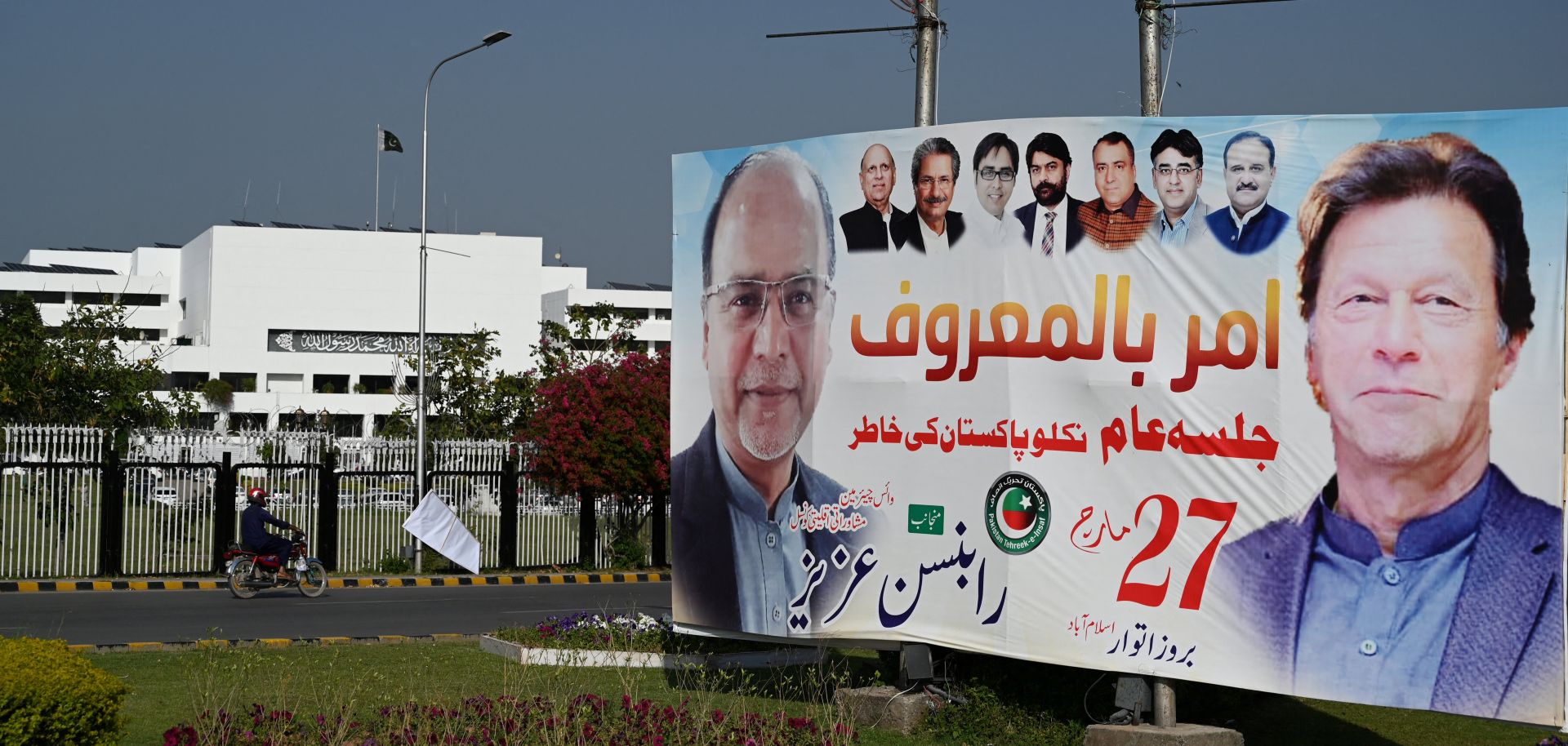
A banner featuring an image of Pakistani Prime Minister Imran Khan (right) is seen outside the parliament building in Islamabad on March 31, 2022.
Political instability in Pakistan will make it hard for the country to address its mounting economic challenges, opening the door to social unrest and threatening the continuity of the government's agreement with the International Monetary Fund. Pakistan's lower house of parliament, the National Assembly, will likely hold a vote of no confidence against Prime Minister Imran Khan in early April. On March 8, a coalition of opposition parties filed a no-confidence motion against the prime minister, accusing him of mismanaging the economy. On March 28, the deputy speaker of the National Assembly approved the motion, which has to be voted on by April 4.
- A no-confidence vote can be passed by a simple majority of 172 votes in the 342- member National Assembly. If Khan loses the vote, he will cease to be the prime minister and the National Assembly will have to appoint a successor.
- Currently, Khan's governing Pakistan Tehreek-i-Insaf party (PTI) and its allies officially control 178 seats in the National Assembly, though not all of them are expected to support the prime minister. PTI has 155 seats, Muttahida Qaumi Movement- Pakistan (MQM-P) has seven, Pakistan Muslim League-Q (PML-Q) has five, Balochistan Awami Party (BAP) has five, Grand Democratic Alliance (GDA) has three, Awami Muslim League Pakistan (AML-P) has one, Jamhoori Wattan Party (JWP) has one, and there is one independent member. The opposition, meanwhile, has 162 members.
The opposition's move against Khan is motivated by the continued decline of economic indicators like inflation, as well as unpopular government-mandated austerity measures. Khan's government inherited high fiscal and current account deficits when it came to power in 2018. Pakistan's economy is critically dependent on imports and, in recent months, the country lost significant amounts of its foreign exchange reserves to fund its increasingly costly energy imports. Although the IMF resumed its support for Pakistan in January, inflation reached 13% in that month and the value of the Pakistani rupee has fallen by more than 30% since 2018. Against this backdrop, the opposition has accused Khan of giving away sovereignty to the IMF and of economic mismanagement. Increasing international crude oil prices amid the war in Ukraine are only exacerbating Pakistan's economic problems and opening the door to social unrest due to the rising cost of living. In an attempt to improve the government's popularity, Khan introduced a relief package that included tax cuts and electricity subsidies, but this did not improve the country's social and political environment.
- Pakistan signed a $6 billion deal with the IMF in 2019. While the program was temporarily suspended, it resumed in January 2022 after the government passed controversial legislative acts to raise taxes and electricity prices in line with the economic reforms the IMF required as conditions for its lending.
- Pakistan's current account deficit amounted to $12 billion in the first eight months of the fiscal year 2022. According to some projections, it could also reach $20 billion by the end of the year, which would account for 6% of the country's GDP.
- Pakistan's fiscal deficit as of March was recorded at about 8% of the GDP. Inflation in the country is expected to stay in the 11-12% range in the coming months.
Khan is becoming increasingly weak as more allies appear to desert his ruling camp. The majority in parliament held by Khan's ruling coalition is in danger as some lawmakers have suggested that they may vote against him in the no-confidence motion. Khan, meanwhile, has suggested that the United States and its Western allies are involved in the push to oust him, likely because of Islamabad's continued neutral stance on Russia's invasion of Ukraine. The rhetoric of foreign meddling in domestic matters is often used in Pakistani politics and the prime minister's support base is expected to believe the theory. Khan's use of this narrative (which involves security concerns) could contribute to his defeat in the no-confidence vote by potentially prompting the Pakistani military to offer direct or indirect support for the opposition.
- On March 27, Khan said in a speech that there is a ''foreign-funded conspiracy'' against his government and that he can prove it.
- On March 28, one leader of the PML-Q party and all five members of BAP crossed over to the opposition and stated their decision to vote against Khan in the upcoming vote of no-confidence. Two days later, the MQM-P (which has seven members in the National Assembly) broke away from Khan's ruling PTI alliance and declared they would also vote against the prime minister. The opposition recently claimed they have 176 votes and are confident of defeating Khan's government in the no-confidence motion.
Regardless of whether Khan stays in power, political turbulence will make it difficult for Pakistan to emerge from its economic crisis. If Khan wins the vote of no confidence, his government will likely remain in power until the next general election in 2023. This outcome would result in some degree of political continuity that would enable the government to continue with its economic policies and engagement with the IMF. Some degree of stability is also essential to attract foreign direct investment and continue with externally funded development projects in the country. However, even in this continuity scenario, political and social risks would remain due to the depth of Pakistan's economic problems and the increasingly assertive opposition. If Khan loses the vote, the National Assembly will have to appoint a new prime minister. This will be accompanied by judicial challenges by Khan to disqualify defecting members of the alliance — adding to the political confusion, with both the election commission and the supreme court required to resolve the constitutional issues related to parliamentary defections. Even if the opposition manages to form a government, there will likely be early elections because of internal divisions within the opposition. This could result in higher political instability that would do further damage to the economy. A new government could reject IMF's terms and implement populist high-spending measures that would undermine investor confidence in Pakistan and its ability to secure financial assistance from other institutions. An opposition-led government could also result in new waves of social unrest because Khan's supporters could protest against the vote and engage in attacks against public and private buildings and scuffles with the police.
- In a low-probability but high-risk scenario, Pakistan's military could take over to end the political deadlock. This is the least likely outcome since the military has largely remained away from the political conflict so far, avoiding taking sides or commenting on political issues. If the military takes over, even temporarily, it would greatly undermine the democratic process, as well as all constitutional institutions in the country.
