
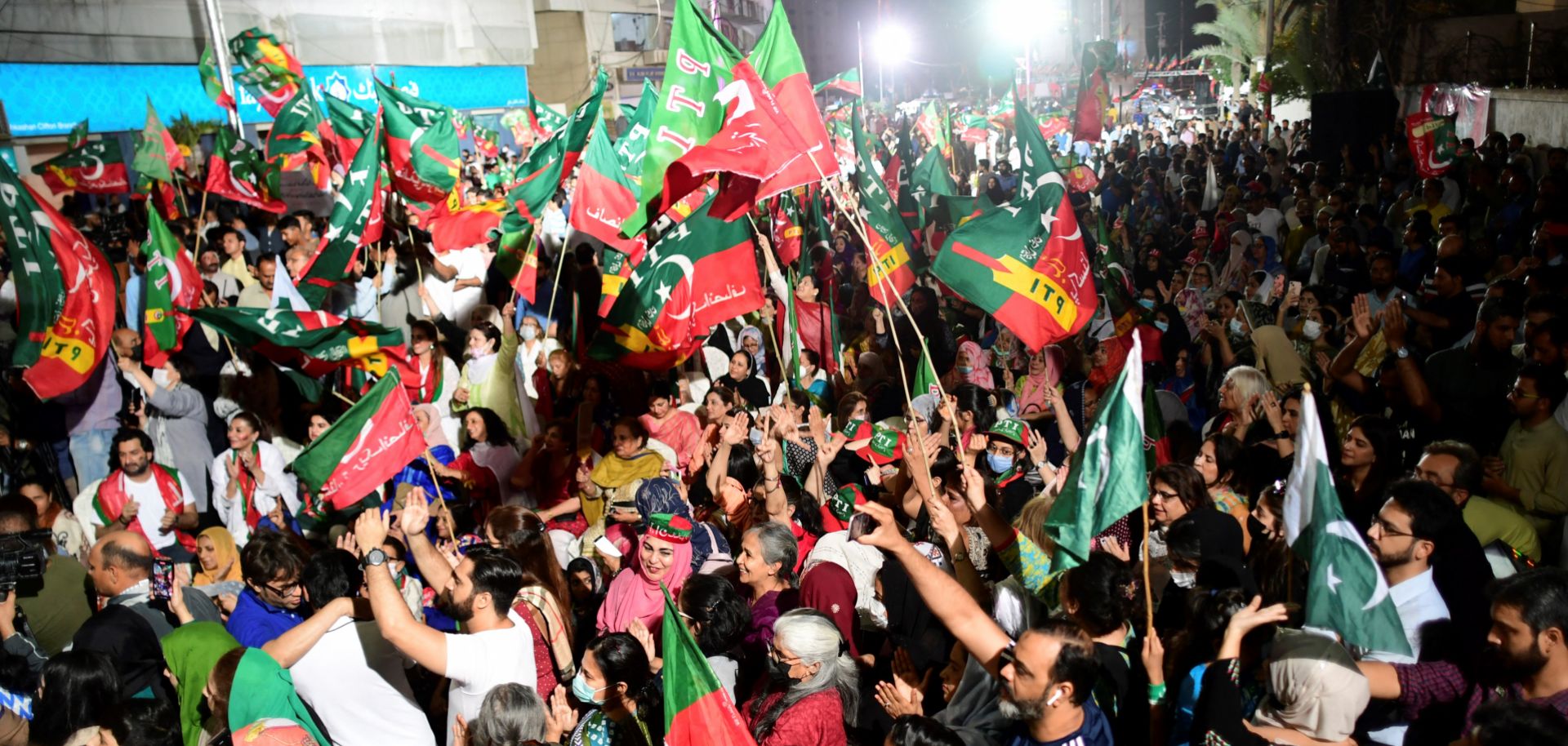
Supporters of the ruling Pakistan Tehreek-e-Insaf (PTI) party take part in a rally in Karachi on April 1, 2022, after debate on a no-confidence motion against Pakistani Prime Minister Imran Khan was postponed.
An upcoming ruling by Pakistan's Supreme Court could not only seal the fate of Prime Minister Imran Khan's embattled government but have long-term implications for Pakistan's democracy. On April 3, the day when Pakistan's National Assembly was expected to debate and hold a vote on a no-confidence motion against Khan, the deputy speaker dismissed the vote amid government accusations of a foreign conspiracy. Later that day, Khan instructed Pakistani President Arif Alvi to dissolve the parliament, call for fresh elections and appoint a caretaker government. Khan made these moves because he was likely to lose the no-confidence vote as the opposition had a majority in the National Assembly after a number of lawmakers from the government coalition defected publicly.
- The opposition argues that the vote of no confidence is connected to Pakistan's dire economic situation and the government's handling of the economy. Khan, however, has insisted there is a foreign conspiracy to depose him and has blamed the United States for pushing for regime change in Pakistan, allegedly in response to Islamabad's neutral position about Russia's invasion of Ukraine.
In the coming days, Pakistan's Supreme Court will rule on the speaker's decision to abort the no-confidence motion against Khan. As Pakistan's political crisis deepens, several scenarios are possible:
1) The Supreme Court rules that the dismissal of the no-confidence motion was illegal.
If the Supreme Court rules that the cancellation of the no-confidence vote against Khan was unconstitutional, the National Assembly will have to set a new date for the vote. In this scenario, Khan would insist on his claims of an international conspiracy, in a last-ditch attempt to delay the vote and win back some of the lawmakers who recently deserted him. If Khan survives the no-confidence vote, his government will be weak and subject to future attempts by the opposition to oust him. If Khan loses the vote, he will be effectively removed from office and the opposition will seek to appoint a new prime minister. Should the National Assembly fail to appoint a prime minister, Pakistan's president would likely call for an early general election. This scenario would showcase the strength of Pakistan's political institutions, as well as the independence of the judiciary, as the events would unfold according to the Pakistani constitution. While there would be a brief period of political instability, this scenario would likely ensure the accountability of the executive branch in the long run.
- Khan's narrative that there is an international conspiracy against him could result in some degree of social unrest, especially if his followers take to the streets to protest the opposition's moves to oust him. Social unrest could be particularly strong if Khan loses the no-confidence vote.
2) The Supreme Court rules that blocking the vote of no-confidence was legal.
Should the Supreme Court confirm the dismissal of the vote of no-confidence against Khan, the planned dissolution of the National Assembly will go ahead and fresh elections will likely take place potentially within three months. Violent protests could follow such a decision as opposition parties call for mass demonstrations. This could also happen if the Supreme Court decides it does not have the competence to rule on this issue, which would mean that Khan's plan to dissolve the National Assembly can go on. The Supreme Court could also declare that the dismissal of the no-confidence motion was unconstitutional, but order the early election to happen regardless because the election commission has already set the dates for it. In either case, the National Assembly would have to appoint a caretaker Prime Minister. The general elections would take place in a highly polarized political environment as Khan's Pakistan Tehreek-e-Insaf (PTI) party has reasonable public support based on nationalist and anti-American rhetoric (Khan's supporters appear to believe the claim of foreign interference in domestic politics and see the current opposition members as acting against national interests.) This scenario would degrade Pakistan's democratic institutions because of the controversial means that the government used to dismiss a vote of no-confidence, which would create a risky precedent for future political crises.
- A new election cycle after the dissolution of the parliament would likely be accompanied by violence and protests as supporters of both Imran Khan and the opposition take to the streets during campaigning.
3) Ongoing political instability forces the military to intervene.
Pakistan's military has historically played a central political role in the country. But in recent years, the military has stayed away from daily politics, focusing instead on national security issues. Still, Pakistani governments need the military's implicit support to govern the country. The military establishment's reluctance to get behind Khan's claims that the international community is conspiring against him (which, if true, would be a national security issue) indicates there is a rift between the prime minister and the military. Pakistan's military has largely refrained from publically intervening in the ongoing political crisis; the country's Chief of Army Staff recently said the military would remain neutral on the debate over the no-confidence motion and let the democratic process ride its course. But if Khan publically defies Supreme Court orders deeming his actions as illegal, the military could take a more prominent role in the political crisis. Should the political crisis linger, the military could also become more vocal in its criticism of the government and politically support moves by the opposition to oust Khan. An outright military coup remains unlikely, but it cannot be ruled out — especially if Khan continues to make seemingly unconstitutional moves to maintain power, which could convince the military to forcibly oust him and take direct control of the Pakistani government in order to restore political stability in the country.
