
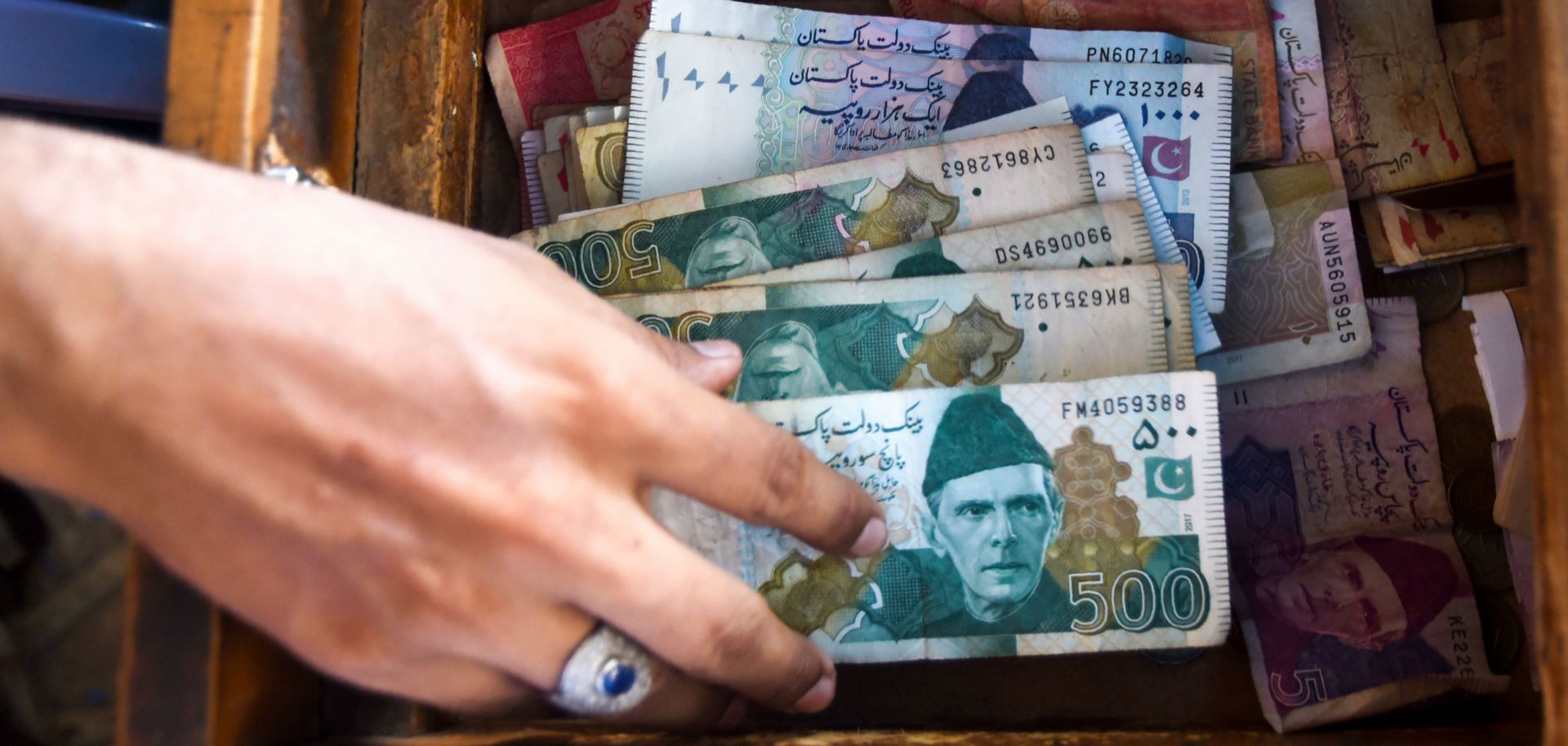
A man counts Pakistani rupees at his shop in Karachi, Pakistan, in May 2019.
While they may unlock more funding from the International Monetary Fund (IMF), the Pakistani government’s new tax hikes are unlikely to solve the country’s larger economic crisis, which will continue to impede Islamabad's ability to change policy regardless of who wins the next general election. On Jan. 13, Pakistan’s National Assembly passed the Finance Supplementary Bill and the State Bank of Pakistan (SBP) bill to clear the way for the next $1 billion tranche of the country’s $6 billion IMF bailout program. The Finance Supplementary Bill (also known as the “Mini Budget”) proposes several unpopular structural reforms — including increasing Pakistan’s general sales tax (GST) from 10% to 17% on 42 goods — in an effort to address the country’s economic crisis and unsustainable taxation policies. The SBP bill, meanwhile, pledges to make Pakistan’s central bank completely autonomous and bans the government from being able to borrow from the bank. The IMF board is scheduled to meet on Feb. 2 to complete the sixth review of Pakistan's bailout package. The meeting was originally scheduled for Jan. 28, but Islamabad requested a delay to give it more time to fulfill the IMF’s conditions beforehand, which included passing the two bills.
- The items subject to the tax hike outlined in the Finance Supplementary Bill include imported luxury products (like cell phones, cars and machines) and imported food products (with the exception of food staples sold in smaller shops, like milk and bread).
- In addition to the passage of the Finance Supplementary Bill and SBP bill, the IMF has also called for reforms in Pakistan’s electricity sector to curtail debt and expedite the privatization of inefficient or unprofitable state-owned companies. Per the IMF’s guidance, the Pakistani government increased electricity tariffs by $0.0079 per unit in November and is currently considering an additional tax hike of $0.0054.
Previously, Pakistan had been reluctant to follow through on IMF requirements as they called for unpopular reforms to public taxation policies. But the country’s worsening balance of payment crisis and debt caused by record inflation forced Islamabad to reconsider. The current IMF bailout program started in July 2019 as a $6 billion package to be disbursed in 39 months subject to regular reviews of Pakistan’s economic policy and growth. The IMF paused the program in early 2021 over the Pakistani government’s failure to enact reforms to reduce social spending and correct the country’s external sector imbalances, including sky-high account deficits. But after prolonged negotiations with the international financial institution, Pakistan reached a staff-level agreement in November wherein IMF specified its conditions for resuming the financial aid package, which included the passage of the Finance Supplementary Bill and SBP bill.
- Negotiations between Pakistan and the IMF had not progressed since January 2021. In October, Pakistan’s finance minister met with the IMF to negotiate terms to restart the program but meetings failed to resolve the deadlock. There are two additional reviews before September 2022 to complete the 39-month bailout program, following the recently completed Jan. 28 meeting.
- The value of Pakistan’s currency against the U.S. dollar has depreciated roughly 30% since Prime Minister Imran Khan’s government took office in August 2018. This has exacerbated Islamabad’s growing balance of payment crisis and has also increased the cost of imports (which are typically purchased in dollars). In November, the cost of oil and liquified natural gas (LNG) imports for Pakistan was up by 112% and 120%, respectively, compared with the previous year — mostly driven by higher international prices.
- At the end of June 2021, Pakistan’s public debt was reported to be roughly $226 billion, with external debt accounting for one-third of that total. According to a government report, Pakistan borrowed a staggering $15 billion in the 2020-2021 fiscal year. In December, Pakistan’s central bank recorded a $1.93 billion current account deficit (CAD), a significant increase from the $629 million CAD reported a year earlier (in December 2020).
The IMF program is unlikely to significantly ease Pakistan’s deep economic problems, which will continue to limit Islmabad’s independence of certain political decisions by keeping the country reliant on external financing. Pakistan’s deepening economic woes will likely force Islamabad to consider another bailout package from the IMF or other sources. Pakistan’s very low taxpayer base and high dependence on energy imports make the country particularly vulnerable to high international prices, which have continued to rise in recent months. The Pakistani economy’s structural problems also keep the country from being able to pursue independent policies focused on increasing long-term economic growth by keeping its government focused on short-term issues like servicing debt and managing inflation.
- According to an IMF assessment, Pakistan will need $28 billion in the next budgetary period of 2022-23, which could also increase to $30 billion depending on global oil prices and the value of Pakistan's local currency.
- Pakistan has recently signed a number of loans and credit lines with countries like China, Saudi Arabia and the United Arab Emirates. However, all of these loans are service debt payments.
The social and political reaction to the reforms outlined in the Finance Supplementary Bill will likely hurt Khan and his government’s prospects in Pakistan’s 2024 general election, potentially opening the door for a change in power. The Finance Supplementary Bill received strong pushback from opposition parties, who argued the reforms would only increase Pakistanis’ financial strain and erode the country’s economic sovereignty. Khan’s government was nonetheless able to cobble together a narrow majority to quickly push through the two bills. But Pakistanis’ discontent against rising prices, particularly food and electricity, will likely come back to bite at the polls in 2024. Pakistan’s worsening financial situation has fueled a number of protests across the country over the past year. In the lead-up to the general election, such protests will likely become more frequent as the center-right and center-left opposition parties make the rising cost of living their primary campaign issue. Public pressure and demonstrations from their constituencies could even push the Khan government’s current allies (who had also expressed concerns with aspects of the Finance Supplementary Bill, despite ultimately voting to approve it) to join an opposition party ahead of the upcoming election. However, even if the opposition is able to unseat Khan’s government by capitalizing on growing social discontent, they too will find that their ability to actually change Pakistan’s economic trajectory is limited upon taking office.
- Pakistan’s Senate was only given three days to review and submit recommendations after the Finance Supplementary Bill and the SBP bill were passed by the National Assembly on Jan. 13 — a process that typically takes several months.
