
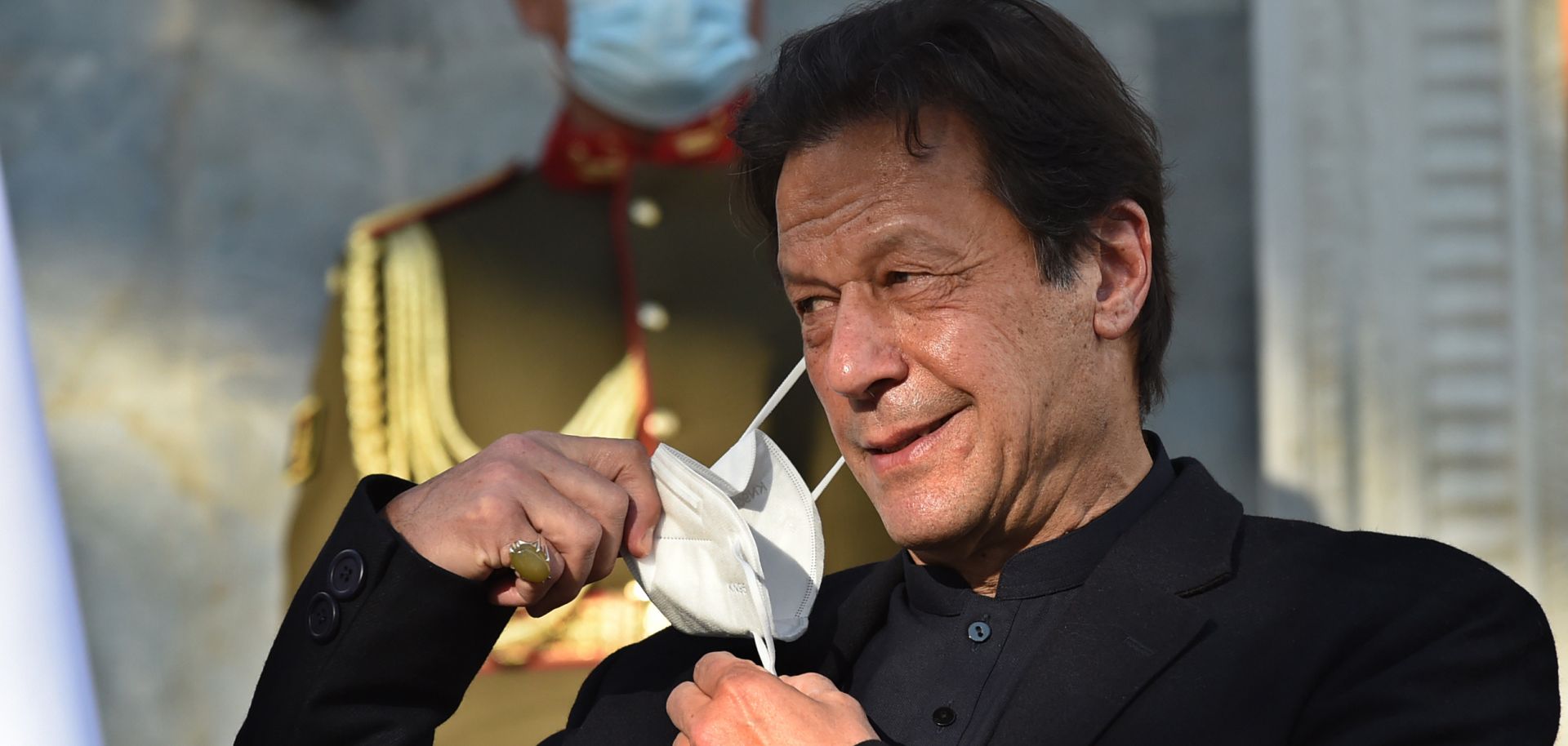
Pakistani Prime Minister Imran Khan removes his facemask during a press conference on Nov. 19, 2020.
Rising domestic pressure is pushing Pakistan to publicly voice concern over pan-Islamic issues. But in doing so, Islamabad will seek to avoid exacerbating the country’s economic crisis by alienating trade and investment partners. During a May 3 meeting, Pakistani Prime Minister Imran Khan urged the Islamabad-based ambassadors to the Organization of Islamic Cooperation to work together to counter Islamophobia around the world. A couple of weeks earlier, Pakistan — which is home to the world’s second-largest Muslim population — also announced a global campaign to fight blasphemy against the Prophet Muhammad in the hopes of driving conversations with the European Union and the United Nations.
- On Jan. 13, Pakistani, Turkish and Azerbaijani officials met in Islamabad for their second trilateral meeting and signing of the Islamabad Declaration, in which all three nations expressed concerns over India’s treatment of the Muslim-majority populations of Jammu and Kashmir.
- On Jan. 7, Khan also reiterated that Pakistan “cannot” recognize Israel and will always support the Palestinian cause after the United Arab Emirates and Bahrain signed agreements to normalize their relationships with Israel, stirring some rhetorical pushback from Muslims worldwide.
By showing it cares about issues like Palestinian statehood, Islamophobia and the treatment of Muslim minorities, Khan’s government is seeking to maintain domestic support and prevent far-right political parties from appealing to disenchanted voters. Islamabad announced its anti-blasphemy campaign last month amid a surge of violent protests organized by far-right Islamist political party Tehreek-e-Labbaik demanding Khan’s government to boycott French goods and expel the French ambassador over the publication of cartoons in France depicting the Prophet Mohammed. Khan and his centrist Tehreek e-Insaf party only defused the situation by promising to discuss the issue in parliament.
- In October, French President Emmanual Macron blamed radical Islam for the violence that led to the murder of a teacher in a Paris suburb who showed his class satirical drawings of the religious leader. Macron and his government’s response to the killing spurred public outcries in Pakistan and other Muslim-majority countries.
Such efforts will help Khan globally defend Pakistan’s leadership role in the Muslim world, especially amid Saudi Arabia’s growing silence on pan-Islamic issues. Saudi Arabia has long been a traditional international leader of the Muslim world. But Riyadh’s growing economic relationship with Pakistan’s chief rival, India, has also dissuaded Saudi Arabia from speaking out on Kashmir, which is a matter of chief importance to many Pakistanis. The kingdom’s new friendlier ties with Israel have harmed Saudi Arabia’s ability to maintain leadership on causes like Palestinian statehood.
Islamabad’s ramped-up defense of global Muslims causes, however, will only go so far in offsetting building social discontent amid the country’s ongoing economic woes. Pakistan is currently struggling with rising debt, unemployment and poverty levels — all of which have been exacerbated by the COVID-19 pandemic. Inflation reached 11.1 % in April, the highest in 11 months, while exports to regional partners fell 5.7%.
- Pakistan is currently seeking $12 billion in loans from the World Bank, which could be approved as early as May 2021. Pakistan is also trying to convince the International Monetary Fund (IMF) to ease what Islamabad has deemed “tough conditions” of the $6 billion loan it took out from the fund in 2019. But in exchange for financial assistance, the World Bank and the IMF are likely to demand unpopular spending cuts and tax hikes that would further irritate voters.
- Khan’s political popularity has slid amid his government’s perceived mishandling of Pakistan’s economic crisis. In 2020, Bloomberg and other outlets reported that members of the Pakistani military had assumed a number of key economic positions in the country previously held by civilian politicians.
Despite his emboldened pro-Islam rhetoric, Khan will remain pragmatic about the issues he defends to avoid seriously damaging Pakistan’s ability to court investment and economic support. Because of Pakistan’s weak economy, Khan will walk a careful line of pursuing leadership on pan-Islamic issues to garner domestic political support without irking Pakistan’s most important economic partners, including China and Saudi Arabia.
- Earlier this month, Saudi Arabia and Pakistan signed a new round of investment agreements after Kashmir-related tensions between the two countries caused the former to recall part of a 2020 loan made to the latter. The new loan highlights how Islamabad still needs Riyadh as an economic partner, even when they fall on opposing sides of global Muslim issues.
- Pakistan has not been outspoken on the issue of China’s treatment of ethnic Uyghurs in Xinjiang, despite its global resonance as an issue of Muslim rights. This is due in large part to the billions of Chinese dollars invested in Pakistan’s economy and the continued growth in the $62 billion China-Pakistan Economic Corridor.
- Despite political rhetoric about Macron’s comments regarding Islamophobia in his country and the subsequent protests that posed security threats to French nationals in Islamabad, Khan will also be careful in his approach to France and other EU members with whom Pakistan has strong economic ties. In 2020, the European Union was Pakistan’s second-largest trade partner, accounting for 14.3% of Pakistan’s total trade and importing 28% of Pakistan’s total exports.
