
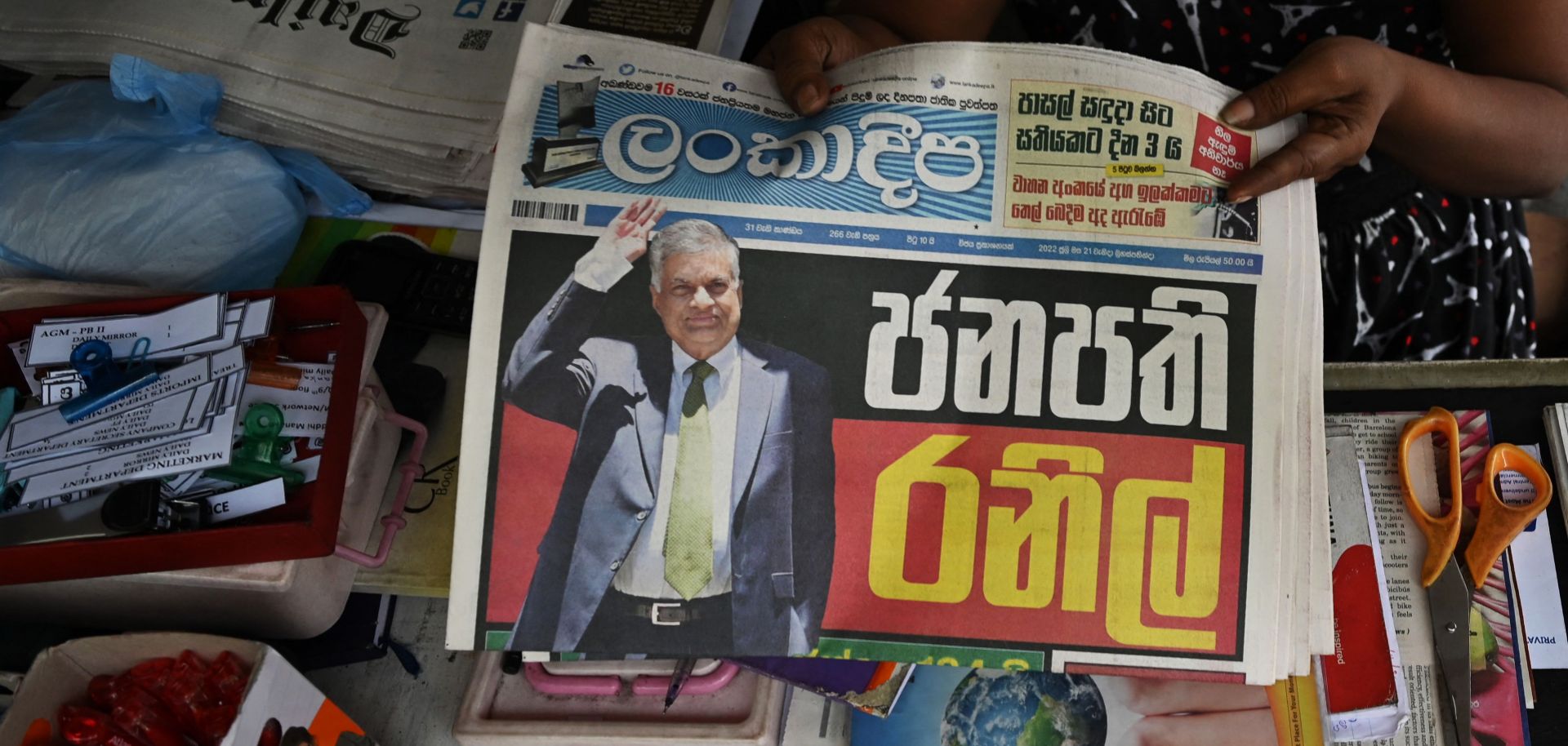
A vendor holds a newspaper with Sri Lanka's President-elect Ranil Wickramasinghe on the front page at a newsstand in Colombo on July 21, 2022. The six-time prime minister was sworn in as president later that day.
Sri Lanka's new, unpopular president faces a host of political and economic challenges that will determine whether the country returns to some level of stability or continues to face ongoing unrest. Ranil Wickremesinghe has been promoted from prime minister to president of Sri Lanka. Per the country’s constitution, lawmakers in Sri Lanka’s parliament held a vote to elect a new president on July 20 after increasingly violent protests forced former President Gotabaya Rajapaksa to flee the country last week. Wickremesinghe — a senior politician and six-time prime minister — secured 134 votes in the country’s 225-member legislature, defeating the other two nominees for the nation’s top job. The presidential pick has been met with a mixed reaction in Sri Lanka due to Wickremesinghe’s controversial ties to Sri Lanka’s political establishment (including ex-President Rajapaksa’s powerful family) and overall unpopularity with the public. He is also taking office at a time when Sri Lanka is facing the worst economic crisis in its history, which has seen severe shortages and mass protests in recent weeks. Within this context, his legitimacy as a leader will remain tenuous, leaving open the potential for another bout of widespread unrest and political instability.
- Wickremesinghe will finish out the last two years of Rajapaksa’s term. He was elected with widespread backing from the Rajapaksa-led Sri Lanka Podujana Peramuna (SLPP) party, which holds a majority in parliament.
- 73-year-old Wickremesinghe has been involved in Sri Lankan politics since 1977, when he was first elected to parliament. He became prime minister for the first time in 1993, and then five more times after that, but has never finished a full term. Wickremesinghe has also made several failed bids for the presidency over the years.
- Wickremesinghe’s most recent stint as prime minister began on May 12, when was appointed by then-President Rajapaksa in a bid to appease increasingly angry and violent protesters. Wickremesinghe replaced Rajapaksa’s brother, Mahinda Rajapaksa, who stepped down as prime minister on May 10 after protesters set fire to the Rajapaksa family’s ancestral home.
Wickremesinghe faces huge political and economic challenges that could prevent him from finishing his term, which lasts until 2024. Several lawmakers have expressed a desire to work with the new Wickremesinghe administration to solve the country's economic crisis. But accomplishing that task — and in a timely enough manner that protesters don’t start to turn on him as well — will prove a tall order. Wickremesinghe is inheriting a bankrupt government with bone-dry foreign currency reserves, which has led to skyrocketing inflation, along with acute shortages of basic necessities like food and fuel, by leaving Colombo unable to purchase imports. In the hopes of shoring up extra cash, one of Wickremesinghe’s first tasks as president will be resuming Sri Lanka’s bailout talks with the International Monetary Fund, as well as financial aid talks with countries like India, China and Japan. These negotiations, however, are unlikely to quickly provide Wickremesinghe’s administration with enough funds to resume imports of essential items. The economic issues that have driven people to take to the streets in recent weeks, including the increasing price and scarcity of goods, are thus poised to endure. Wickremesinghe’s long career and ties to Sri Lanka’s ruling elite — along with concerns about his legitimacy (given that he wasn’t elected to the parliament, and now the presidency, by a popular vote) — have left him in a fragile political position as well, which could further hinder his ability to lead Sri Lanka out of its crisis. This combination of financial and political constraints could eventually give rise to another popular revolt against Wickremesinghe’s administration, potentially even supported by opposition members in parliament.
- Wickremesinghe lost his parliamentary seat in the 2019 elections and was only nominated to the parliament through a national list provision based on a percentage of votes for a party; in the minds of his critics, this further strengthens the argument against his legitimacy to be the president, along with the fact that he has the backing of the Rajapaksa-led SLPP.
- In June, inflation exceeded 50% in Sri Lanka. The country defaulted on its $51 billion external debt last month and is currently effectively closed to international markets.
- The IMF has indicated that a viable debt restructuring plan with Sri Lankan creditors, along with the implementation of other austerity measures, must be in place before the institution grants Sri Lanka a bailout package. However, negotiations with creditors will face difficulties as bilateral creditors like China are not generally inclined to restructure debts. Sri Lanka will reportedly need $6 billion in additional financing in 2022, which will likely be available only after the IMF bailout package is agreed to. Even if the Wickremesinghe administration inks such a deal, IMF dismemberments will likely take time and could be further delayed if the country spirals back into a political crisis.
What to Watch For
Several factors will help determine how events play out in Sri Lanka in the near term:
The trajectory of the protest movement. Media reports have noted shock and fatigue among some protesters in the capital following the election of Wickremesinghe, which likely helped limit the size of protests. Significant numbers of protesters giving into Wickremesinghe's accession to office would obviously undermine the movement. A state of emergency, imposed by Wickremesinghe in the run-up to the presidential election, also may continue to constrain protests. Significant anger at the country's ongoing economic crisis means Sri Lankans' fundamental grievances remain unaddressed, however, so the potential for disruptive demonstrations will persist. Even if most protest activity since Wickremesinghe’s election has remained small and peaceful, there are many potential flashpoints that could reinvigorate the movement in the future. Official statements in the wake of protesters storming the prime minister's office on July 13 indicate the security forces are under intense pressure to prevent a recurrence. This suggests that security forces will be more aggressive vis-a-vis protesters, which could lead to street clashes if protest activity does resume. Curfews and other restrictions and more security forces aside, protesters have still taken to the streets. Wickremesinghe's need to implement painful austerity measures to receive foreign economic assistance could enhance residual popular anger.
Political support for the new administration. While most parliamentarians support Wickremesinghe's presidency, a minority believes he lacks a popular mandate. Wickremesinghe will likely appoint a prime minister and a Cabinet within days and call on members of all political parties to form a consensus government. If SLPP members continue to dominate the Cabinet, protesters will see it as illegitimate and demand it be changed. Meanwhile, some SLPP members did not support Wickremesinghe's presidential bid, and a party rebellion could ensue if Wickremesinghe's economic plan is not well-received by the public and the country's economic crisis persists. Such a scenario would produce calls for early parliamentary and presidential elections, which currently are scheduled for 2025 and 2024, respectively.
Changes to the political system. Many Sri Lankans and at least part of the political class expect political changes that boost parliamentary power and presidential accountability in the coming months. While Wickremesinghe has been known to support such reforms in the past, now that he is president, he might decide to forgo major changes, choosing instead to achieve stability via strong-arm tactics. While this might temporarily generate stability, it would come at the cost of alienating much of the public. Whatever course the new president takes will likely anger at least some factions, creating internal political problems for Wickremesinghe.
How the government's economic plan unfolds. Negotiations with the IMF for $2 billion to fund Sri Lankan imports have been stalled amid the country's ongoing political crisis, but are expected to resume under the new president, who previously served as finance minister and so was in charge of negotiating with the IMF. Sri Lanka is expected to unveil an interim budget in August that would highlight a clear road map for fiscal consolidation and austerity measures, most likely tracking IMF requirements. Getting a favorable deal with the IMF, however, would require Sri Lanka to restructure its debt with creditors. Major structural reforms will likely increase popular anger due to austerity measures before they improve the economy. Among major creditors, China is estimated to hold at least 10% of Sri Lanka's debt, and favors refinancing the debt rather than restructuring. Meanwhile, Sri Lanka is also looking to secure credit lines from nations like India that have helped the country over the past two months. Sri Lanka is also trying to source fuel from countries like India and Russia to ease current power cuts and disruptions to the transport sector amid the inability to fund fuel imports. Any delays to these efforts will exacerbate the country's economic and social problems.
