
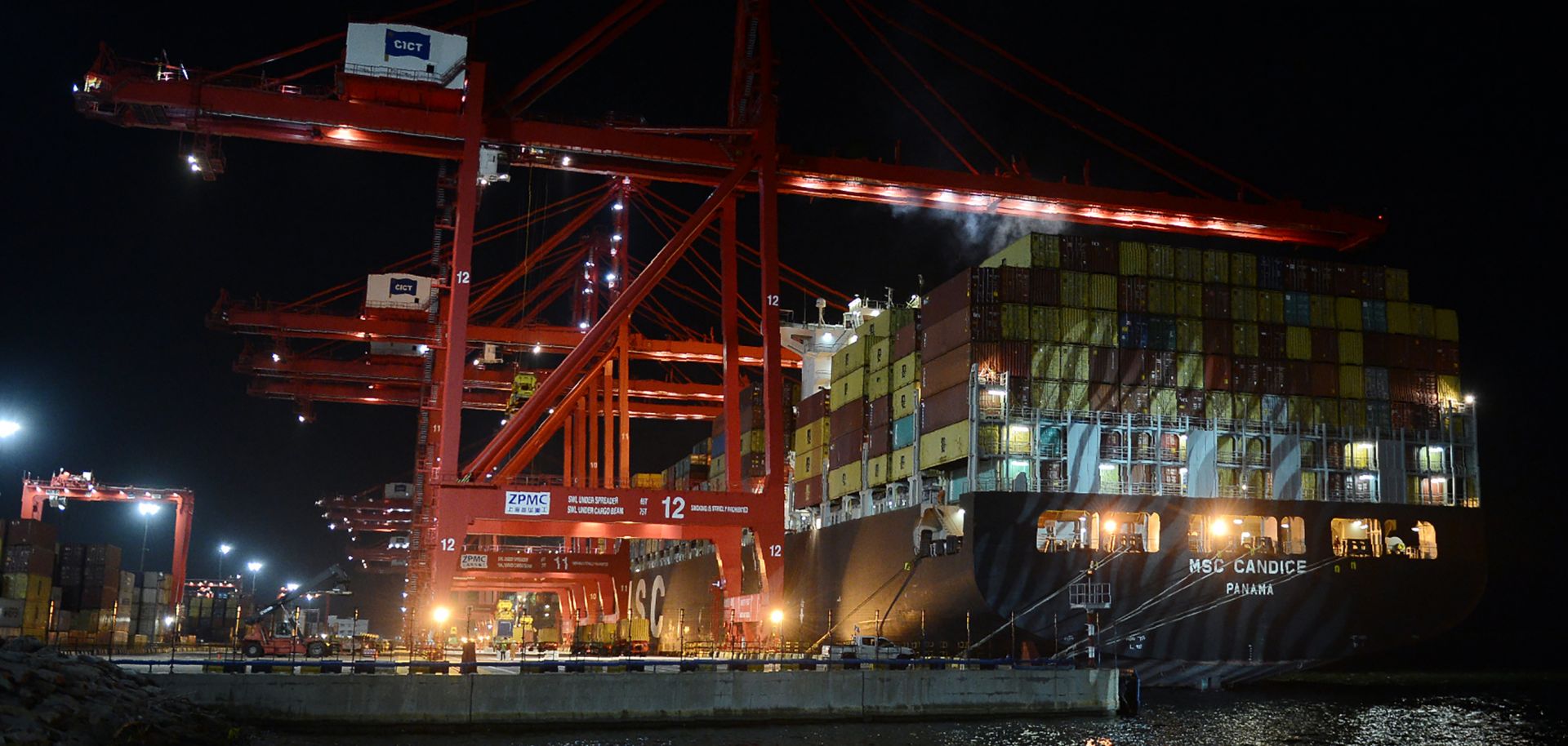
Workers at the Chinese majority-owned Colombo International Container Terminal (CICT) in Colombo load a cargo ship in this photograph from June 24, 2016. Sri Lanka's new president, Gotabaya Rajapaksa, will seek to maintain a delicate balance between the region's heavyweight powers.
A familiar name is taking the helm in Sri Lanka. On Nov. 16, Gotabaya Rajapaksa — a onetime defense minister under his brother, former President Mahinda Rajapaksa — scored 52 percent of the vote to defeat Sajith Premadasa and become the country's president. Gotabaya Rajapaksa surged to victory in part because he succeeded in channeling his credentials as a minister who helped end Sri Lanka's long-running civil war (committing war crimes in the process, according to allegations) to win the confidence of an electorate demanding security after an Islamic State-inspired group killed 290 people in terrorist attacks in April.
Economic grievances, however, were as much a factor in the minds of voters as national security. And as Sri Lanka's $89 billion economy lumbers through its latest downturn, the new president's administration will focus on reviving growth, raising per capita income and creating jobs, all while ensuring its growing debt burden remains manageable. As a developing country in a strategically significant location, Sri Lanka's needs for capital will create more opportunities for China and India to lavish funding on it. Whatever the case, Gotabaya Rajapaksa will need to strike a careful balance between Sri Lanka's powerful patrons to advance his country's infrastructural needs, even if his outreach to China rankles India, the dominant power in South Asia.
The Rajapaksas Return
Gotabaya Rajapaksa will serve as Sri Lanka's third president since the end of the country's civil war. As defense minister under his brother, he oversaw the military's 2009 victory against the Liberation Tigers of Tamil Eelam, an insurgent organization that waged an armed struggle for a quarter-century, seeking an independent homeland for Sri Lanka's Tamil minority in the north and east of the island. Both brothers, however, faced allegations of war crimes over the indiscriminate killings of thousands of mostly Tamil civilians as the conflict ground to an end. Gotabaya Rajapaksa, in fact, was bellicose on the subject during the campaign, declaring that his administration would not honor an agreement that Maithripala Sirisena, the man he replaced as president, signed with the United Nations to investigate the allegations. During the war, the United States criticized the Rajapaksas' human rights record, but another major power — China — did not. Beijing's stance put it in a position to benefit from Sri Lanka's push for reconstruction after the war, as Chinese companies won several major investment projects.
Clinching the presidency was a major victory for Rajapaksa's Sri Lanka Podujana Peramuna party — as was the fact that Prime Minister Ranil Wickremesinghe resigned after his party's presidential candidate failed. That paved the way for Gotabaya Rajapaksa to appoint none other than Mahinda Rajapaksa as prime minister. Still, the Rajapaksa brothers' party will not hold a majority in parliament, which is scheduled to hold its own elections next year, meaning there is no guarantee of harmony between the president and parliament.
Indeed, when Mahinda Rajapaksa was president in 2014, his health minister, Maithripala Sirisena, sprung a surprise challenge to his re-election wresting away the presidency in the January 2015 election. In parliamentary elections later that year, the opposition under Wickremesinghe forged a coalition with the president that put him in the prime minister's seat. Mounting tensions between the two reached a breaking point in October 2018, and Sirisena fired Wickremesinghe, replacing him with the leader he'd unseated in the first place — Mahinda Rajapaksa. The Supreme Court of Sri Lanka capped off the seven-week political crisis with a ruling that permitted Wickremesinghe to be reinstated.
Growing the Economy and Shrinking the Deficit
Political maneuverings aside, the new president's biggest domestic objective in the months ahead will center on reviving growth in Sri Lanka's services-driven economy, which is suffering its third dropoff in a decade. In 2009, the global financial crisis sent year-over-year growth tumbling. The economy rebounded over the next three years amid Sri Lanka's postwar reconstruction boom. A second downturn, however, hit in 2013 after the government took corrective measures to cool the overheating economy. The subsequent mild recovery failed to match the blazing growth of the postwar years as a third slowdown set in, in part due to the combination of a slowing global economy, a weakening rupee, investor uncertainty stemming from the political crisis and a drop in tourism following the Easter 2019 bombings.
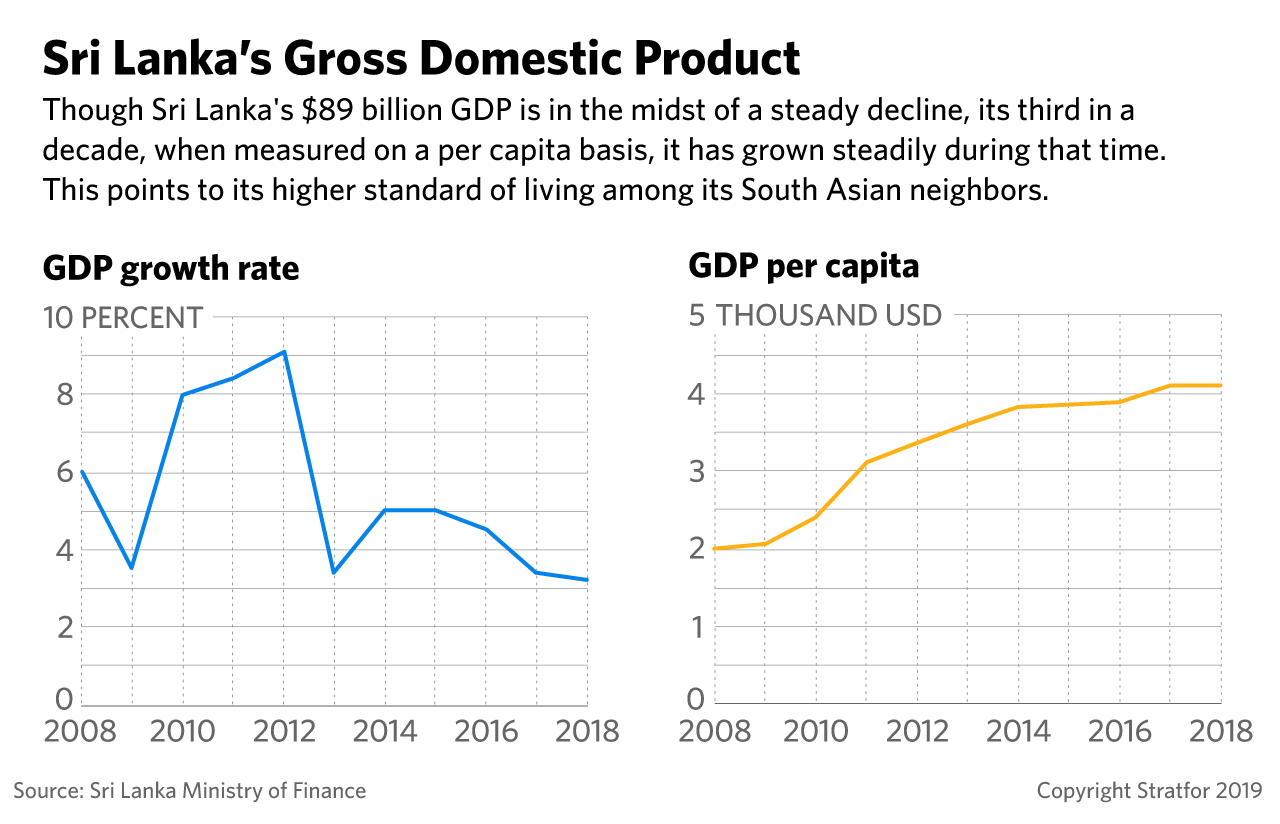
In turn, a cooling economy will affect Sri Lanka's tax revenues and impinge on some of the goals of its Vision 2025 plan to attain a gross domestic product income of at least $5,000 per capita within six years. Over the past decade, Sri Lanka's budget deficit — the difference between revenues and expenditures — vacillated before jumping up in 2015, the first year of Sirisena's presidential term. At that point, the government unveiled a fiscal consolidation strategy aimed at shrinking the deficit by boosting revenue instead of trimming expenses, most of which go toward non-discretionary bills like salaries, goods and services and, finally, interest — the single biggest government expense at 5.9 percent of GDP.
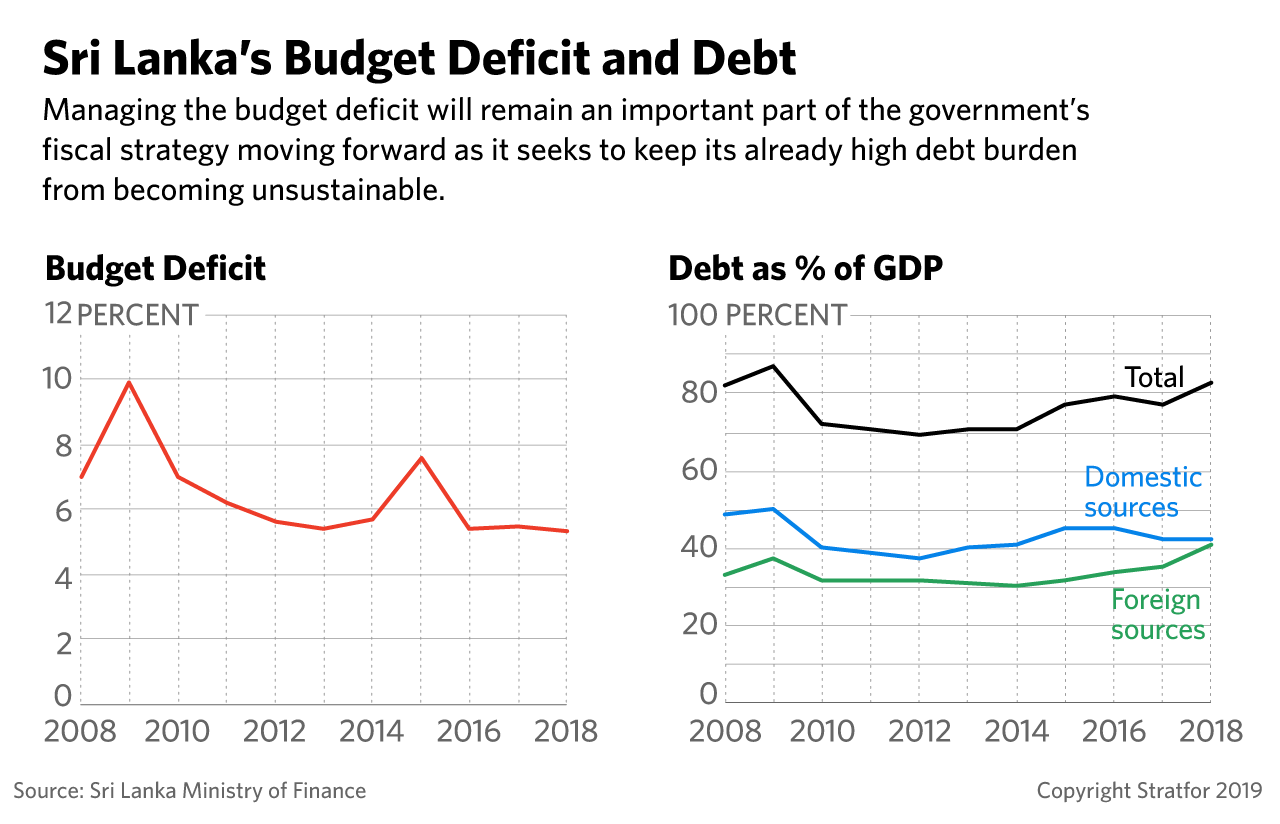
Because economic activity generates taxable income, a slowdown means less revenue for Colombo. This explains why tax revenue as a share of GDP fell from 12.4 percent in 2017 to 11.9 percent. The large share of non-discretionary spending also diverts government funding from investment in capital projects. This presents a challenge due to Colombo's official investment program for key development projects, which require an estimated $15 billion from 2018 through 2021, about half of which will go to infrastructure. Consequently, any funds Colombo cannot obtain from revenue will force it to borrow money from domestic and international sources. Ultimately, the growing share of foreign debt in the country's overall debt profile draws attention to the role of one country in particular: China.
Funding Development and Fueling Infrastructure
The need for capital in a developing economy such as Sri Lanka's has presented China with a golden opportunity to extend its largesse, raising concerns in neighboring India over its rival's growing influence in the strategically significant island nation. The share of foreign debt in Sri Lanka's overall debt profile has grown from 30 percent of GDP in 2014 to 41 percent in 2018. And though Colombo draws funding from a broad range of sources, including the World Bank, the Asian Development Bank and the United Nations, China has remained one of the top lenders funding construction in the postwar years. Last year, Beijing provided the single biggest source of bilateral development funding, disbursing $371.2 million. The outlay accounted for 46 percent of the official development assistance Sri Lanka received that year, exceeding that from the next six nations combined. (India, whose economy is nearly five times smaller than China's, provided $49.3 million to Sri Lanka.) To help meet Colombo's debt obligations, the China Development Bank also offered a $1 billion loan in 2018.
Sri Lanka's new government will thus focus on extracting the most favorable loan terms and investment deals, creating more opportunities for regional powers like India, China and Japan to deepen their involvement in the country. More worrying for India, however, is the prospect that the new administration will forge closer defense ties with China; for India, such a development would fuel its fears of Chinese encirclement, but for Gotabaya Rajapaksa, it would allow Sri Lanka to achieve a greater balance in foreign policy to offset India's domineering presence in South Asia.
'Creditor Imperialism'
Given Sri Lanka's proximity to major Indian Ocean shipping routes, ports are among the island's most valuable infrastructural assets. Over the past decade, the amount of cargo handled by the Port of Colombo, the busiest of the country's five ports, has doubled from 49 million metric tons in 2009 to 100 million metric tons last year, fueled in part by the performance of the Chinese-funded Colombo International Container Terminal. That hub, which began operations in 2013 as part of the port complex, handled just 745,000 metric tons of cargo at its debut, but that number skyrocketed to 34 million in 2018. At present, Japan and India are cooperating with the Sri Lanka Ports Authority to build the deep-sea East Container Terminal in the Port of Colombo.
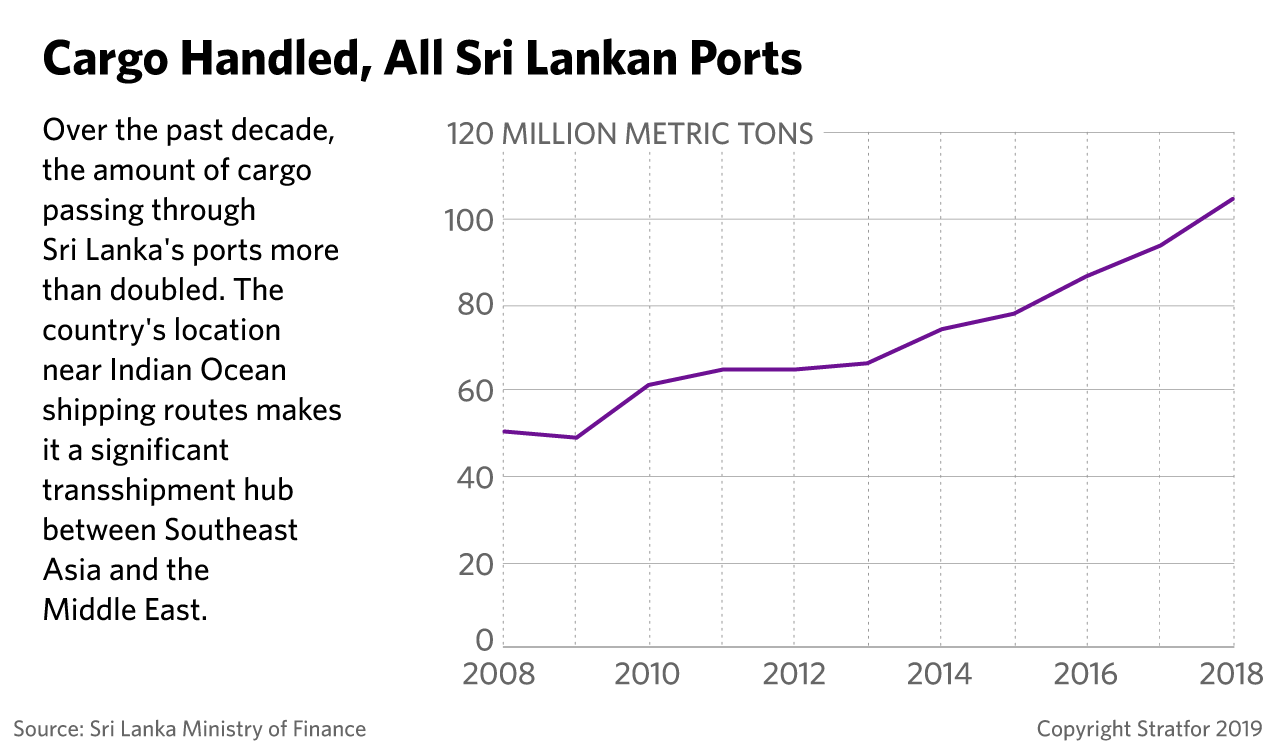
Still, not all of the country's Chinese-funded ports have experienced such phenomenal growth. The Magam Ruhunupura Mahinda Rajapaksa Port — more commonly known as the Hambantota port — has come to symbolize the risks of smaller countries financing infrastructure projects under Chinese debt. The port, which commenced operations in 2011, accounted for less than 1 percent of the country's total cargo traffic last year. Underwhelming revenues forced Sirisena's government to grant the China Merchants Port Holdings a 99-year lease for the port in 2017 in exchange for debt relief. Unsurprisingly, critics of China's lending practices have derided its appropriation of strategic assets in other countries as "creditor imperialism." And China isn't just the only foreign power involved in Hambantota; earlier this year, India's Accord Group partnered with Oman's Oil Ministry to construct a $3.85 billion refinery at the port. Then, on Nov. 14, Sri Lanka's Board of Investment approved a $24 billion foreign direct investment proposal — the largest in the country's history — by Singapore-based Sugih International to build another oil refinery.
The Way Ahead
Being a developing country in a strategic location, Sri Lanka has long drawn lavish funding from regional powers. Even so, Sri Lanka is still nursing the wounds of a civil war that left up to 100,000 dead, highlighting the challenges facing a country after the Easter bombings shook the delicate ethnic balance between the majority Sinhala Buddhists and minority populations, sparking concerns of rising anti-Muslim sentiment. For many in the country's Tamil minority, the ascendency of another Rajapaksa to power is a worrying development, even as the president called for unity following his victory. But however Gotabaya Rajapaksa navigates the tricky landscape of Sri Lanka's ethnic politics, much of his administration's energy will be devoted to improving Sri Lanka's economy while maintaining a delicate balance between some of Asia's bigger powers.
