
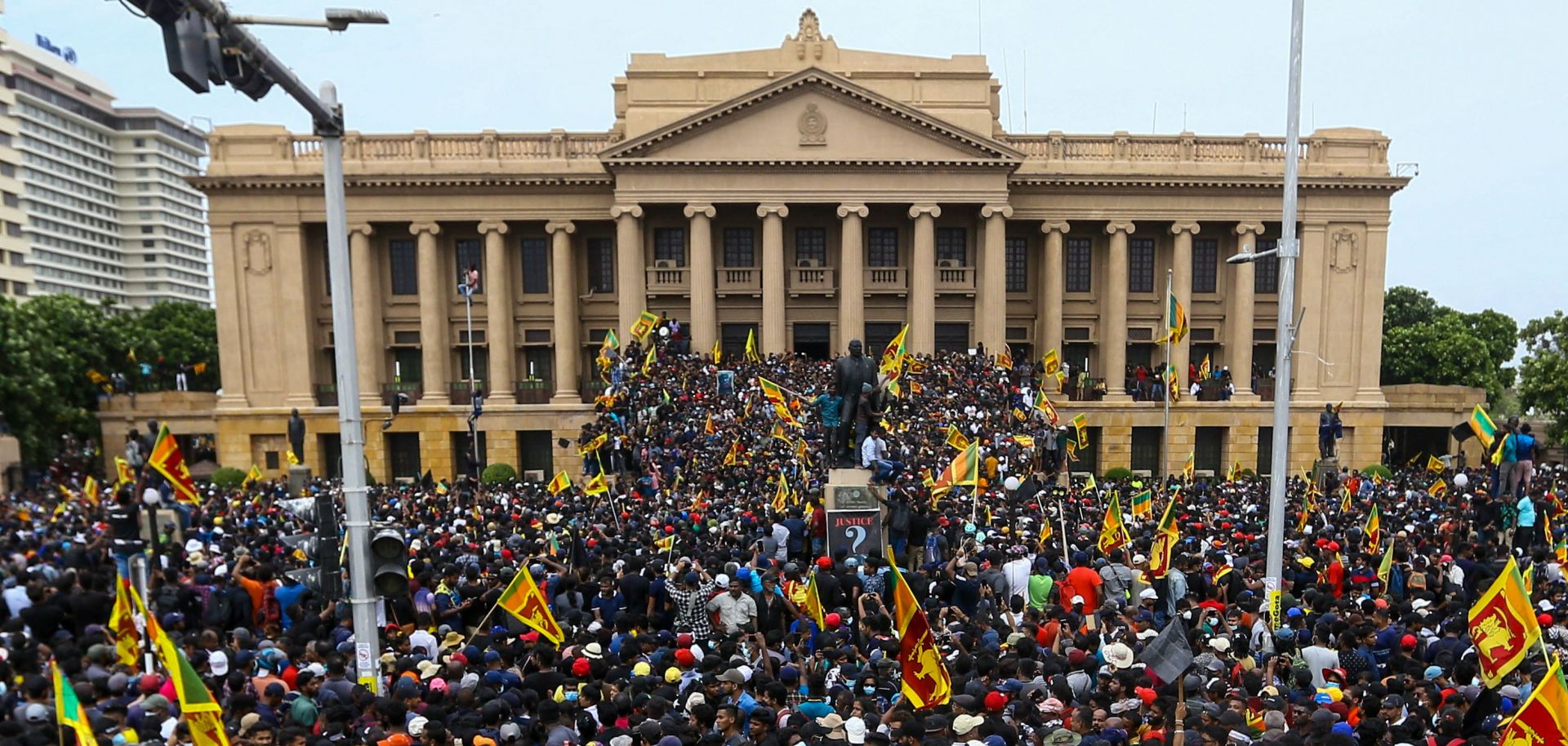
Anti-government protesters gather outside the presidential palace in Colombo, Sri Lanka, on July 9, 2022.
The appointment of a national unity government could temporarily appease protests in Sri Lanka, but the country’s massive economic challenges and the likely imposition of austerity measures could spur new bouts of unrest in the coming months. Sri Lankan President Gotabaya Rajapaksa and Prime Minister Ranil Wickremesinghe have both signaled they will resign in the coming days, bowing to pressure from large protests in Colombo that recently damaged both leaders’ homes. In the coming weeks, most parties in the Sri Lankan parliament will likely come together to appoint a new national unity government. That government, however, will face the herculean task of imposing the reforms needed to mitigate the country’s deteriorating economic situation without driving more angry and cash-strapped Sri Lankans to take to the streets.
- On July 9, protesters broke into the president's official residence and set fire to the prime minister’s residence, as thousands gathered in Colombo to demand the resignation of both leaders. A month earlier, a mob of anti-government protesters set fire to the Rajapaksa family's ancestral house, which was situated among the homes of dozens of other pro-Rajapaksa legislators.
- On July 11, the speaker of Sri Lanka’s parliament announced the president had decided to resign. Two days later, the prime minister announced his own plans to step down.
The resignations come after months of protests driven by skyrocketing inflation and widespread shortages of essential goods. The South Asian country is currently in the throes of the worst economic crisis in its modern history, which has seen thousands of Sri Lankans protest against their government since April amid widespread shortages of food, fuel, medicines and power. In mid-May, Sri Lanka announced a preemptive default on its foreign debt, deepening the country’s struggles in accessing foreign exchange reserves to purchase imports of fuel, medicines, fuel and cooking gas. Power and gas shortages in Sri Lanka then became more acute in June after a credit line from India for fuel ran out. Without cash to pay for imported fuel, Prime Minister Wickremesing’s new government was forced to close schools and public offices for two weeks starting June 20. Sri Lankans, meanwhile, have had to wait in lines that extend several miles to purchase staple goods like car fuel and cooking gas.
- Sri Lanka’s government introduced significant tax cuts in 2019 and early 2020, which severely reduced state revenue in a country where tax evasion is already widespread.
- Sri Lanka’s fiscal deficit reached 12.1% of GDP in 2020 amid increased government spending to cope with the COVID-19 pandemic. The country’s debt-to-GDP ratio rose from 86.9% to 105.6% between 2019 and 2021 as Colombo increasingly resorted to debt to pay for its policies. Throughout this time, Sri Lanka also kept a constant balance of trade deficit, which then depleted its foreign currency reserves. These twin fiscal and current account deficits, coupled with global rises in energy and food prices, forced Sri Lanka to default on its foreign debt in May.
- India, which has provided a credit line for fuel imports, has reportedly asked for advance payments from Sri Lanka to continue the assistance.
This growing economic instability and the government’s perceived failure to address it set the stage for the violent unrest on July 9 that ultimately prompted Sri Lanka’s president to put in his resignation. Sri Lankans have largely blamed their country’s deepening economic crisis on the corrupt leadership and poor policy decisions of the powerful Rajapaksa family. President Gotabaya Rajapaksa’s brother, Mahinda Rajapaksa, was prime minister until he stepped down in the wake of the May 9 rallies that saw the family’s ancestral home set ablaze by protesters. On May 12, President Rajapaksa appointed a new government led by Prime Minister Wickremesinghe, a seasoned politician who has advocated for curtailing the president's powers in the country. Given Wickremesinghe’s background, Rajapaksa hoped the change in leadership would reduce tensions. But the shake-up did little to appease demonstrators’ concerns about the Rajapaksa family’s unchecked political influence, as Wickremesinghe’s government still relied on support from the Rajapaksa-led Sri Lanka Podujana Peramuna (SLPP) party, which has a majority in the parliament. President Rajapaksa has largely avoided making public appearances and participating in parliament since the protests took a violent turn in May and began threatening the safety of his family. But despite the escalating unrest, he refused calls to step down and insisted on finishing his term in 2024. However, the direct targeting of his residence in Colombo by thousands of protestors on July 9 seemed to have finally changed his mind.
The Rajapaksas’ exit from power and the likely appointment of a consensus government could briefly restore some order by enabling Colombo to focus on the country’s economic woes, including by resuming debt restructuring talks with the International Monetary Fund (IMF). In the coming weeks, the Sri Lankan parliament is expected to appoint a national unity government including most parties in parliament whose main goal will be to stabilize the political, social and economic situation. One of the government’s priorities will be to conclude negotiations with the IMF over financial assistance. The new government will also likely resume its push to obtain financial assistance for essential imports from countries like India and seek discounted oil from Russia. Meanwhile, the governor of Sri Lanka’s central bank will likely remain at his post throughout the political transition to ensure institutional continuity. A more stable social and political situation would reduce the risk of disruptions in Sri Lanka’s crucial textile industry. It would also aid the country’s tourism sector, which provides a significant source of foreign currency.
However, internal divisions within the new government and the need to impose unpopular economic reforms will risk returning Sri Lanka back to chaos. An early general election is unlikely in the short term, as the government will first seek to stabilize the economy. But given the diversity of its member parties, the governing coalition will likely also be fragile and plagued with internal disagreements. The unity government is thus unlikely to survive to the end of its term in 2025, raising the specter of early elections in the medium-to-long term that could slow the pace of crucial economic reforms. Protesters’ anger with their government has so far been largely directed at the Rajapksas. The family’s exit from power with the president’s imminent resignation could thus calm things down in Sri Lanka, at least temporarily. However, to make the country’s budget more sustainable, many of the policy recommendations from Colombo’s resumed talks with the IMF will likely include controversial measures like spending cuts and tax hikes — opening the door for new waves of social unrest, as well as new phases of deep political instability, in the coming months. Lawmakers seen as Rajapaksa loyalists (namely those from the SLPP, which holds two-thirds of the seats in parliament) could still be included in the new government as well, which would raise the risk of fueling more unrest and political infighting.
- A technical team from the IMF visited Sri Lanka in June. A deal was originally expected by the end of August. In exchange for financial assistance, the IMF is asking Sri Lanka to reduce its fiscal deficit, contain inflation, reduce its balance of payments deficit, and reform the tax system to increase state revenue and reduce tax evasion. The IMF is also asking for institutional reforms to reduce corruption and improve the business climate.
