
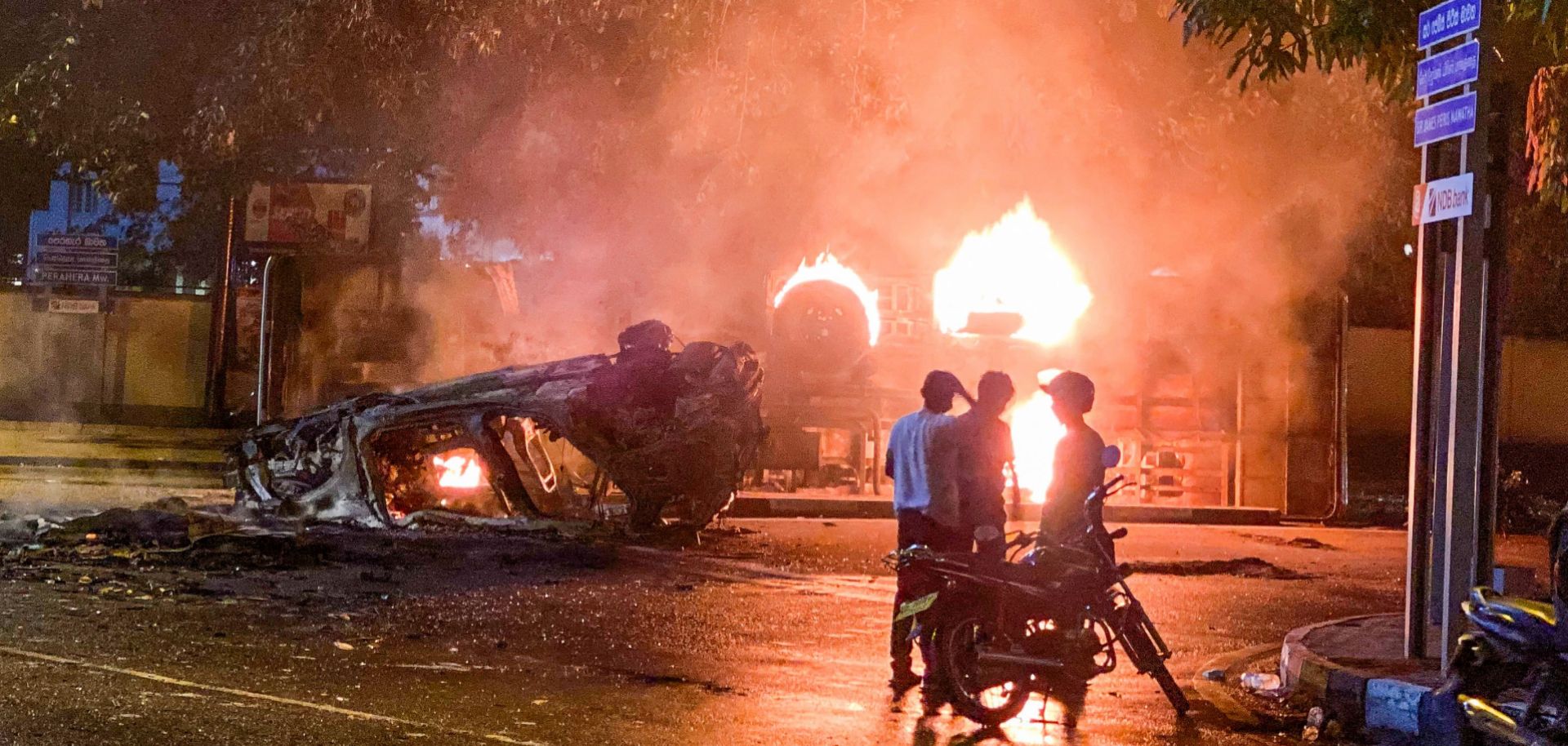
Flames engulf a vehicle belonging to the security personnel and a bus near outgoing Prime Minister Mahinda Rajapaksa's official residence in Colombo, Sri Lanka, May 9, 2022.
Momentum garnered by the prime minister's forced resignation — combined with increasingly violent clashes with police, military and pro-government supporters — will likely see the mass protests against Sri Lankan President Gotabaya Rajapaksa intensify in the coming days, opening the door to multiple outcomes with social and political implications for the South Asian country. On May 9, the popular movement against the Sri Lankan government (and, in particular, President Rajapaksa) took a significantly violent turn. Pro- and anti-government groups clashed on the streets of Colombo while an anti-government mob set ablaze the Rajapaksa family's ancestral house, which was situated among the homes of dozens of other pro-Rajapaksa legislators. The events marked the bloodiest day of political unrest in the country since the current wave of demonstrations against the Sri Lankan government began four weeks ago.
- While the government imposed a national curfew on May 9, several hundred protesters continued to gather on the streets of Colombo demanding Rajapaksa's resignation. To contain the unrest, the government deployed the military to the capital city, and also handed over emergency powers to both the army and police that allow them to shoot on sight, detain persons without a warrant and search private property.
- The president's brother, Prime Minister Mahinda Rajapaksa, tendered his resignation in an attempt to appease protesters on May 9. He and his family have reportedly since fled their house in Colombo and are now seeking refuge in a naval base in Trincomalee, where people gathered to protest on May 10.
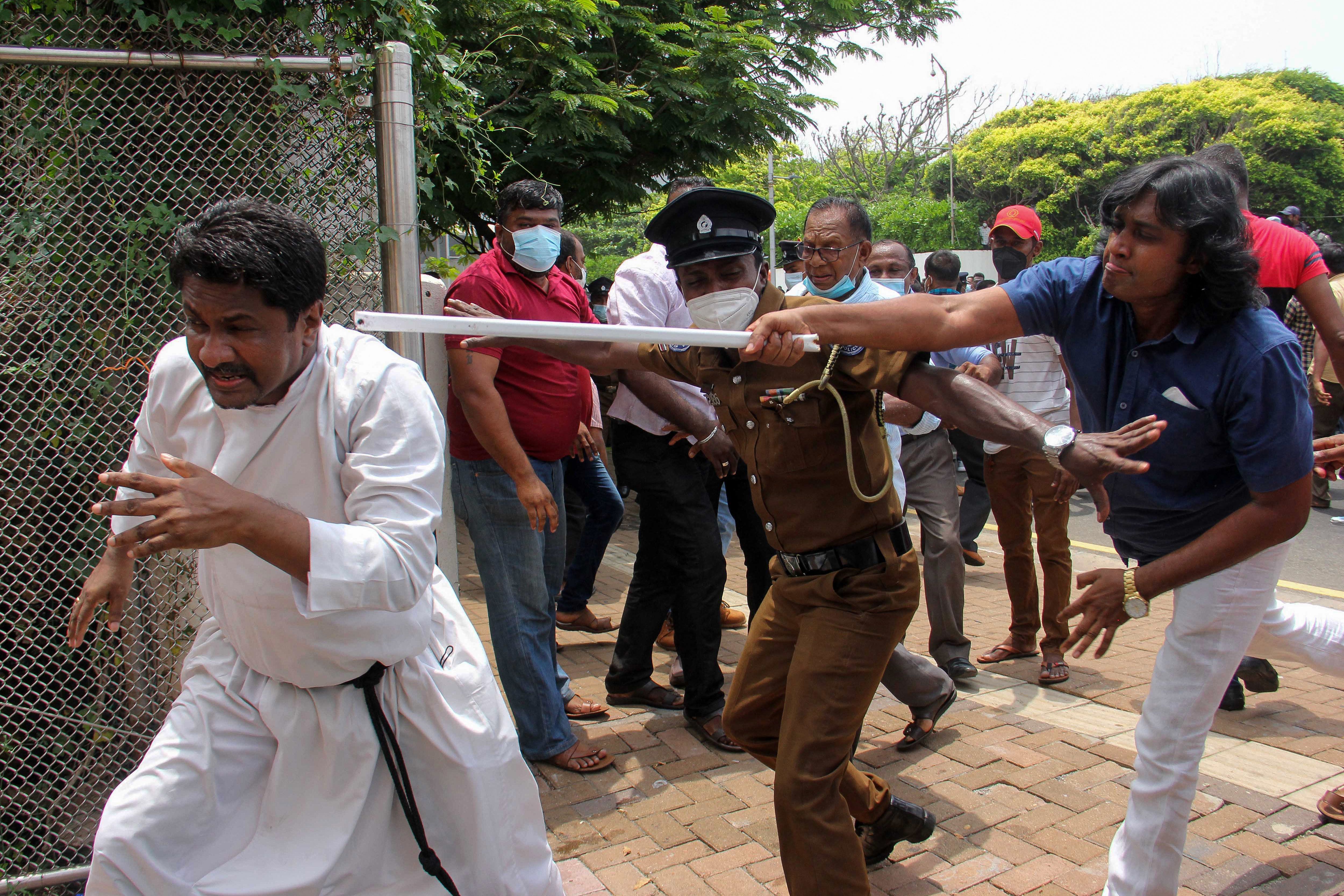
Demonstrators and government supporters clash outside the president's office in Colombo, Sri Lanka, on May 9, 2022. (AFP via Getty Images)
What to Watch for
In the short-to-medium term, Sri Lanka's economic crisis will persist regardless of what happens to the country's current government amid the unrest. The import-dependent country's foreign low reserves have left Colombo unable to purchase essential imports of fuel and food items, which has already led to widespread shortages in Sri Lanka and will likely eventually force the government to default on its foreign debt.
With Sri Lanka's political establishment fractured amid the turmoil, and with the country's military and the police now armed with sweeping powers to suppress the protest movement, there are several ways the ongoing crisis could take shape:
1) The president remains in office.
This scenario, which is currently the most likely, would see President Rajapaksa refuse to resign despite growing protests, raising the risk of violence and widespread unrest. So far, Gotabaya Rajapaksa has not shown any signs he intends to take his brother's lead and resign, and has instead continued to urge opposition parties to form a consensus government under his presidency. Such a government would be in charge of introducing constitutional changes and weakening the president's powers to pacify the protestors and the political opposition. However, his position is becoming increasingly fragile amid the escalating protests. As evidenced by the recent burning of houses associated with the Rajapaksa family, the escalation of protest activity and the growing scope of demonstrators' targets will further drive political leaders away from the president. Rajapaksa's refusal to resign and the use of police and military force to clamp down on protesters will further enrage the anti-government camp. While the government said it will withdraw the military's extraordinary powers in the coming days, it could use the ongoing violence as a justification to extend them or even impose martial law. Anti-government protesters have already defied the curfew in some parts of the country, and the continuation of the status quo could result in the destruction of public property by protesters, as well as in large-scale arrests and potential human rights violations by authorities. Alternatively, the president could ask lawmakers to approve the dissolution of parliament in order to hold an early general election. But even if parliamentarians agree to this, it would mean that President Rajapaksa would remain in office, which would prolong the social unrest.
2) The president resigns.
A less likely but still possible scenario in which Rajapaksa resigns would probably result in a reduction of protests and the formation of a caretaker government that seeks to stabilize the economy. Under pressure from the public and several opposition parties, Rajapaksa could step down. This would open the door to the formation of a caretaker government composed of most of the country's political parties. This government's primary goal would be stabilizing the Sri Lankan economy by, for example, holding negotiations with the International Monetary Fund for a bailout package, along with debt restructuring talks with international bondholders and potential financial assistance discussions with bilateral partners like India and China. This would probably end anti-government protests and related violence. The new government would also have to decide between staying in power to focus on economic reforms or holding an early general election to further decompress the political and social situation. Even if the overall social climate would improve in this scenario, sporadic protests will remain likely due to Sri Lanka's continued economic fragility.
- The main opposition party, Samagi Jana Balwegaya, submitted a no-confidence motion against the president and the prime minister on May 3. While the Sri Lankan parliament could discuss the issue during sessions starting on May 17, the process to impeach Gotabaya Rajapaksa would be complex and include a lengthy investigation into the opposition's accusations against him, reducing the efficiency of this tool as a way to oust the president and thereby defuse the political crisis.
3) The military deposes the president.
There is also a chance, while slim, that the military could use its emergency powers to forcefully oust President Rajapaksa if the situation becomes particularly untenable. This scenario remains unlikely, as there have been no successful coups in Sri Lanka's history nor evidence of the country's military ever attempting to seize power. Possible loyalties within Sri Lanka's military establishment for President Rajapaksa — who previously served as the country's defense secretary and, before that, a military officer — may further reduce the probability of such a takeover. But if social unrest escalates, violence becomes widespread and shows no signs of abating — and if Rajapaksa and the opposition fail to reach a deal to unblock the political situation — the military could resort to using its emergency powers to depose the president in the hopes of restoring some sense of stability. After that, the military could stay in power for an indefinite period or, more likely, stabilize the country and organize a general election within a few months. The president's forceful deposition would deepen the constitutional crisis in Sri Lanka and create a significant precedent for future crises in Sri Lanka. A military takeover of the government could also temporarily lead to suppression of freedom of movement and expression. This scenario would impede Sri Lanka's ongoing negotiations with the International Monetary Fund and other bilateral partners, as the new government would struggle to obtain recognition from most of the international community, at least initially.
