
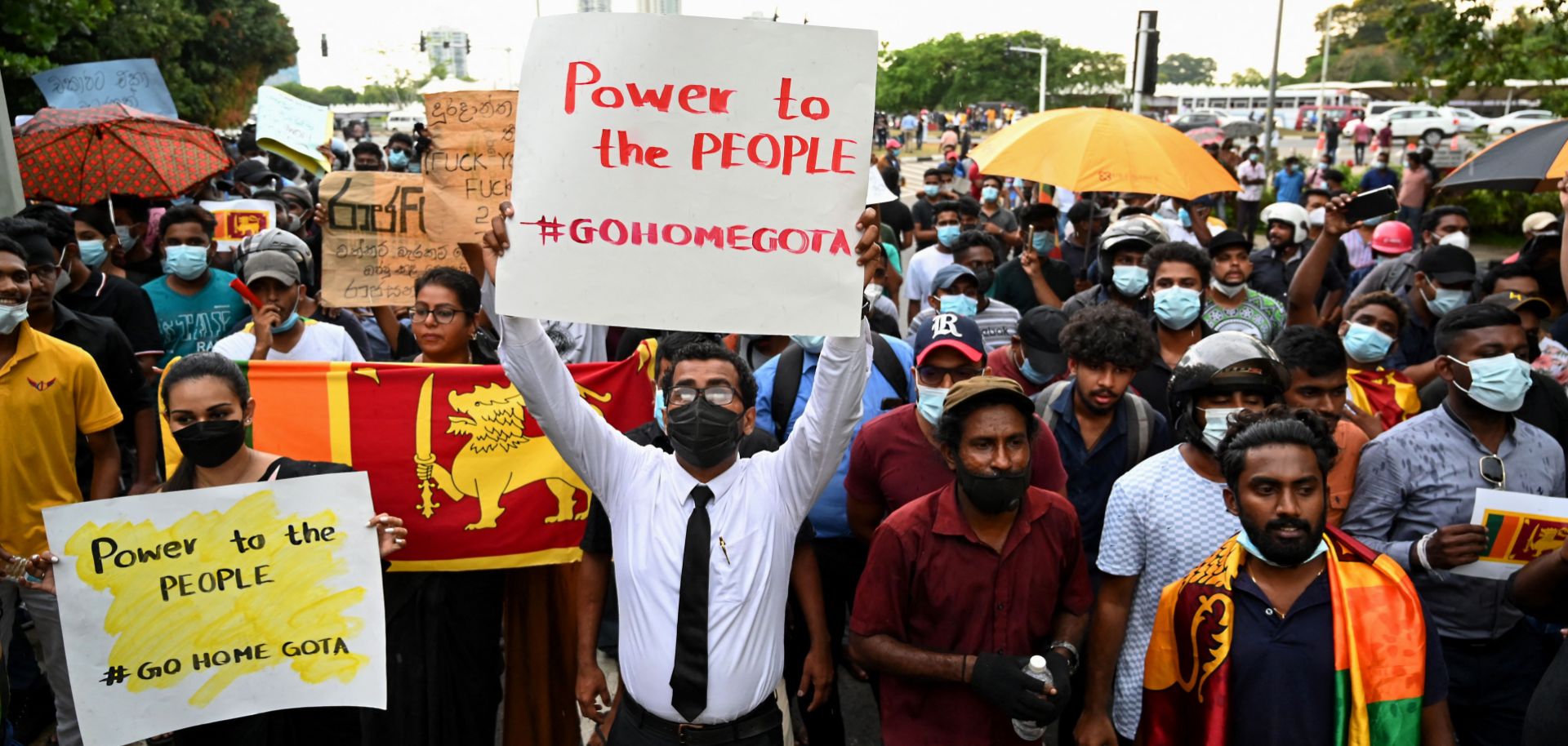
People hold up posters calling for the resignation of Sri Lankan President Gotabaya Rajapaksa with the hashtag ''#GoHomeGota'' at an anti-government protest in Colombo on April 5, 2022.
The mass protests spurred by Sri Lanka's deepening economic crisis may provide a catalyst for political change, but the country's long-term financial outlook remains grim — portending more unrest as basic goods and services become increasingly scarce. Social unrest driven by the severe economic crisis in Sri Lanka has morphed into a popular movement demanding political change in the country. In recent days, thousands have protested against the government amid widespread shortages of food, fuel, medicines and power. A combination of economic mismanagement and protracted negotiations with the International Monetary Fund (IMF) over a bailout package has exacerbated tensions between Sri Lankans and their political leaders in Colombo. Against this backdrop, calls for the resignation of President Gotabaya Rajapaksa and Prime Minister Mahinda Rajapaksa have grown as the public blames their authoritarian style of leadership for the country's woes.
- Sri Lanka has almost $7 billion in sovereign debt due in 2022, with a $1 billion payment due in July. On April 12, the government announced a default on foreign debt that led to a further decline of its credit ratings by international credit rating agencies.
- Sri Lanka's foreign currency reserves fell to $1.93 billion in March, a 16% decrease from $2.3 billion in February. Meanwhile, inflation reached 16% in March, the highest in South Asia.
- In March, the central bank devalued the Sri Lankan rupee and pegged the currency to 230 rupees per U.S. dollar. The dollar, however, had already been trading at higher rates on the black market in Sri Lanka prior to the official devaluation. Since the central bank's announcement, the value of the Sri Lankan rupee against the dollar has dropped another 60-70%, compounding already high inflation in the country.
- Shortages of imported fuel and insufficient water reserves for hydroelectricity generation have forced Sri Lankan officials to issue hours-long daily power cuts across the country. The crisis has also forced citizens nationwide to stand in line for cooking gas and fuel supplies.
- Large-scale protests demanding the president's resignation have been attracting more everyday citizens since the demonstrations began on April 9. While most of the rallies have been peaceful, one protester died at a demonstration held on April 13 after police opened fire on a crowd.
The economic crisis has renewed calls to reform Sri Lanka's rigid political system and limit the president's vast powers. Protesters are demanding changes to Sri Lanka's rigid semi-presidential system, which makes it very difficult to impeach a president and hold him accountable through judicial or legislative means. During his 2019 campaign, President Gotabaya Rajapksa promised to reform Sri Lanka's political system. But shortly after taking office, he promoted a constitutional reform in July 2020 that actually consolidated the president's powers. As social discontent increased, opposition parties and some former government loyalists started to call for the establishment of a new consensus government where the president would hold far less power.
- President Rajapaksa and his brother, Prime Minister Mahinda Rajapaksa, have been the central figures of Sri Lankan politics for decades. Both have held multiple executive and legislative positions since the 1970s.
- The 2020 constitutional amendment reduced the checks on the president by diluting the independence of the judiciary, legislature and various commissions. It also gave additional powers to the president vis-a-vis the prime minister and the cabinet.
While the government is likely to accept moderate political reforms, it may not be enough to appease Sri Lankans' growing discontent and demands for sweeping change. This could result in prolonged social unrest and an increased risk of widespread violence. The Rajapaksa brothers have so far resisted calls for resignation and promised to work with all political parties to resolve Sri Lanka's political and economic crises. However, many lawmakers supporting the government have either left the coalition or joined the opposition's demands for the resignation of at least the prime minister. In addition, some major opposition parties are working to introduce a no-confidence motion against the prime minister. In order to remain in power, President Rajapaksa has accepted some constitutional changes, which parliament must now debate and vote on. The president may also agree to dismiss his brother as prime minister and form a coalition government that includes members of the opposition. This scenario, however, is unlikely to pacify protesters, who will continue to demand President Rajapaksa step down as well. In a less likely scenario, both brothers may resign from their respective leadership posts, which could temporarily appease protesters and reduce social unrest. But so far, neither the president nor prime minister has signaled any intention to resign. Finally, in a low probability but high-risk scenario, President Rajapaksa could refuse to implement stricter checks on his authority and try to squash the growing protest movement via security crackdowns conducted by the police or military. The use of such force against protesters would increase the risk of violent clashes across the country by only fueling Sri Lankans' anger with their government.
- All 26 ministers in the Sri Lankan government's cabinet (aside from the president and prime minister), along with the governor of the country's central bank, announced their resignations on April 4. The following day, 41 lawmakers then left the ruling coalition to serve as independent members of parliament, causing the government to lose its legislative majority. In response to the mass exodus, President Rajapaksa called on opposition parties to form a unity government and take ministerial posts, which the opposition promptly rejected.
- President Rajapaksa appointed a new cabinet on April 18, which approved a new constitutional amendment on April 25 that reportedly dilutes some presidential powers taken from two previous constitutional amendments outlining the powers of the president and the checks on his or her authority.
Even if the current crisis brings about constitutional amendments, Sri Lanka will struggle to implement reforms to stabilize its economy. High inflation and continued power outages due to fuel and food shortages will likely result in an overall slowdown of economic activity and growth in the short-to-medium term. It could take months for Sri Lanka's ongoing negotiations with the IMF to yield actual financial aid. To fill the financing gap in the meantime, the government will thus need to reach out to countries like India and China, as well as other multilateral institutions, in the hopes of securing more immediate relief. While an IMF bailout program could eventually help improve investor confidence in Sri Lanka, the austerity measures and structural reforms that Colombo would need to implement as part of any such program would initially further constrain the country's economic growth.
- Sri Lanka is reportedly seeking $4 billion in bridge financing to hold it over until it reaches a deal with the IMF. Colombo is negotiating new potential credit lines from India and China, underscoring the strategic rivalry between Beijing and New Delhi for influence in the Indian Ocean country. In exchange for its financial assistance, India will likely request concessions or future economic deals. China, for its part, will likely provide loans and push Sri Lanka to finalize the free trade agreement negotiations, which have progressed slowly since they began in 2015.
- As part of initial talks with the IMF that began on April 18, Sri Lanka will soon begin holding debt restructuring negotiations with its creditors, the majority of whom are international bondholders.
