
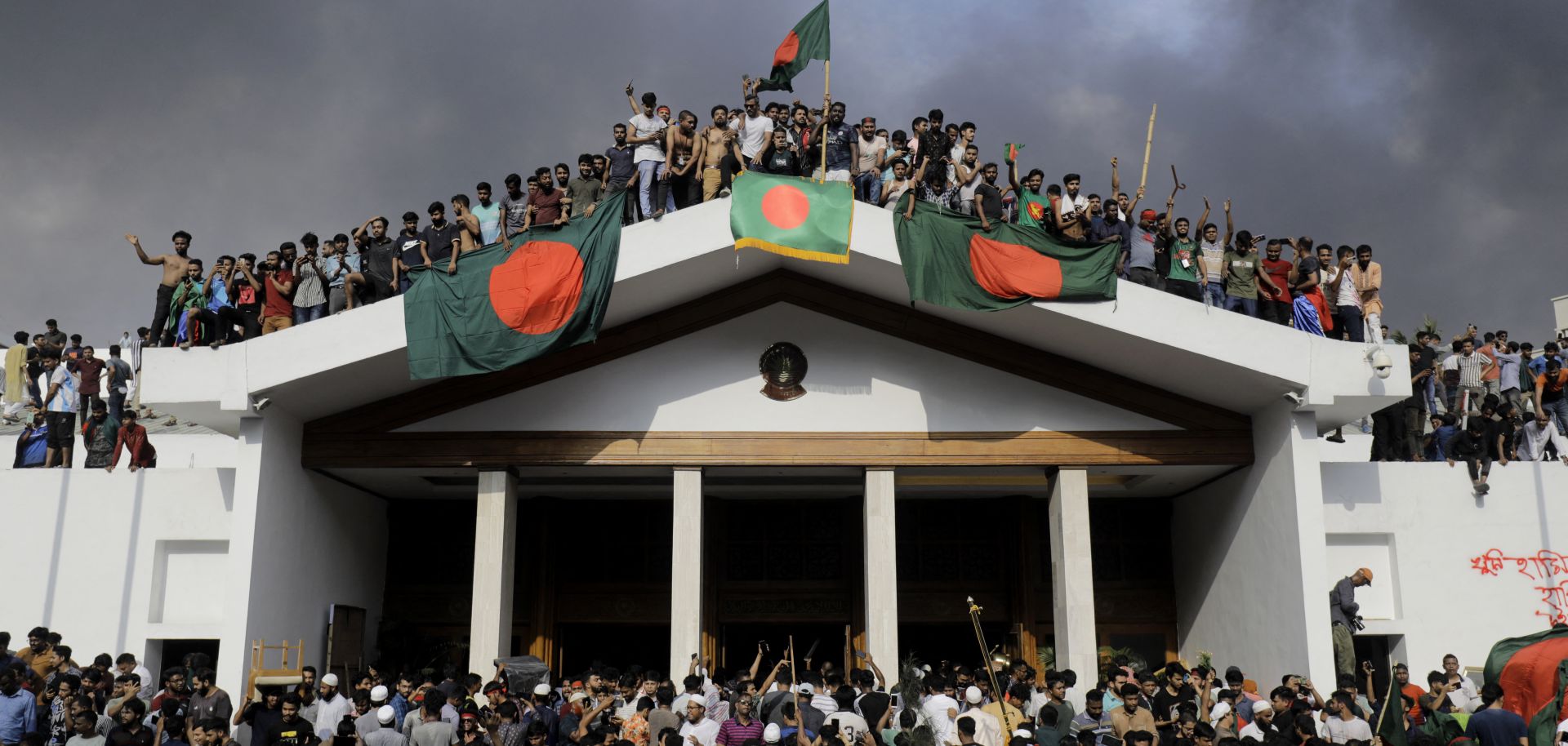
In Bangladesh, Prime Minister Sheikh Hasina's decision to resign and flee the country sets the stage for an uncertain interim government that will have to contend with a high risk of social unrest and economic challenges, both of which could hamper the country's crucial ready-made garment industry. On Aug. 5, Bangladesh's Army Chief General Waker-uz-Zaman announced that Hasina had resigned after weeks of mass anti-government protests, which were met with severe crackdowns by security forces and led to over 200 deaths. The unrest directed at Hasina and her ruling Awami League (AL) party reached a peak when thousands of anti-government protesters defied a nationwide curfew and stormed the Ganabhaban, Hasina's official residence. Local media reports indicate Hasina escaped moments before protesters stormed the building, and subsequently boarded a military helicopter to flee to India, where she is reportedly awaiting the United Kingdom to grant her asylum. Following Hasina's resignation, General Waker-uz-Zaman announced he would consult President Mohammed Shahabuddin and key opposition parties — including the main opposition Bangladesh Nationalist Party (BNP), Jatiya Party and the recently-banned Jamaat-e-Islami (JI) party — on forming an interim government.
- Student protests began in early July after a ruling by Bangladesh's top court reinstated a controversial quota system originally abolished in 2018, in response to a petition from relatives of war veterans, which reserved 30% of government jobs for family members of veterans who fought in Bangladesh's 1971 War of Independence. The quota also reserved jobs for minorities, disabled people and women, though protesters were mainly angry about the special benefits for war veterans who are seen as politically close to Hasina's AL-led government. Despite authorities simultaneously violently cracking down on unrest and eventually reducing the job quota for descendants of veterans from 30% to 5%, these actions failed to quell protesters' anger and the demonstrations eventually escalated into a broader anti-government movement.
- Under Bangladesh's anti-terrorism law, the government on Aug. 1 banned the opposition JI, an ally of the BNP, and JI's student wing, both of which authorities have blamed for the recent violent unrest.
- As the daughter of Sheikh Mujibur Rahman, the founder of Bangladesh, Hasina hails from an extremely influential family and had been in office since January 2009 before she resigned, making her one of Bangladesh's longest-serving leaders (Hasina also previously served as prime minister from 1996-2001). Her leadership has been marked by substantial economic growth and development initiatives, including major infrastructure projects. However, her tenure has also been controversial, with frequent allegations of authoritarianism, crackdowns on political dissent, and human rights abuses.
While the interim government will likely oversee new elections in the coming months, it remains unclear how such an administration will be formed, who will lead it, and especially how much influence the military will have over it. General Waker-uz-Zaman and President Shahabuddin are reportedly in discussions with Bangladesh's main opposition parties — not the ruling AL itself — to form the interim government, though it is unclear precisely how this process will take shape and if Waker or another military leader will head the caretaker government. Bangladesh's military has a long history of intervening in politics, including through a series of coups (with the most recent successful one taking place in 2007 and a thwarted one in 2011). But in recent years, the military has played a more supportive role to the government without directly assuming political power. While the military has reasons to avoid taking control of day-to-day governance (to avoid popular backlash at home and criticism abroad), the impending formation of the interim government may provide it a platform to play a more overt role in ensuring the caretaker administration restores order. Although the details are still unknown, Hasina's sudden exit from the country also suggests she may have faced pressure from the military to step down, which if true would suggest a willingness among at least some military leaders to play a more active role in Bangladeshi politics.
- According to Bangladesh's constitution, the president is responsible for appointing a new prime minister if the country's current prime minister resigns. If a new prime minister is not appointed, an interim government must be established, and general elections must be held within 90 days after the prime minister's resignation. However, given the current deviation from the constitutional process, there has been no confirmation of a timeline for the elections.
- Despite the military's involvement in last month's crackdown on protesters, there have been reports of discomfort within the ranks. On Aug. 4, Army Chief Gen. Waker-uz-Zaman convened a meeting with senior officers, which was seen as an effort to address these concerns. Following the meeting, the army stated that the chief had reaffirmed the military's commitment to standing by the people and serving the state's needs.
In the coming days, the risk of protests will remain high, threatening safety, transit and supply chain disruptions. But even with a new government, Bangladesh is still poised to face continued economic turmoil in the coming weeks and months that drives social unrest and harms the country's export-dependent economy. While Hasina's resignation may calm anti-government protesters, the risk of continued unrest remains high due to the potential for clashes between those protesters and supporters of Hasina's AL party, as well as security forces as authorities try to restore calm. While unrest is possible across the country, it will be highest in the capital Dhaka and major cities like Chittagong, the site of Bangladesh's largest port. Meanwhile, the indefinite curfew and previous designation of Aug. 5-7 as public holidays — in addition to other potential restrictions authorities may impose to stem additional violence — will disrupt travel and business continuity. While the restoration of internet access (which had previously been cut to try to disrupt the anti-government protests) will improve the operating environment for businesses, ongoing unrest risks continued curfews and other disruptions to transit. This will worsen the outlook for Bangladesh's already sluggish economy, especially for the country's crucial ready-made garment sector, which has struggled to fulfill foreign orders due to curfews, internet shutdowns and factory closures. More broadly, whatever interim government may take shape in the coming days will face the same economic challenges that confronted Hasina's government. In particular, the International Monetary Fund (IMF) forecasts that Bangladesh's foreign exchange reserves will decline from $24.8 billion today to $19 billion in 2025. Fewer foreign reserves may increase pressure on the local currency, the taka, potentially leading to its devaluation, thereby raising inflation rates and import costs (especially for the ready-made sector, which imports raw materials before exporting finished goods). The IMF's support may help bolster Bangladesh's reserves by providing loans, offering policy guidance and restoring market confidence. However, this support will hinge on the next government implementing IMF-requested reforms in the coming months, which include economically painful policies that could trigger renewed social unrest. And, should the new government fail to implement the IMF program's conditions and reforms due to its desire to avoid popular backlash and lack of a political mandate to enact such economic changes, the country's financial position will continue to deteriorate.
- Bangladesh's Foreign Investors' Chamber of Commerce & Industry (FICCI) estimates that previous curfews, internet shutdowns and protests could have a $10 billion impact on the economy, with costs expected to rise further.
- Bangladesh is the world's second-largest exporter of ready-made garments, which account for over 80% of the country's yearly exports and generated 16% of its GDP in 2022.
- Since the protests began, Bangladesh Garment Manufacturers and Exporters Association (BGMEA) reported that nearly 37,000 containers are currently pending at ports. BGMEA's statements indicate that this has led to a decline in foreign retailers' confidence in Bangladesh and ''many garment suppliers have received 30-40 percent fewer work orders than usual.''
- S&P Global Ratings downgraded Bangladesh's credit rating from BB- to B+ on July 30, citing a persistent decline in the country's foreign exchange reserves.
- In May 2024, the IMF approved the third installment of $1.15 billion as part of the $4.7 billion loan program for Bangladesh.
