
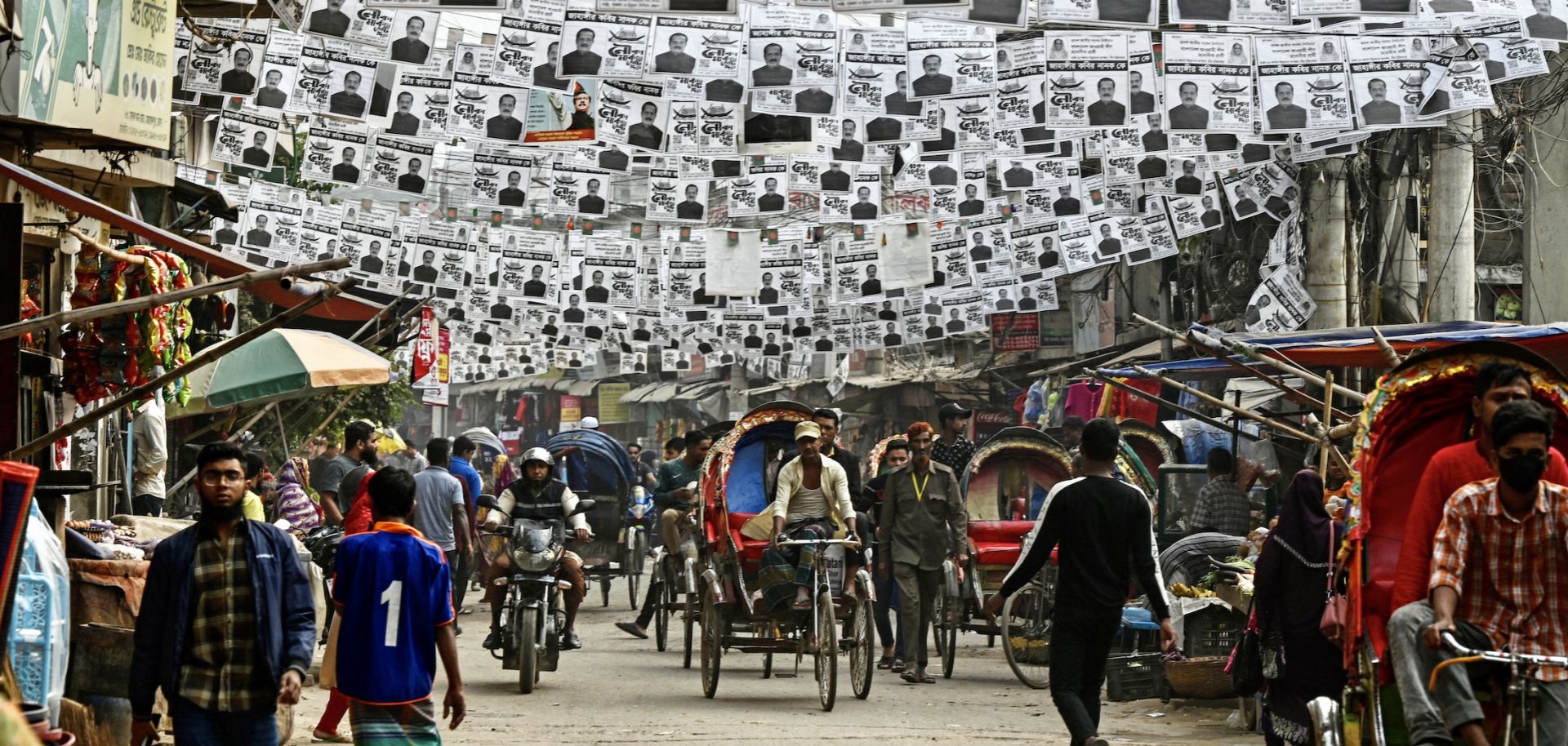
Bangladesh's upcoming general election will likely produce short-term social unrest and open the door to potential foreign sanctions, but this will not affect the government's long-term goals of maintaining a nonaligned foreign policy and complying with its International Monetary Fund program. On Jan. 7, Bangladesh will hold general elections, with the ruling Awami League party, or AL, aiming to clinch a fifth term for Prime Minister Sheikh Hasina. The lead-up to elections has been marked by significant political turbulence, especially after the opposition Bangladesh Nationalist Party, or BNP, announced that it will boycott the election to protest the government's refusal to establish a neutral caretaker government to oversee elections. The BNP hopes that this boycott will delegitimize a likely Hasina victory that the party alleges would be the result of electoral rigging by the AL. Boycotts have marred upcoming elections with protests, violence and heavy government crackdowns on dissent.
- From 1991 to 2008, Bangladesh established a nonpartisan and technocratic administration that would oversee elections to curb power abuses. However, following the AL's win in 2008, the government abolished the caretaker system in 2011, prompting the BNP and other opposition parties to boycott the 2014 elections.
- During Bangladesh's 2018 general elections, the AL claimed 96% of the votes, securing 300 out of 350 directly elected Parliament seats. The BNP denounced these outcomes as "farcical," with groups like Human Rights Watch raising concerns about alleged election misconduct, citing intimidation and rigging accusations.
Opposition protests have exacerbated economic grievances and instigated intense government crackdowns, sparking concerns in the West. The general elections come as Bangladesh faces significant economic challenges, which opposition parties have exploited to rally against the ruling AL. Protest activities, including widespread blockades, strikes and demonstrations, have caused transportation delays and slowed supply chains and business operations, exacerbating inflation and steep living costs. Though the Bangladeshi government regularly cracks down on protests and the opposition, especially in the run-up to elections, the latest surge in mass arrests and political instability has drawn particular attention from the United States and the European Union, which have urged the government to conduct free and fair elections and expressed concern regarding human rights abuses. While U.S. Ambassador to Bangladesh Peter Haas in October 2023 encouraged the AL to initiate talks with opposition parties to address political unrest, Hasina dismissed the suggestion amid the BNP's demand for her resignation. Additionally, Haas emphasized that restricting peaceful assembly and internet access hampers the democratic election process, and he later faced death threats from AL members over these statements.
- Global disruptions, particularly to fuel and commodity supply chains, drove up costs globally in 2023, intensifying inflationary pressures in Bangladesh. According to Bangladesh's Bureau of Statistics, the country's inflation rate has persistently stayed above 9% since March 2023. Food inflation soared even higher, reaching 12.56% in October, the highest recorded rate in at least 10 years. According to the IMF, Bangladesh witnessed a spike in inflation from 6.1% in 2022 to 9.0% in 2023. However, IMF forecasts indicate that inflation will decrease to 7.9% in 2024.
- Bangladesh is also grappling with a fragile banking sector, a deficit in its financial account, exchange rate volatility and dwindling foreign exchange reserves. Additionally, Bangladesh's gross domestic product growth slowed from 7.1% in 2022 to 6.0% in 2023. According to the IMF, this rate will likely remain steady at 6.0% in 2024.
- In December 2021, the U.S. Treasury Department imposed sanctions on the Bangladesh police's counterterrorism paramilitary unit, the Rapid Action Battalion, due to severe allegations of human rights violations. These sanctions appear to have been effective since the number of extrajudicial killings in Bangladesh decreased in 2022. Additionally in May 2023 and again in September 2023, the U.S. State Department unveiled a visa policy that limits issuance for Bangladeshi individuals who "undermined the democratic election process in Bangladesh."
- The AL has also faced allegations of spreading disinformation. In December, the Financial Times revealed that pro-government news outlets have been endorsing artificial intelligence-generated disinformation and deepfakes to propagate false narratives against the BNP.
The AL's expected victory will very likely result in continued protests and ensuing government crackdowns, but even if the United States sanctions Bangladesh, the White House is unlikely to target the country's vital ready-made garment industry due to geopolitical concerns. The AL will likely win the general elections, especially amid boycotts of key opposition parties, despite some politicians associated with the BNP and its allies running as independents. An AL win would likely lead to continued protests and related business and transportation disruptions. However, the government would conduct crackdowns and detain hundreds of opposition leaders and activists, which would likely challenge the longevity of demonstrations. An AL win amid opposition crackdowns would also spark allegations of electoral fraud and democratic backsliding, risking condemnation and sanctions from the West. Foreign sanctions would be particularly painful for Bangladesh if they target its ready-made garment industry, which is a vital contributor to Bangladesh's GDP and accounts for more than 80% of its annual exports. However, the United States appears unlikely to impose such sanctions because Bangladesh's position as the third-largest exporter of ready-made garments means restrictions on this industry would interrupt supply chains for Western companies. Additionally, Bangladesh's nonaligned status makes it a battleground among major powers that want to increase their influence over the country. As a result, the United States would be reluctant to implement painful sanctions that push Bangladesh toward U.S. rivals, particularly China.
- The United States considers Bangladesh an important player amid the U.S.-China rivalry and Washington's wider Indo-Pacific strategy due to Bangladesh's geostrategic positioning and potential to serve as a corridor to South and Southeast Asia. Bangladesh has demonstrated alignment with the United States' Indo-Pacific strategy through its own Indo-Pacific outlook, which promotes a "free and open" Indo-Pacific. Additionally, Bangladesh maintains cordial relationships with India and several European nations.
- China and Russia have accused the United States of interfering in Bangladesh's electoral process. China is taking this tack because it regards Bangladesh as a "strategic development partner," recognizing its proximity to India and its strategic location along the Bay of Bengal. China has actively cultivated robust economic relationships with the AL government, positioning itself as a close collaborator while occasionally advising Bangladesh against forging strong ties with the West.
- India, which also supports the AL, has labeled the elections an "internal matter." Bangladesh has played a significant role in India's "Act East" policy, emphasizing cooperation in regional transport, promoting digital connectivity, building trade, cultivating investment, converging on energy efforts, and mitigating extremism and cross-border militancy. Consequently, India perceives the AL as an ally and lends support to the existing political framework.
Following the election, Bangladesh will maintain balanced relationships with its various allies while walking a tightrope between appeasing the population and complying with reforms required by the IMF as part of its loan program. Bangladesh is poised to maintain its nonaligned stance after the AL's likely electoral victory, guided by its principle of "friendship to all, malice to none." Thus, the government will emphasize fostering economic partnerships, attracting foreign investment and prioritizing digital adaptation. According to the AL, other post-election actions will include alleviating poverty, creating jobs and building infrastructure, although the government will face limitations amid budget constraints and ongoing economic challenges. The government will also implement IMF-requested reforms to increase tax revenue, rationalize expenditures, promote macroeconomic stability and bolster external resilience. However, aligning with IMF-related conditions entails unpopular actions like cutting social programs, eliminating subsidies and raising taxes. These steps triggered sporadic protests in 2023, and further implementations of these measures may incite additional economic grievance-related protests in the months ahead. Such protests would create frequent risks of disruptions to transportation, supply chains and business operations, as well as risk violent clashes with security forces when the government cracks down on dissent. Moreover, ongoing political instability could constrain Bangladesh's willingness to immediately enact contentious reforms in the near term, leading the government to potentially lessen or delay the reforms' implementation after election-related demonstrations have died down. Consequently, Bangladesh's position with the IMF might turn precarious, potentially affecting its access to future tranches of its bailout program.
- After grappling with declining foreign exchange reserves and soaring inflation due to the COVID-19 pandemic and Russia's invasion of Ukraine, Bangladesh's economy faced challenges such as high inflation, reduced remittances and energy price volatility. To address this, the IMF approved a $4.7 billion loan to Bangladesh in January 2023. This financial aid aimed to "create fiscal space for increased social and developmental spending," enhance the financial sector, update policy structures and bolster climate resilience. By December 2023, the IMF had approved the release of $689 million, the second tranche of the loan package allocated for Bangladesh.
