
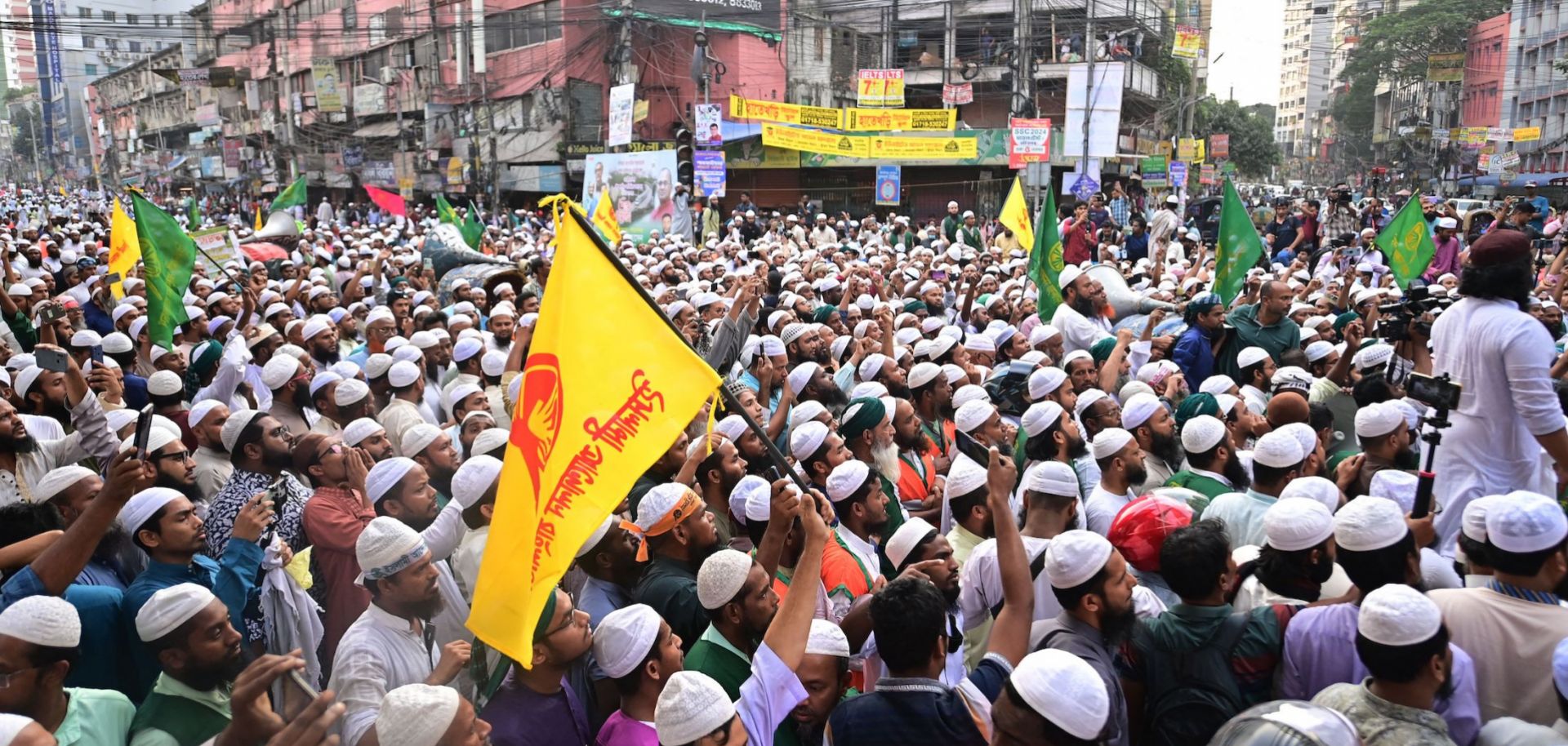
As Bangladesh prepares to hold elections on Jan. 7, growing concerns about vote rigging, rising inflation and the government's crackdown on dissent risk triggering more political violence and economically disruptive protests ahead of — and potentially after — the ballot. Bangladesh has a long history of turbulent elections marked by violent unrest, and its 2024 general election appears poised to prove no different. On Nov. 15, Bangladesh's election commission announced that the country would hold its next general election on Jan. 7, which has since triggered widespread blockages, hartals (or strikes) and demonstrations across the country. Over the past two weeks, opposition parties like the Bangladesh Nationalist Party (BNP) have reiterated their intent to boycott the elections as a means to ''delegitimize'' another likely victory by the ruling Awami League (AL) party, which has been in power since 2009. Additionally, since mid-October, workers in the country's ready-made garment (RMG) industry have staged protests to demand wage increases, which have resulted in deadly clashes with security forces amid the government's escalating crackdown on dissent ahead of the upcoming ballot.
- After announcing the election date on Nov. 15, Bangladesh's chief election commissioner urged all political parties to participate in the ballot, assuring that the commission would employ essential steps to guarantee free and fair elections. However, the BNP and other opposition parties have called for a caretaker government to oversee the upcoming vote, citing allegations of electoral rigging under Prime Minister Sheik Hasina's leadership.
- The ongoing garment worker protests were triggered by low wages amid soaring inflation — which increased from 9.63% in September to 9.93% in October — and rising food and fuel prices, which have exacerbated economic grievances. In response to the demonstrations, authorities in Bangladesh announced on Nov. 7 that the monthly minimum wage for workers in the garment industry would be increased by 56%. But while union representatives agreed to the announcement and assured that workers would return to their jobs, the new minimum wage still falls short of the garment workers' expectations. Prime Minister Hasina has since rejected the prospect of further wage increases, warning of potential job losses and disruptions to business.
- On Nov. 27, Human Rights Watch (HRW) released a report detailing Bangladesh's crackdown on opposition parties and government critics ahead of the general elections. According to HRW, around 10,000 opposition supporters have been arrested, with reports indicating an increase in election-related violence, mass arbitrary detentions, forced disappearances, torture, and extrajudicial killings carried out by security forces.
Social unrest and political tensions will remain high in Bangladesh ahead of the election, as a cost of living crisis coexists with political repression and electoral opacity. In recent weeks, Bangladeshi news outlets and civil society groups have reported intensifying political polarization and violence ahead of the country's general election. The opposition's constant demonstrations, strikes and blockades have disrupted transportation and commerce across Bangladesh. Clashes with police, road barricades and incidents of arson involving vehicles have caused widespread injuries, and have also disrupted the movement of people and goods, further increasing transportation and overall living costs. According to Prime Minister Hasina's Information and Communication Technology (ICT) Advisor, the economy lost an estimated $3.5 billion between Oct. 28 and Nov. 6 as a result of protest-related business and supply chain disruptions. Additionally, the Federation of Bangladesh Chambers of Commerce and Industries (FBCCI) estimates that each day of protests and blockades costs the economy around $588 million. The government's actions — including its crackdown on protesters and failure to negotiate with opposition parties and garment workers — have only further heightened political tensions while worsening levels of social unrest and violence. The garment worker protests, meanwhile, have led to mass arrests, vandalism, blanket charges and injuries, in addition to business disruptions and staffing shortages. On Nov. 3, it was reported that over a hundred garment factories were forced to shut down due to walkouts, though media reports indicate they have since reopened.
- Bangladesh is the world's second-largest exporter of ready-made garments, which represent more than 80% of its annual exports and contributed 16% to its GDP in 2022. With about 4,000 manufacturing facilities according to the World Bank, Bangladesh's growing RMG sector is credited with reducing the country's poverty rate from 11.8% in 2010 to 5% percent in 2022. However, per Bangladesh's Export Promotion Bureau, the country's export earnings dropped by 13.6% to $3.76 billion in October — a 26-month low — amid the onset of the ongoing wage strikes and protests.
Opposition parties will continue protesting and garment workers may stage a nationwide strike if inflation remains high ahead of the January election, risking further economic instability and business disruptions. As the general elections approach, the BNP and other opposition parties are advocating for ongoing boycotts to delegitimize polls. The ruling AL party, meanwhile, has not shown any sign that it plans to ease its crackdown on the opposition and garment worker protests, nor has it expressed any desire to engage in meaningful discussions with the opposition about the upcoming election. The unrest, and the consequent supply chain and transportation disruptions, are thus likely to endure in the lead-up to next year's general election, further hampering Bangladesh's economic productivity. Additionally, if Hasina is reelected for another five-year term on Jan. 7, opposition protests would likely continue after the election. The economic grievances that are driving garment workers to take to the streets, such as elevated food and fuel prices, also have the potential to worsen in the coming months, as the country continues to grapple with the aftershocks of the COVID-19 pandemic, as well as the ongoing global economic fallout from Russia's war in Ukraine and, more recently, the Israel-Hamas conflict in Gaza. Moreover, the Bangladeshi government will face pressure from the International Monetary Fund to implement austerity measures that potentially increase taxes and subsequent financial pressure on households and businesses. Against this backdrop, inflation could remain high or continue to increase. In response to the ongoing cost-of-living crisis, garment workers will likely keep pushing for higher wages, potentially risking strikes, disruptions to RMG exports, and further violent crackdowns on protests. As both opposition parties and RMG workers grow increasingly frustrated with Hasina's government, there's a possibility of both protests overlapping or joining forces, which would only magnify Bangladesh's political and economic instability.
- Global fashion retailers, including H&M and Gap, have called on the Bangladeshi government to increase wages for the country's garment factory workers. But the government has been reluctant to heed these calls, as such wage hikes would elevate labor costs for local manufacturers and factory proprietors. Given that factories are already struggling to manage operational expenses amid surging energy costs, the added financial burden could force some businesses to shutter their doors.
- Bangladesh's tourism industry — which accounts for 3% of its GDP — will likely also take hits during its peak season of November to mid-April. Popular destinations like Cox's Bazar, St. Martin, and Kuakata have already seen a significant drop in visitors and will likely continue to see declining business as Bangladesh's ongoing political, economic and social turmoil deters travelers from visiting the country. This downturn may force tourism-reliant businesses — like hotels, resorts and restaurants — to reduce costs and potentially lay off workers, adding to Bangladeshis' economic grievances.
If the government continues its authoritarian actions, it may face additional pressure from the United States and other Western countries. The government's actions — including its crackdown on protesters and failure to negotiate with opposition parties and garment workers — have only further heightened political tensions while worsening levels of social unrest and violence. Against this backdrop, foreign actors like the United States and the European Union have urged the Awami League to resolve its political disputes and ensure peace and stability. But while the AL has occasionally shown a willingness to engage in dialogue with other parties, the party has refused to communicate with its political rivals since announcing the date of the upcoming general election. As political tensions and protests continue to mount, the United States and its European allies may reiterate calls for free and fair elections. In September, the United States imposed visa restrictions on Bangladeshi individuals believed to be involved in undermining the democratic election process in the country, in an effort to incentivize a free and fair general election on Jan. 7. Such U.S. measures have proven to be effective in influencing the government's behavior; in 2021, for example, Washington sanctioned Bangladesh's elite counterterrorism force, the Rapid Action Battalion (RAB), due to human rights violations, which has since seen a drop in enforced disappearances in the country. The AL is unlikely to concede to all of the opposition's requests, like establishing a caretaker government to oversee the Jan. 7 vote. But if the ruling party takes action to deescalate the current crisis — by, for example, engaging in dialogue with opposition parties, reducing crackdowns on protests, and releasing detained opposition leaders — foreign criticism and pressure would likely abate.
- In response to the government's authoritarian behavior, the United States and its Western partners are unlikely to sanction entire sectors of the Bangladesh economy for fear of further eroding living conditions for the millions of citizens already struggling to make ends meet. Additionally, considering that the United States and various European nations rank among the primary importers of Bangladeshi garments, implementing sanctions on the country's crucial RMG industry could risk economic slowdowns and supply chain disruptions for Western companies as well.
