
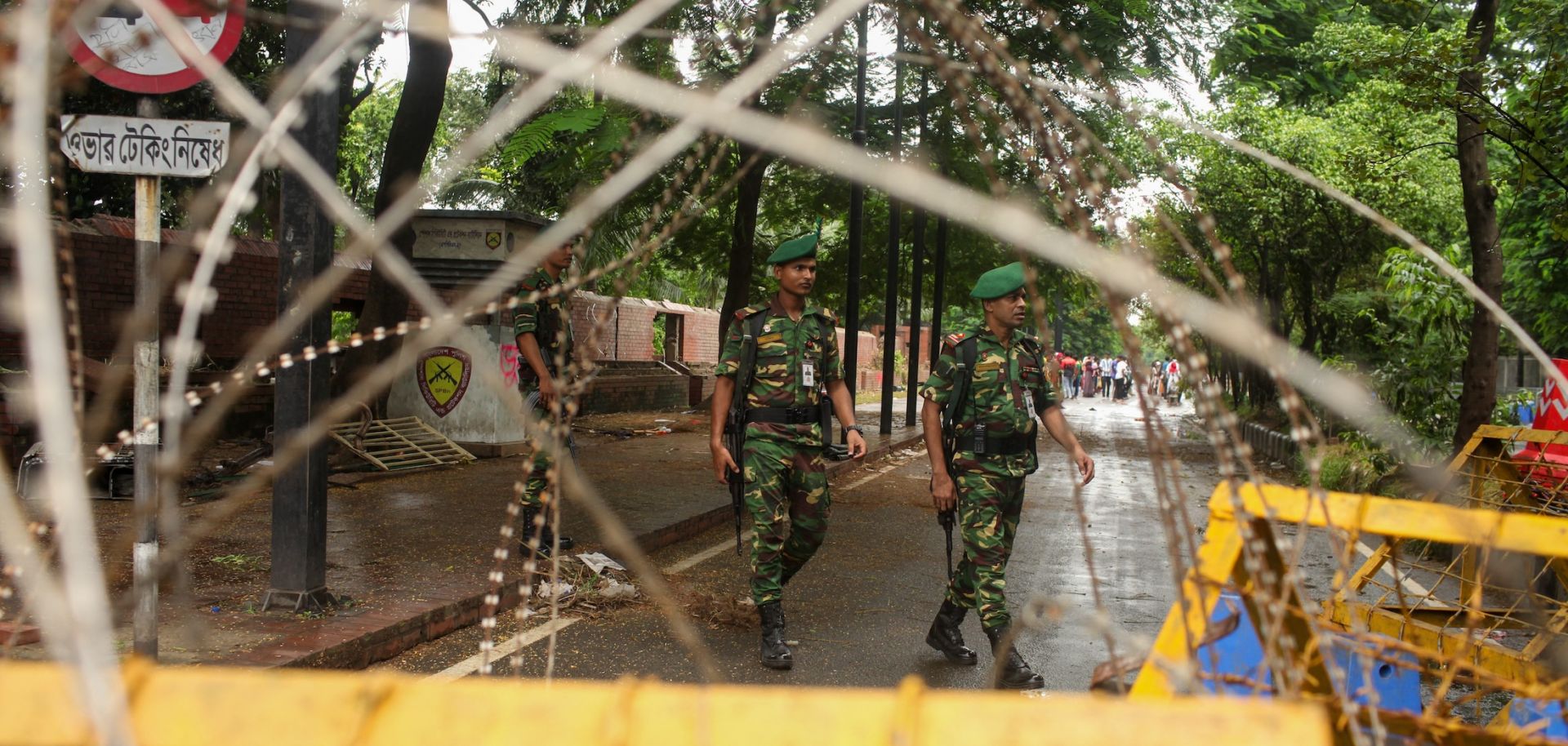
Bangladesh's military is likely to play a continued role in domestic politics, particularly if the general election is delayed and economic challenges and unrest worsen, and renewed episodes of social unrest are likely if the military takes measures to prevent the Awami League from returning to power. On Aug. 8, Muhammad Yunus was sworn in as the chief adviser in a role equivalent to that of prime minister as part of a technocratic interim government. According to statements by members, the interim government will focus on restoring stability in Bangladesh by establishing law and order and overseeing free and fair elections, although a timeline for elections has yet to be announced. Bangladeshi Chief Justice Obaidul Hassan, widely regarded as a loyalist to former Prime Minister Sheikh Hasina, meanwhile resigned Aug. 10 after protesters gathered outside the Supreme Court demanding his resignation. Five other Supreme Court judges, the vice chancellor of Dhaka University, and Bangladesh Bank Gov. Abdur Rouf Talukder also resigned. Driven by popular pressure and encouraged by student leaders in the interim government, the resignations may result in further departures as part of a broader restructuring effort to reduce political influence and ensure a fairer legal process. Meanwhile, a Dhaka court named ousted Bangladeshi Prime Minister Sheikh Hasina as a suspect in a case involving the death of a grocer during protests. A subsequent complaint filed Aug. 14 with the International Crimes Tribunal (Bangladesh) accused her of crimes against humanity and genocide between July 15 and Aug. 5.
- After former Prime Minister Sheikh Hasina's resignation and departure to India, Cabinet members were chosen in consultation with student protest leaders, the military, opposition parties and civil society representatives. The Cabinet, whose 17 members are all referred to as advisers, comprises a diverse group of notable individuals. They include respected human rights defenders, legal experts, influential nongovernmental organization founders, economists, academics, a retired military officer and two prominent coordinators from the student-led movement.
- Yunus' involvement as chief adviser likely represents an effort by the army to introduce a credible figure into a politically sensitive role while also addressing student protesters' demands by appointing their preferred candidate. Yunus' reputation as a Nobel laureate and his focus on social entrepreneurship could also be intended to address public dissatisfaction and unrest. Given his lack of affiliation with any party, Yunus may be viewed as someone who can mediate between different political factions and manage the transitional period with a focus on economic and social stability. Additionally, his role will likely help reassure both domestic and international observers of the interim government's commitment to fair governance and reforms.
- The Bangladeshi Constitution requires elections within 90 days of parliament's dissolution, which happened Aug. 6.
Bangladesh's military has long been involved in politics, notably during the 2006-08 political crisis when it cracked down on opposition figures and limited political freedoms. Bangladesh has a long history of military involvement in politics, something particularly evident under the country's caretaker government appointed in 2006. The appointment arose from severe political instability and violence ahead of the 2006 general elections between the governing Bangladesh Nationalist Party, led by then-Prime Minister Khaleda Zia, and the opposition Awami League, led by Hasina. In response, President Iajuddin Ahmed suspended the election and established an interim government, which lasted two years and was heavily influenced by the military. The army played a central role in political affairs and managed the 2008 election process to ensure stability. Controversially, the military's involvement included widespread arrests of political leaders from all parties, curfews and restrictions on political activity. The period ended with the 2008 elections, where Hasina's Awami League emerged victorious, leading to a restoration of civilian rule and a significant reduction in the army's direct political involvement.
The military is likely to assume a more assertive yet still covert role, particularly if economic challenges and unrest continue to fuel instability and dissatisfaction with the interim government. While Bangladeshi Army Chief Waker-uz-Zaman has publicly supported holding elections and assured the military's backing to ensure they are fair and free, the longer the interim government remains in power, the more likely it becomes that the military will adopt a more active role in politics, albeit not necessarily all out in the open. This involvement could manifest in the army steering major decisions and overseeing critical governmental functions, such as maintaining law and order, overseeing elections, and managing key ministries, to prevent further instability. If Bangladesh's economic troubles persist and social unrest escalates, it could lead to animosity toward the interim government for failing to adequately improve the situation. The army is likely aware of the risk and is keen on facilitating elections and guiding the political process to prevent the country from descending into chaos while avoiding the appearance of overt military intervention in civilian governance. Even after the elections, the army may continue to play a significant political role depending on the composition of the next government. The main opposition Bangladesh Nationalist Party has gained some support for its anti-establishment stance. But its frequent use of unrest to protest Awami League rule combined with its lack of a clear governing agenda beyond merely opposing the league has led to growing public frustration and increasing criticism of its approach. Thus, if the BNP or a coalition of parties wins, it may still face the country's swelling public frustration and criticism of the government, which could necessitate the army's continued involvement in political affairs to maintain stability. This is exacerbated by the potential for unrest caused by Awami League supporters, who will likely protest election results unfavorable to them.
- Bangladesh is currently grappling with significant economic challenges including high inflation, which according to the International Monetary Fund will rise from 5.6% in 2020 to 9.3% in 2024. The IMF also forecasts that Bangladesh's foreign exchange reserves will decline from $24.8 billion today to $19 billion by 2025. This reduction in reserves could pressure the local currency, the taka, potentially leading to its devaluation and exacerbating inflation.
The Awami League's likely attempt to return to power in the next general election could cause the military to take measures to undermine the party, which could produce another wave of politically motivated social unrest. According to Hasina's son Sajeeb Wazed Joy, Hasina will return to Bangladesh once elections are announced, though it is unclear if she will attempt to run. Either way, the Awami League still enjoys significant support from a portion of the population. If unrest and economic challenges persist under the interim government, the party could regain favor by capitalizing on any dissatisfaction with the current administration. Under the Awami League, Bangladesh experienced notable economic growth and development, including improvements in infrastructure and social welfare. The party will highlight this record to appeal to voters, promising a return to growth if conditions worsen. But the Awami League will also face major constraints, as the party lacks representation in the interim government and faces a diminishing presence in government amid calls for the depoliticization of institutions. Moreover, Hasina's ongoing legal challenges could impact her eligibility to run, and the Awami League lacks a clear successor to her. Whoever did succeed her would likely face similar constraints and legal issues. Additionally, given the significant unrest and protests against the Awami League during its time in power, the army may covertly intervene by sidelining the league. This could occur through supporting calls for the resignation of its members and influencing the political environment by facilitating favorable conditions for alternative political forces to reduce the Awami League's chances of returning to power to prevent further instability. But efforts to prevent the Awami League from returning to power could mobilize its supporters and lead to heightened unrest. If no clear, stable alternative government is established — and especially if the Awami League is prevented from returning to power — a gap in effective governance could emerge, leading to further political uncertainty as different parties jockey for power.
- Under Hasina's leadership, Bangladesh achieved robust economic growth, largely fueled by the garment export industry. Since 2009, the economy expanded at an average annual rate of more than 6%, significantly reducing poverty levels and providing electricity access to more than 95% of the population.
- On Aug. 13, following Hasina's call for supporters to demonstrate their strength two days later — the anniversary of the slaying of her father, Sheikh Mujibur Rahman, during the country's 1975 military coup — hundreds of protesters gathered in Dhaka, where opposition-affiliated protesters attacked them, ending the demonstration.
