
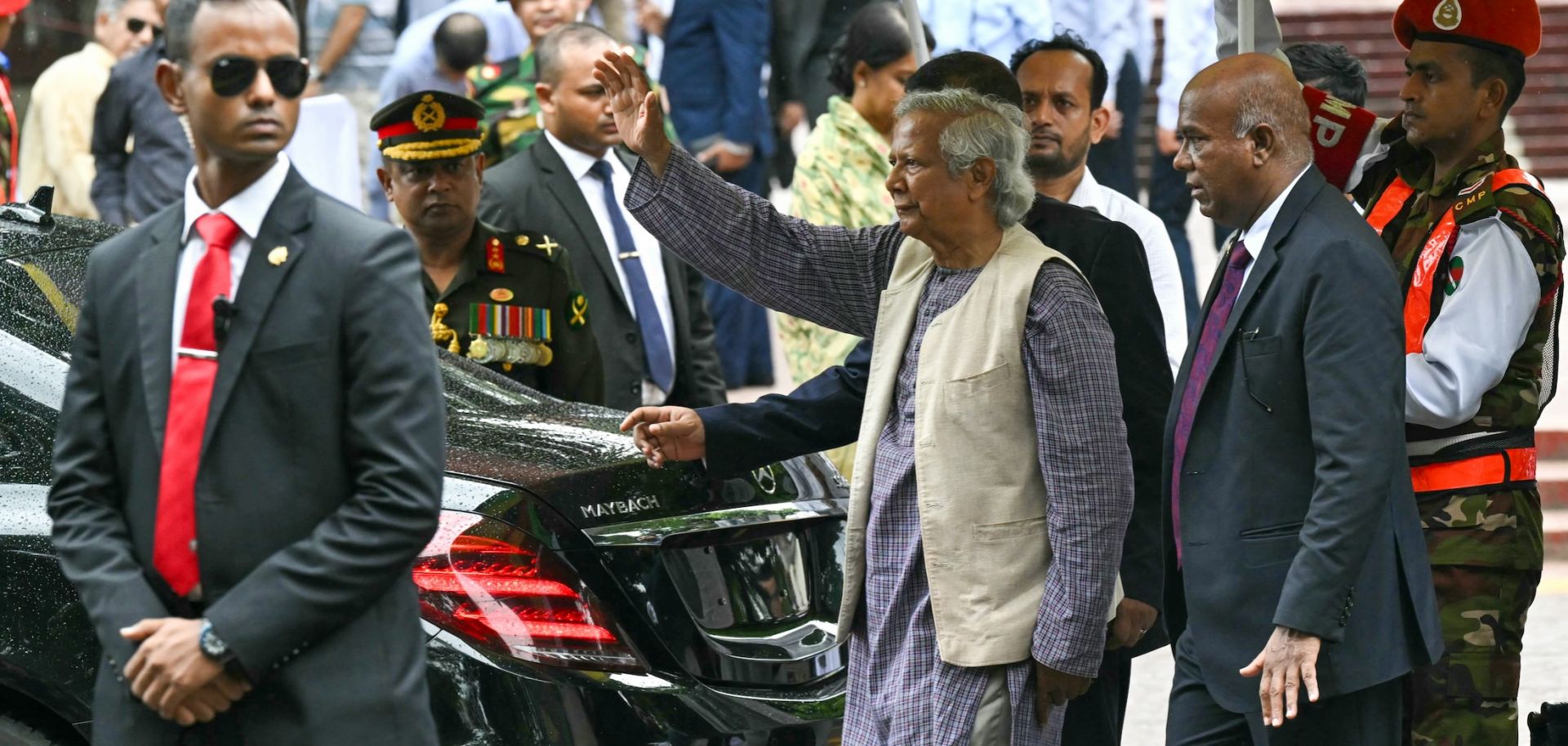
While Bangladesh's interim government is unlikely to make drastic changes in foreign policy, the government that emerges after new elections could seek closer ties with China and distance from India. This would delay bilateral projects with India, increase security challenges for India and lead to greater Chinese influence in the region. On Aug. 8, Nobel laureate Muhammad Yunus was sworn in as chief minister of Bangladesh’s interim government. This came after Prime Minister Sheikh Hasina resigned and fled to India on Aug. 5 following weeks of deadly anti-government protests. In the aftermath, the army chief in collaboration with Shahabuddin announced plans to form an interim government with opposition parties (excluding Hasina's Awami League). The president dissolved Parliament on Aug. 6, paving the way for fresh elections. Although the constitution requires these elections to take place within 90 days, no timeline has been confirmed.
- Known as the "banker to the poor," the economist and banker Yunus received the Nobel Peace Prize in 2006 for his innovative use of microcredit to assist impoverished individuals, especially women. Yunus is a vocal critic and political adversary of Hasina, and described her resignation as the country's "second liberation day."
- In 2011, Hasina's administration ousted Yunus as the head of Grameen Bank, claiming he had exceeded the legal retirement age of 60. In January 2024, Yunus received a six-month prison sentence for labor law violations. In June, he and 13 others were charged with embezzling 252.2 million taka (about $2 million) from a telecom company's workers' welfare fund that he had established. Yunus also faced more than 100 other charges related to graft and various alleged offenses. He denies all the accusations, calling them "very flimsy, made-up stories." Hasina's animosity toward Yunus stems from his attempt to enter politics in 2007, when he announced the formation of a political party seen as a direct challenge to the established political order. Although he eventually stepped back from politics, this move created friction with Hasina.
- Other members of the 17-member interim government, referred to as "advisers," include a diverse range of prominent figures: renowned human rights defenders, legal experts, influential founders of nongovernmental organizations, economists, academics, a retired military officer and two key coordinators from the student-led movement.
The anti-India opposition's influence in Bangladesh's interim government and upcoming elections could weaken India-Bangladesh relations. In light of recent events in Bangladesh, Indian External Affairs Minister S. Jaishankar said that his government's priority was protecting Indian citizens and Hindu minorities amid a surge of anti-Hindu violence in Bangladesh. Hasina's resignation will open the door for the opposition Bangladesh Nationalist Party to play a significant role in the interim government and the upcoming elections. The BNP has long defended anti-India positions, including on alleged Indian influence in domestic affairs; shared water resources, particularly the Teesta River; and calls to reduce fiscal and strategic dependence on India by diversifying trade partners and adopting equitable and independent approaches to border and water resource management. Thus, an opposition government could delay the implementation or finalization of negotiations for the India-Bangladesh free trade agreement; the construction of an 800-metric ton advanced oceangoing tug (contracted by Bangladesh with the Indian defense shipyard GRSE in Kolkata in June and pending development); and the Teesta River development project, a deal in negotiations that aims to enhance water management, flood control, and irrigation infrastructure along the river. Hasina's resignation could signify the loss of a regional ally for India, particularly in a region where it contends with adversarial neighbors like Pakistan and maintains complex relations with Nepal and Sri Lanka. Despite prevalent anti-India sentiment in Bangladesh, during her decade and a half in power Hasina kept cordial ties with New Delhi. Choosing to flee to India after her resignation contributed to opposition perceptions of India's support for Hasina. As a result, the new interim government — and in particular the government that emerges after the general elections — may take policy measures to take distance from Hasina's perceived pro-India policies. India will try to forge new ties with the interim government and the administration that emerges after the general elections, although these ties will likely not match the close relations experienced under Hasina. Sustained weakening of India-Bangladesh relations could lead to heightened border tensions and security challenges, including the potential resurgence of terrorist and other anti-India activities in the medium to long term. This concern arises from the fact that, compared to the BNP, Hasina was regarded as more sensitive to India's security concerns and her administration's effective crackdown on terror groups had previously curbed anti-India activities by Bangladesh.
- In January, a campaign led by the BNP and the Bangladeshi diaspora accusing India of interfering in Bangladesh's politics and elections gained momentum. The movement, called "India Out," urged people to protest against India and boycott Indian products. The message spread on social media, with some individuals sharing images of Indian products being crossed out.
- An agreement on water sharing for the Teesta was reached in 2011 but was not finalized due to objections from West Bengal, the eastern Indian state through which the river flows before entering Bangladesh. With India delaying a resolution, China proposed joining the Teesta water project. In response, India made a counteroffer earlier this year driven by security concerns over Chinese engineers operating near its borders. In July, Hasina noted, "China has made an offer and conducted a feasibility study. India has also made an offer and will conduct its own study." She emphasized, "I would prefer India to handle this project as India has been responsible for holding up the Teesta's waters."
In the meantime, some opposition members' pro-China stance could revitalize Chinese projects in Bangladesh. So far, China has issued only a brief statement regarding the situation in Bangladesh, indicating that it is closely monitoring developments and hopes for a swift restoration of social stability. China cultivated a good relationship with Hasina in areas of infrastructure and development. While not ideologically aligned with the Awami League as was India — (where the AL's secularism and regional security priorities found common ground with India's broader political framework under the ruling Bharatiya Janata Party — China valued the political stability under Hasina and her openness to Chinese trade and investment. Absent a lost ideological link, China will likely find it easier than India to engage with a post-Hasina government, especially amid the current political uncertainty regarding Awami League's return to power. Some opposition members, including those in the BNP, have shown a more pro-China stance by engaging in diplomatic meetings with Chinese officials, supporting Chinese investments and advocating for stronger economic ties with China as a counterbalance to India's influence. Such alignment could facilitate ongoing projects, such as the Kushiyara River Project and the Sonadia Island deepwater port project previously shelved due to Indian concerns. If Bangladesh's new government shifts from its previously strong ties with India to a closer relationship with China, this could exacerbate strategic and security challenges for India, given India's ongoing issues with Pakistan and China; the recent election of communist leader Khadga Prasad Sharma Oli in Nepal, who has historically bolstered ties with China; instability in Afghanistan; and an anti-India Maldivian government.
Amid ongoing economic challenges and efforts to achieve stability, Bangladesh will likely balance its relationships with both India and China, acknowledging their economic importance and contributions to development. Given its focus on overseeing elections and stabilizing Bangladesh internally, the interim government will have a limited ability to make major foreign policy changes. If a government with a more pro-China stance emerges after the vote, it could still recognize the importance of maintaining a constructive relationship with India due to its regional power and significant economy. Given that Bangladesh is in a recovery phase following weeks of unrest and persistent economic challenges — such as rising inflation, which the International Monetary Fund estimates will climb from 5.6% in 2020 to 9.3% in 2024 — a government promising recovery may find it difficult to entirely sideline India. India's status as one of Bangladesh's top trading partners will reinforce this, highlighting the economic interdependence between the two nations. Bangladesh is the largest export destination for Indian cotton, accounting for 34.9% of India's total cotton exports, which is vital for Bangladesh's ready-made garment industry, represents approximately 80% of Bangladesh's annual exports and contributed 16% of its gross domestic product in 2022. Additionally, the cordial relations maintained by Bangladeshi Army Chief General Waker-Uz-Zaman with India, coupled with the military's growing political influence, may deter extreme anti-India measures and promote a more balanced diplomatic approach. Thus, given that China is also a major trading partner — data from the Export Promotion Bureau and Bangladesh Bank indicates that Bangladesh's bilateral trade with China totaled $18.5 billion for the fiscal year 2022-2023 — and a key investor in infrastructure, Bangladesh will likely continue to balance ties between India and China.
- According to India's Ministry of External Affairs, Bangladesh is India's biggest partner in the subcontinent, and India ranks as Bangladesh's second-largest partner in Asia, following China. In FY 2023-24, Bangladesh exported goods worth $1.97 billion to India, with total bilateral trade amounting to $14.01 billion. Key Indian exports to Bangladesh include vegetables, coffee, tea, spices, sugar, refined petroleum, chemicals, cotton, iron and steel, and vehicles, while Bangladesh primarily imports fish, plastic, leather and apparel.
- Bangladesh is among India's largest development partners. Over the past eight years, India has extended three lines of credit to Bangladesh, totaling approximately $8 billion, to develop infrastructure in various sectors such as roads, railways, shipping and ports. The Indian government has also provided grant assistance for several infrastructure projects in Bangladesh, including the construction of the Akhaura-Agartala rail link, dredging of inland waterways, and the building of the India-Bangladesh Friendship Pipeline.
- Bangladesh became part of China's Belt and Road Initiative in 2015, prompting significant Chinese investment in Bangladeshi infrastructure projects. This includes the Karnaphuli Tunnel, an underwater expressway currently under construction in the port city of Chittagong. According to American Enterprise Institute estimates, China invested approximately $7.56 billion in Bangladesh between 2005 and 2024.
