
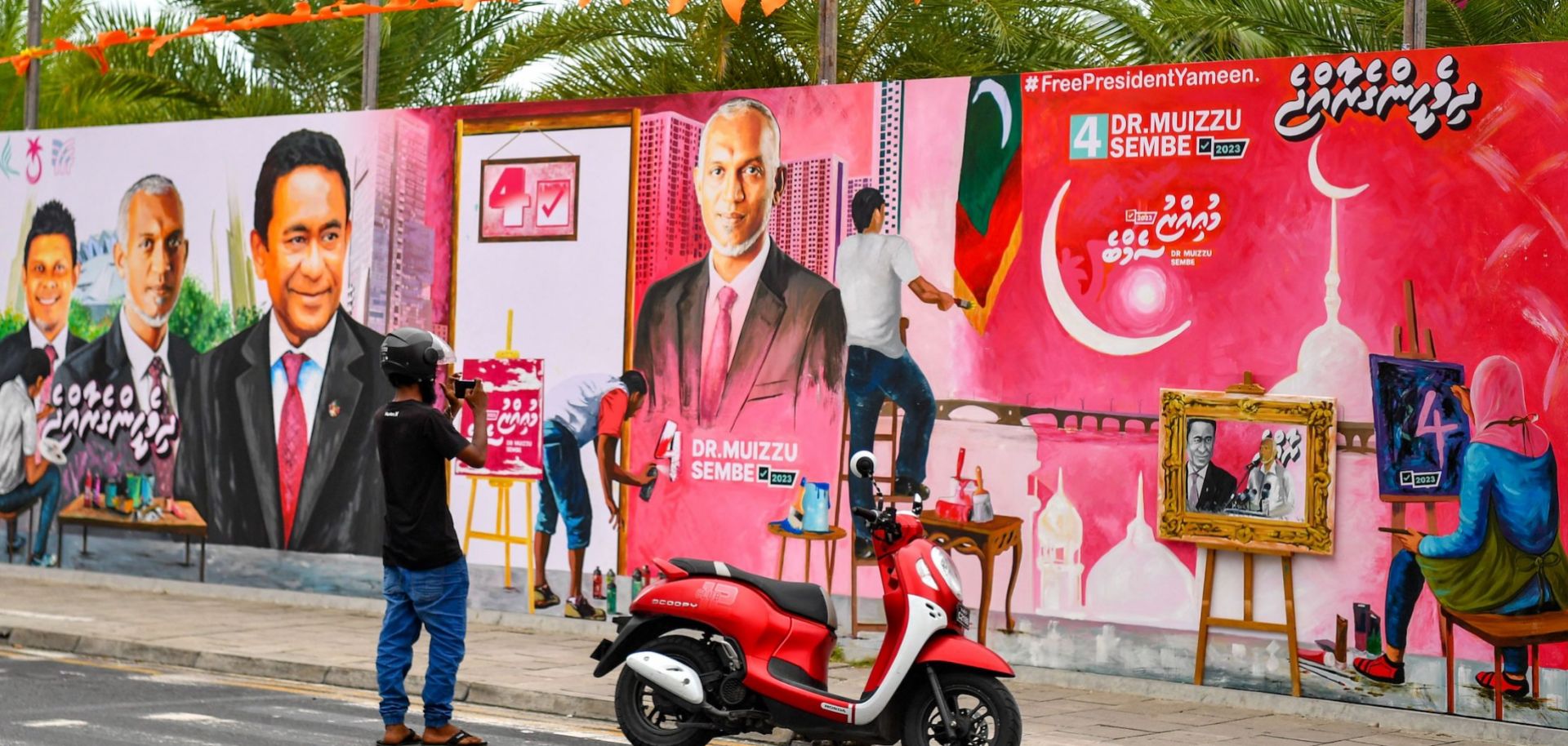
A presidential runoff in the Maldives will determine whether India or China has greater influence in the country, but whoever wins will likely retain pragmatic relations with the other country. On Sept. 30, the Maldives will hold a run-off presidential election that could alter the island nation's strategic balance between China and India. Incumbent President Ibrahim Mohamed Solih will face off against opposition challenger Mohamed Muizzu, who surprisingly came out on top in the first round of the presidential election on Sept. 9 with 46% of the vote, beating out Solih's 39%. The primary differentiator between the two candidates is their foreign policy agendas. Since taking office in 2018, President Solih has strengthened the Maldives' historically close ties with India, and has pledged to maintain his pro-India approach if elected for another term. Muizzu, by contrast, has positioned himself as the pro-China candidate and has promised to scale back India's deep-rooted influence in the country while bolstering the Maldives' ties with Beijing.
- The 2023 presidential election advanced to a runoff after no candidate received more than 50% of the vote in the first round held earlier this month.
- The Maldives is situated along some of the most vital maritime trade routes in the Indian Ocean, making it a key battleground for influence in China and India's regional rivalry. Over the years, both China and India have contributed to the growth of the Maldivian economy via a multitude of investments in large-scale infrastructure projects and the island nation's tourism industry.
- For India, the Maldives is a key maritime neighbor and feeds into Indian Prime Minister Narendra Modi's Security and Growth for All in the Region (SAGAR) and Neighbourhood First policies. Given the Maldives' geopolitically strategic location in the Indian Ocean, New Delhi also sees the country as key to enhancing the Indo-Pacific security space and countering China's regional rise.
- China, meanwhile, has sought to use Maldives to expand its Belt and Road Initiative (BRI), including by sponsoring multiple infrastructure projects in the country. For Beijing, a greater presence in the country would also grant it access to key sea lanes that could counter India's Indo-Pacific strategy.
If Solih is re-elected, his government will continue its current approach of deepening the Maldives' ties with India while sustaining pragmatic relations with China. Solih has reaffirmed the Maldives' so-called ''India First'' policy since taking office in 2018, which has seen Male increase engagement with New Delhi in mutual areas of interest, including infrastructure development, maritime security and connectivity, and disaster management. Indeed, just last month, the Solih administration signed the Maldives' largest-ever infrastructure deal with India for the construction of a roughly 7 km (or 4 mi)-long bridge and causeway linking two of the latter's islands. If Solih is elected for another term, the Maldivian and Indian governments would likely continue to develop even stronger ties, with the former wary of falling into China's debt trap and the latter wary of China's growing regional influence. Compared with his predecessor Abdulla Yameen (who is currently serving out an 11-year prison sentence after being convicted on corruption charges in 2022), Solih has also taken a more skeptical approach to pursuing Chinese investments. This has seen his administration engage with China in commercial areas, while refusing to grant Beijing major opportunities, like signing a free trade agreement that could have significantly expanded China's strategic leverage over the much smaller island nation. But despite being predominantly pro-India and wary of becoming overly dependent on China, Solih has still retained pragmatic relations with Beijing, which would unlikely change if he's re-elected due to China's global influence and infrastructure development assistance. Indeed, in a Sept. 27 interview with the BBC, Solih stated his administration did not view the Maldives' balance between China and India as ''a zero-sum game where good relations with one country [come] at the cost of relations with the other.''
- Solih's pro-China predecessor, former President Yameen, brought in significant Chinese investments through Beijing's Belt and Road Initiative (BRI) during his time in office. But that strategy came at the cost of accumulating a large sum of government debt, with the Maldives currently owing China over $1 billion in outstanding commitments, according to the foreign ministry. Solih has previously characterized Yameen's BRI investments as ''reckless development projects'' that have left the Maldives in ''a precarious financial situation.'' His skepticism toward deepening engagement with Beijing remains rooted in fears that taking out more Chinese loans could turn into a ''debt trap'' that could leave the Maldives beholden to China for years to come.
- One of Solih's key accomplishments was convicting Yameen on corruption charges. The former president is now in jail, barring him from contesting this election. Muizzu, meanwhile, has repeatedly said that he would try to free Yameen if elected president on Sept. 30.
Conversely, if Muizzu wins the presidency, his administration would seek to diminish India's influence in the Maldives and prioritize relations with China, but it would face multiple constraints on tilting too far into Beijing's orbit. Muizzu is widely seen as a proxy for former president Yameen, who was the opposition's favored presidential candidate prior to his arrest last year. Yameen initially launched the India Out movement in 2020 in response to the Solih administration's efforts to increase economic and defense collaboration with India. The campaign has since gained popularity, sparking protests from the opposition and nationalist groups that see their country's increased reliance on India as a threat to national security and Maldivian sovereignty. Since emerging as the opposition's stand-in presidential candidate following Yemen's arrest, Muizzu has wooed voters by echoing the former president's conservative and anti-India rhetoric. If he wins the Sept. 30 presidential runoff, Muizzu's government would seek to reduce the Maldives' reliance on India, as well as diminish India's small military presence in the country. Ongoing projects that are currently being financed by India — like the Greater Male Connectivity Project, the largest infrastructure initiative in the Maldives — could be delayed as well. On the campaign trail, Muizzu has also stressed the need to reform the Maldives' healthcare system, which is dependent on Indian investments, particularly for medical treatments and the maintenance of hospitals. When it comes to implementing his pledged healthcare reforms, Muizzu would likely aim to acquire air ambulances to strengthen the state's medical capabilities and decrease reliance on the Indian military for emergency medical airlifts. However, diminishing India's influence in the Maldives will prove easier said than done, given New Delhi's dominance in the country and surrounding region. But even with these constraints on fully removing India's deep-rooted cultural, economic and security influence, Muizzu will still lean more toward China in expanding economic and political engagement via increased investment in the country.
- The Maldives relies on a trilateral security mechanism with India and Sri Lanka to oversee maritime security threats and food security. The Solih administration reaffirmed the trilateral security pact in November 2020 during what was the three South Asian countries' first meeting in six years.
- In addition to boosting the tourism industry, Muizzi's other reforms may involve decreasing budget deficits, making improvements to the fisheries and agriculture sector, and enhancing the country's health insurance scheme (by, for example, including coverage for fertility treatment programs).
- To help with medical evacuations and sea surveillance, India has provided the Maldives with two helicopters and a Dornier aircraft. To assist in the maintenance and operations of these capabilities, India has stationed around 75 military personnel in the Maldives. The opposition has heavily criticized these deployments, calling them a ''loss to independence and sovereignty.''
