
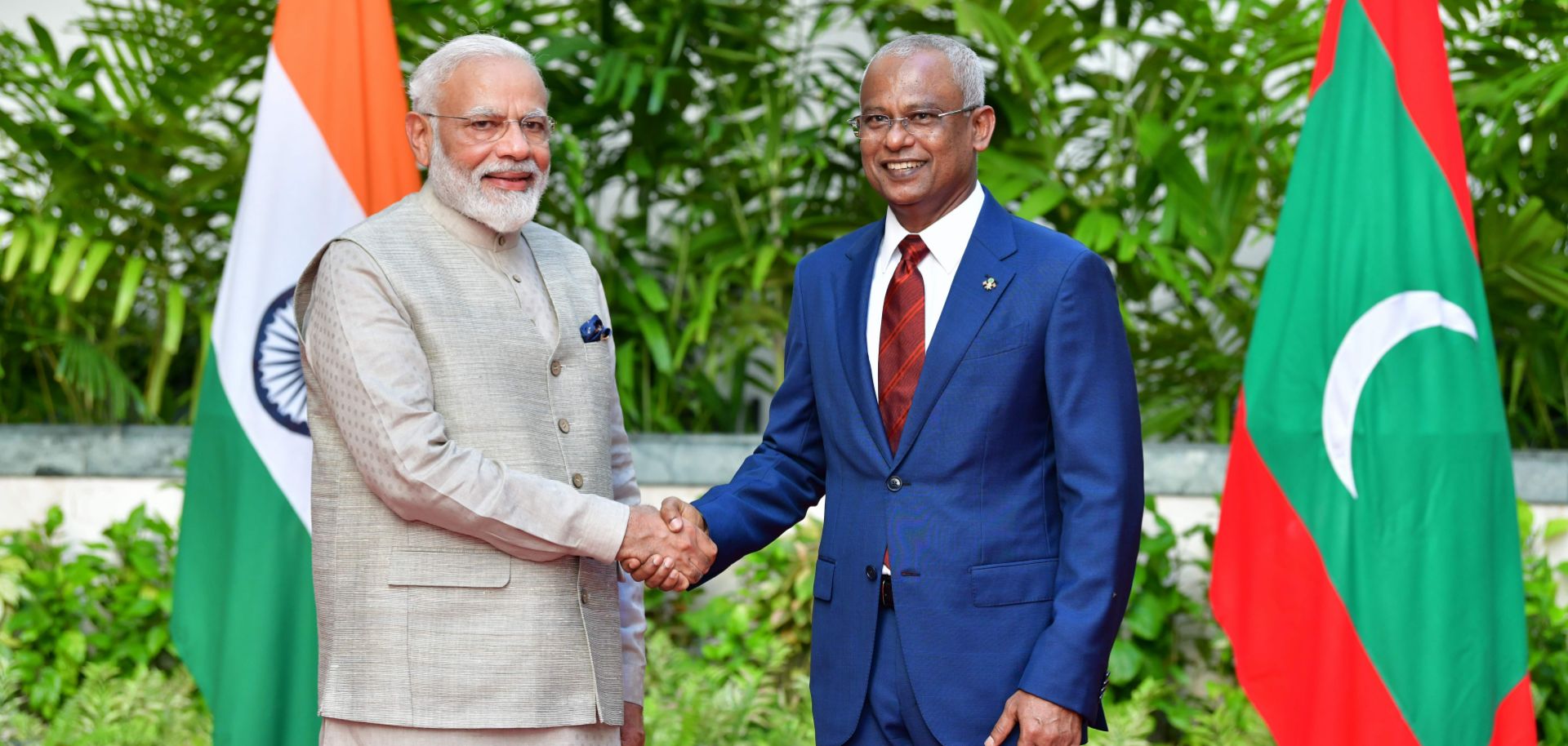
Indian Prime Minister Narendra Modi (left) shakes hands with Maldivian President Ibrahim Mohamed Solih during a visit to the island nation on June 8, 2019.
Former Maldivian President Abdulla Yameen Abdul Gayoom’s recent support for the “India Out” campaign could elevate the opposition movement’s profile, threatening Indian investment and influence in the strategic island nation. The India Out campaign is a loosely organized series of protests and propaganda objecting to India’s involvement in the Maldives. The campaign emerged after current Maldivian President Ibrahim Mohamed Solih took office in 2018 and recalibrated the country’s foreign policy to strengthen ties with India — marking a notable shift from his predecessor’s focus on bolstering ties with China. Over the past four years, the Solih administration has increased both economic and defense collaboration with India, sparking protests from the opposition and nationalist groups that see this increased reliance on India as a threat to national security and Maldivian sovereignty. These anti-India protests have gained significant momentum in recent weeks following the acquittal of former president Yameen, who was released from house arrest in November after the country’s top court revoked his five-year prison sentence over money laundering charges. Since being freed, Yameen has become the leader of the India Out campaign, giving new life to the movement with the potential to expand its appeal to a greater swath of Maldivians.
- Since Solih took office in 2018, India has extended more than $1 billion in credit to the Maldives. In February, the Solih administration inked a deal with India to develop a Maldivian naval coast guard harbor at Uthuru Thila Falhu (UTF) atoll near Male, which sparked controversy due to a lack of transparency around the terms of the agreement and the role of Indian defense services in the project. In May, India also decided to open a new consulate in Addu City.
- During its time in office between 2013 and 2018, the Yameen administration followed a pro-China policy, bringing in investment through Beijing’s Belt and Road Initiative. But skepticism about inflated Chinese debts made the strategy unpopular with Maldivian voters — paving the way for Solih’s victory in 2018 and his pro-India Maldivian Democratic Party (MDP)’s landslide victory in the 2019 parliamentary election. Yameen also maintained an anti-India stance during his presidency. In 2016, his administration asked India to take back two helicopters it had gifted to the Maldives in 2013 but India refused to do so. The presence of Indian helicopters remains a key grievance among those participating in the ongoing anti-India protests.
Yameen’s involvement in the growing India Out movement could see a rise of anti-India and nationalistic sentiments in the Maldives ahead of the country’s 2023 presidential election. The current Solih government has been quick to condemn the India Out campaign, reaffirming the Maldives’ policy priorities regarding India as an important neighbor and strategic development partner. However, Yameen is working to build a considerable support base that could sustain the campaign for the next two years, driving deeper divides between the Maldivian people. The former president has so far focused on organizing rallies and holding similar events in the country’s isolated islands/atolls instead of urban areas, where people are more aware of India’s COVID-19 financial aid are thus more skeptical of anti-India rhetoric. Whether anti-India sentiment and protests become more widespread in the Maldives will depend on the current Solih government’s response to the movement. The ruling coalition of the MDP has so far responded with a unified stance, but divisions on other political issues — including a proposed constitutional reform that would shift the country to a parliamentary system of government — could lead to a more serious crack in the coalition that would benefit the India Out campaign. A government crackdown that sees protesters arrested or injured in clashes with security forces could also draw drive further support to the opposition, even in urban areas.
- India has provided millions of dollars worth of financial aid to help the Maldives mitigate the economic fallout from the COVID-19 pandemic.
- In June, the Indian High Commission in Male sent a letter asking the Maldivian foreign ministry to ensure the safety of its diplomats and take action against the spread of misinformation about India in local media. The following month, security at the Indian embassy was strengthened after bomb threats circulated on social media.
- Opposition-led protests have a history of unseating political control in the Maldives. Weeks of protests, including several anti-India demonstrations, forced former President Mohamed Nasheed to resign in 2012.
Rising public unrest could impede future engagement between the Maldives and India, opening the door for China to reassert its influence in the island nation. The Salih administration will seek to keep the India Out campaign from jeopardizing bilateral projects with India. But growing public pressure against Indian economic and defense engagement over the coming year could still delay the implementation of those projects. If the movement continues to gain steam ahead of the 2023 election, any new policies that could be perceived as pro-India will likely be held up in the Maldivian parliament, with legislators afraid of spurring political backlash at the polls. Increasing support for the opposition’s anti-India platform could also spur a political proxy battle for influence between China and India, with the former supporting Yameen and his India Out movement, as the latter ramps up support for Solih and the MDP. Beijing could opt to negotiate debts with the Maldives (78% of the country’s external debt is owed to China). And to counter China’s actions in the country, India could work even more closely with the current government to secure its interests through proactive diplomatic outreach and additional economic or developmental support.
