
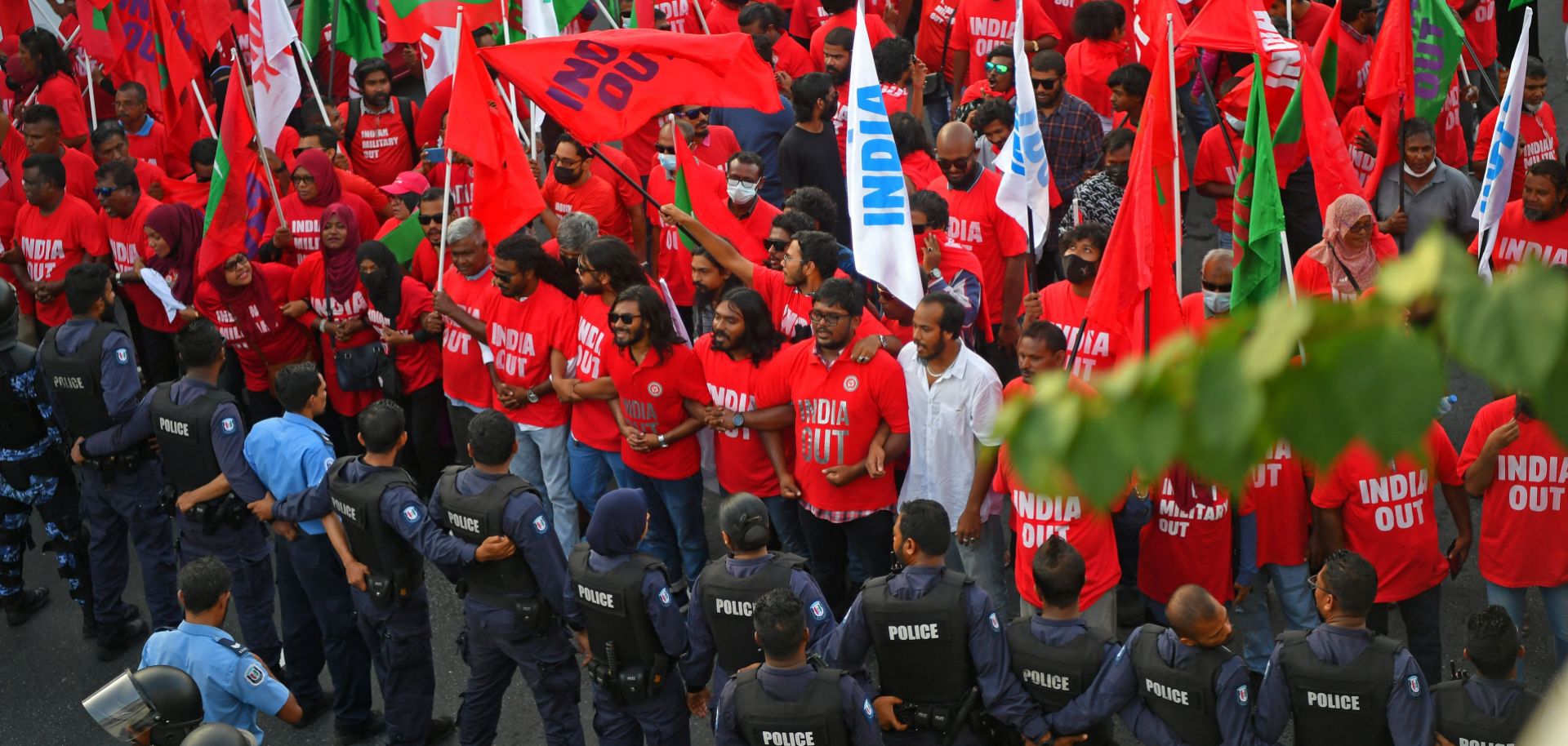
Police stand guard in Male, the Maldives, as protesters take part in an anti-India rally organized by the island nation's opposition coalition on March 25, 2022.
The September presidential elections in Maldives will influence the country's position amid growing competition between India and China for influence on the island nation. While a victory by the ruling party would keep Male close to New Delhi, a victory by the opposition could improve ties with Beijing. The Maldives will hold elections on Sept. 9 to elect its fourth president since the country instituted a multi-party presidential system in 2008. Incumbent president Ibrahim Mohamed Solih from the ruling Maldivian Democratic Party (MDP) will be seeking a second five-year term. Solih's predecessor, former President Abdullah Yameen from the opposition Progressive Party of Maldives (PPM), will be his main challenger. Both sides face obstacles that could undermine their electoral prospects ahead of the ballot — with the MDP facing internal divisions that could split the vote, as the PPM scrambles to free its candidate from prison.
- Solih won the MDP's presidential primaries on Jan. 30, beating out former President Mohamed Nasheed for the ruling party's nomination. Since being defeated in the primaries, Nasheed has not publicly endorsed Solih's candidacy and is now considering forming a new political faction within MDP.
- In December, PPM candidate Yameen — who also served as president of the Maldives from 2013-2018 — was sentenced to 11 years in prison and fined $5 million after the country's criminal court found him guilty of corruption, money laundering and bribery. He has since appealed the conviction and jail sentence to the Maldives' high court. But even if the appeal is successful, Yameen faces another pending corruption case that could land him back in prison.
- If no candidate gains a simple majority in the first round of the presidential race on Sept. 9, a second round will be held on Sept. 30.
India and China play a significant role in Maldivian national politics and will be closely monitoring the election as the two regional powers vie for influence over the strategically located island nation. The Maldives is situated along some of the most vital sea routes for trade in the Indian Ocean. This strategic location has made the island nation a key battleground for China and India's competition for regional influence. India has deep-rooted cultural, economic and defense ties with the Maldives, and has traditionally seen the island nation as within its sphere of influence. In recent years, however, China has been making inroads into the Maldives through its Belt and Road initiative, investing heavily in infrastructure projects. This has led to a split between the two main political parties in the Maldives, with the MDP being more pro-India and the PPM being more pro-China. While MDP has increased engagement with India since 2018 through its India-First policy, the PPM has criticized alleged Indian excessive influence (particularly through the presence of military personnel in Maldives) and adopted an ''India-Out Campaign.'' The PPM has a publicly pro-China stance, as evidenced by the multiple large infrastructure deals that the Yameen administration inked with Beijing during its time in office. The MDP, meanwhile, is wary of the unsustainable debt associated with Chinese deals and has slowed economic engagement with China since retaking power in 2018.
- During Yameen's presidency, China became a major player in domestic economic and political affairs in the Maldives. Beijing signed a free trade agreement with the country and invested in massive infrastructure projects, including a bridge connecting the main island of Male to the smaller island of Hulhumale. The former Yameen administration also awarded many projects to Chinese companies without due diligence and transparency, stoking allegations of corruption and unsustainable Chinese debt. During this period, the Maldives' relationship with India took a nosedive, as New Delhi became increasingly suspicious of China's actions. In 2016, the Maldives leased a small (0.5 sq mile) island near Male to a Chinese company, which raised speculations about the island's potential use in times of conflict.
- After Solih took charge in 2018, he revived the MDP's so-called ''India First'' policy, positioning the country's foreign policy back toward strengthening ties with India. This has seen the Solih administration increase defense cooperation with India in an attempt to ease New Delhi's national security concerns over the Chinese military potentially gaining access to strategic islands or territory in India's backyard. The two countries' economic relationship has also improved, with the Maldives receiving various lines of credit for infrastructure projects in recent years from India. India's delivery of COVID-19 vaccines to the Maldives helped further strengthen their partnership as well.
- The Solih administration's increased collaboration with India prompted Yameen to launch his so-called ''India-Out'' campaign in 2022, which has since sparked protests from the opposition and nationalist groups that view their country's increased reliance on India as a threat to national security and Maldivian sovereignty. The campaign alleges that the MDP's policies are effectively turning the Maldives into a client state for India, pointing to the presence of Indian military personnel who operate the equipment that India has provided the island nation. Over the past year, the PPM has organized large anti-India rallies in the capital of Male and other islands to generate public support for the opposition (and erode such support for the ruling party).
In the coming months, intra-party disputes within the MDP and Yameen's legal issues will determine the two parties' electoral chances. Solih's re-election prospects will hinge largely on whether his growing feud with fellow MDP member Nasheed ends up fracturing the ruling party. Nasheed wants to install a parliamentary system in the Maldives, while Solih wants to keep the country's current presidential system in place. Additionally, Nasheed has publicly advocated for harsher policies to prevent religious radicalization, which Solih has refrained from adopting for fear of alienating the MDP's conservative allies, like the Adhaalath Party. If these disagreements create a permanent rift in the MDP between the Solih camp and the Nasheed camp, it could split the ruling party's support base and undermine its chances of victory in September. A key signpost to monitor in assessing the evolution of this issue will be whether Nasheed eventually throws his support behind Solih in the coming months. The PPM's electoral chances, meanwhile, hinge largely on whether Yameen's legal troubles bar him from running for president. Yameen is the opposition party's most popular leader. If he's banned from running in September's election, it would thus significantly harm the PPM's electoral prospects, helping clear the path to victory for Solih and the MDP. Such a scenario would also carry the risk of increased unrest, as PPM supporters have threatened to organize large protests (some of which could turn violent) unless Yameen is acquitted and allowed to run in the election.
- The Adhaalath Party, a religious conservative party that is part of the MDP-led ruling coalition, has decided to again back Solih for the presidential polls.
- Yameen was convicted of graft charges in 2019, but the Supreme Court later lifted the conviction due to a lack of evidence. This precedent gives Yameen's supporters hope that his current conviction can also be overturned.
If the MDP wins the presidential election, the Maldives will continue to strengthen bilateral ties with India while also maintaining cordial relations with China. Solih's re-election would largely benefit the Maldives-India relationship as the MDP's India-First policy would remain in place. While the MPD government would continue to avoid a direct confrontation with China, its relationship with Beijing would probably remain cordial but distant under Solih, who has warned against an over-dependence on China and unsustainable debt from Beijing. Another term under a more India-friendly, China-skeptical government would also incentivize the United States to ramp up its engagement with the Maldives. However, persistent intra-party feuds within the MDP could weaken the Solih administration by potentially causing lawmakers from rival camps to withdraw their support from the government at any time. Additionally, depending on the religious ideology of its coalition partners, MDP would have to devise a pragmatic policy to counter extremism without offending its conservative partners.
- The United States has worked closely with India on efforts to curb China's influence in the Indo-Pacific, including by having the U.S. navy conduct Freedom of Navigation Operations in India's exclusive economic zone.
- The Maldives, a Muslim country, has seen increased incidents of religious extremism and jihadist violence in recent years. Local Islamic State sympathizers have conducted increased attacks in the island nation, including a series of stabbings of foreign nationals and arson attacks in 2020, and jihadist ideology remains a long-time problem in certain local communities. In May, former president Nasheed — a vocal critic of religious extremism — was injured after an Improvised Explosive Device (IED) detonated outside of his home in Male. In August, the country's minister of environment and climate change, Ali Solih, was also stabbed by an assailant with alleged links to the Islamic State, who chanted Quran verses before he tried (unsuccessfully) to slit the minister's throat with a knife.
Conversely, if the PPM wins the election, Male will increase economic and political engagement with China, damaging Maldives's bilateral relationship with India while domestically causing the potential spread of anti-India extremism and religious radicalization. A PPM win would also be a victory for China, given the party's pro-China stance and anti-India policy. If Yameen retakes office, Chinese investment would grow into various projects while Indian involvement would probably wane, enabling Beijing to re-establish its foothold in the country at New Delih's expense. This would exacerbate already tense India-China ties by fueling speculations of a future Chinese military presence in Maldives — especially if China starts sending alleged ''civilian'' ships to the country, as it's done in Sri Lanka. As a conservative Islamist party, the PPM's policies would also risk fanning anti-Indian sentiments, as India is largely perceived as a Hindu majority state that discriminates against its Muslim minority population under Indian Prime Minister Narendra Modi. Increased nationalist, pro-Muslim and anti-India rhetoric from the PPM and its conservative partners may embolden extremist groups in the Maldives that, if left unchecked, could place the lives of Indian diplomats and tourists in danger. If this results in violent attacks against Indians in the country, Male's diplomatic relations with New Delhi would only further deteriorate.
- China has sent ships to Sri Lanka in the Indian Ocean that, according to Beijing, have civilian purposes. But according to New Delhi, the vessels may have military goals.
- A PPM politician is under investigation after sharing a social media post in December in which he appeared to call on his supporters to attack the Indian High Commission in Male.
- In June 2022, a group of protesters vandalized the venue in Male where the Indian High Commission was holding an event for International Yoga Day. The protesters stated that yoga was against Islam and should not be practiced in a Muslim-majority country like the Maldives, since the practice has a religious association with Hinduism. About 30 people were later charged by the police, some of whom had links to the PPM.
