
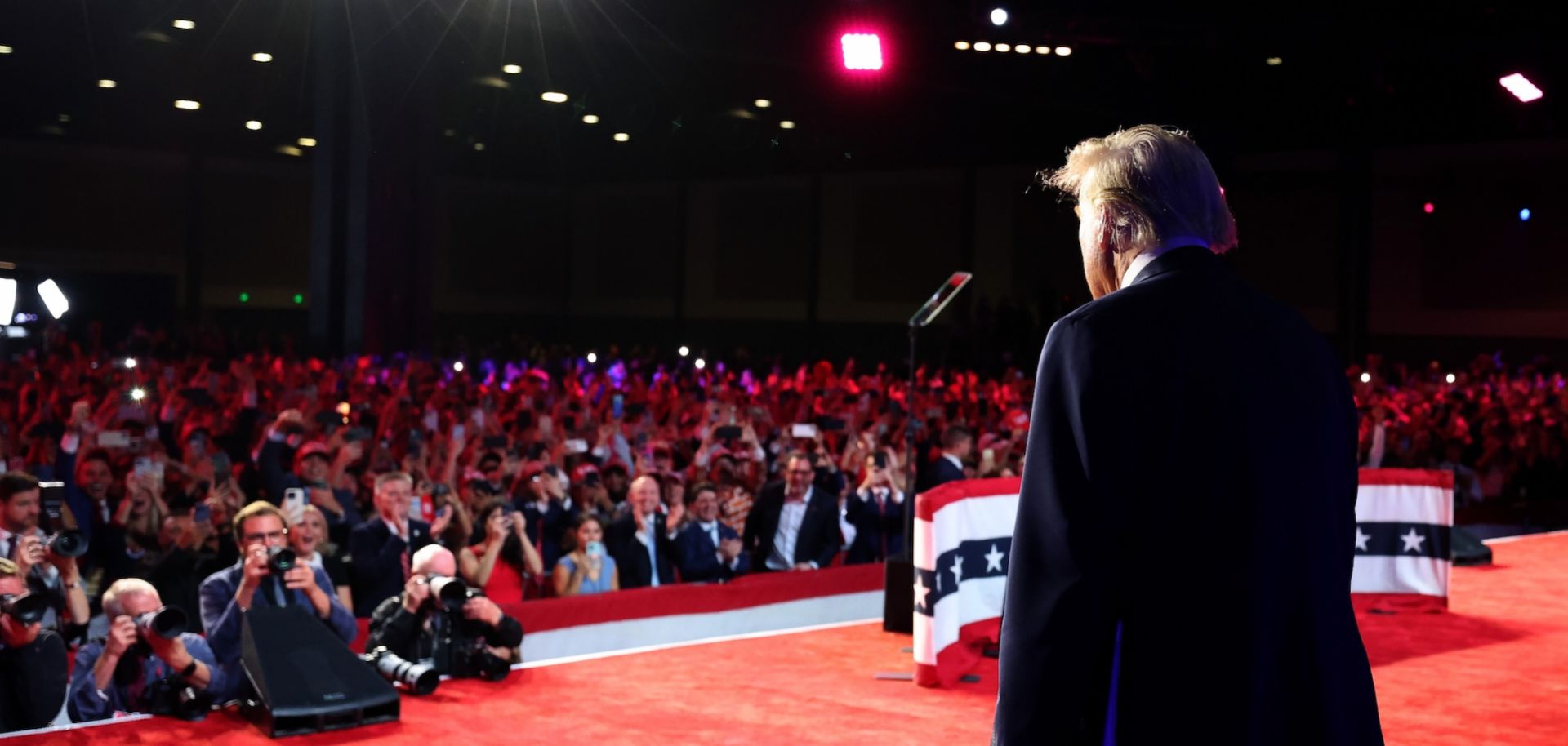
Donald Trump's return to the White House will result in more trade wars between the United States and its major trade partners, as well as reduced support for Ukraine. However, Trump's foreign policy in the Middle East and restrictions on China's technology sector will largely align with those of outgoing President Joe Biden. Trump won the Nov. 5 U.S. presidential election, most likely with a clean sweep of the industrial Midwest whose industries he has promised to protect via tariffs; and, for the first time in his three presidential campaigns, and most likely the national popular vote as well. The Republican Party has also so far picked up three seats in U.S. Senate elections, giving Trump's party a majority in the upper chamber of the U.S. Congress. Control of the House of Representatives remains up for grabs with many votes in close electoral districts likely to take weeks or days. Trump's potential win of the national popular vote, however, makes it more likely that the Republican Party will retain control of the lower chamber, though likely with another slim majority.
- In his election victory speech early on Nov. 6, Trump claimed that his strong performance in the election gave him a ''powerful mandate'' for his agenda.
- In the coming days, Trump and his transition team's picks for certain cabinet positions — including secretary of state, secretary of defense, secretary of commerce and secretary of treasury, as well as a handful of non-cabinet positions, such as national security advisor and U.S. trade representative — will be important to watch to give clues on how his administration may handle certain issues. Trump is expected to appoint people who are more ideologically in sync with his so-called ''America First'' trade and foreign policies than he did during his first administration.
Trump will likely place high tariffs on China and other countries, but his threat to place a 10-20% blanket tariff on all imports will likely drive some U.S. trade partners to engage in talks to secure exemptions. During his campaign, Trump threatened to impose various different tariffs, including a 10-20% tariff on all U.S. imports, a 60% tariff on all Chinese imports, a 25% tariff on all Mexican imports, and an up to 100% tariff on imports of certain automobiles. Trump threatened to impose similar sweeping tariffs ahead of the 2016 election, though once in office, he ended up only placing tariffs on China and steel and aluminum imports and a handful of other goods. This was due in part to concerns about the negative impact of higher tariffs on the U.S. economy and manufacturing sector, as well as significant internal disagreement inside his first administration over the tariffs as many of the Wall Street executives he brought in, such as Treasury Secretary Stephen Mnuchin, opposed Trump's tariff agenda. In his second term, Trump's cabinet will not act as strong as a roadblock on higher tariffs, making it far more likely that proposals largely backed by the Republican Party, like the tariff threat on China, will come to fruition over the next four years. However, more economically disruptive tariffs, like broader 20% tariffs on all imports, are more likely to see pushback. Beyond tariffs on China, Trump will likely wield tariff threats on other countries (including the 10-20% blanket tariff proposal) as a negotiating ploy to gain concessions like voluntary export restrictions, reduced trade barriers for U.S. exports, or changes on foreign or migration policy. The blanket tariff threat — which would likely be controversially implemented using the U.S. International Emergency Economic Powers Act that has never before been used to place tariffs on a country — will likely prompt the United Kingdom, Japan and other U.S. trading partners to offer such concessions in an effort to secure exemptions. Trump may also use a similar strategy to target individual sectors, like auto imports, which he threatened to do in his first term. The incoming Trump administration is far less likely to impose across-the-board tariffs on countries that have a small trade surplus or a trade deficit with the United States, like the United Kingdom, compared with those that have a larger trade surplus, like Vietnam; countries that have a free trade agreement with the United States are also more likely to secure exemptions. Additionally, countries targeted by Trump's levies will impose retaliatory tariffs on the United States that will primarily focus on hitting Republican districts, which will largely affect U.S. agricultural exports, as well as industrial goods, such as vehicles and the steel sector. From a macroeconomic perspective, Trump's tariffs may ultimately only have a modest impact on U.S. GDP and inflation as the U.S. economy's dependence on trade is small and the U.S. dollar will likely strengthen to offset any sweeping tariff.
- In October, Yale's Budget Lab estimated that a 10% tariff on all U.S. imports and a 60% tariff on China, along with the resulting retaliatory tariffs, would cause long-term U.S. GDP to decline by just 0.6% and inflation to rise by just 1.66%, while costing the average American household $2,576 in real disposable income annually. If the blanket tariff were bumped up to 20%, long-term U.S. GDP would decline by 1%, inflation would rise by 2.5%, and Americans' disposable income would decline by $3,855.
Beyond tariffs, Trump's policy on China will be similar to Biden's with more restrictions being placed on China's technology sector that slowly separate U.S.- and China-centric supply chains. While Trump's approach to China will place a greater emphasis on trade than technology, he will likely continue the Biden administration's strategy of placing more significant restrictions on exports of U.S. technology in the semiconductor, AI and quantum computing industries. Such export restrictions would make it more difficult for the United States to reduce its trade deficit, a key goal of the second Trump administration. However, limiting China's access to these technologies has a clear national security objective and is widely supported by both Republicans and Democrats in Washington. Additionally, Trump will likely continue Biden's policy of restricting investment into these strategic technology sectors, while also tightening rules around the use of Chinese equipment in certain industries (by, for example, maintaining the Biden administration's ban on Chinese equipment being used in vehicles' communications systems). Trump is also unlikely to significantly depart from Biden's push to deepen U.S. security ties with Taiwan, which will likely embolden Taiwanese President Lai Ching-te vis-a-vis China, keeping tensions between Taipei and Beijing high.
Trump's threats to end support for Ukraine will increase pressure on Kyiv to enter talks with Russia that will largely be beneficial to the Kremlin, while his hawkish approach to Iran will likely keep tensions in the Middle East elevated. Shortly after he retakes office, Trump will likely threaten to cut off military aid to Ukraine to try to compel the country to quickly begin talks with Russia. But if Kyiv continues to refuse to enter such talks, there will be a growing likelihood of a larger cutoff of military aid that impedes Ukraine's ability to withstand Russia's military offensives throughout 2025 and invariably weakens Kyiv's negotiating position. While the European Union may initially increase military aid to Ukraine in response to U.S. threats, the bloc's ability to continue doing so will diminish over time as countries like Hungary argue that increased European aid is only prolonging an inevitable negotiation between Russia and Ukraine where the Kremlin has the most leverage. Meanwhile, in the Middle East, Trump's return to the White House will also likely keep U.S.-Iran tensions high, as Trump will seek to tighten sanctions enforcement on Iran and could even be more willing to back (or, at the very least, not constrain) more provocative Israeli actions against Iran's nuclear and missile programs. While the Trump administration will likely put some pressure on Israel to reduce its military operations in Gaza and Lebanon, even if those conflicts see cease-fires, Trump's hawkish policy against Iran will keep the risk of another Middle Eastern crisis breaking out during his next term high.
Trump will likely again withdraw the United States from the Paris Agreement and attempt to reverse most of his predecessor's green energy policies, but he is unlikely to fully repeal Biden's Inflation Reduction Act. Trump's election will loom large over this year's U.N. climate summit, which begins on Nov. 11, as Trump will likely trigger the United States' exit from the Paris Agreement for the second time, weakening pressure on non-Western countries at COP29 from strengthening their climate ambitions. The Trump administration will also likely weaken (or abandon) many of its predecessor's emissions and energy transition targets, such as Biden's goal to reduce U.S. carbon emissions by 50-52% emissions by 2030. Through executive action, Trump will likely try to reverse several Biden administration regulations that the U.S. Environmental Protection Agency has put into place over the last year, including a March 2024 rule to strengthen tailpipe emissions requirements in an effort to boost electric vehicle sales by the early 2030s and an April 2025 rule aiming to cut coal-fired power plant emissions by 90% by the mid-2030s. Legal challenges could theoretically curtail these efforts, as U.S. courts occasionally ruled against Trump on climate and environmental issues during his first term. However, the U.S. Supreme Court's conservative majority and the end of the Chevron Deference doctrine, which largely supported federal agencies' rulemaking powers, means such changes may be more likely to survive court challenges during Trump's second term. While Trump has vocally opposed Biden's Inflation Reduction Act (IRA), over three-quarters of the act's benefits have gone to Republican-held districts; this will make it difficult for Trump to gain enough support in Congress to repeal the act because, even if the Republicans win the House, their majority will likely be slim and some individual Republicans will be under pressure by their constituencies to keep the IRA in place. Trump will thus be forced to rely more on executive action to stop the IRA's implementation, like exiting the Biden administration's critical raw materials trade deals with foreign countries that have made it easier for electric vehicles made with more materials sourced outside of North America to qualify for tax credits under the IRA.
- Trump will likely give broad support to the U.S. oil and gas industry, including by hastening the approval of new liquified natural gas (LNG) export projects, rolling back some environmental and emissions regulations on upstream oil and gas producers, and opening up more exploration and investment opportunities in Alaska, including potentially in the Arctic National Wildlife Refuge. However, many of these policy changes will be challenged in court.
- Trump allies have drafted day-one executive orders he could sign shortly after retaking office, which include a version of leaving the Paris Agreement that would also trigger a U.S. withdrawal from the 1992 United Nations Framework Convention on Climate Change (UNFCCC) treaty altogether. While it remains legally questionable whether Trump could do this unilaterally, leaving the UNFCCC treaty would cut off more U.S. cooperation on climate issues internationally. It would also make it far more difficult for a future U.S. president to re-enter those discussions and the Paris Agreement, as it would require a two-thirds majority in the Senate to back reentry into the UNFCCC — a tall order given the widespread opposition to climate change and the Paris Agreement within the Republican Party.
Trump will likely extend tax cuts that expire at the end of 2025, but Congress' inability to significantly reduce U.S. spending — including some industrial subsidies signed into law by Biden — likely means that U.S. federal debt levels will grow, placing more pressure on U.S. government finances that outlast Trump's time in office. Most of Trump's signature 2017 tax cuts expire at the end of 2025. With Trump back in the White House and his Republican Party likely to gain control of the House, an extension of these tax cuts is likely, as well as potentially other tax cuts. While such tax cuts will be broadly positive for U.S. economic growth, the Tax Foundation, a U.S.-based think tank, estimated in October 2024 that Trump's tax proposals could cut U.S. 10-year revenue by more than $3 trillion. The Trump administration will also likely refrain from backing new industrial subsidy programs similar to Biden's CHIPS and Science Act and the IRA. However, given the fact that the current subsidy programs are largely helping Republican districts, including via investments in Arizona fabs and clean energy projects in Texas, finding enough Republican support in Congress to overturn the legislation may be difficult, making it likely that existing subsidy programs will remain in place. For the U.S. technology sector, Trump's election will largely be beneficial as he is less likely to appoint strong anti-trust hawks to the U.S. Justice Department or Federal Trade Commission, and is also highly unlikely to pass major regulations that tighten restrictions on AI or other areas.
- The Tax Foundation's analysis may understate the impact of Trump's fiscal policy on long-term government revenue. This is because it is based on a scenario where Trump also repeals the IRA's tax credits (which the Tax Foundation estimates would increase long-term revenue by an estimated 0.9% trillion), as well as imposes a universal tariff of 20% on all U.S. imports and an additional 50% tariff on all imports from China (which it estimates would increase long-term revenue by $3.8 trillion) — both of which are on the extreme end of potential outcomes.
Finally, Trump will likely threaten Mexico with increased tariffs to more aggressively pressure the country to stem the flow of migrants northward. Trump campaigned heavily on reducing the number of migrants flowing across the U.S.-Mexico border. Over the next four years, Trump and his Republican allies in Congress will thus likely boost measures to strengthen U.S. border security and increase mass deportations, and may also even bring back Trump's controversial family separation policy. While a full shutdown of cross-border trade is highly unlikely given the impact this would have on the U.S. manufacturing sector, at some point during his next term, Trump will probably threaten to place tariffs on Mexican imports unless Mexico complies with some sort of demand on stemming migration flows, just as he did during his first term. But such tariffs are ultimately unlikely to be implemented, as Mexican President Claudia Sheinbaum will almost certainly acquiesce to such demands due to Mexico's economic dependence on exports to the United States. Finally, Trump's election will ensure that the 2026 review process for the U.S.-Mexico-Canada Agreement, or USMCA, will be contentious. This is because the Trump administration will likely try to remedy Mexico's large trade surplus with the United States by changing the pact's rules of origin requirements that make it more difficult for goods to qualify for benefits under the USMCA, which will principally affect the auto sector. To put pressure on Mexico, Trump may also threaten to withdraw from the USMCA — or even formally trigger a U.S. exit — as a part of these negotiations. Nevertheless, Trump is unlikely to fully exit the agreement due to the severe economic consequences, and the fact that Canada and Mexico would likely offer significant concessions to ensure the pact remains in place.
- During his first term, Trump threatened to place a 5% tariff on all imports from Mexico if the country did not take more action to curb immigration flows, but the tariff was ultimately avoided after Mexico agreed to deploy its national guard to its southern border in order to stem the flow of northbound migrants crossing into Mexico from Central and South America on their way to the United States. On Nov. 4, the day before the U.S. election, Trump threatened to place a 25% tariff on Mexico if it did not stop the flow of migrants across the border, and warned he would increase those tariffs to 100% if the original threat did not work.
