
Editor's Note: This is a complimentary piece of content we share from our Core Intelligence platform. RANE’s foundational intelligence product covers four major categories of risk: cybersecurity, physical safety, geopolitics, and compliance. Core Intel allows our clients to view risk through a unique, integrated lens, providing situational awareness across multiple risk categories. Contact us to learn more.
Regardless of whoever emerges as the winner of the Nov. 5 U.S. presidential election, technology policy – particularly towards China – will be a major focus of the incoming U.S. administration. While both President Joe Biden and former President Donald Trump will have similar national security concerns about China's access to foreign technology and exports of technology goods, Trump may entertain talks with China on a second trade deal or another agreement that could lead to a slowdown or a deal on some of the U.S. restrictions – an outcome that is highly unlikely to occur in a second Biden term. Domestically, a Trump presidency may dial back aggressive antitrust action by the Department of Justice and Federal Trade Commission across all sectors. Still, Trump would instead likely focus his criticism and scrutiny on specific technology companies, including those he believes have squelched his speech or that of his conservative followers, or specific deals he does not like, similar to his focus on TikTok during tenure as president. To discuss the election's impact on technology policy, RANE spoke with Adam Golodner, CEO of Vortex Strategic Consulting, LLC.
Both Trump and Biden Will Have Core National Security Concerns, and Neither Will Push Through AI, Data Privacy Legislation
No matter who wins on Nov. 5, Golodner says either administration will implement core national security and technology policies. He notes that both Biden and Trump would want to keep hostile actors — primarily China, but Golodner also mentions Iran and Russia — in mind when creating these policies, with Trump being less concerned about Russia and likely open to giving Putin a wide berth. Both presidential candidates are concerned about "China's developing military capacity and the challenge and threats that it poses to the US," says Golodner, and this continued idea will inspire policy. Specifically, U.S. policy will aim to "police China's civil-military fusion and the ability of U.S. technology or intellectual property to flow from the commercial side in China to the military side."
- Congress will also likely continue pushing for increased legislation targeting China, especially via the House Select Committee on the Chinese Communist Party. A report released by the Committee in December 2023 outlined a number of policy recommendations designed to slow down China's military technology modernization program and support American leadership in critical technologies. In addition to matters relevant to trade and other policy domains, the Committee recommended Congress enact legislation requiring large public companies to disclose key supply chain risks associated with the potential loss of access to Chinese suppliers. Furthermore, it proposes giving the president the authority to ban Chinese technology products from the U.S. market and to enact legislation to allow the Treasury Department to place sanctions on Chinese companies directly tied to the Chinese military-industrial complex.
Golodner also says both potential administrations would likely continue focusing on the artificial intelligence (AI), quantum computing, critical and advanced materials (materials for military application and rare earth metals), biotechnology, and semiconductor industries. Policies and restrictions on these key industries will likely increase as these technologies and their military applications advance. This may include tightening export controls on the most advanced semiconductors as both semiconductors and their application in AI and supercomputing also advance. China will continue to try to build up its own indigenous semiconductor industry to compensate for the loss of the most advanced Western chips and equipment. Restrictions like export controls, however, tend to be a "lagging indicator" catching up to the advances in technology, according to Golodner. Fundamentally, Golodner notes that future tech policy will likely be rooted in protecting U.S. national security, as opposed to denying purely commercial technology to others, as the sale of commercial technology to others helps fund U.S. company innovation.
Irrespective of the incoming administration, Golodner anticipates little progress toward the enactment of comprehensive federal legislation pertaining to data privacy or a highly regulatory federal AI law akin to the European Union's AI Act that was approved in the European Union this year. He says one exception might be a privacy law focused on protecting children, an idea that seems to have broad bi-partisan support. Golodner expects the states to continue to take the lead with state-level data privacy acts in the absence of a federal data privacy law. In total, 13 U.S. states have enacted comprehensive data privacy laws as of Feb. 28, 2024, with New Hampshire also passing legislation that still needs to be signed into law. Another 18 states – primarily in the Midwest, Mid-Atlantic and Northeast – have bills that have been introduced.
While some Democrat-led states have been aggressive in passing data privacy laws, like California, many Republican states have also sought to pass data privacy laws, including Texas and Montana. On AI in the United States, Golodner expects voluntary pledges, National Institute of Science and Technology (NIST) AI best practices and guidelines, and OECD and G7 sets of good practices – as opposed to explicit requirements – for AI companies. One exception may be in U.S. government procurement, where agencies may try to impose specific requirements. Biden's October 2023 Executive Order largely focused on ordering various government agencies to develop voluntary standards and guidance for the use of AI, with only a small portion of AI models posing a risk to national security, economic security or public health and safety, requiring higher standards of operation and reporting.
A Second Biden Term Would Focus on Pushing U.S. Allies to Place Restrictions on China
In a second term, Golodner believes the Biden administration would likely continue its existing framework of implementing further national security-based export controls on technology exports to China, as well as U.S. investments in sensitive industries. As noted by Commerce Secretary Gina Raimondo in October 2023, the Biden administration is looking at a "grand vision" of about five to six years to decouple semiconductor supply chains from China, with the current policies working toward that goal. Golodner forecasts a continuation of technology policy that is both national security-based and aware of the benefits to U.S. industry and innovation from the sale and export of commercial technologies globally. On the core military use side, the United States will continue global policies that "create a balance against China's continued expansion of its sphere of control and policies." The core principle of protecting U.S. national security will remain constant, but the targeted industries and specific policies will likely change in accordance with the evolving nature of technology.
Additionally, a second-term Biden administration would likely increase pressure on its allies and partners to implement similar measures. Golodner emphasizes that Biden aims to cooperate with allies and align foreign policy measures with other democracies "to present a values-based proposition for people around the world" in the face of rising autocracies. This could result in an organized multilateral framework coordinated on technological restrictions on China or, as Golodner mentions, increased cooperation in existing partnerships like the Quad — a strategic security dialogue between Australia, India, Japan and the United States.
The Biden Administration is currently pressing many of its allies to step up restrictions on China, and a second Biden term would see similar pressure. Specifically, the United States is pushing the Netherlands to stop semiconductor manufacturing equipment producer ASML from servicing advanced lithography machines that it sold in China before the Netherlands placed restrictions on the export of those machines last year. The United States is also pressuring Japan to restrict chemical exports to China for use in chipmaking. The United States is similarly pressuring South Korea and Germany.
A Second Trump Presidency Would Bring Back An 'America First' Policy But Also a Potential Deal with China
Golodner says that a second Trump administration would bring back an 'America First' approach to foreign and national security policy that would differ significantly from Biden's and would inform Trump's technology policy towards China and Russia, even if Trump continues to, largely speaking, implement more national security-focused restrictions on China. Golodner points out that Trump "does not view the role of the United States as having an obligation to provide for the stability of the world." He adds that as president, Trump's policies would push Europe away from the United States, as in his previous term. Trump's focus on 'America First' trade policies would likely mean a resumption of the U.S. trade war with the European Union – and likely continue to increase tariffs on China. This will make it more difficult for Trump to place any pressure on European countries to implement harsher technology restrictions on China, similar to those for which the Biden administration is currently pressing.
Without European or Asian countries placing restrictions on technology exports to China, a second Trump administration would likely need to be even more expansive in unilateral restrictions by the United States – possibly even increased sanctions – in order to have the same impact on China's technology sector that a second Biden administration would be able to achieve through global cooperation.
Golodner also warns that there could be policy whiplash, or 'zigzag,' on China in a second Trump term. While Golodner expects a second Trump Administration to place more restrictions on China due to national security concerns, he points out that a second Trump term is likely to have more political appointees that are aligned with his 'America First' approach to foreign policy than he did in his first term. As a result, while many U.S. government agencies will still be pushing for a hardline approach to China, the White House may quickly latch onto an issue and redirect the United States' focus to something else. Golodner points out that in his first term, Trump was "enamored of making deals with dictators, and [he thinks] that will continue." He points out that Trump is very "transactional" and that a second Trump term would have "fewer people who might put brakes on [his] policies appointed to positions of authority, and there will be much less of the structure to hold back or stymie some of his impulses." He adds that if there's a deal to be made, Trump might trade off "what one might consider a national security interest for an interest that he personally thinks is more important." Golodner notes that the first Trump Administration reportedly delayed placing some restrictions on Huawei over concerns that it would have disrupted China-U.S. negotiations on a trade deal.
A Second Trump Administration Would Narrow Focus on Antitrust Concerns With Tech Companies
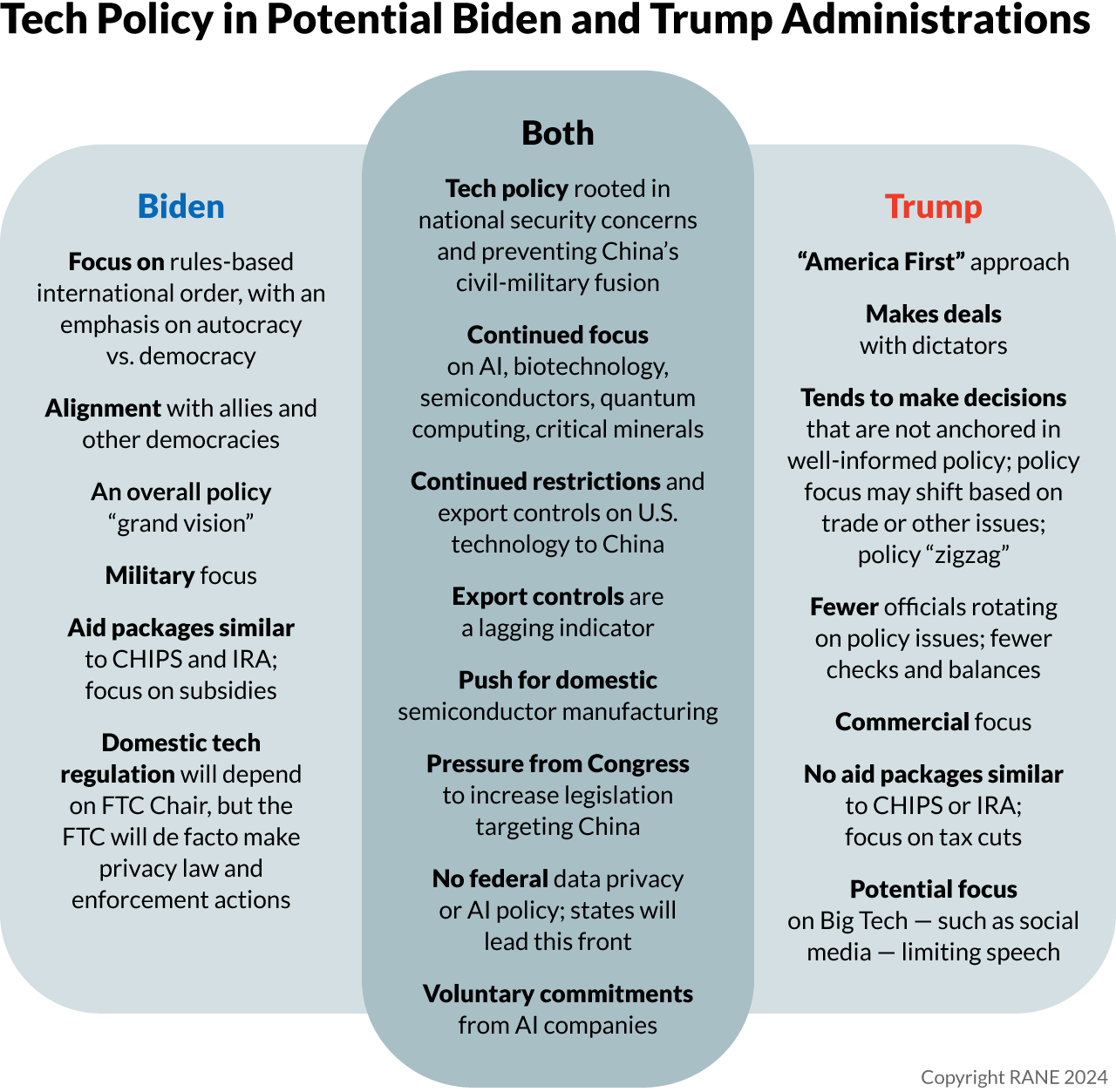
Golodner does not expect a second Trump administration to focus on launching antitrust lawsuits against all technology companies for 'big is bad' philosophical reasons, but says the administration could instead focus its enforcement efforts on whether or not the administration believes a particular technology company has been curbing conservative or Trump's own speech. He adds that the concern over curbing conservative speech has gotten significant attention from Republican Congressional leaders. Overall, he says it will be important to watch who will get key antitrust positions in a second Trump administration at the Federal Trade Commission (FTC) and the Department of Justice (DOJ) Antitrust Division. If the appointees are traditional Republican Chicago School, economic-based antitrust professionals, then Golodner says there will likely be a return to a more traditional view of antitrust enforcement across sectors. However, regarding technology companies, a Trump appointee may still be compelled to focus particularly on the speech issues Trump espouses. For non-technology enforcement, it would be hard to imagine a full-on 'big is bad' approach followed by the current FTC chair, Lina Khan. However, Golodner cautions that just as Trump was previously able to readily involve himself in a technology dispute with China, he maintains the capacity to push for antitrust and regulatory investigations across various sectors and "take enforcement actions against companies and owners of companies that he did not like." At the minimum, this could result in regulators taking a "hard, close look" at deals Trump is interested in.
- Under a Trump presidency, CFIUS reviews of foreign takeovers of domestic companies in strategic industries are likely to be heightened, even from allied countries. A Biden administration would be less concerned about such takeovers. Still, as the bipartisan push against Nippon Steel’s acquisition of U.S. Steel demonstrates, even a second Biden administration could still be skeptical of some takeovers by foreign firms from allied countries in politically sensitive industries where unions oppose the acquisitions.
If Biden wins, Golodner says it will be crucial to see what happens to Khan and her position as chair of the FTC. Khan's term as chair expires Sept. 25, 2024, and Golodner points out that she is not required to leave until a replacement for her slot is confirmed; she could therefore, retain her position, at least for a while, even if she is not renominated. He notes that even if Biden is re-elected, the FTC nomination and confirmation process will receive a lot of attention because of how Lina Khan was appointed previously. President Biden nominated her as an FTC commissioner, later surprising many in the Senate by appointing her as Chair immediately upon confirmation, a move considered controversial given her views on antitrust and application to tech companies. Golodner says that if the Republicans regain control of the Senate and Biden is president, they will take a hard look at the FTC chair appointment, and it is unlikely the Senate would approve anyone with her expansive views on anti-trust issues. Khan has launched a number of high-profile antitrust investigations and lawsuits against technology companies, approaching antitrust in a different way from her predecessors by focusing less on consumer welfare and more on how monopolies harm competition in other ways, such as potential competitors, actual competitors, sellers and labor markets. Her mixed track record in cases that have gone to court – including a high-profile court defeat for the FTC trying to block Microsoft's $70 billion acquisition of Activision Blizzard – has led critics to question her approach. In a second Biden administration, Golodner adds that regardless of who the FTC chair is, "you will continue to see the FTC de facto making Privacy Law and [using] enforcement actions."
On domestic technology subsidies, Golodner says that he would not expect the Trump administration to back another Chips Act, referring to the $280 billion 2022 law that set aside more than $52 billion in subsidies and tax benefits for semiconductor production in the United States. While Trump would certainly push for increased domestic semiconductor manufacturing — during his first term, he personally pushed for TSMC to build a plant in the United States — Trump, as well as most Republican fiscal hawks in Congress, have criticized the Biden administration's spending bills for the industrial sectors, including the 2021 Bipartisan Infrastructure Investment and Jobs Act, the 2022 Inflation Reduction Act and the Chips Act. A return to a Trump presidency would likely lead to more emphasis on tax cuts rather than subsidies, while new subsidies for green technologies like those included in the Inflation Reduction Act will discontinue.
- A Biden administration would likely try to increase subsidies and other financial incentives for domestic manufacturing similar to the three major acts passed in its first term.
What Companies Should Do to Prepare
Companies should immediately start planning a strategy for the next U.S. administration, says Golodner. He explains that companies need to ensure they understand the technology restrictions, policies and related issues discussed above, elaborating that they need to also understand "the policies not just in the U.S. but in Europe, India, Australia, Korea and Japan." Golodner adds that companies should be looking at how these issues are relevant to their particular industries and products, as the impact on companies directly in the technology sector differs from those just using technology goods in their own services and products.
- Golodner adds that this strategy planning needs to be "cross-functional between business units, government affairs, the CFO's office and communications" to understand how the election may impact them and how they might adjust their course based on the election outcome.
Golodner says that it is also "vitally important for corporate leaders to decide whether or not to engage with policymakers in the U.S. and globally in order to shape those changes and to push those changes." He points out that second-term administrations are "just different." Second-term presidents do not need to be as concerned with how their decisions affect their electability in the future, giving them more freedom to express their personal views on specific issues. Golodner says he thinks there will be "opportunities in [a] second Biden Administration to push for changes." He also says that companies will need to decide whether or not they will want to interact with a second Trump administration as well. He concludes that if corporate leaders do decide to act to shift corporate decisions based on what comes out of the election, they need to have a "very clear path forward both in the U.S. and globally," given the narrowing window for such actions.
Golodner's view that Congress is unlikely to pass a broad-based federal data privacy law regardless of the outcome of the election also means that companies should continue to prepare for greater compliance burdens resulting from the patchwork of state laws. Under a Biden administration, the FTC will continue its efforts to alleviate this issue by effectively establishing federal regulations in specific realms where its authority is clearly defined, such as matters concerning discrimination, protection of children and consumer consent. In a Trump administration, the FTC will not be nearly as active, magnifying the differences between state-level data privacy laws.
About the Expert:
Adam M. Golodner is CEO of Vortex Strategic Consulting, LLC, and an advisor and authority on global cyber, emerging technology, national security and regulatory issues. A former global law firm partner, technology executive, senior Justice Department official and academic, Adam advises companies on how to navigate the intersection of cyberspace, markets, and governments. Adam is also a Fellow at the Center for Digital Strategies, Tuck School of Business at Dartmouth and an Adjunct Professor of Law at the George Mason University Law School. He is a graduate of the University of Colorado Law School and Colorado College.
