
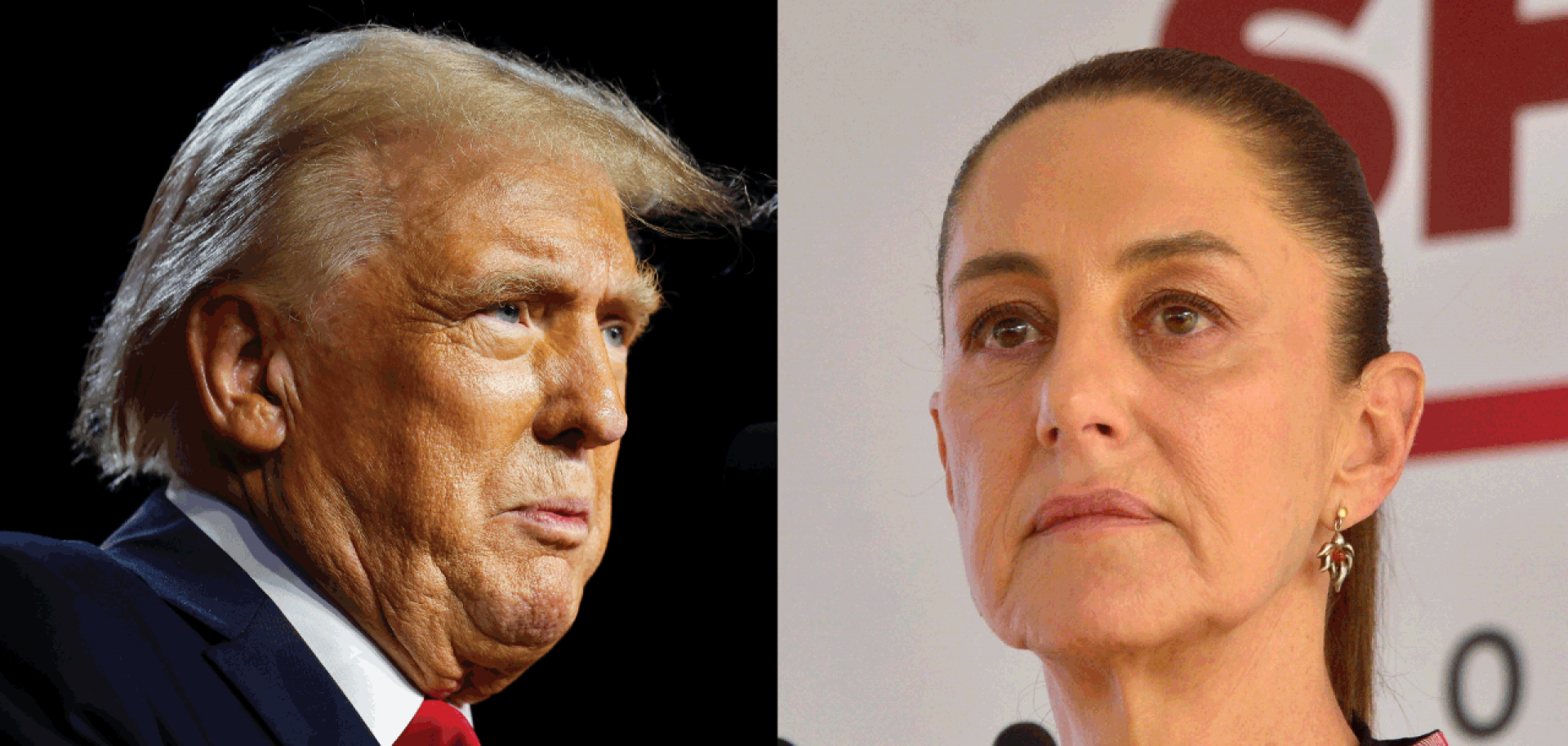
During his next term as U.S. president, Donald Trump will increase pressure on Mexico to curb immigration and drug trafficking, while threatening tariffs and generating uncertainty surrounding the U.S.-Mexico-Canada Agreement, which will harm Mexico's investment attractiveness, even if the country ultimately remains an attractive manufacturing destination. In overnight trading on Nov. 5-6, as it became clear that Trump would win the U.S. presidential election, the value of Mexican currency fell by 3.5% to 20.81 pesos to the U.S. dollar, its lowest since mid-2022. The peso has since recovered, but the drop likely reflected investors' concerns over how a second Trump term could impact Mexico's economy, given Trump's repeated campaign pledges to impose steep tariffs on Mexican goods. On Nov. 4, the day before the U.S. election, Trump said the first international call he would make as president would be to Mexican President Claudia Sheinbaum; in particular, he said he would ''inform her on day one or sooner, that if they don't stop this onslaught of criminals and drugs coming into our country, I'm going to immediately impose a 25% tariff on everything they send into the United States.'' On Nov. 6, following Trump's projected victory, Sheinbaum said she would wait until the vote tallies were finalized before congratulating the winner, but assured that ''Mexican compatriots [and] entrepreneurs'' had ''no reason to worry'' and that ''Mexico always comes out ahead.''
- On the campaign trail, Trump threatened tariffs as high as 100% on all Mexican goods. In October, he specifically threatened to impose a 200% tariff on cars coming from Mexico.
Trump's first term heightened U.S.-Mexico tensions, though he and former Mexican President Andres Manuel Lopez Obrador ultimately achieved a stable relationship, which Sheinbaum will likely try to do, too, given Mexico's economic dependence on exports to the United States. Trump's campaign focused heavily on Mexico and its alleged inaction to curb illegal immigration and drug trafficking across the U.S. border; he also repeatedly blamed Mexico for supposedly ''stealing'' U.S. jobs. During his first term, Trump expressed similar concerns, which caused multiple disputes with former Mexican President Enrique Pena Nieto (who left office in 2018) and his successor Lopez Obrador (who left office on Oct. 1). Trump's repeated threats to build a border wall and make Mexico pay for it, as well as his demands that Mexico increase its efforts to combat illegal immigration, led to the cancellation of multiple bilateral meetings during the four years he was in office. Trump also strong-armed the Mexican government into meeting his demands by threatening tariffs, but these were never imposed because Lopez Obrador ultimately established a stable relationship with Trump by acquiescing to his demands to restrict immigration and attempting to avoid conflict with him. Sheinbaum is a member of Lopez Obrador's ruling Morena party and is aligned with her predecessor on most issues. This and her comments following Trump's victory suggest she will likely try to build a similarly stable relationship with the next Trump administration, in an effort to avoid any tariffs or other retaliatory measures that could severely damage the Mexican economy due to its deep dependence on exports to the United States.
- In May 2019, Trump threatened to impose a 5% tariff on all Mexican goods unless Mexico took ''substantial'' action to reduce the flow of migrants showing up at the U.S.-Mexico border. Lopez Obrador ultimately agreed to take such action, sending 6,000 troops to Mexico's southern border with Guatemala in June 2019.
- According to the U.S. International Trade Commission, 80.9% of Mexico's exports went to the United States in 2023. The same year, Mexico surpassed China as the largest source of U.S. imports.
- The Mexican industries most dependent on U.S. exports include the automotive, appliance and electronic manufacturing, and food and agricultural sectors.
Trump is highly likely to significantly increase pressure on Mexico to take action on regional migration, a demand that will threaten to strain Mexican government resources given that authorities have already implemented stricter measures in recent months. Despite Sheinbaum's intent to build a stable relationship with Trump, his comments as recently as the day before the election indicate his willingness to make significant demands of the Mexican government over immigration policy. Such demands will likely include expanded efforts to prevent migrants from reaching the border and the deployment of security personnel to key migration chokepoints, particularly the Guatemalan border and the U.S. border. The Mexican government has already significantly increased measures to reduce illegal U.S.-Mexico border crossings throughout 2024, detaining migrants and repatriating them or transferring them away from the U.S.-Mexico border region to slow their progress. These measures have significantly reduced migration flows into the United States over the course of 2024, despite migration through other regional chokepoints such as Panama's Darien Gap remaining near record highs. However, while they have proven to be an effective way to reduce arrivals in the United States, such measures require significant security resources, and given that the Mexican government is also focused on preventing an increase in violent crime amid multiple ongoing conflicts between rival criminal groups, it is unclear how much more bandwidth the country's security apparatus has to devote to immigration efforts. Sheinbaum will likely be easily able to divert needed funding to the efforts thanks to her Morena party's control over the executive and legislative branches, but it will pull resources from elsewhere in the government and could thus restrict Sheinbaum's broader or long-term policy goals, including poverty reduction efforts.
- In December 2023, U.S. Customs and Border Patrol (CBP) recorded an all-time monthly high of 301,981 encounters with migrants at the U.S.-Mexico border. Immediately after, encounters began to drop amid Mexico's increased efforts to combat migration, falling to 176,195 in January and continuing to fall over the course of the year to 101,790 in September, the lowest level since February 2021.
- Also contributing to the drop in migration, in June, U.S. President Joe Biden signed an executive order that restricts asylum requests at the U.S.-Mexico border when the daily average number of CBP encounters reaches 2,500. As encounters are typically far above this level, the measure effectively prevents most asylum requests.
Trump will also likely pressure Sheinbaum to take greater action on organized crime and drug trafficking, with the small risk that the U.S. could even conduct unilateral actions against cartels, which would threaten to upend Sheinbaum's less confrontational security policies and escalate violent crime in Mexico. Another major focus of the Trump campaign and the broader Republican Party has been violent organized crime in Mexico and the trafficking of illegal drugs like fentanyl into the United States. Trump's reference to drugs alongside immigration in his Nov. 4 remarks about Mexico suggests his next administration will prioritize reducing drug trafficking, though based on the precedent of his first administration, the issue will likely be secondary to immigration and economic concerns. Still, recent comments by Trump and other Republican lawmakers indicate the issue of Mexican organized crime could receive increased attention in Washington in the coming years. Demonstrating this, in May 2024, Rolling Stone reported that Trump told allies he wanted to covertly deploy assassination squads into Mexico after he takes office to combat drug cartels, with other notable Republicans including Rep. Marjorie Taylor Greene and Florida Governor Ron DeSantis voicing support for U.S. drone strikes on Mexican cartels. Trump and his allies remain highly unlikely to follow through on these threats, which would severely damage U.S.-Mexico relations. But unilateral U.S. actions against cartels could become more likely over the course of Trump's term, particularly if he is unsatisfied with Sheinbaum's actions or if U.S. citizens are kidnapped or killed in a high-profile event involving Mexican cartels. Such unilateral actions by the United States could destabilize cartels' dynamics and result in increased turf wars and a surge in violence, similar to the ongoing conflict in Sinaloa following the July 2024 U.S. arrest of Sinaloa Cartel leader El Mayo, which has since internally split the group. But even if Trump opts against taking direct unilateral actions, he will likely still consider designating Mexican cartels as terrorist organizations and pressure the Sheinbaum administration to take greater action to combat drug trafficking. For Sheinbaum, this will risk undermining her security strategy, which focuses on reducing poverty to combat crime, while avoiding a crackdown on organized crime that would trigger an escalation in violence like that seen under former President Felipe Calderon (2006-2012). If Trump administration policies on Mexican organized crime do trigger a similar crackdown, it would likely raise safety threats across Mexico and worsen the operating environment for businesses.
- President Calderon launched a crackdown on crime shortly after taking office in 2006. The crackdown included targeted operations against Mexico's cartels, leading once dominant groups to weaken and fracture into multiple smaller groups. This subsequently triggered a period of increased cartel competition that significantly increased levels of violence, doubling the country's homicide rate over the following decade.
- During Trump's first term in early 2020, he spoke privately about the potential for the United States to fire missiles at drug labs in Mexico.
Sheinbaum will likely at least partially accede to Trump's demands to avoid tariffs, and while uncertainty over trade restrictions will hurt Mexico's attractiveness for investors in the near term, Mexico will likely remain an attractive manufacturing destination as Trump targets other countries around the world with tariffs. On the issues of immigration and crime, Trump's main point of leverage will be his threats to impose tariffs on Mexico. The drop in the value of the Mexican peso shows how these threats are already fueling concerns among groups considering investing in Mexico or moving manufacturing operations to the country, as Trump's tariffs, if implemented, would reduce Mexico's attractiveness for companies seeking to take advantage of U.S. nearshoring trends and diversify their supply chains away from China. A blanket U.S. tariff on all Mexican goods would not entirely eliminate the benefits of manufacturing in Mexico (namely cheaper labor and proximity to the United States). However, the threat of such tariffs adds to broader concerns about the country's long-term regulatory and operational environment following Mexico's recent passage of contentious constitutional reforms. In the coming months, this will continue to damage investor confidence in Mexico, potentially even leading to a slowdown in new investments until there is greater certainty regarding potential U.S. tariffs and the implementation of the constitutional reforms. However, given Mexico's economic dependence on exports to the United States, Sheinbaum will ultimately likely show she is willing to take action to address Trump's demands on immigration and crime, which will reduce the likelihood of significant tariffs on Mexico over the next four years. In fact, Trump's hawkish trade policies could even benefit Mexico, as his broader intent to implement tariffs globally means that if Mexico avoids tariffs, it would be an even more attractive destination for manufacturing in comparison to other potential targets for tariffs, like Vietnam and China.
- Mexico is currently in the process of implementing a package of constitutional reforms proposed by President Lopez Obrador in February 2024. The government has already enacted controversial reforms to the judicial system that will make all judges popularly elected, a move that has faced criticism for undermining the independence of the judiciary and creating long-term policy uncertainty. Given Morena's near-full control of the Mexican government, additional reforms are expected in the coming weeks and months, including a measure to prioritize state-owned energy companies, and an expansion of state control over infrastructure, including water and railways.
Finally, Trump is unlikely to leave the U.S.-Mexico-Canada Agreement (USMCA), but he will threaten to do so to gain leverage in upcoming talks to extend the pact, where he will likely press for more restrictions on the auto sector. Separate from near-term tariff concerns, a second Trump administration also means that trade talks will be contentious when the USMCA comes up for review in 2026. To increase the United States' leverage in those negotiations, Trump will likely threaten to leave the USMCA, which was established during his first term as the successor to the North American Free Trade Agreement, or NAFTA. Trump's demands will largely center on the automotive industry in an effort to prevent further jobs in the sector from leaving the United States. If this results in restrictions on vehicle imports from Mexico, it would damage Mexico's automotive sector, and particularly the economies of carmaking hubs like Monterrey, Puebla and Zacatecas. The U.S. business community will likely pressure Trump to extend the USMCA, meaning he is unlikely to follow through on his threats to exit the pact. But the contentious negotiations will nonetheless generate uncertainty over the trade agreement's longevity, potentially causing more temporary damage to investor sentiment in Mexico.
