
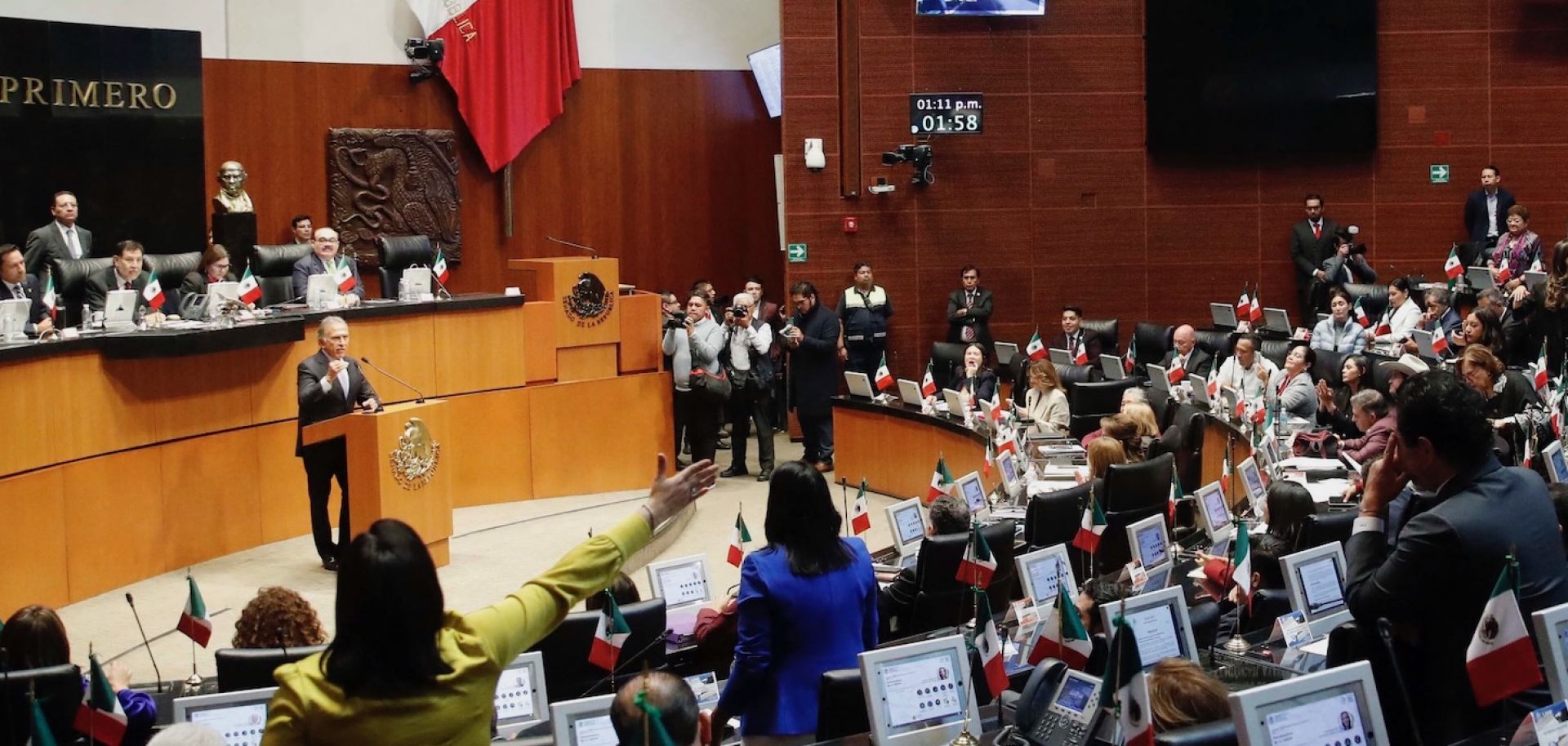
Mexico's government will likely concentrate power and introduce interventionist policies that will increase operational costs for companies and inefficiencies in the economy, but structural drivers behind geopolitical realignments will continue to underpin foreign investment inflows in the long term. Nov. 1 marked President Claudia Sheinbaum's first month in office and the second month of the new legislature dominated by the ruling coalition. Throughout September, government allies leveraged their two-thirds majority in the Chamber of Deputies and their comfortable lead in the Senate to rush parts of a package of 18 constitutional reforms that then-President Andres Manuel Lopez Obrador presented in February — dubbed "Plan C." Out of that package, the most controversial and consequential proposal was the judicial reform, which Congress approved and Lopez Obrador enacted in just two weeks on Sept. 15. In his last day in office on Sept. 30, the former president also signed into law two additional constitutional changes of Plan C: the militarization of the National Guard and the expansion of Indigenous and Afro-Mexican rights. Since Sheinbaum's inauguration, the legislative branch has voted on several of the 15 remaining reforms of Plan C, and given the ruling coalition's control of the legislative branch, the entire package of reforms will eventually be implemented. In the meantime, Sheinbaum has outlined 100 additional commitments and reform plans, which will prioritize women's and workers' rights.
- The transfer of the National Guard to the Ministry of Defense will increase the militarization of public matters in Mexico and reverse the National Guard's original purpose of being a security institution under civilian rule when it was created in 2019.
- The reform regarding Indigenous and Afro-Mexican people's rights gives them legal status to receive budget resources and a more prominent role in consultation around future extractive and infrastructure projects and construction works, which could delay licensing processes.
The reforms included in Plan C and Sheinbaums' reform plans will likely further concentrate power under the ruling party in the long term. Lopez Obrador's Plan C includes changes to the country's political and electoral systems and eliminates several autonomous and regulatory agencies, institutes and commissions. Additionally, Sheinbaum promised to present in 2025 bills to ban the reelection of legislators and mayors (presidents cannot currently be reelected) and to fight nepotism by banning close relatives of public officials from running for the same office until another term has passed. The ruling coalition's ample legislative majority and the opposition's internal struggles will limit meaningful pushback, although civil society mobilization will likely result in occasional protests. As a result, these structural and regulatory changes will broadly restructure the Mexican state and likely enable the ruling Morena party to exert strong control over the country's three branches of power and institutions, as well as overhaul Mexico's existing constitutional and regulatory frameworks. These changes will profoundly impact how businesses operate in the country in the coming years.
- Changes to the country's political system proposed under Plan C include reducing the number of senators from 128 to 64 and deputies from 500 to 300, as well as restricting funding for electoral campaigns and political parties. While this streamlines bureaucracy and likely reduces spending, the changes will likely favor politicians in power, namely Morena members considering the party controls most seats in Congress, state legislatures and governorships. Additionally, the proposal to lower the participation threshold for popular consultations to be binding from 40% to 30% will likely favor the introduction of populist policies.
- Under Plan C, the proposed constitutional reform of Mexico's bureaucracy entails the elimination of seven autonomous bodies responsible for overseeing economic competition, social development, data protection, telecommunications, energy, oil and gas activities, and education policies. The reform would transfer these bodies' responsibilities to the executive branch. Limited checks and balances will likely further undermine accountability and strengthen the centralization of power under the ruling coalition.
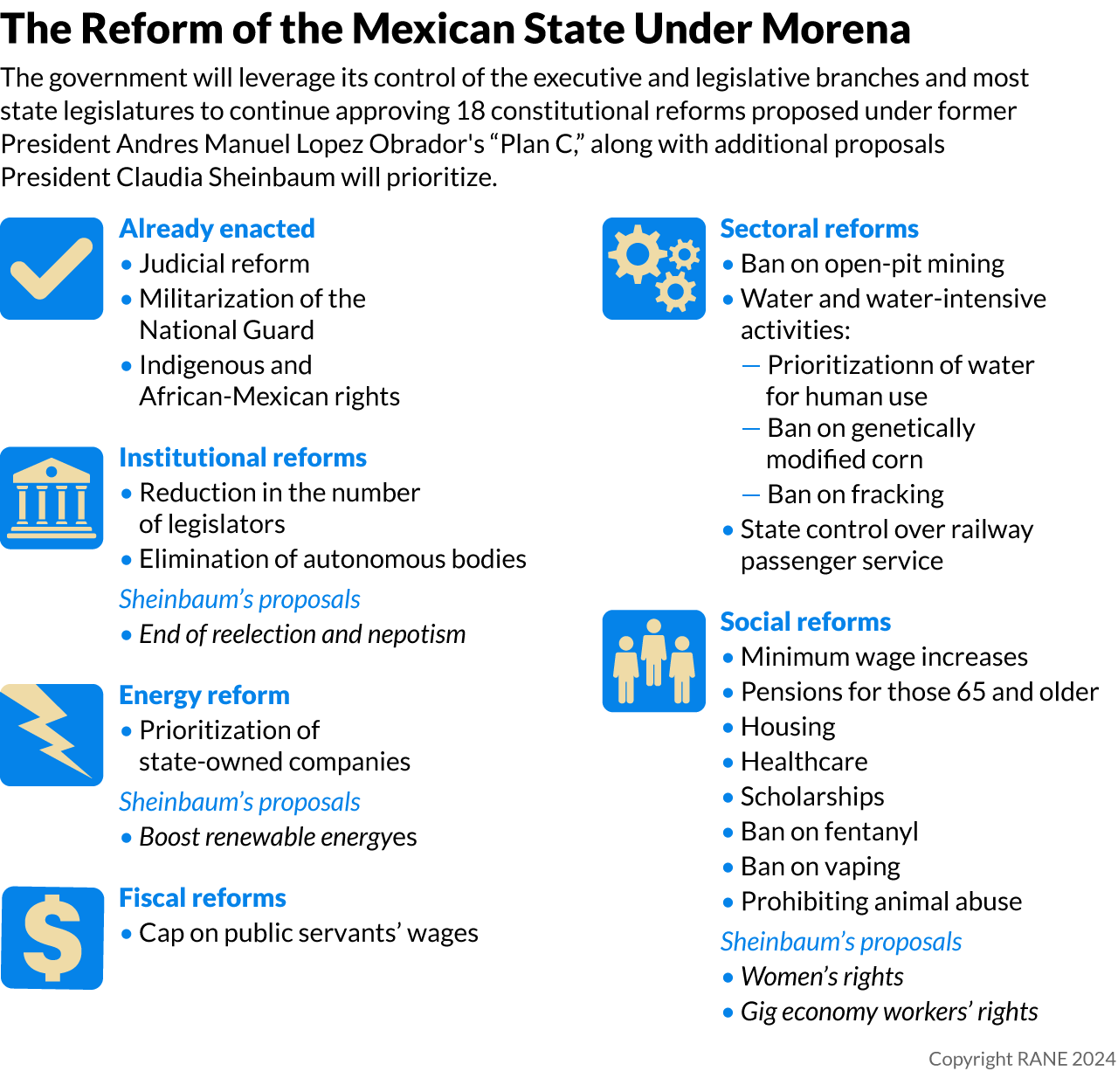
A recent reform that increases the state's role in the energy sector illustrates how Morena will likely interfere with business operations in the coming years. Congress approved on Oct. 17 an energy reform that enables the government to determine the strategic planning of state-owned companies in the energy sector, requiring them to pursue activities based on political motivation rather than purely business-oriented drivers. For oil and gas company Pemex, this change will translate into further expanding operations related to lithium, fertilizers, renewable energy, electricity generation and refining, which are mostly loss-making enterprises and will likely add to the company's $100 billion debt pile; however, Sheinbaum will seek to reduce the company's indebtedness and attract private investment for partnerships, including for deepwater exploration. In terms of the electricity sector, the reform gives the executive branch power to manage and regulate production, transmission and commercialization which, combined with a rhetoric of energy sovereignty, will result in the prioritization of state-owned enterprises over private players, such as by limiting the private sector's share in the country's electricity generation to 46%. Such policies will likely limit business opportunities, and the government's direct interference with market dynamics is likely to result in a less efficient and reliable power grid, potentially increasing electricity costs in the long term as the government struggles to make the necessary investments while maintaining control over 54% of the energy produced in the country. These structural constraints are also likely to slow electricity infrastructure projects that would enable nearshoring opportunities, such as transmission lines, potentially hurting the broader private sector. This set of rules increases state control over economic activities and creates market access restrictions, which will spark additional trade disputes under the U.S.-Mexico-Canada Agreement, set to be renegotiated in July 2026.
- The new rules partially reverse the pro-market energy reform former President Enrique Pena Nieto introduced in 2013, and they reclassify Pemex and state-owned electric utility CFE as "public companies."
- The most recent official data from the Mexican government shows that at the end of 2022, public companies accounted for 41.8% of all electricity generated in Mexico, while the private sector accounted for the remaining 58.2%. Sheinbaum stated that after the government purchased 55% of Spanish company Iberdrola's operations in Mexico for $6.2 billion, the public sector reached the 54% threshold of electricity generation.
Morena's political dominance will enable it to pass interventionist economic policies in other strategic sectors, including mining and agriculture. Congress has kicked off discussions on Lopez Obrador's proposal to ban open-pit mining, which accounts for 60% of all mining activities in Mexico. Sheinbaum has backed the initiative, arguing it prioritizes technological innovation and environmental requirements. Two other reforms Congress is also likely to approve over the coming year are additional bans on genetically modified corn and the prioritization of water for human consumption, affecting especially agriculture and mining activities. Overall, decisions around sectors or activities deemed strategic by the government, such as food security or critical minerals extraction, are likely to remain significantly politicized. More broadly, the Sheinbaum administration's approach to economic policies will likely result in interventionist rules for other strategic sectors, such as manufacturing, telecommunications and railway. For instance, in October Congress approved another leg of Plan C that reverses a 1990s law that privatized Mexico's national rail company and ended its passenger rail services.
- Mexico has 264 open-pit mines in the states of Sonora, Zacatecas, San Luis Potosi and Chihuahua. According to Mexico's Economy Ministry, Canadian companies operate 151 of these mines, and U.S. companies operate 53. Copper is the metal mostly reliant on this type of activity in Mexico, with 80% of production coming from open-pit mines.
The proposed social and labor reforms under Plan C, coupled with Sheinbaum's own priorities, signal increased regulatory scrutiny and oversight that could lead to higher operational costs and growing reputational risks for private companies. The Mexican Congress on Oct. 9 approved a constitutional reform establishing that minimum wage increases will never be below inflation. On Oct. 22, legislators reduced the age for workers to access pensions from 68 to 65 years old. On Oct. 23, the Chamber of Deputies started discussions to allow the government to build 500,000 homes. Additionally, Sheinbaum aims to fight gender discrimination and violence and ensure gender parity in government cabinets at federal and state levels while introducing a constitutional guarantee of equal pay for equal work. In terms of employees' rights more broadly, proposals include reducing weekly working hours while also expanding benefits to those providing services to ride-hailing or food delivery apps. Such policies aimed at regulating workers' rights will directly impact companies' operations and finances, and although government allies in Congress promised to discuss regulatory changes with the private sector, they are likely to approve most of these changes regardless of companies' positions, as they did with the judicial reform in September. As a result, companies will face increasing costs, regulatory volatility and growing oversight and media scrutiny over the coming years, which will fuel latent reputational risks.
- Under Lopez Obrador's six-year term, Mexico's daily minimum wage increased by 181% (more than the accumulated gains in the previous 36 years), while inflation stood at 31% over the same period; Sheinbaum has promised salary increases of around 12% per year.
- Plan C's social components include reversing restrictive pension reforms approved in 1997 and 2007; ensuring that the minimum wage to state teachers, nurses, doctors, police and armed forces officials is not below that of workers enrolled on social security; providing free healthcare for all; banning fentanyl and vaping systems; expanding scholarships for students; and prohibiting animal abuse — in addition to the expansion of Indigenous and Afro Mexican rights already enacted under Lopez Obrador.
- Sheinbaum's policies to fight gender inequality include giving land titles to 150,000 female farmers, pensions for all women over 64 years old, and the creation of public daycare for low-income families.
While interventionist policies may constrain companies' interest in Mexico, growing desires to de-risk supply chains, particularly from China, will continue to increase foreign direct investment in the coming years. Part of Plan C's goal is to reduce public spending via shrinking government bureaucracy while preventing public servants from earning more than the president. However, the scale and scope of social rights' expansion and the orientation of state-owned companies toward political goals rather than profit will almost certainly result in fiscal deficits. While Sheinbaum has indicated she will not raise taxes, she could change her position later in her term given Mexico's likely growing fiscal pressure, and higher taxes could hurt the business environment. Additionally, productivity gains are unlikely to keep up with sharp wage increases under Morena, likely fueling inflation and forcing the Bank of Mexico to raise interest rates. That outlook — combined with curtailed checks and balances, decreased rule of law and additional interventionist economic policies — will likely diminish Mexico's attractiveness to foreign investors and undermine potential nearshoring opportunities. However, as global companies' geopolitical concerns lead them to reduce exposure to China, many will turn to Mexico as an alternative, likely increasing foreign investment in the long term and enabling Shenibaum to advance Morena's platform.
- Mexico's debt accounted for 48.2 % of the country's nominal gross domestic product in June 2024, which is in line with those from some other emerging economies, such as Chile, Indonesia, South Korea and Turkey, but well below countries like Brazil, Egypt, India, Malaysia and South Africa.
- Mexico's external debt remains manageable against a small current account deficit and net foreign direct investment inflows large enough to cover the external shortfall. The medium-term outlook for the fiscal deficit, public debt and economic growth is a greater concern, at least for investors focused on Mexico's domestic market.
- Despite vast regulatory volatility, Mexico will likely receive record-high foreign investment of $38.4 billion in 2024, most of which will be concentrated in manufacturing. This trend will likely persist in 2025, according to Mexico's Center for Public Finance Studies.
