
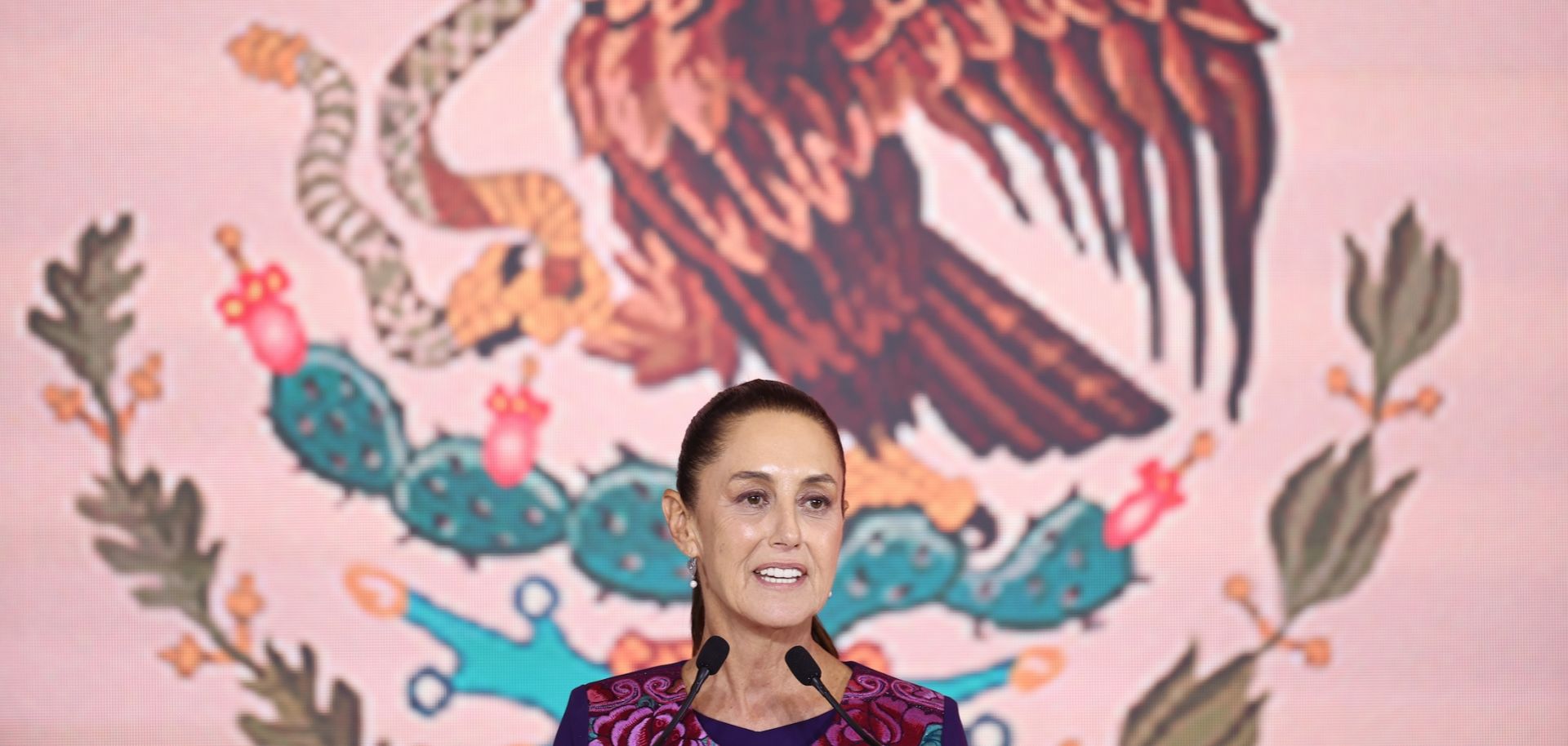
In Mexico, the ruling Morena party's victories in the presidential and legislative elections set the stage for policy continuity focused on poverty reduction and the expansion of government control over energy. Should Morena also achieve a qualified majority in both legislative chambers, the party could pass controversial constitutional reforms that decrease government checks and balances, while increasing corruption risks for businesses. On June 2, Mexico's National Electoral Institute (INE) announced that the ruling National Regeneration Movement (Morena) party candidate Claudia Sheinbaum won Mexico's presidential election with 58%-60% of the vote. Meanwhile, Xochitl Galvez of the opposition National Action Party received approximately 26% of the vote, while Jorge Alvarez Maynez of the Citizens' Movement party received approximately 10% of the vote. Both Galvez and Maynez have conceded defeat. Morena also retained its absolute majority in both the Senate and the Chamber of Deputies, alongside the allied Labor Party and the Ecological Green Party of Mexico, though it is unclear whether the Morena bloc achieved the qualified (two-thirds) majority required to pass constitutional reforms without needing votes from the opposition. Sheinbaum, who will be Mexico's first female president, is set to take office on Oct. 1 for a single six-year term (Mexico's Constitution does not allow presidents to run for re-election). The new legislative session will begin one month earlier on Sept. 1.
- President-elect Sheinbaum is a climate scientist and was formerly the head of the Mexico City government from 2018 to 2023. She is a close ally of outgoing President Andres Manuel Lopez Obrador, who supported her campaign.
- Compared with other Mexican parties, Morena is a relatively young political party, with Lopez Obrador founding the party in 2011 after leaving the Party of the Democratic Revolution. Morena has been Mexico's ruling party since Lopez Obrador won the 2018 presidential election with 53% of the vote, lower than Sheinbaum.
- A qualified majority requires 334 out of 500 legislators in the Chamber of Deputies and 86 out of the 128 legislators in the Senate. Preliminary results indicate that Morena is within 10 seats of achieving qualified majorities in both houses.
Morena's victory highlights widespread approval for Lopez Obrador's policies, despite tensions between him and electoral institutions and the judicial system, as well as shortcomings in his anti-crime policies. The electoral success of Sheinbaum, who modeled much of her campaign on Lopez Obrador's policies and the wider Morena party, demonstrates that Lopez Obrador and his agenda retain high popularity at the end of his six-year term. This popularity is partially the result of broader popular frustration with Mexico's formerly dominant political parties, the Institutional Revolutionary Party and the National Action Party, but is also due to the success of the Lopez Obrador administration's "Fourth Transformation" policies aimed at reducing poverty and economic inequality by expanding social programs and growing the Mexican economy. Lopez Obrador has been able to claim success in some parts of his policy platform, with the expansion of social programs in recent years, as well as the acceleration of nearshoring trends that have increased U.S.-Mexico trade. Still, Lopez Obrador's term has not been without controversy. His repeated efforts to eliminate or downsize the INE and recurrent political disputes with the Supreme Court over the body's rejection of some of his policies fueled accusations that he was attempting to weaken Mexico's democracy. He has also faced criticism for his "hugs not bullets" anti-crime policy, which seeks to combat the underlying drivers of crime (particularly poverty), with less of a focus on counter-crime operations targeting drug cartel leadership, as was common under previous Mexican administrations. Though Mexico's homicide rate has dropped slightly since Lopez Obrador took office, many attribute the persisting high levels of organized crime in the country to this policy. Opposition to Lopez Obrador has repeatedly triggered mass protests, with opposition groups organizing multiple demonstrations with participation in the tens of thousands in the first months of 2024.
- Lopez Obrador's approval ratings peaked at 81% in early 2019 after taking office in December 2018. While his approval ratings have since dropped, they have remained around 66%, including in recent months.
- Mexico's National Council for the Evaluation of Social Development Policy (an independent federal institution) reported in 2023 that its preferred measurement for the country's poverty rate fell 5.6% from 2018 to 2022, with over 5 million people lifted out of poverty.
- In 2023, Mexico reported an official homicide rate of 23.3 per 100,000 people, a drop from 25.8 per 100,000 people in 2018. However, disappearances — which are often not counted in these statistics — have increased, meaning the homicide rate is almost certainly a significant undercount. Furthermore, while some parts of the country experience low crime rates, some areas experience extreme levels of violence between rival cartels, including the Pacific coast state of Colima, which has reported homicide rates of over 100 per 100,000 people in the last year.
As president, Sheinbaum will largely maintain Lopez Obrador's policies, creating significant political continuity that will provide opportunities for companies expanding operations in the country, though her agenda may lead to some energy availability shortfalls and increased cartel violence. Sheinbaum's presidential victory and Morena's absolute legislative majority portends a continuation of many of the Lopez Obrador administration's policies, including a further expansion of social programs (such as free education, pensions and aid for impoverished communities), as the Mexican government continues to try to reduce the country's still-high rates of poverty and economic inequality. This will create policy stability for organizations considering Mexico for nearshoring, and such policies should continue to improve the development of human capital over time. Sheinbaum will also likely implement some tax incentives to continue to support nearshoring trends, particularly for areas of southern Mexico. Sheinbaum will expand electricity generation capacity while keeping the sector largely under government control, though she will almost certainly increase focus on renewable energy compared with Lopez Obrador, further increasing the country's investment attractiveness. For businesses, government control of electricity and fuel subsidies should prevent operating costs from increasing significantly. However, private investment in the sectors will decrease, potentially leading to a drop in generation capacity that would risk power outages. Amid increasing popular pressure for greater government efforts to combat crime, Sheinbaum will likely slightly deviate from Lopez Obrador, with increased operations targeting high-ranking cartel members. In the near term, this will risk triggering increased incidents of retaliatory violence that create safety threats, but this policy may ultimately help lower violence in states experiencing particularly severe inter-cartel conflict, including Colima and Guanajuato.
- Sheinbaum has promised to expand investment in renewable energy and implement policies intended to decrease environmental damage, including stopping gas flaring and imposing stricter emissions standards. However, she has also promised to maintain support for state-owned Petroleos Mexicanos, more commonly known as Pemex.
- Throughout May 2024, an increase in electricity demand due to an unseasonable heat wave led to power outages in 20 of 32 Mexican states.
- Should former U.S. President Donald Trump return to the White House in 2025, he would be highly likely to threaten tariffs on at least some Mexican exports to the United States. Negotiations for the automatic renewal of the United States-Mexico-Canada Agreement in July 2026 will likely be a particular flashpoint for regional trade tensions. Moreover, Trump's focus on curbing migration could also lead him to threaten to close the border if Mexico does not take more aggressive measures to stop migrants from moving north.
If Morena achieves a qualified majority in both legislative chambers, the party could pursue multiple constitutional changes that undermine Mexico's checks and balances and increase corruption risks for businesses. Morena needs a qualified majority to pass a package of constitutional reforms Lopez Obrador submitted in February. If the party does receive a two-thirds majority in both chambers, Lopez Obrador will be able to pass the reforms during the month between the start of the new legislative session on Sept. 1 and the end of his presidency on Oct. 1. However, a majority of states would still need to approve the package before their final implementation, which could take longer than a month. Among other things, the package of 18 reforms would eliminate several government bodies; while this policy would reduce some bureaucratic challenges and free up some government funds, it would also decrease government checks and balances and independent oversight, a move that could contribute to corruption risks in the long term. Other reforms would fold the National Guard into the military, which is controversial due to repeated incidents of military abuses over recent decades, and replace the INE with a smaller electoral body to which officials are democratically elected, which critics argue would undermine Mexico's democracy by making electoral authorities less independent. Even if Morena does not achieve the qualified majority, Lopez Obrador will likely push for most of the reforms in hopes that popular demand will successfully pressure some opposition politicians to vote for them. However, the government would likely be unable to pass the majority of the package in this scenario. If Lopez Obrador is unable to pass the reforms before his term ends, Sheinbaum will likely continue to push for most of the policies after she takes office, though she may abandon some of the particularly controversial policies such as the INE reform.
