
Editor's Note: With many significant elections occurring in 2024, RANE is publishing a series of scenario analyses focused on different outcomes of major elections occurring this year, describing how an election outcome might unfold with implications for each potential outcome. The first installment covered India's general elections, the second covered European parliamentary elections, and the third covered South Africa's general elections. The following is a scenario analysis for Mexico's June 2 presidential election.
Mexico will hold elections on June 2 to elect a new president and all 628 seats in Mexico's Congress. Additionally, eight states and Mexico City will hold gubernatorial elections. The elections will determine whether Mexico continues down the path of what outgoing President Andres Manuel Lopez Obrador calls Mexico's ''fourth transformation,'' a broad set of anti-neoliberal policies and development priorities underpinned by generally prudent fiscal management or returns to the pro-business framework of the legacy traditional political establishment. The presidential race will pit former Mexico City mayor Claudia Sheinbaum from the ruling Morena party against Xochitl Galvez, who represents the opposition coalition between the three main traditional parties in Mexico: the Institutional Revolutionary Party (PRI), the National Action Party (PAN), and the Party of Democratic Revolution (PRD).
If she wins, Sheinbaum will likely ground her presidency based on her predecessor's key policies. She has endorsed Lopez Obrador's package of 18 constitutional reforms that he wants to pass before the end of his term in September, which include provisions to ban fracking and open-pit mining, and abolish some independent regulatory bodies. The reforms also include measures that would reduce the size of Mexico's Supreme Court and shift to a system where judges on the top court are popularly elected. However, Sheinbaum and her Morena party would need to secure a supermajority in Congress for these ambitions to become realistically feasible, as the opposition is unlikely to back the majority of Lopez Obrador's reforms — especially those that alter democratic institutions in Mexico, like the Supreme Court and autonomous regulatory agencies. If elected president, Sheinbaum's economic policy would also likely mirror those of current President Lopez Obrador, which have included general fiscal austerity, a nationalist approach to the energy sector, and targeted social programs to provide support to elderly, disabled and low-income Mexicans.
If, by contrast, Galvez wins the presidency, she would likely boost anti-crime measures targeting the various drug-trafficking cartels in the country, given that Galvez has centered much of her electoral campaign on addressing security concerns in Mexico. On economic policy, Galvez would implement reforms that benefit micro-, small- and medium-sized enterprises by making it easier to form new businesses through digitization of permits, and by creating new tax schemes to drive their growth.
Claudia Sheinbaum Wins the Presidential Election
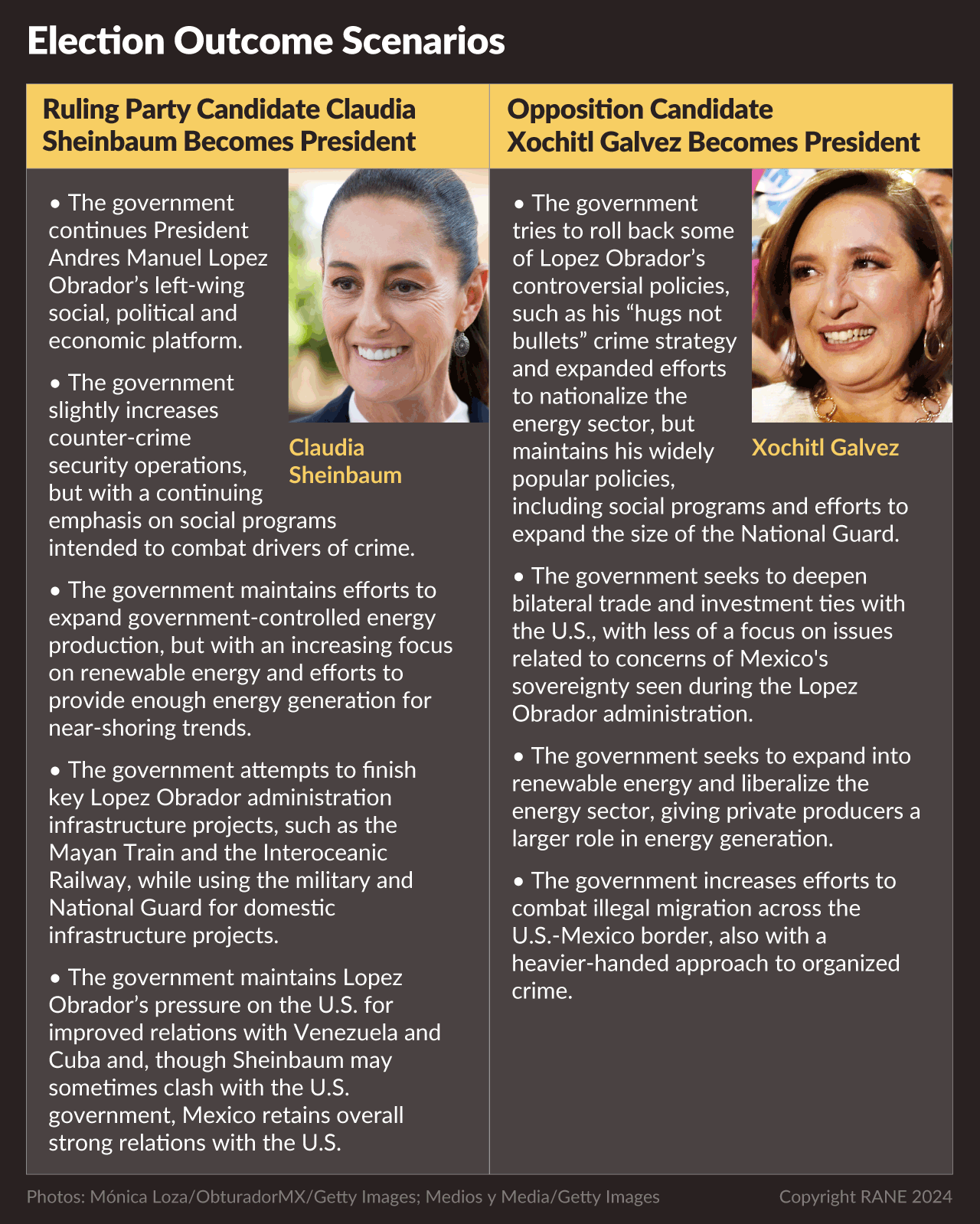
As president, Claudia Sheinbaum of the ruling Morena party broadly continues outgoing President Andres Manuel Lopez Obrador's social, political and economic platform, while deviating slightly at the margins to build her own image. Her government expands public programs targeting cash transfers to women and children, education subsidies for students, and increased retirement benefits for pensioners. She similarly seeks to address insecurity in Mexico through a variety of social programs targeting those most at risk of recruitment to criminal groups, but likely avoids combatting the cartels head-on. Sheinbaum also continues Lopez Obrador's statist economic program, favoring heavy subsidies for state-run firms like Pemex and the Federal Electricity Commission, allowing both firms to deepen their influence over the domestic market, which likely keeps energy prices low for Mexican consumers, while raising the risk of trade disputes with the United States. Sheinbaum structures Mexico's relationship with the United States around bilateral trade, based on national sovereignty. She likely continues President Lopez Obrador's advocacy of Cuba and Venezuela on the global stage, occasionally inviting the leaders to Mexico for summits, while pressing the United States to withdraw policies that harm the two countries' economies, such as the U.S. embargo on Cuba and U.S. sanctions on Venezuela's oil and gas sector. She also attempts to finish the uncompleted infrastructure projects left by President Lopez Obrador, including the Mayan Train, Interoceanic Railway and Dos Bocas oil refinery, probably leaning on the National Guard for construction and development, though the projects continue to face delays and cost overruns. Finally, despite using Lopez Obrador's agenda as a template for most of her policy priorities, Sheinbaum takes a more aggressive approach to encouraging Mexico's energy transition than her predecessor by pursuing large-scale renewable energy projects, potentially partnering with private firms to do so.
Implications
- The Mexican government continues policies to maintain the supremacy of state-run energy companies including Pemex and electric utility CFE; however, lack of substantial participation by the private sector in the energy industry will likely contribute to higher costs and deepening CFE and Pemex's debt burdens.
- The government will likely strip the National Electoral Institute (INE) of funding, leading to large-scale protests in support of INE, while making the results of future elections less reliable by opening the door to electoral challenges from campaigns that refuse to accept the results.
- Sheinbaum initially pushes for policies that make public universities free to attend and increase their capacity to teach more students, potentially boosting human capital in the long term and growing the pool of skilled Mexican workers, even as it likely adds to growing government expenses. However, funding limitations and pushback from conservative congressional forces will likely force Sheinbaum to pare back or fully scrap such policies.
- The government prioritizes Mexico's Federal Electricity Commission's (CFE) role in electric generation and dispatch. This, in turn, makes electricity more expensive for companies and potentially leads to trade disputes under the United States-Mexico-Canada (USMCA) free trade agreement as the policy unfairly prioritizes Mexican companies over U.S. or Canadian firms — a development that will pose the risk of triggering U.S. retaliatory trade measures that harm nearshoring prospects, especially if former U.S. President Donald Trump is reelected in November.
- Sheinbaum's government forwards aspirational policies to reduce Mexico's carbon footprint through the elimination of gas flaring and an audit of Pemex's sustainability standards; however, technologies used to capture gas and store it are expensive and require expertise to implement, likely hindering the implementation of such a plan.
- The government continues to use the National Guard for domestic infrastructure projects and highway maintenance, crowding out what would otherwise be private investment in construction. Such actions contribute to broader nationalization concerns with the Morena party, potentially decreasing the country's attractiveness for foreign investment.
- The National Guard remains in the hands of the Ministry of National Defense (SEDENA), not under civilian command. The force takes a leading role in immigration enforcement and management of port facilities, with little accountability or transparency, further militarizing Mexican society and potentially leading to human rights violations.
- Mexico's government backs labor unions and joins their side in negotiations with private businesses for wage hikes, increasing labor costs for private businesses operating in Mexico, including multinational companies that employ Mexicans. However, this support of labor unions does not prevent the government from challenging USMCA labor disputes (like the 2023 probe into a Grupo Mexico copper mine in Zacatecas state), which the Sheinbaum government will view as an issue of Mexican sovereignty rather than labor rights.
- The Sheinbaum government finishes President Lopez Obrador's key infrastructure projects, including the Mayan Train Line, the Interoceanic Railway, and the Dos Bocas Refinery. These projects boost development in the Yucatan Peninsula, provide faster shipping methods for supply chains within Mexico, and increase oil refining capacity. However, despite Lopez Obrador and Sheinbaum's ambitions for the Interoceanic Railway, the railway does not reach a level of convenience or cost-effectiveness that allows it to become a viable alternative for the Panama Canal.
- Mexico continues to develop tax-free industrial zones in the southeast of the country, spreading some of the economic benefits of ''nearshoring'' to Mexico's south as companies opt to place new facilities in southern Mexico to take advantage of tax breaks and the availability of water resources. However, the desirability of facilities close to the U.S. border, combined with the Sheinbaum government's fears that forcing companies away from northern Mexico will make the country less attractive for investment and manufacturing facilities, will limit the efficacy of such incentives, leaving the majority of new and expanded ventures focused on northern and central Mexico.
- The government seeks to create a universal pension scheme for retired Mexicans, providing a social safety net for a large segment of the population, while likely boosting consumption in the process. However, the policy will eventually risk straining government funds.
- The government pushes the United States to invest in economic development across migrant-sending countries in Central America and reduce economic sanctions targeting Venezuela and Cuba as a means to limit migration. This effort by Mexico does little to stem the large number of migrants that end up at the U.S.-Mexico border, resulting in occasional border closures that delay supply chain shipments.
- Sheinbaum pursues an anti-crime policy focused on less confrontational community policing, using similar rhetoric to Lopez Obrador's ''hugs, not bullets'' approach to combatting crime. But compared with Lopez Obrador, Sheinbaum shows a greater willingness to deploy security forces to high-crime areas and launch operations intended to arrest gang leaders — slightly increasing the risk of a miscalculation that leads to an escalation in cartel-government violence, like that seen under former President Felipe Calderon, which led to a surge in homicides through the mid-2010s.
- The Sheinbaum administration will likely seek to implement President Lopez Obrador's controversial constitutional reforms, including those that propose dissolving independent regulatory bodies, reducing the size of the Supreme Court, and limiting the mandate of court magistrates — especially if the Morena party also secures a supermajority in the congressional elections.
Xochitl Galvez Wins the Presidential Election
Opposition candidate Xochitl Galvez wins the presidency after running a campaign focused on wealth redistribution, combating insecurity, and developing deeper ties with the United States. Shortly after taking office, Galvez takes steps to combat criminal organizations in Mexico without going so far as to launch a new ''War on Drugs.'' She doubles the number of troops in the National Guard — while clearly establishing civilian control of the force — and looks to build a new high-tech maximum security jail to house cartel bosses. Previous attempts by former Mexican administrations, such as that of President Felipe Calderon (2006-2012), to combat criminal groups with militarization often backfired, resulting in the fragmentation of cartels and high homicide rates, suggesting Galvez's strategy may similarly fail. Galvez sets out to overhaul Mexico's energy sector, starting with the country's largest energy company Pemex, which she has frequently criticized as being a drag on Mexico's public finances. As part of such reforms, Galvez potentially tries to pivot the company toward renewable energy, as evidenced by her discussed plans to change its name from Pemex (which is short for Petroleos Mexicano, or ''Mexican Petroleum'') to Emex (short for Energias Mexicanas, or ''Mexican Energy''). In an effort to fulfill key campaign promises, Galvez also tries to force Pemex to stop burning methane and to shut down its refineries in Cadereyta, Nuevo Leon, and Madero, Tamaulipas. Galvez strengthens social programs, even those formed by outgoing President Lopez Obrador, and expands care services for children and the elderly, making it easier for Mexican women to enter the workforce. Her administration seeks to deepen bilateral trade and investment ties with the United States to take advantage of the nearshoring boom. The Galvez government seeks to work more closely with U.S. officials to address cross-border issues such as migration and fentanyl trafficking, and shows a greater willingness to deploy troops to both Mexico's northern and southern border to do so. But while Galvez's enhanced border security measures may temporarily slow the surge of migrants northward, her strategy's failure to address the underlying drivers of migration likely limits its long-term success. The Galvez government's close alignment with the United States also pushes it to reduce engagement with undemocratic countries in the region, including Cuba and Venezuela.
Implications
- President Andres Manuel Lopez Obrador may allege that Galvez's electoral victory was somehow rigged, potentially triggering protests by Morena supporters in Mexico City and other major cities that create logistical disruptions for businesses. Though most protests will likely be non-violent, potential clashes between protesters and security forces may occur, posing safety risks, particularly if protesters attempt to storm government buildings such as INE facilities. Additional protests will be likely around the September inauguration.
- Galvez pushes for closer cross-border anti-crime collaboration with the United States, slowing the trafficking of southbound U.S. firearms and northbound fentanyl shipments, ultimately resulting in fewer border closures. Increased scrutiny of shipments from the United States to Mexico slightly slows supply chains, but authorities likely do not implement enough searches to create significant delays for commercial shipments; however, this hesitancy means gun trafficking is not significantly disrupted.
- The Mexican government deepens its partnership with the United States on immigration policy, strengthening border enforcement measures on the Mexico-Guatemala border and conducting more repatriation flights. While this policy may temporarily decrease the amount of migrants traveling north, it is unlikely to succeed in the long term because enhanced enforcement measures do not address the underlying drivers for regional migration.
- The government withdraws substantial financial support and tax benefits to state-owned oil firm Pemex, pushing the company to divest unproductive assets, manage its debt burden, and diversify into petrochemicals.
- The Galvez government likely seeks to implement energy reforms similar to those of former President Enrique Pena Nieto, giving private producers a larger role in energy generation. The energy sector, in turn, becomes more liberalized and attracts higher levels of foreign direct investment.
- Galvez likely moves to reopen the oil bidding rounds that were suspended or canceled under President Lopez Obrador, enabling joint ventures between Pemex and private exploration and production companies to produce more oil in the coming years.
- Mexico invests in developing multiple new high-tech maximum security prisons for drug-trafficking cartel bosses, deterring criminal activity and limiting criminal organizations' ability to coordinate operations while incarcerated.
- The government roughly doubles the number of National Guard troops and deploys them to dangerous cities throughout Mexico, resulting in a short-term higher incidence of clashes between drug-trafficking cartels and state security forces. But the deployment is eventually somewhat successful in limiting criminal activity in some current high-crime areas.
- President Galvez creates a National Care System that funds daycare centers and increases benefits for caregivers; the program enables more women to join the workforce, in turn boosting domestic consumption by strengthening local purchasing power.
- The government implements policies to cut bureaucratic red tape in business formation, streamlining the process for registration and licensing in Mexico. This could result in shorter timelines for project approval, and reduce barriers to doing business in the country. But such policies may face legal challenges in the courts and may hurt anti-corruption efforts, increasing compliance risks for companies.
- The government prioritizes Mexico's energy transition, leaning on private investment to develop solar, wind, and geothermal energy projects. This would increase the availability of renewable electricity in Mexico and allow more international businesses to meet ESG standards while investing in Mexico.
- The Galvez administration tries to institutionalize a response to the water crisis facing Mexico by making water a matter of ''national security'' in legal frameworks. The administration also invests in technologies like rainwater capture systems, desalination plants, and modernization projects for outdated aqueduct and piping infrastructure. But the high cost of modernizing water infrastructure, combined with environmental elements outside the government's control (such as drought conditions), ultimately hinder these efforts, sustaining Mexico's long-term water availability challenges.
- Mexico takes a stronger stance against Russia's invasion of Ukraine and withdraws its tacit or symbolic support for Cuba, Nicaragua and Venezuela, as the Galvez government pursues a foreign policy based on respect for democracy and human rights — potentially stoking tensions with left-leaning governments in the region, including Colombia, Chile and Brazil.
