
Editor's Note: With many significant elections occurring in 2024, RANE is publishing a series of scenario analyses focused on different outcomes of major elections occurring this year, describing how an election outcome might unfold with implications for each potential outcome. The following is a scenario analysis for India's general elections, which will be held April 19-June 1. The second installment is a scenario analysis for European parliamentary elections, which will be held on June 9, and the third installment covers South Africa's general election, which will be held on May 29.
India's 2024 general elections, which will be held from April 19 to June 1, will likely result in Prime Minister Narendra Modi and his Bharatiya Janata Party retaining control of the government. Although the BJP could win enough seats to form a majority by itself, it may need to rely on support from National Democratic Alliance coalition partners to form a government. A BJP-led government would have largely the same policies regardless of whether it is working through the National Democratic Alliance. A Modi-led government would try to implement many of its election manifesto promises, including controversial policies like the National Register of Citizens and the further implementation of the Uniform Civil Code, which substitutes religious personal laws with unified common laws governing marriage, relationships and inheritance. These moves would exacerbate political divisions and communal tensions in India, potentially affecting the country's investment attractiveness in the long term if social unrest turns violent. A new Modi government would also likely maintain protectionist policies to boost employment, bolster domestic manufacturing and further his Make in India initiative. To decrease dependence on Chinese imports and enhance India's tech status, the BJP would extend production-linked incentives, offer tax benefits to foreign companies and invest in infrastructure to attract foreign investment and foster economic growth. Despite initial financial incentives, India's appeal for investment will remain hampered by subpar working conditions, an unskilled labor force and regulatory deficiencies.
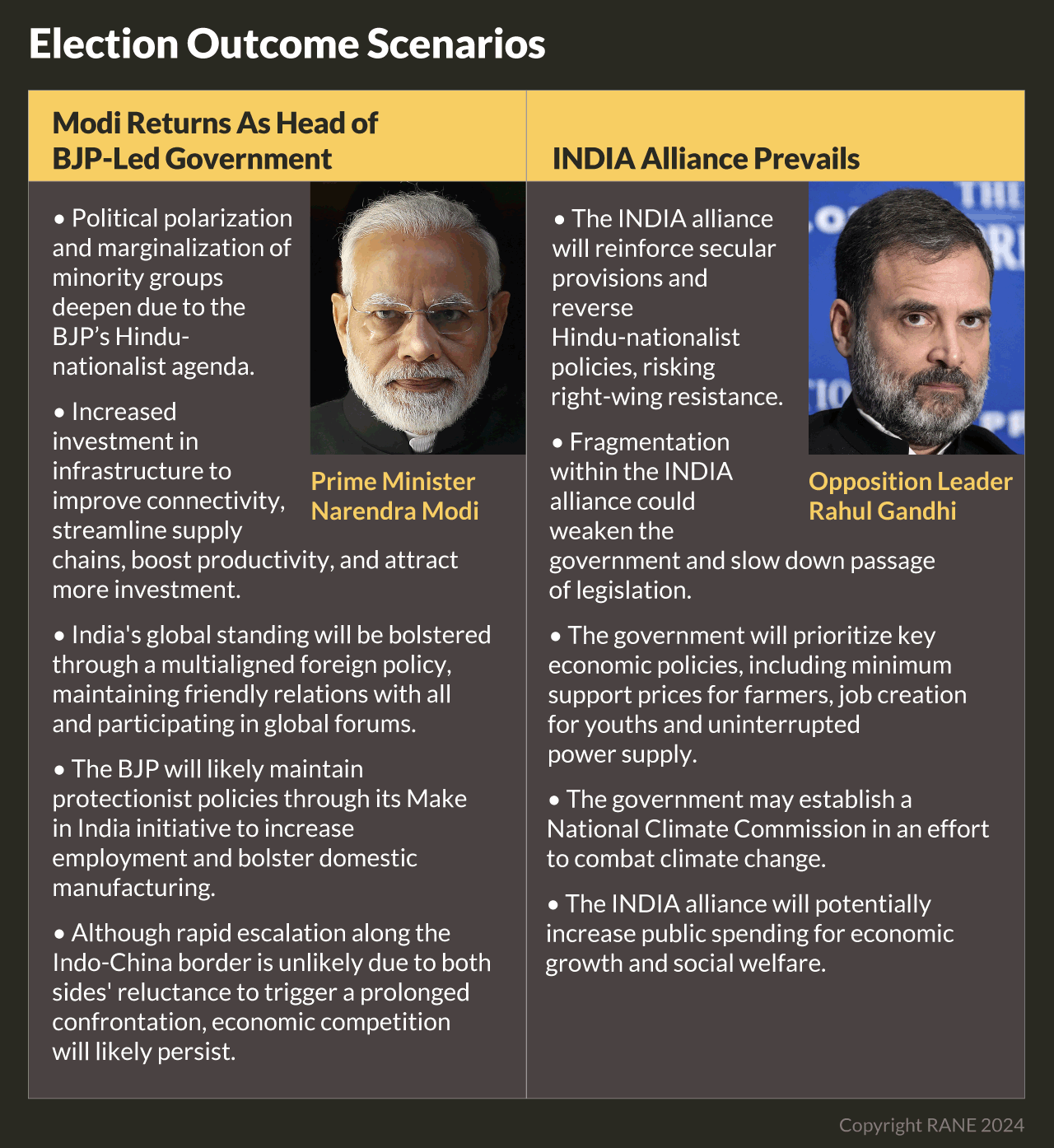
In a less likely election outcome, the opposition Indian National Developmental Inclusive Alliance (aka INDIA) coalition led by the Indian National Congress party wins a majority. This would likely lead to Congress leader Rahul Gandhi becoming prime minister. The INDIA coalition would probably prioritize economic advancement and social welfare. Economic and energy priorities will likely prioritize implementing a minimum support price for farmers that guarantees them a certain price for products, creating government jobs to tackle high youth unemployment and ensuring the national power supply. Implementation of these policies will, however, face constraints amid fiscal limitations and infrastructural inadequacies, as well as internal divisions and a lack of unity within the alliance, which could weaken governance and hinder policy implementation. The alliance may also reverse prior BJP-led Hindu nationalist policies, risking protests and unrest from right-wing and Modi supporters.
Modi Returns As Head of BJP-Led Government
The BJP and/or the National Democratic Alliance secures a majority in the lower house, enabling Modi to remain as prime minister; in his new term, he focuses on economic protectionism and Hindu nationalism. The Modi government will likely push for the implementation of previously promised policies delineated in its manifesto, including the National Register of Citizens and the "One Nation, One Election" proposal aimed at facilitating simultaneous state assembly and general elections. Furthermore, BJP-governed states such as Assam, Gujarat, Madhya Pradesh and Rajasthan will likely try to adopt the Uniform Civil Code. National Democratic Alliance coalition partners like the Shiv Sena and Janata Dal, however, will oppose many of these Hindu nationalist policies, pushing back on their implementation and perhaps delaying them from being passed at the federal level if the BJP lacks the votes without their support. In addition, the government will adopt protectionist measures to stimulate employment, promote domestic manufacturing and advance Modi's Make in India initiative. These measures will include tariffs, trade restrictions and regulations, with a particular focus on sectors such as technology and automobiles. In an effort to reduce reliance on imports from China and position India as a premier destination for technology, the BJP will continue its production-linked incentive program by offering tax incentives to foreign corporations and investing in infrastructure projects to support economic growth and attract foreign companies to establish manufacturing facilities and invest in the country. Modi's push for implementing controversial policies such as the National Register of Citizens and Uniform Civil Code will likely exacerbate political divisions and intercommunal tensions in India, fueled by accusations that Modi's government is advancing its Hindu nationalist agenda and discriminating against Muslim citizens. In the short term, these political disputes along with potential social unrest may persist, and thus will not threaten India's investment attractiveness.
Implications
- Securing a majority in parliament bolsters the BJP's legislative power, facilitating the smoother passage of its agenda and policy initiatives, such as the "One Nation, One Election," aimed at consolidating electoral cycles. This may reduce government spending by diminishing the need for poll officials and security personnel, reducing the cost to political parties during election campaigns and potentially improving voter turnout.Smaller regional parties may, however, face constraints in effectively spotlighting local concerns to voters, particularly amid the competition with better-funded parties.
- A BJP victory will likely exacerbate political polarization, as its Hindu-nationalist agenda coupled with the BJP's dominance further divides public opinion, minimizes political representation for minority groups and fuels ideological clashes with opposition groups. These risks are most likely outside the Hindi heartland in areas such as northeastern states including Arunachal Pradesh, Assam and Manipur and southern Indian states such as Karnataka and Kerala.
- The implementation of the Citizenship Amendment Act in conjunction with the National Register of Citizens will amplify social unrest amid concerns that it may disproportionately impact Indian Muslims, potentially rendering them stateless and vulnerable to deportation, thereby increasing the risk of protests and political polarization in states like West Bengal and Assam with high Muslim populations.
- The implementation of the Uniform Civil Code in Uttarakhand will encourage other BJP-governed states to adopt similar measures for uniformity in personal laws nationwide and promotion of gender equality. But it will also provoke accusations of imposing a "Hindu Code," potentially conflicting with existing religious laws and traditions, heightening the risk of protest.
- In line with Modi's commitments, the BJP will invest in enhancing infrastructure capabilities, including railway lines, roads, highways, renewable energy and transmission lines, particularly in key manufacturing cities and rural areas across the southern states of Telangana and Tamil Nadu and the eastern states of Odisha, West Bengal and Bihar in effort to improve connectivity, streamline supply chain operations, boost productivity, enhance working conditions and potentially attract increased investment.
- The government is unlikely to meet farmers demands for a minimum support price for all crops due to implementation challenges and fiscal impracticality, leading farmers protests to persist and pressure the government in ongoing discussions.
- Despite persistent agricultural challenges, such as infrastructure development and vulnerability to climate change, the BJP faces limitations to executing agricultural reforms given India's federal system grants autonomy to state governments, particularly in areas such as agriculture, which is considered an area under state authority.
- The BJP will back an aggressive strategy against China, aiming to reduce its dependence on China by enhancing domestic manufacturing in sectors such as technology and defense to advance its industrial base, while also potentially seeking assistance from allies like the United States and Japan to decrease imports of Chinese goods like electronics.
- The BJP will ground its foreign policy in multialignment, positioning itself as a friend to all major powers and important groupings while maintaining amicable relations with everyone, entailing active participation in forums like BRICS, QUAD, and G20 emphasizing India's role as a key player in global affairs.
- Given Pakistan's internal challenges, the BJP will likely prioritize monitoring other border frontiers while remaining vigilant about the potential spillover effects of Pakistani instability. Amid the assembly elections in Jammu and Kashmir, the province's first since the abrogation of Article 370 set to take place by September 2024, tensions may escalate as jihadist groups seek to intensify their activities, inflaming tensions between Pakistan and India.
- India has traditionally concentrated its defense policy on securing its land borders, especially with rivals Pakistan and China, however, with expanding global ambitions, the BJP and India are now turning their attention to developing its naval power, particularly in international waters such as the Indian Ocean, underscored by the BJP increase in defense spending and efforts to enhance its operational capabilities in its existing bases such as "INS Jatayu," situated in Minicoy and bolster its naval presence on the world stage. Therefore, a victory for the BJP would strengthen its ability to bolster initiatives aimed at enhancing maritime security by fostering partnerships with countries such as the United States and strengthening regional cooperation.
- While sporadic clashes between China and India along the border may occur, the BJP will ensure the situation will not escalate to the extent seen in the 2020 conflict, as neither side desires prolonged conflict. India will, however, redeploy a 10,000-troop unit from its western border to the disputed border with China, supplementing the 9,000 soldiers already stationed there.
- The BJP's strength will enable a more assertive approach to bolster India's presence in the Indian Ocean region by maintaining active engagement with neighboring countries such as Sri Lanka, Bhutan and Bangladesh, primarily through economic partnerships, including the establishment of a Comprehensive Economic Partnership Agreement with Bangladesh and the implementation of infrastructure and cross-border trade initiatives between India and Bhutan.
- A BJP victory and its strength will ensure that its ambitious targets remain intact, aiming to slash carbon emissions by 50% by 2030 and achieve net-zero emissions for the entire economy by 2070; however, achieving these goals will be constrained by the country's soaring demand for power supply, exacerbated by climate-related risks and frequent heat waves, which pose significant challenges to transitioning toward cleaner energy sources and implementing sustainable practices.
- Violence and escalating unrest stemming from the BJP Hindu nationalist policies disrupt the functioning of businesses and supply chains, resulting in economic slowdowns. As a result, India struggles to fulfill ESG standards, thereby reducing its appeal for investment and hindering investments in sustainable development initiatives and infrastructure, further impeding India's progress toward ESG compliance.
- To boost India's tech stature, the BJP will continue its production-linked incentives to attract foreign investment, however, despite these efforts, India's appeal for investment will be hindered by inadequate working conditions, low-skilled labor and regulatory deficiencies. Additionally, the BJP will implement import duty concessions to companies establishing manufacturing units in the country to attract investments from global electric vehicle companies, stimulate job creation and improve trade prospects. Concerns will arise, however, over potential competition from Chinese auto firms entering the market, which could adversely impact local players like Tata Motors and Mahindra, undermining investor confidence.
- Despite Modi's strong political position, he may face hurdles in enhancing India's overall competitiveness and cutting red tape due to entrenched bureaucratic policies and institutional capacity limitations, resulting in slower economic growth, reduced foreign investment and eroded investor confidence.
- If the BJP fails to secure a majority and is forced to rely more on coalition partners within its National Democratic Alliance, it could face challenges in implementing laws due to differing ideological perspectives and perceptions of Hindutva (e.g., Hindu nationalism) among its partners and potentially lead to alliance ruptures. This could result in a more complex legislative process as the BJP navigates the divergent interests and priorities of its coalition partners, potentially slowing down or altering the implementation of its agenda. Additionally, managing these ideological differences within the coalition may require compromises and negotiations that could affect the overall government.
- Although sporadic clashes between China and India along the border may arise, the likelihood of rapid escalation is low due to both sides' reluctance for prolonged confrontation; however, India may redeploy more troops to the disputed border with China, underscored by Janata Dal's call for a more proactive approach to safeguarding land in Ladakh amid prior criticism of inaction.
- A divergence between Shiv Sena and the BJP over the implementation of the Maratha reservation, which would guarantee slots at educational institutions and government jobs to the Maratha community in Maharashtra, may impact policy focus and cooperation on economic development initiatives. The attention and resources of the government could be diverted toward resolving the issue of Maratha reservation and the lack of alignment between the two parties may result in a slowdown or disruption in the implementation of policies and development projects.
INDIA Alliance Prevails
Led by the Indian National Congress, the Indian National Developmental Inclusive Alliance secures a majority in the lower parliament and forges partnerships with regional parties nationwide, prioritizing an agenda centered on economic advancement and social welfare and ultimately securing a clear majority. The new government would likely select de facto Congress leader Rahul Gandhi as prime minister. A victory for the INDIA alliance would likely lead to the reinforcement of the Indian Constitution's secular provisions and the reversal of Hindu-nationalist policies, like the Citizenship Amendment Act, risking protest and social unrest from right-wing politicians and supporters. INDIA will aim to prioritize several key economic policies including the implementation of minimum support prices for farmers, creating government jobs to boost employment, ensuring uninterrupted power supply nationwide, providing free electricity to the poor, establishing high-quality government schools in every village, and setting up clinics in every village and locality and multispecialty government hospitals in every district. Nevertheless, reform implementation could face delays due to a number of factors. Internal divisions within the INDIA alliance will be significant; currently, unity is primarily based on mutual opposition to the BJP and many of its policies. This lack of unity could undermine economic and reform policies. Moreover, any moves by the alliance to weaken the previous government's Hindu nationalist policies will face opposition from BJP-led state chief ministers and state assemblies, particularly in Hindi-speaking heartland states like Haryana, Madhya Pradesh, Uttar Pradesh and Uttarakhand. In the long run, the INDIA government will also move away from the centralization push championed by Modi, restrengthening the role of India's states vis-a-vis New Delhi. This will ultimately complicate foreign investment, as it will reexpand India's bureaucratic challenges that have stifled India's development for decades.
Implications
- The INDIA alliance's resonance with voters dissatisfied with the BJP's policies, particularly regarding caste representation, the Citizenship Amendment Act, and agricultural issues, could significantly challenge BJP dominance in states it leads in follow-up state assembly elections over the next few years, potentially weakening BJP influence at the state level and facilitating greater INDIA dominance in state legislatures.
- A victory for the INDIA alliance may trigger resistance and protests from right-wing politicians and supporters, who perceive the reinforcement of secular provisions and reversal of Hindu-nationalist policies as a threat to their ideology and interests, potentially amplifying political uncertainty and social unrest. This will heighten the risk of violent protests and lead to diminished investor confidence and disrupt business operations. These risks are most likely in regions with strong right-wing political presence, such as Gujarat, Madhya Pradesh and Uttar Pradesh.
- Internal divisions and lack of unity within the INDIA alliance regarding power-sharing and ideology could weaken the government, increasing the risk of political instability and hindering the implementation of reforms, particularly concerning welfare and economic development, as different regional parties may prioritize their respective states' interests.
- Political polarization between the BJP and Congress in the lower house may hinder the legislative process, leading to gridlock and further delays in implementing reforms on matters such as labor and caste-based representation.
- INDIA alliance formation in the government may lead to increased fragmentation in regional politics, as smaller parties align themselves strategically to either support or oppose the alliance. This will complicate the political landscape and hinder the passage of social and welfare laws, as regional parties' may give precedence to the interests of their individual states.
- The transition of power to the INDIA alliance, and the subsequent potential reversal of expansionary fiscal policy and increased public spending for economic growth and social welfare, contrasts with the BJP's preference for fiscal consolidation and structural reforms, potentially introducing uncertainty in economic policy, undermining investor confidence and impeding short-term economic growth.
- A victory for the INDIA alliance could invigorate greater opposition participation, fostering a resurgence of debate and scrutiny of government policies, and enabling broader participation of multiple parties. But reducing the dominance of a single party would also increase political friction and delay the passage of social, welfare and economic policies amid challenges in building policy consensus.
- The INDIA alliance's emphasis on social welfare and secularism may energize civil society movements advocating for marginalized communities' rights and social justice, contributing to broader societal mobilization and activism.
- The INDIA alliance prioritizes key economic policies, including minimum support prices for farmers, job creation, uninterrupted power supply, free electricity for the poor and infrastructure development, yet faces formidable challenges in fulfilling commitments due to fiscal, resource, and power constraints, limited financial resources, competing budgetary demands, and infrastructural limitations, exacerbating challenges in implementation.
- Amid high unemployment rates, INDIA will likely expand education and health sectors, to create new job opportunities for teachers, doctors, nurses, paramedics, technicians, instructors and administrators, while also preparing youth for emerging roles driven by technological advances.
- The potential introduction of the "Make for the World" Policy championed by the Indian National Congress could establish exclusive export-only zones to attract foreign and Indian investment, offering incentives such as exemption from indirect taxes and reduced corporate tax rates for companies manufacturing for export.
- INDIA is expected to develop a Clean Energy policy aimed at transitioning existing fossil fuel-based power plants toward green energy sources like solar and wind, as part of efforts to increase the share of renewable energy in the overall energy supply.
- INDIA may launch the Mahatma Gandhi National Rural Employment Guarantee Act 3.0, which aims to provide rural livelihood security by offering at least 100 days of wage employment annually to households volunteering for unskilled manual work, focusing on addressing issues such as water security and soil quality to alleviate farmers' distress.
- INDIA is likely to prioritize defense spending to meet the requirements of the Armed Forces, expediting modernization programs transparently to ensure readiness and capability enhancement.
- INDIA may enact a National Climate Commission to coordinate the country's efforts to combat climate change and establish a National Clean Air Programme aimed at controlling pollution levels.
- India will continue to station troops along the Chinese-Indian border with the possibility of sporadic clashes, but escalation akin to the 2020 conflict is improbable due to both sides' aversion to prolonged conflict. Nevertheless, INDIA may push back on China's inclusion of Arunachal Pradesh and Aksai Chin in its new map.
- The shift away from centralization and towards restrengthening the role of India's states could complicate foreign investment, as foreign investors may encounter a more fragmented regulatory environment with varying procedures across different states. More complex regulations could raise the cost of doing business in India, potentially discouraging foreign investment and slowing economic growth and uncertainty and delays in investment decisions.
