
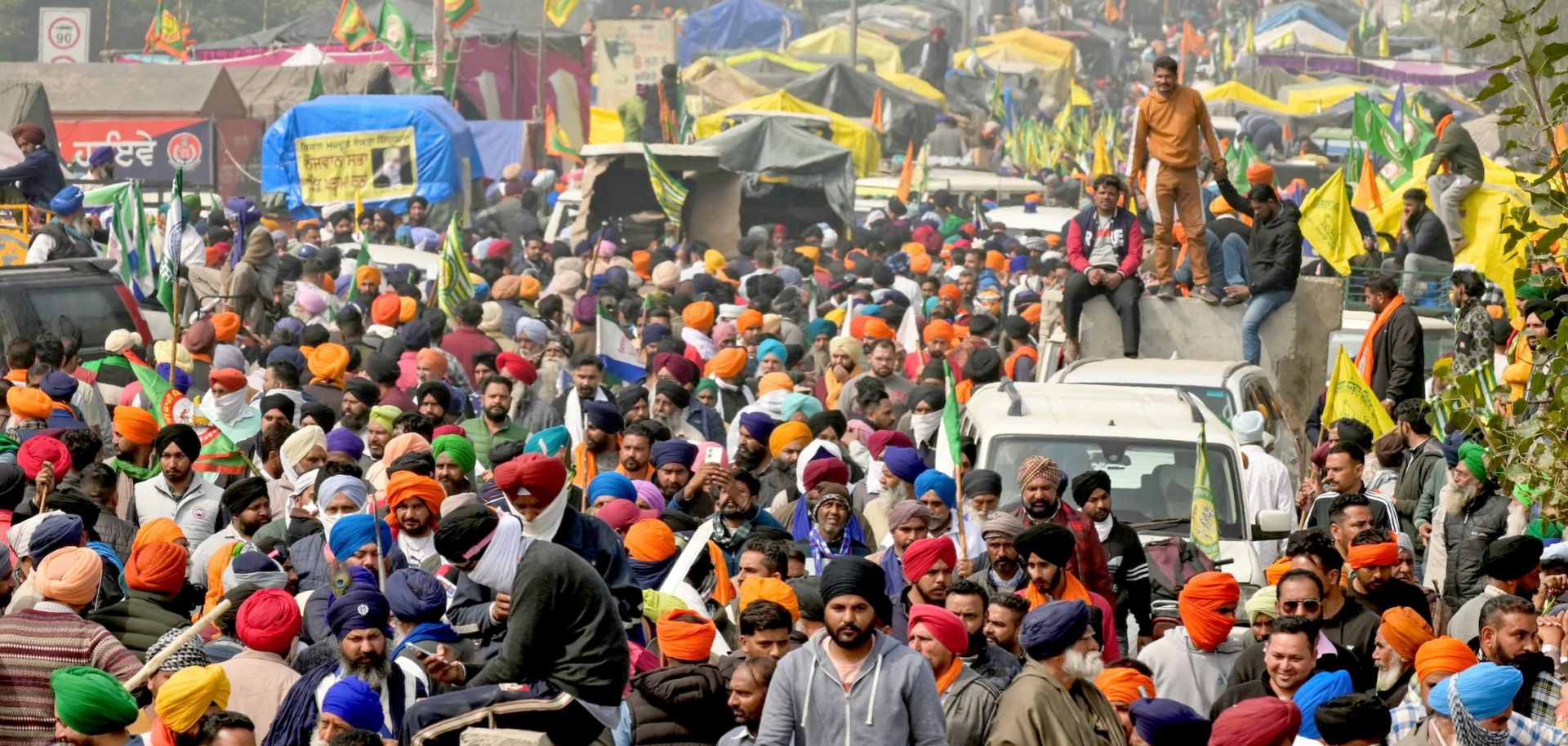
The ongoing farmers' protests in India will likely persist for weeks and potentially longer, creating significant disruptions and personal safety risks in and around New Delhi and other areas of northern India, while also illustrating challenges to agricultural sector reform. For more than two weeks, a coalition of more than 200 Indian farmers' unions has been leading tens of thousands of farmers on a protest march to the country's capital New Delhi in support of varying demands. The protesting farmers, who are primarily from nearby northern states including Punjab and Haryana, have severely challenged travel and business operations in northern states and the capital of New Delhi by blocking roads and conducting other localized disruptive actions. Authorities have deployed some 50,000 police officers, who have used tear gas and sporadically clashed with farmers. Security forces have also used static obstacles (like concrete barriers and concertina wire) in an attempt to prevent protesters from entering the capital, and have implemented localized curfews and internet suspensions as well. Meanwhile, the government began negotiating with the farmers before the protest began on Feb. 13 and has since conducted several rounds of talks that have reportedly seen some progress, prompting temporary pauses to farmers' efforts to reach the capital. Nevertheless, the two sides still appear far from reaching a compromise. With no near resolution in sight, Indian farmers have continued to take to the streets and are planning to stage additional actions, the details of which are set to be announced on Feb. 29.
- Media reports claim at least five people have died in the protests, with protest leaders often blaming clashes with police, and one protester reportedly suffering a heart attack.
- In a Feb. 21 post, X (formerly Twitter)'s Global Government Affairs team said that the Indian government had ''issued executive orders requiring X to act on specific accounts and posts,'' and that the social media platform disagreed with the order but would ''withhold these accounts and posts in India alone.'' Local media reports have linked the targeted accounts to Indian farmers' protests.
The protests are taking place weeks before the Indian general election, which gives farmers an opportunity to express their dissatisfaction with many unresolved issues from the 2020-2021 wave of protests. Farmers previously conducted mass protests around New Delhi from 2020-2021 against three controversial Farm Bills that had sought to reform the agricultural sector by reducing the government's role and incentivizing increased private investment. The government ultimately caved to farmers' concerns about reduced government protections and repealed those bills in late 2021; however, farmers maintained other demands that the government had pledged to consider, and in following years, continued to conduct sporadic, generally small-scale protests in northern states to pursue them. Farmers' central demand has been for a law guaranteeing a minimum support price for all crops, which determines the lowest price at which the government buys crops to protect farmers from market fluctuations. Though the government formed a committee in July 2022 officially tasked with making minimum support prices ''more transparent and effective,'' farmers accuse the government's efforts of being insufficient and slow. Among other things, farmers have also demanded a doubling of their income, loan waivers, and the withdrawal of legal cases registered against them during the 2020-2021 protests. With India's general elections expected around April-May, farmers' unions in early 2024 announced plans to conduct the Feb. 13 protest march to New Delhi, paving the way for the current agitation. The farmers probably believe that the lead-up to the elections, where Prime Minister Narendra Modi will seek another term, offers them a chance to voice their grievances and obtain concessions from the government.
- While the government announces support prices for 23 crops each year, it typically only buys rice and wheat at these prices to bolster its own stockpiles, leaving farmers vulnerable to price fluctuations for other, unprotected crops.
While the Indian government will likely eventually make concessions to the farmers, it could be weeks or potentially months before both sides reach a deal to end the protests. While polls and opposition disunity suggest the ruling Bharatiya Janata Party will win the general elections, the BJP still wants to avoid alienating or appearing at odds with India's farmers as it did in 2020-2021, given farmers remain a large and influential constituency. The government also likely wants to end the protest to avoid farmers gaining further momentum and expanding or prolonging their disruptive action. Local reports suggest authorities have already been willing to accept some of the farmers' more minor demands, including that legal cases against them be withdrawn. However, the government appears unlikely to concede to farmers' central demand of a minimum support price for all crops, as government ministers have noted doing so would be challenging to implement and fiscally impractical, taking up a disproportionate amount of the budget and offering little money for other development efforts. But the protesting farmers have appeared less willing to compromise on this core demand, rejecting a reported government offer late Feb. 19 of a five-year contract for guaranteed prices for five crops. This suggests the farmers' protests will likely continue for at least several more weeks, as both sides likely need further rounds of negotiations to come closer to a mutual understanding.
As long as there is no agreement, the farmers' protests will fuel travel and business disruptions, as well as personal safety risks, in northern India. Until there is a deal between the government and the farmers, the protests will continue driving severe disruptions to travel and business continuity in northern states including Punjab and Haryana, as well as New Delhi. Protesters will also risk clashing with police, especially as they intensify their efforts to reach the capital, driving heightened personal safety risks. The local harvest season, which begins around April, may force some farmers to return to their farms should protests continue through then; however, Indian farmers have also developed strategies over the years to sustain protests while still harvesting their crops, which could help prolong the agitation. According to trade and industry body PHDCCI, a prolonged protest movement that challenges the transport of raw materials to northern India would disrupt a wide range of sectors including food processing, cotton textiles, garments, information technology, trading, tourism and hospitality; the body further believes extended protests would result in economic losses of over $60 million a day.
More broadly, the demonstrations also underscore the government's challenges to liberalizing India's agricultural sector. The political and economic challenges threatened by renewed farmers' protests highlight the continuing influence farmers wield and their ability to disrupt government efforts to liberalize the agricultural sector. Additional concessions granted to farmers would only further strengthen their influence and ability to limit reforms that would boost the sector's productivity. Such concessions would also exacerbate India's challenge of shifting potential and current workers away from the already outsized agricultural sector to other sectors the government is trying to boost, like manufacturing. This may increasingly impede India's efforts to bolster its investment attractiveness and ultimately dampen the South Asian country's economic growth.
