
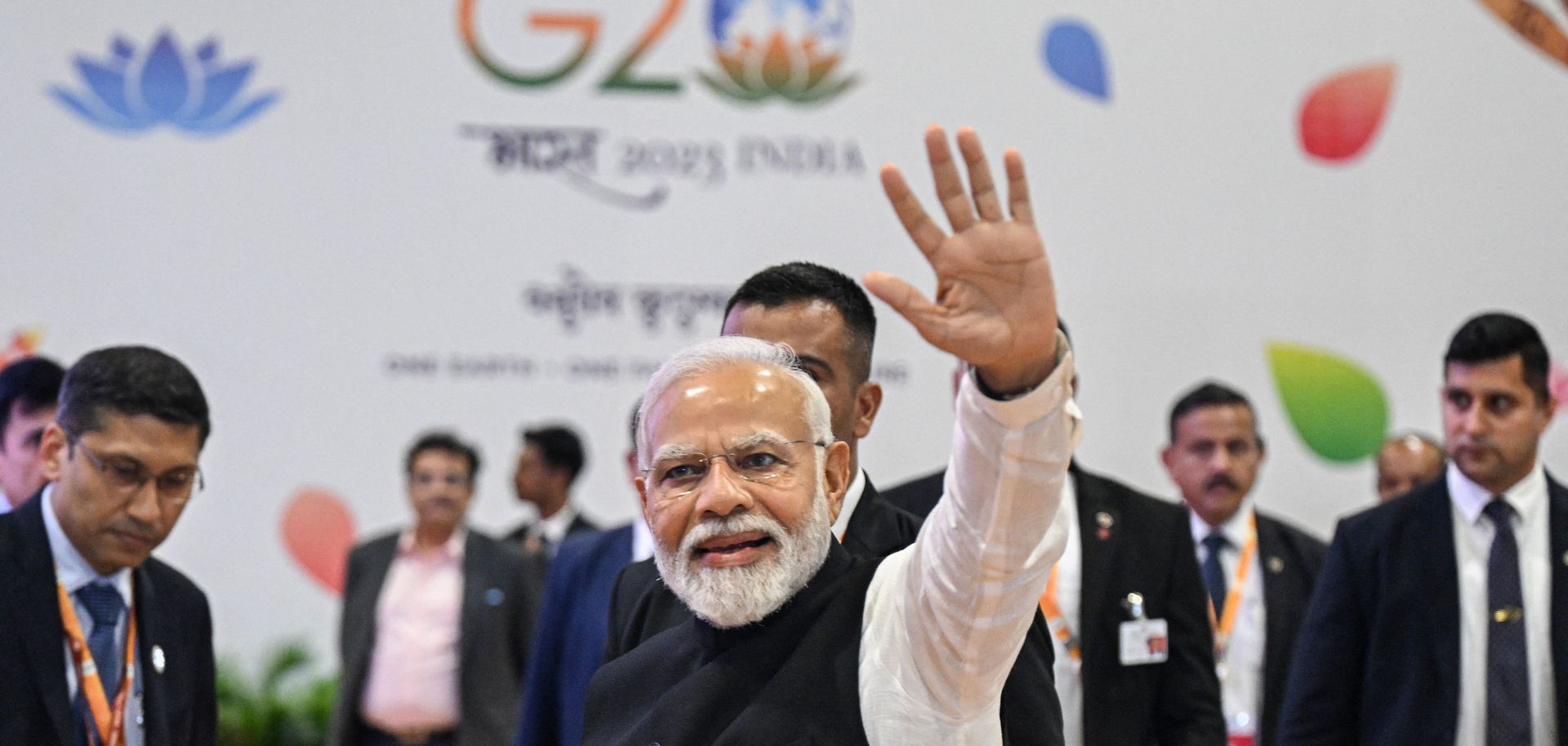
India's strong medium-term economic growth outlook will enable its government to direct financial resources and diplomatic efforts toward managing the country's complex security environment. Prime Minister Narendra Modi and his ruling Bharatiya Janata Party (BJP) have dominated Indian politics since first coming to power in 2014. And that trend appears set to continue, with opinion polls projecting that the BJP will secure another five-year term in India's next general election, which is expected to be held in April and May. The opposition Indian National Congress party, meanwhile, remains frail amid increased factionalism and ideological weakness in the context of rising Hindu nationalism. The BJP's dominant position will, in turn, give it significant leeway to pursue its domestic economic and foreign policy agenda in the likely case that the party is re-elected later this year.
- In December 2023, Modi's approval rating stood at 76%, according to Morning Consult. In recent polls, the right-wing National Democratic Alliance (NDA), which is led by the BJP, has been ahead of the Indian National Developmental Inclusive Alliance (I.N.D.I.A.), which is led by the Indian National Congress, by 8-13 percentage points. Recent polling projects the right-wing I.N.D.I.A. alliance will secure between 296-366 out of 543 seats in the lower house of India's parliament, compared with the 350 seats it secured in the 2019 election.
- In the last interim budget presented before the 2024 elections, the Modi government opted in favor of increased funding (even if at a slightly slower pace than in previous years) for infrastructure investment rather than more traditional pre-electoral tax cuts for the middle class and significant increases in social spending, including subsidies for poorer households. Typically, Indian governments shift spending from investment to increased social spending to garner votes. Confident of its strong political position, the Modi government has largely refrained from doing so. The budget allocated the equivalent of $130 billion to fund physical infrastructure, which represented a more than 10% annual increase. A more growth-friendly macroeconomic policy is made possible by the BJP's electoral dominance.
India's medium-term economic growth outlook is strong, which will help it double its economic size over the next decade and consolidate its position as the world's third-largest economy. India has overtaken China as the world's fastest-growing major economy in the world. Moreover, India will likely be able to sustain real economic growth of more than 6% annually during the remainder of the decade, flanked by broadly sensible macroeconomic policies, including manageable fiscal deficit and moderate inflation. The government will continue to be tempted to pursue less growth-oriented trade policies in the guise of selective protectionism, like export controls and selectively higher tariffs. But this is not going to turn into a wholesale protectionist policy because protectionist measures are meant to support industrial policy through selective sectoral intervention (e.g. laptops), which will limit its negative impact on economic growth. India will also benefit from increased foreign investment in the context of multinational corporations' supply chain reengineering and friend-shoring. In the context of intensifying U.S.-Chinese economic conflict, including ''decoupling'' and de-risking, Western companies are trying to reduce their dependence on China and seek to invest elsewhere, including in geopolitically friendly countries like India. Solid domestic investment levels and an increasing focus on much-needed, productivity-enhancing infrastructure investment in the context of manageable fiscal policy and government debt levels also bode well for India's medium-term economic growth.
- India is the world's fifth-largest economy in nominal dollar terms and it is the third-largest economy in terms of GDP measured purchasing-power parity. India is currently ranked 121 out of 185 countries in terms of per capita income measured in purchasing power terms, just below Laos and just above Uzbekistan, with a per capita income of $7,100. By comparison, U.S. and Chinese GDP per capita income was $18,700 and $59,500. India's per capita income will continue to lag behind most other countries, which will limit the country's ability to mobilize resources for international ends.
- Both the International Monetary Fund (IMF) and the Organization for Economic Cooperation and Development (OECD) expect India's real economic growth to average more than 6% over the next few years. While this is significantly lower than the growth China registered during its high-growth phase from 1980 to 2020, it does make India the fastest-growing major economy in the world. India's real economic growth rate now comfortably exceeds China's growth rate of 4-5%.
- On its current trajectory, India's economy will more than double in size from less than $10 trillion in 2020 to more than $20 trillion by 2030. In non-inflation-adjusted terms, this will make India's economy three times larger than Japan's today. India's per capita income will exceed $10,000 by 2030.
- India is benefitting from a favorable demographic momentum, but also from a major demographic transition. The country's fertility has declined to just over 2 births per woman, which is below the replacement ratio of 2.1. This is translating into an improving dependency ratio (ratio of people of working age vs. people of non-working age), which creates favorable conditions for increasing the national savings rate and investment, while expanding the labor supply in relative (and absolute) terms.
- Investment in India has averaged around 30% of GDP over the past few years. This is lower than at the beginning of the past decade, which suggests that India has significant room to increase both savings and investment. Favorable demographics have the potential to raise economic growth via higher investment, provided the government does nothing to counteract the structural increase of India's increasing savings potential. Indeed, China managed to generate a savings rate of 50% and real GDP growth of 10% during its high-growth phase.
If they win another term in this year's election, Modi and his BJP will be well-positioned to mobilize the resources and expend the diplomatic efforts necessary to pursue its foreign policy goals in a complex international security environment. India's higher economic growth and greater potential to mobilize resources, including financial resources, will place it in a strong position to compete successfully with its two main strategic rivals — China and Pakistan — in the coming years. India's greatest strategic challenge is managing its security and economic relations with China, including in the Indian Ocean, where Beijing's geostrategic and commercial interests are expanding. This will increase pressure on India to compete for influence in countries like Sri Lanka and the Maldives, which will see New Delhi deploy greater resources, including loans and other financial support, to maintain its diplomatic foothold in the region. Pakistan, India's long-standing geopolitical rival, also remains a major security concern for New Delhi. While Pakistan is experiencing significant domestic and economic challenges, which makes it more difficult for Islamabad to compete strategically, that instability does create risks for neighboring India. But India's increased availability of resources will enable it to keep managing the security situation on its northeastern frontier, as it has done for decades.
- India and Pakistan fought wars in 1947, 1965, 1971 and 1999. The two countries' ongoing conflict, which is rooted in control over the disputed Kashmir region along their shared border, will continue to require India's attention, not least because Pakistan has nuclear weapons.
- Border disputes are also an important source of Indian-Chinese competition. India fought wars with China in 1962 and 1967. More recently, border skirmishes in disputed areas led to several deaths. China has friendly ties with Pakistan as well and is a major provider of financial support to Islamabad, including infrastructure projects that New Delhi regards as threatening. In addition, China has been expanding its maritime presence around India to secure access to oil-rich Arab Gulf states. This is leading to intensifying security competition in India's ''near abroad,'' including Sri Lanka and the Maldives.
India's rapid economic development, increasing defense expenditure and government stability under the BJP's continued control will make it an attractive partner for the United States and European countries. India will carefully seek to deepen ties with the United States, which will afford India opportunities to strengthen its geopolitical position. This will likely involve closer bilateral military cooperation and increased purchases of U.S. defense equipment. The goal is to partner enough with the United States to deter China without running the risk of being drawn into a broader U.S.-Chinese conflict. This will force India to maintain its balancing act, whereby it gradually increases security cooperation with the United States without entering into formal defense commitments. India's increasing importance to Washington in light of intensifying U.S.-China competition will help New Delhi strike the right balance, as long as India-China relations do not deteriorate significantly. Finally, India will continue to have to diversify its sources of foreign defense purchases amid the decline of Russian sales to India in the wake of the Ukraine war. Europe and the United States are India's only other major suppliers of advanced defense equipment, in addition to Japan and South Korea. New Delhi will have little choice but to turn to these countries for advanced defense purchases.
- India is a member of the Quadrilateral Security Dialogue (Quad) with the United States, Japan and Australia. Among other things, the Quad is committed to a Free and Open Indo-Pacific, and it is the sort of loose security cooperation India prefers to engage in to deter China, compared with more formal treaty commitments. India also joined 13 other countries under the U.S.-led Indo-Pacific Economic Framework (IPEF), which has a similar purpose in the economic realm. Meanwhile, India has refrained from joining the West in sanctioning Russia in the wake of the Ukraine invasion and has, in fact, increased its energy trade with Russia over the past two years.
- India has the world's fifth-largest military. In 2022, it spent more than $80 billion on defense (in current dollar terms). Strong economic growth will allow the government to increase spending by 6-10% annually in nominal terms. Indian defense equipment imports from Russia have declined sharply in the context of the Ukraine war, which will lead India to seek closer cooperation with other countries able to offer such supplies. In June 2023, Germany signed an agreement for the possible construction of six submarines for India. In January 2024, France and India agreed to establish a defense industrial partnership for joint production of defense equipment, including helicopters and submarines.
