
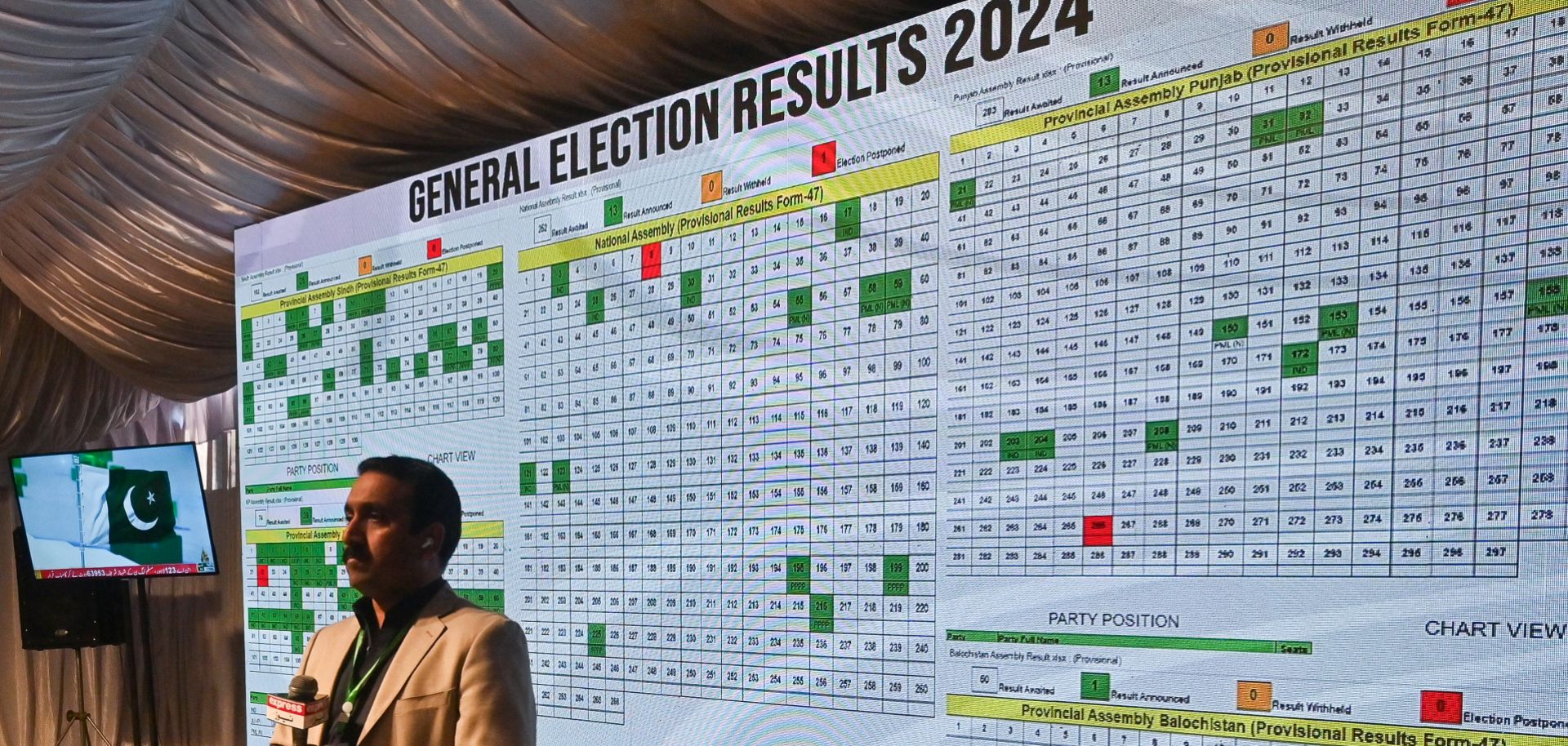
The inconclusive outcome of Pakistan's national elections marks a setback for the military and portends scaled-down economic reforms and further political instability; however, the country's powerful army will likely still succeed in pressuring ideologically divergent parties into forming a coalition government devoid of members aligned with former Prime Minister Imran Khan. On Feb. 11, the Election Commission of Pakistan (ECP) announced that independent candidates affiliated with Khan's Pakistan Tehreek-e-Insaf (PTI) party had secured 93 of the 266 National Assembly seats elected by direct voting in the country's Feb. 8 general elections. The Pakistan Muslim League (PML-N), led by former Prime Minister Nawaz Sharif, came in second with 75 seats, followed by the Pakistan People's Party (PPP), led by former foreign minister Bilawal Bhutto Zardari, with 54 seats. Additionally, Muttahida Qaumi Movement (MQM), a party likely to play a key role in coalition talks, secured 17 seats. However, with no clear majority, Pakistan's political atmosphere remains polarized, especially as both Sharif and Khan have claimed victory, intensifying political uncertainty over who will govern the country.
- Of the 336 seats in Pakistan's National Assembly, 266 are elected through direct voting. The remaining 70 seats are reserved for women and minorities, which are allocated based on political parties' number of seats in the National Assembly.
- Despite Khan's enduring popularity, his PTI party encountered persistent obstacles in contesting in the elections due to the military's maneuvers to sideline Khan and his party, including by cracking down on PTI leaders and supporters. Consequently, PTI members were compelled to participate in the elections as independents, following a Supreme Court decision that prohibited the use of the PTI's recognizable electoral symbol, a cricket bat.
- Elections faced significant delays in tallying, which authorities blamed on internet disruptions after shutting down mobile phone service to ''maintain law and order'' and curb potential security threats. However, the government's opponents said the delays were due to vote rigging and demanded services be restored immediately. Some activists accused the government of censorship, arguing that the internet suspension was politically motivated rather than court-mandated.
- In response to the ECP's announcement, Khan's PTI and several other political parties called for protests across various Pakistani cities, alleging rigging and manipulation of results. Post-election protests have so far resulted in clashes between demonstrators and authorities, who have used tear gas and other riot control tactics.
With no single party securing an outright majority, parties will need to forge coalitions to form a government, with the focus in the immediate term set to shift toward the attribution of reserved seats in the National Assembly. In the absence of any single party or political grouping securing a parliamentary majority, Pakistan's next government is set to be a coalition comprising several political parties. In the immediate term, parties will likely focus on the allocation of the 70 reserved seats for women and minorities, which are assigned according to each party's representation in the National Assembly. While PTI-affiliated candidates secured the largest number of seats in direct voting, their formal status as independents means they will be ineligible to acquire reserved seats. Therefore, parties such as PML-N and PPP, which are entitled to these reserved seats, are set to expand their parliamentary advantage. However, if independent candidates choose to form a coalition with a political party, they would then become eligible to fill reserved seats based on the collective strength of their affiliation. The new National Assembly is set to convene on Feb. 29, as the Pakistani president is mandated to summon the next legislative term within 21 days after the election results are announced. Coalitions are expected to form before this deadline, likely under pressure from the army. During the first National Assembly session, the incumbent speaker will administer the oath to newly elected lawmakers and elect a prime minister, who will need to secure a simple majority of 169 votes encompassing all 336 seats. All political parties submit a roster of preferred candidates for reserved seats during the election nomination process, which is then subject to scrutiny by the ECP.
- Independent candidates have the option to join any political parliamentary party within three days of the announcement of the election results (Feb. 11). For independents to declare affiliations with a party, they must submit an application to the leader of the chosen political party, who subsequently notifies the ECP.
- In theory, independent candidates have the option to refrain from joining other parties and instead unite together. However, this strategy is only useful if they are collectively able to surpass the necessary threshold of 134 seats for the majority of 266 lawmakers elected via direct voting, which in this case they are not, thus necessitating a coalition with another party.
The PML-N and PPP are expected to form a coalition with smaller parties and independent lawmakers amid likely pressure from the military, which will probably be successful in preventing Khan's PTI party from forming a coalition government. On Feb. 11, the PML-N and PPP engaged in discussions to establish a coalition government. This move was likely actively encouraged by Pakistan's military, as the army has a strong incentive to avoid a PTI-led government given its fraught relationship with Khan. However, the PML-N and PPP together comprise 129 of the 266 directly elated seats in Pakistan's National Assembly, putting them just shy of a 134-seat majority. To form a governing coalition, the PML-N and PPP would thus need to poach independents, portending a series of horse-trading negotiations. The PML-N may also reach out to other smaller parties like MQM to join the coalition and meet the threshold for majority. Although a coalition between PML-N and PPP may result in disagreements over the prime ministerial candidate, potentially delaying the coalition's formation, pressure from the military would likely ensure the alliance is ultimately established. However, an alliance between Sharif and Bhutto would probably infuriate Khan's supporters, many of whom have already voiced concern over the legitimacy of the election results, heightening the risk of protests and social unrest. The PPP could opt to form coalitions with PTI-backed independent candidates, but the pressure it'd face from the army against doing so makes this a low-likelihood scenario. Meanwhile, PTI independents will look to set up their own coalition with smaller parties, but the army will likely be successful in deploying tactics similar to those deployed following violence triggered by Khan's arrest in May 2023 to prevent such a PTI-led coalition from emerging. Furthermore, with Khan — who is currently serving a prison sentence — unable to assume the role of prime minister, PTI independents may face disagreements with other parties regarding a prime ministerial candidate.
- PML-N and PPP were the primary members of the Pakistan Democratic Movement (PDM), a coalition comprising several parties that successfully removed the Khan-led government from power in April 2022 and governed the country for the subsequent 16 months.
- Thus far, one PTI-affiliated independent candidate has shifted allegiance to PML-N. Around 18 to 20 independent candidates who secured seats in the National Assembly have also reportedly indicated their willingness to support the PPP and PML-N in the formation of a coalition government. However, the PTI has pushed back against this, stating that ''any elected member of the National Assembly supported by PTI will not back any other party.''
- An additional factor driving unrest in the coming weeks will be the numerous legal complaints filed by defeated PTI-affiliated candidates claiming to be the rightful winner in their constituency, which could see courts ordering that new votes be held in a number of constituencies.
While an expected coalition between the PML-N and PPP would grant the Pakistani military a tactical victory by ensuring that the PTI will not return to power, the army's failure to shape a stable post-election environment portends watered-down economic reforms and sustained political instability. Since Khan's arrest triggered mass nationwide protests in May 2023, the Pakistani military has used both overt and covert methods to prevent Khan's party from returning to office. Although the army has succeeded in preventing PTI-backed candidates from securing a parliamentary majority, the outcome of the Feb. 8 election nonetheless marks a setback for the military given the PML-N's need to rely on several coalition partners to secure a majority, and given the ensuing political uncertainty that will result. While Pakistan's new government was largely expected to prioritize economic reform amid the country's balance of payments crisis and low foreign exchange reserves, these efforts will now be hampered by the new prime minister's need to balance their coalition members' diverging interests, likely resulting in a scaling down of economic reform and delays in securing a new bailout from the International Monetary Fund. Moreover, large swaths of the Pakistani public are angry over the widespread allegations of mass election interference, which will further heighten political instability and raise the risk of anti-government protests for the foreseeable future. This difficult political environment will likely force both the government and the Pakistani military to focus on internal issues as opposed to external ones, with foreign policy initiatives, such as a hinted-at rapprochement with India, likely to be indefinitely shelved. More broadly, the fragmented composition of parliament and political turmoil facing the upcoming government heightens the risk of early elections while also raising the possibility of a military coup in the medium term in the event of a protracted political logjam.
- The strong performance of PTI-backed candidates in the Feb. 8 ballot reflects Pakistanis' broad discontent with the military, particularly among younger voters. This new phenomenon raises questions over the military's future ability to retain power as Pakistan's youth population expands amid the country's expected demographic boom.
- Highlighting the economic uncertainty triggered by the election results, Pakistan's top financial index, the KSE 100, lost around 3,000 points since Feb. 9, representing a nearly 5% decline in two trading sessions.
