
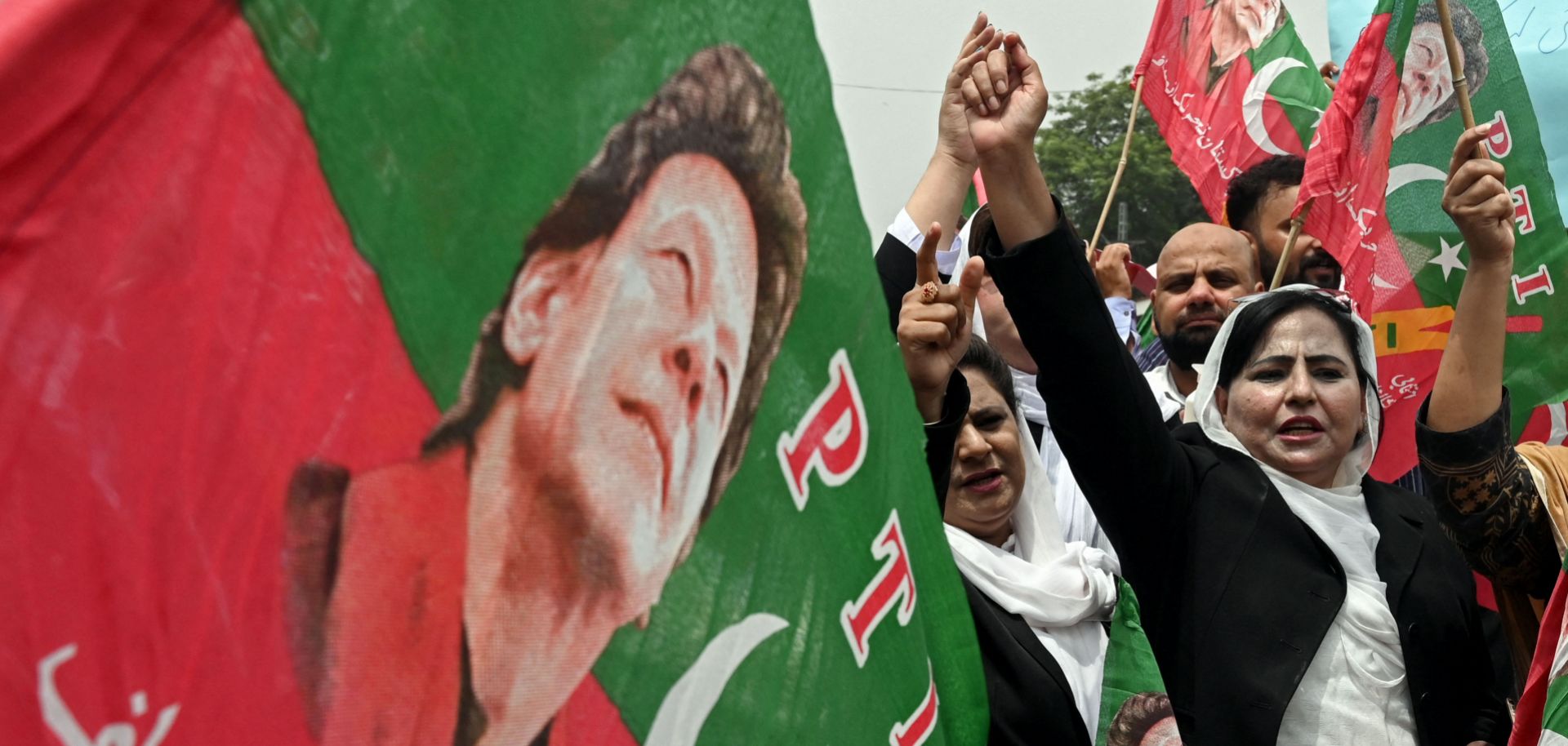
In Pakistan, former Prime Minister Imran Khan's arrest and sentencing may not generate immediate unrest as courts consider legal challenges to his conviction. But other legal troubles and potential election delays will keep the risk of potentially violent protests high for the rest of the year and complicate his party's ability to compete. On Aug. 5, police arrested Khan at his residence in Lahore after an Islamabad trial court sentenced him to three years in prison for illegally selling state gifts. Local media reports indicate Khan has been taken to Punjab province's Attock prison. The court's order states that Khan ''has been found guilty of corrupt practices by hiding the benefits he accrued from the national exchequer wilfully and intentionally.'' Khan allegedly failed to disclose receiving certain gifts from the Toshakhana — the government department tasked with overseeing valuables received by officials and elected leaders — and allegedly provided inaccurate information about the sale of certain gifts from the department — which according to the court, established his dishonesty ''beyond doubt.'' The conviction, should it hold, would disqualify Khan from holding political office for up to five years. Soon after, Khan's Pakistan Tehreek-e-Insaf (PTI) party condemned the verdict, claiming it has challenged the decision in the Supreme Court and calling for peaceful nationwide protests. Some protests have broken out in response to the verdict, but turnout and consequent disruptions have been limited; at least a few dozen protesters have been arrested in multiple areas, including Khyber Pakhtunkhwa province's Shangla district, as well as the Punjab province cities of Rawalpindi and Lahore. Authorities have also imposed bans on large gatherings in multiple districts, including the Shangla district, along with the districts of Rawalpindi, Kasur, Jhelum, Mianwali, and Mandi Bahauddin in Punjab, where Khan is broadly popular.
Khan's arrest comes amid a government and military crackdown on those allegedly involved in the mass unrest following Khan's first arrest earlier this year, as well as in advance of a transition to a caretaker government and elections due later this year. The former prime minister was first detained by authorities on May 9 for allegedly receiving millions of dollars of land from a real estate tycoon in exchange for the tycoon's protection in a legal case. Khan's arrest followed a year-long standoff with the government and military that ensued after he was ousted via a no-confidence vote in April 2022. In response to the verdict, thousands of PTI supporters immediately took to the streets and staged disruptive protests nationwide, some of which directly targeted the military. The unrest saw protesters breach a part of the Pakistan Army's headquarters in Rawalpindi, while another group burned the Lahore Corps Commander's residence. Violence abated after the Supreme Court on May 11 deemed Khan's arrest unlawful and ordered his immediate release. But since then, authorities have reportedly arrested thousands of protesters and PTI figures accused of taking part or being complicit in the violence. Amid this sweeping crackdown, a number of PTI leaders have either defected or resigned from the party in recent months, all of whom explicitly denounced the violence that followed Khan's May 9 arrest in their announcements. In addition, the military has cracked down on alleged complicity in the violence and support for Khan within its ranks, having fired at least three army officers (including a lieutenant general) and disciplining at least 15 other senior officers. As a result, Khan and the PTI have generally maintained a lower profile in recent months, holding only limited rallies. This comes as Pakistan is preparing to transition to a caretaker government in advance of elections due by October or November, where the PTI is expected to contest. Parliament's five-year term expires Aug. 12, and local media has reported that Pakistan's Prime Minister Shehbaz Sharif intends to prematurely dissolve the lower house on Aug. 9. As these dates approach, Pakistani lawmakers have passed a number of contentious pieces of legislation that among other things, bolster the powers of intelligence agencies and caretaker governments. Opposition parties have criticized the latter bill for potentially portending elections under a caretaker government that lacks sufficient impartiality, and which would instead be focused on continuing to implement the current government's policies rather than being narrowly focused on holding ostensibly free and fair elections.
In the coming days, disruptive activity from PTI supporters may be muted as higher courts consider legal challenges to Khan's conviction. Khan can appeal the verdict in higher courts and up to the Supreme Court, which could potentially suspend or overturn his conviction. The PTI has claimed it has appealed the decision in the Supreme Court on the grounds that Khan's conviction was unfair and issued in his absence. Significant pro-Khan protests, however, did not erupt over the weekend in the immediate wake of his latest arrest (when they would be expected to be the largest). This relatively muted response may be because Khan's supporters are cautiously optimistic about the legal challenges' chances — particularly in the Supreme Court, given it has issued rulings favorable to Khan before, including ordering his May 11 release following his prior arrest. PTI supporters may also be more concerned over the repercussions of protesting amid the months-long crackdown on the PTI and supporters accused of violently protesting in May. But regardless, large disruptive protests appear less likely until legal challenges to Khan's conviction are exhausted.
But regardless of what happens with Khan's latest conviction, his other legal cases and the potential for election delays mean that the risk of potentially violent unrest will persist in the coming months as the PTI faces challenges in its ability to electorally compete. If legal challenges to Khan's conviction fail, the risk of disruptive nationwide protests would increase significantly, particularly given that such a decision would mean Khan would remain disqualified from politics for up to five years. Though Pakistan has a long history of the military interfering in elections and political affairs, Khan's supporters would see his arrest and continued imprisonment as fully discrediting upcoming elections, incentivizing strikes, mass protests and other forms of civil disobedience; past unrest suggests disruptive activity could turn violent and again target the military. Compared with the demonstrations seen earlier this year, turnout may be smaller as PTI supporters may be more afraid to take to the streets amid the government and military's recent crackdown. But Khan's supporters have previously demonstrated their commitment to engaging in disruptive activity in the event action is taken against him. If Khan's conviction is eventually suspended or overturned, the risks for such near-term unrest would abate, but longer-term risks of disruptive protests would still persist. This is because Khan will remain at risk of being arrested again in the more than 150 legal cases currently leveled against him, especially as the government and military continue to try to prevent him from returning to power. These risks would be worsened by the recent passage of controversial legislation bolstering the caretaker government and authorities' powers, and would become particularly acute if the upcoming general and provincial elections are delayed. Pakistan's federal minister for law and justice on Aug. 5 told Pakistani media outlet Geo News TV that elections due in October or November will be based on a new census, which would likely delay polls by several months, potentially until 2024. Should this happen, it would further amplify the political opposition's concerns and threaten disruptive protests. In such a situation, the PTI would likely be incentivized to generate unrest to exert political pressure given it is facing numerous challenges to its future. The party remains weakened after a wave of leadership resignations in recent months, and PTI officials have acknowledged that none of the party's leaders comes close to matching Khan's popular support. While it is possible that Khan's potentially continued imprisonment would sustain or even bolster the PTI's support, it could also lead party supporters to seek alternative parties, especially as the military and government will very likely continue efforts to prevent the PTI's return to power.
