
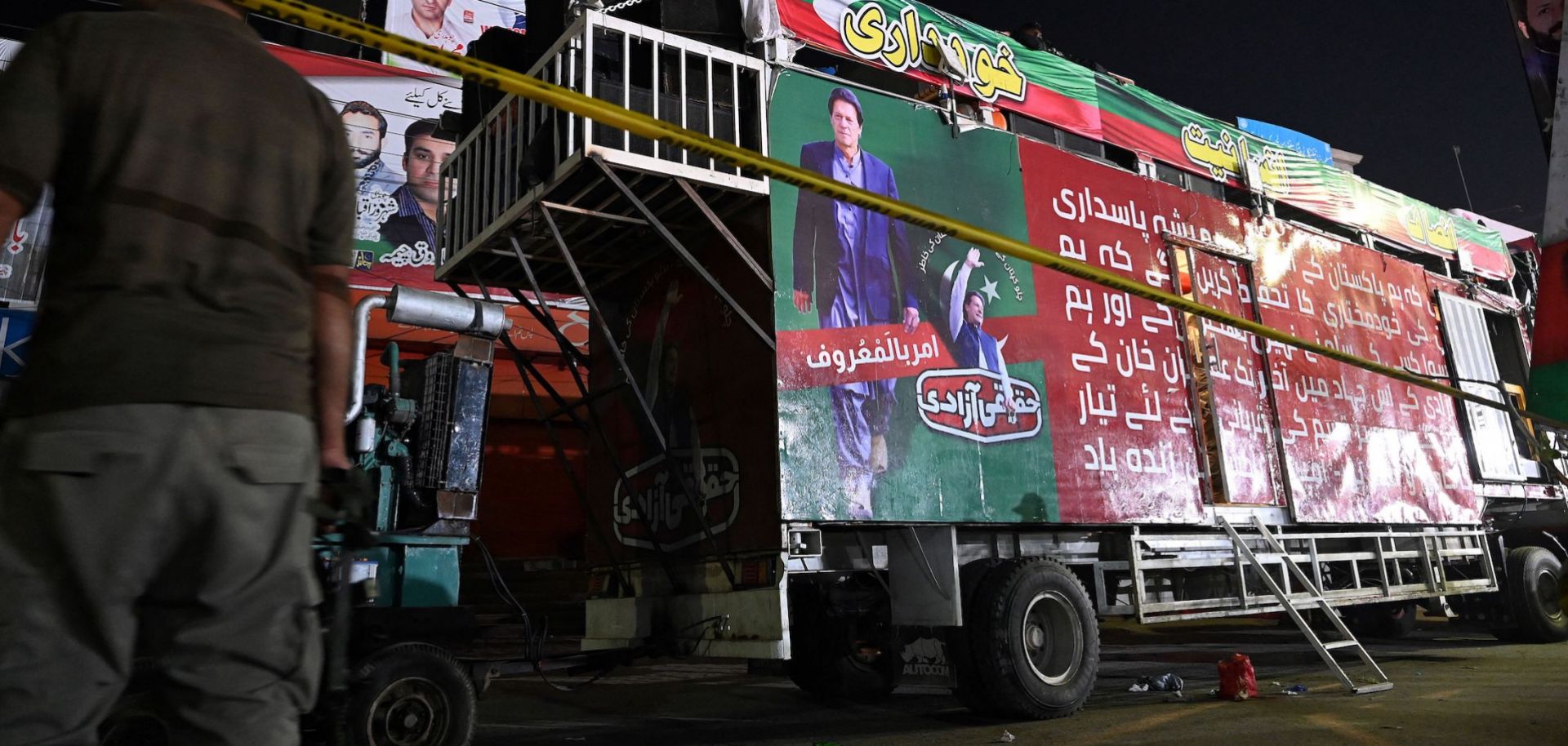
In Pakistan, the shooting of former Prime Minister Imran Khan will raise the risk of violence and worsen political instability. On Nov. 3, a gunman fired at a campaign truck carrying former Prime Minister Imran Khan during his protest march to the capital of Islamabad, killing one person and wounding Khan and nine others. The incident occurred in the city of Wazirabad — approximately 106 miles (171 kilometers) from Islamabad — in the eastern province of Punjab. Khan, who appeared to sustain a gunshot wound to the shin, was subsequently transported to and underwent surgery at Shaukat Khanum Hospital in Lahore, according to Omar Ayub Khan, a senior leader of Khan's Pakistan Tehreek-e-Insaf (PTI) party. The gunman — who AP says has been identified as Faisal Butt by Information Minister Maryam Aurangzeb — was arrested after the shooting, and the government has opened an investigation into the incident.
- In an apparent video confession later released by police, the suspect emphatically claimed that he had acted alone and spontaneously targeted Khan because he considered the loud music playing at the march during the day's Muslim call to prayer disrespectful; he also stated that Khan "was misleading the people, and I couldn't bear it."
- Information Minister Aurangzeb cited the confession video in claiming the incident seemed to lack political motivations, calling for calm and for people to refrain from "irresponsible statements unless and until [sic] investigation is completed."
- By contrast, Khan's supporters and PTI leaders have claimed the shooting was a clear and well-planned assassination attempt. Notably, PTI Secretary-General Asad Umar claimed in a video message released by the party that Khan suspects Prime Minister Shahbaz Sharif, Interior Minister Rana Sanaullah and intelligence official Maj. Gen. Faisal Naseer of being responsible for the attack, although he has provided no evidence to support this claim thus far. Umar tweeted shortly after the shooting, "If they could not stop it, the cowards tried to kill him."
The shooting occurred in the context of Khan's renewed efforts to regain power since his May ousting. Khan's protest march began on Oct. 28 and was scheduled to reach the capital on Nov. 4 to demand snap elections, and it followed recent electoral victories for the PTI and Khan in provincial and National Assembly by-elections. Amid this strong popular support, Khan recently doubled down on harshly criticizing the government and the military, claiming that both are behind a conspiracy that seeks to silence him. These new accusations join Khan's months-long reiteration of claims that these entities were responsible for his downfall as prime minister earlier this year and have sought to threaten the lives of him and other government critics.
- In May, after having been ousted in a no-confidence vote in Parliament on April 10, Khan claimed that foreign and domestic actors were conspiring to take his life, supposedly believing him to "be an obstacle in [their] path and needs to be removed;" he further claimed to have video evidence of the conspiracy in which he "name[s] everyone" involved, and expressed intent to release the video if "something happens to me," though he has provided no proof of this. More recently, Khan made statements on Oct. 25 implying that the government was complicit in senior Pakistani journalist Arshad Sharif's Oct. 23 killing in Kenya.
- Pakistan has a history of conducting political killings or sidelining leaders through corruption cases at the behest of the military, which has historically wielded disproportionate political power. In recent times, however, the military has claimed to be a neutral player and refuted all allegations of political interference.
- On Oct. 27, the chief of Pakistan's premier spy agency, Inter-Services Intelligence (ISI), and head of Inter-Services Public Relations, the media wing of the Pakistani military, held an unprecedented press conference rejecting Khan's claims and blaming him for misleading people through false narratives. Though likely meant to redeem some of the military's lost reputation, Khan's supporters saw the press conference as an attempt to justify future action against him.
The shooting risks sparking more violence in the coming days and more broadly will stoke political instability that weakens Sharif's government. Statements by PTI leaders and Khan's supporters suggest that the shooting has intensified their anti-government grievances by reinforcing Khan's unconfirmed claims that he and his party are being persecuted by the Pakistani government. Khan's supporters have already begun engaging in spontaneous protests in various parts of the country demanding justice for Khan's shooting, and Khan's accusations against the government and military — and especially against the aforementioned named individuals — could drive targeted attacks by Khan's aggrieved supporters. Videos circulating on social media illustrate these risks, with one showing protesters vandalizing an armored vehicle, and another purportedly showing protesters outside a Pakistani military commander's house, both in the city of Peshawar. Security forces will likely harshly crack down on escalating unrest, particularly if Khan's supporters engage in widespread vandalism and violence, which may only fan the flames of the protest movement. Risks will be especially high in and around Islamabad should the protest march continue as planned, as the Insaf Students Federation stated in a tweet supposedly quoting Khan that the march would resume on Nov. 4 at 11 a.m. "no matter what." While it remains unclear how Khan's shooting will precisely affect Pakistani politics, the current polarized atmosphere suggests that it will further stoke societal divisions that undermine Prime Minister Sharif's government.
- Sharif's government is already under immense economic pressure due to low foreign exchange reserves that have left the government unable to import essential energy resources. Recent floods further exacerbated inflationary pressures and supply-side disruptions, particularly for food items. Inflation has remained above 20% since June, and Sharif's administration has increased fuel prices and certain taxes to comply with the terms of the International Monetary Fund's bailout program. However, such unpopular economic measures risk undermining the government's popularity, which Khan's shooting will only worsen by fueling political uncertainty.
