
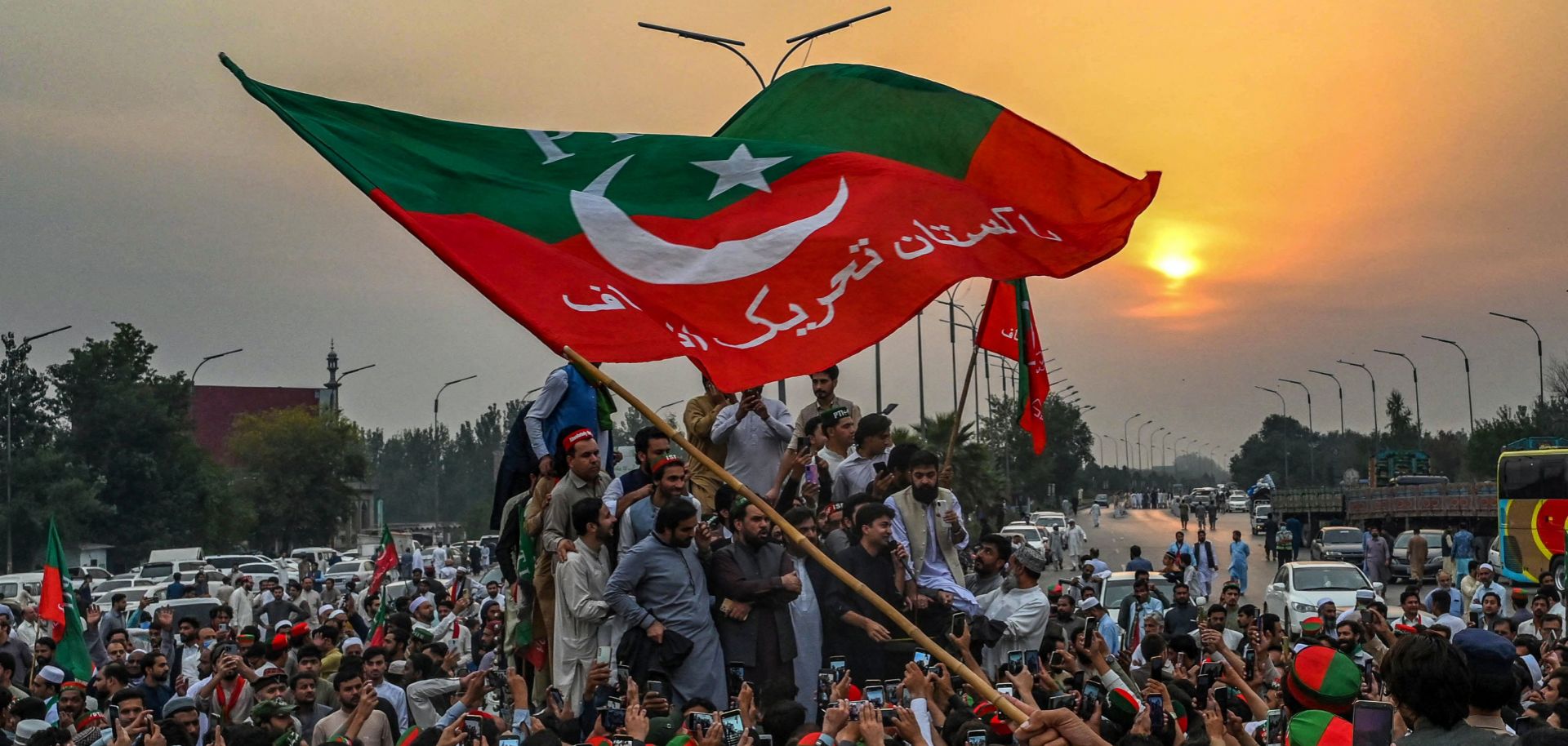
Supporters of former Pakistani Prime Minister Imran Khan take part in a protest as they block the main road in Peshawar, Pakistan, a day after the assassination attempt on Khan on Nov. 4, 2022.
A former prime minister's showdown with Pakistan's powerful military is testing the very foundation of the country's system of governance, opening the door to continued political, economic and security turbulence. Seven months after being forced to step down, former Pakistani Prime Minister Imran Khan continues to accuse the country's military and political establishment, as well as the U.S. government (although toned down), of conspiring against him. And his accusations appear to be resonating among supporters, as evidenced by his Pakistan Tehreek-e-Insaf party's strong performance in recent elections and the large turnouts seen at his continued demonstrations across the country.
- Khan, a former cricket player, became Pakistan's prime minister in 2018. In April 2022, he was forced to resign after losing a no-confidence motion in parliament triggered by the opposition. Since then, he has insisted on a conspiracy against him and has demanded early elections. In October, he launched a ''long march'' from Lahore to Islamabad to show his popularity and demand early elections. On Nov. 4, he survived an alleged assassination attempt in Wazirabad (a city 118 miles from Islamabad) where he was shot in the foot. Once more, he alleged that current Prime Minister Shehbaz Sharif, the Pakistani military was behind the assassination attempt, though there is no evidence backing up his accusations.
- On July 17, Khan's Tehreek-e-Insaf won most seats in by-elections in the populous Punjab province, which allowed the party to regain control of the politically critical territory. Punjab accounts for about 55% of Pakistan's voters and 53% of seats in the country's National Assembly. Khan's party also won six of the eight seats up for grabs in by-elections held on Oct. 16.
Khan's criticism of Pakistan's defense establishment is notable, given the military traditionally had a dominant role in domestic politics and the economy. Pakistan's military has yielded undue power throughout the country's post-colonial history. In fact, since gaining independence in 1947, the country has had four periods of military rule, with the last one ending in 2008. Even when the military is not directly in power, no civilian government has been able to come to power without endorsement from the military (or the ''establishment,'' as it is called in the country.) The Pakistani military bases its strong political influence on its role in fighting the multiple risks to national security facing the country, including internal threats emanating from homegrown extremist groups, terrorists and separatist movements within Pakistan, as well as external threats emanating from its enduring rivalry with neighboring India and the ongoing instability in Afghanistan. Inefficiency and corruption during civilian governments further eroded the credibility of politicians vis-a-vis the powerful military in the eyes of many voters. The Pakistani military is also heavily involved in the country's economy through its control of companies in a diverse array of sectors, including education, corporate security and insurance, as well as cement manufacturing and agriculture. Driven by self-interest and self-preservation, the military has continuously pressured civilian governments to enforce policies that protect its influence over Pakistan's economy and political system. And over time, this unrelenting pressure has created a hybrid system of governance where civilian politicians oversee domestic policy matters and day-to-day lawmaking, with the military maintaining near total control over matters of foreign policy and national security. Few civilian leaders have challenged this informal power-sharing system for fear of making enemies with the country's formidable defense establishment. And that's why Khan's direct criticism of the military, and the apparent resonance it's having with Pakistanis, are so significant.
- Pakistan has been led by four different military rulers under three separate military coups during the periods of 1958-1977, 1977-1988 and 1998-2008.
- None of the 23 prime ministers Pakistan has had since 1947 have completed a full five-year term, and only three have remained in office for longer than four years.
Khan's rhetoric could destabilize Pakistan's decades-long arrangement between politicians and the military. In 2018, following years of poor governance and rampant corruption within Pakistan's mainstream political parties, the military tacitly paved the way for newcomer Khan (who had no previous experience in politics) to become prime minister, in the hopes that he would be easily controlled. In fact, after Khan's victory in 2018, some members of the opposition suggested that the military had rigged the vote in his favor. During most of his tenure, Khan followed the unwritten rules of military supremacy over civilian rule. But in the months leading up to his ousting in April, Khan's poor management of the economy — along with his refusal to cooperate with the opposition and bypassing parliamentary procedures to push through his policy agenda — had left him in a politically vulnerable position. But perhaps the biggest factor that led to his downfall, however, was his breakup with the military after a series of controversial foreign policy decisions — including his deprioritization of the important China-Pakistan Economic Corridor partnership, his failure to prevent U.S. tensions from worsening after last year's Taliban takeover in Afghanistan, and his timid response to India's unilateral revocation of Indian-administered Kashmir's autonomous status in 2019. After his resignation in April, Khan has been able to remain popular and relevant among young Pakistanis by branding himself as a nationalist, populist and corruption-free alternative to ''status quo'' politicians. And he's bolstered this anti-establishment image through his accusations that the current government and military conspired to depose him. Khan's relative success in blaming the military for political machinations, while simultaneously questioning the blurry lines of the country's civil-military system, has made him something of an enigma in Pakistani politics. Indeed, Pakistan has never seen such a polarizing leader who is also so popular — making Khan's challenges to the military a particularly potent threat to the country's political stability.
In the coming months, the military will use all the means at its disposal to undermine Khan and prevent him from returning to power. In the past, the Pakistani military has deposed leaders by indicting them on corruption charges and pressuring political parties to withdraw support. The military has also resorted to coups and assassinations. But to reassert its dominance this time around, the military is unlikely to use direct intervention, which would only risk feeding into Khan's depiction of Pakistan's defense establishment as a power-hungry, self-serving institution. With insufficient popular support for another coup due to its battered reputation amid Khan's constant attacks, the military will instead maneuver behind the scenes to keep Khan from returning to power, using its influence over Pakistan's judicial and electoral institutions (a number of ongoing corruption-related cases against Khan, for example, could result in rulings that ban him from running in the next election). The military will also pressure Sharif's government against holding an early general election in the hopes that Khan's movement will eventually lose momentum. However, Sharif's government may struggle to remain in power until the next general election (which must be held before October 2023) due to Pakistan's weak economic conditions, with the country facing low foreign exchange reserves, potential energy and food shortages, and the looming risk of a default amid rising debt levels.
- In an unprecedented move, the head of Pakistan's powerful spy agency, the Inter-Services Intelligence (ISI), and a serving general from the military's media wing held a detailed press conference on Oct. 27 denying Khan's claims against the army's political interference in the former prime minister's removal from power. Both the ISI chief and general also condemned Khan for misleading people by making false claims.
- On Oct. 21, Pakistan's election commission ruled that Khan was guilty of corruption charges that would disqualify him from holding political office. Khan challenged the ruling, which is currently being reviewed by a higher court.
Khan's political agenda could eventually lead to systemic changes that determine the country's socio-economic trajectory. Khan's constant criticisms and accusations have battered the reputations of both the military and the Sharif administration. This has impeded their ability to bring the situation under control in Pakistan by leaving them in a politically weak position. In the short term, the military and the Sharif government will likely try to pool their resources and work together toward mitigating the mutual threat that Khan poses to their places in power. However, the political instability and demonstrations Khan is staging are raising the stakes of any power-sharing negotiations between the civilian government and the military. Pakistan politics hence is at a critical stage where the military will have to decide between solidifying the red lines that civilian governments are not allowed to cross (which could come at the price of stronger anti-establishment sentiments in the population) or giving up some of the political and economic influence that it's built up over decades. In the long run, changing Pakistan's political system will be a slow, long-term process as established norms will be difficult to modify. But eventually, that process could result in either a more democratic system of governance, or a new variation of the hybrid system currently in place. Meanwhile, political instability driven by opposing interests of politicians and the military will likely continue to exacerbate the country's enduring economic instability — creating fertile ground for more anti-establishment leaders to emerge in the future. A coup remains unlikely, but it cannot be ruled out — especially if Pakistan's political chaos devolves into nationwide violence or faces a greater national security crisis.
