
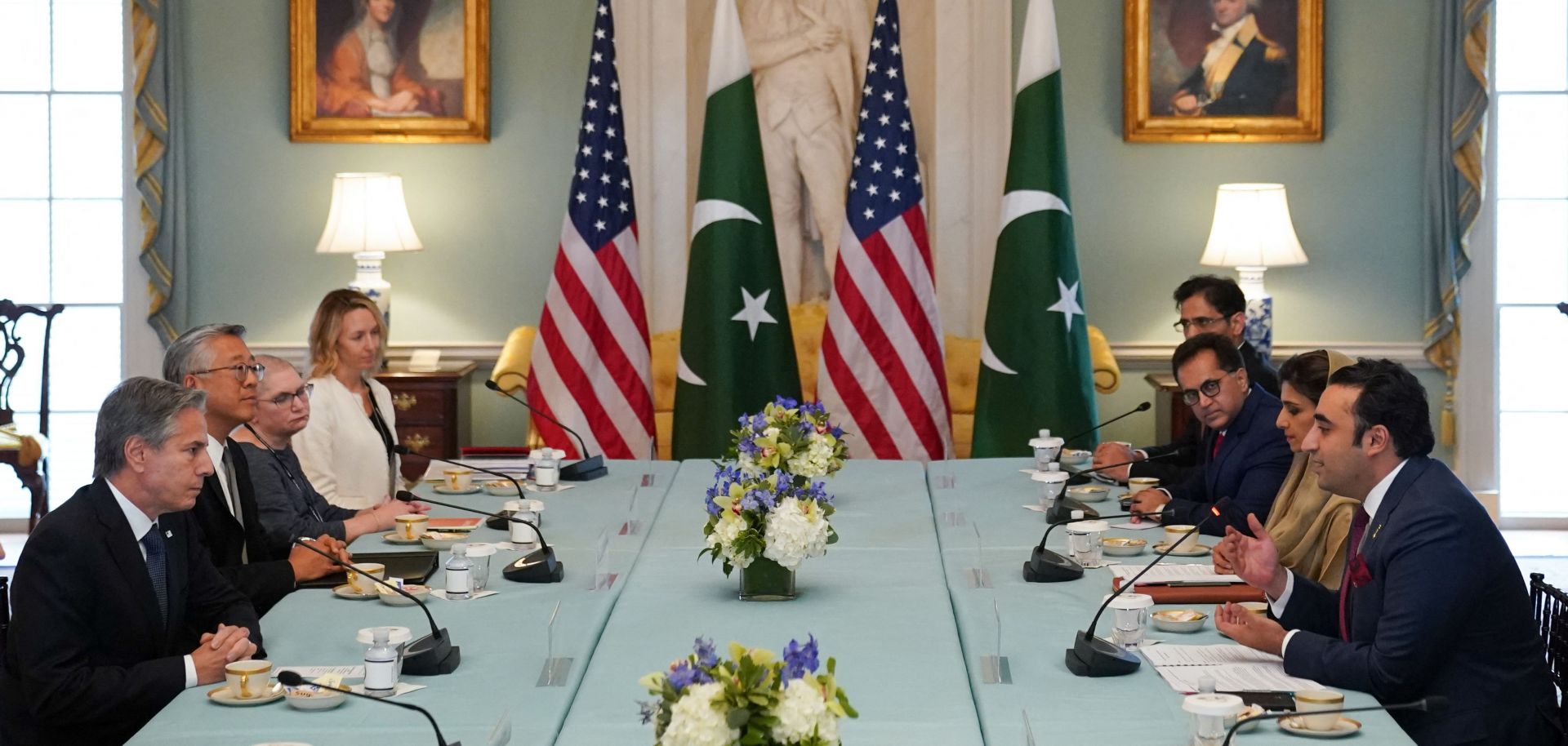
A delegation led by U.S. Secretary of State Antony Blinken (left) meets with a delegation led by Pakistani Foreign Minister Bilawal Bhutto-Zardari at the State Department in Washington, D.C., on Sept. 26, 2022.
While Pakistan's ongoing push to improve ties with the United States will likely result in a more pragmatic relationship after years of mistrust, cooperation will continue to primarily focus on security issues and a substantial U.S. economic involvement in the country is unlikely. Recent outreach between the United States and Pakistan indicates the two countries are trying to improve their strained diplomatic ties:
- On Oct. 9, Pakistan's Chief of Army Staff Gen. Qamar Javed Bajwa wrapped up a six-day visit to the United States, where he discussed regional security matters in meetings with senior U.S. defense officials, including Secretary of Defense Lloyd Austin, National Security Advisor Jake Sullivan, National Intelligence Director Avril Haines and CIA Director William Burns.
- On Sept. 26, Pakistani Foreign Minister Bilawal Bhutto Zardari also visited Washington, where he discussed humanitarian aid for flood relief and other regional issues with his U.S. counterpart Antony Blinken.
- On Sept. 8, the administration of U.S. President Joe Biden provided Pakistan $450 million to upgrade the country's fleet of F-16 fighter jets — indicating a policy reversal from its predecessor, which suspended military aid to Pakistan for failing to clamp down on terrorist groups. The same day, CIA Director William Burns visited Pakistan to discuss the situation in Afghanistan with the country's defense officials.
These developments suggest a mutual desire by both Pakistan and the United States to reset bilateral ties after a rocky few years. Washington's relations with Islamabad have hit several rough patches in recent years amid the latter's ongoing ties to the Taliban in Afghanistan. Throughout the 18-year Afghan conflict, Pakistan maintained support to both the militant group and the U.S. military. Over the years, this increasingly fueled concerns in Washington that Islamabad was playing a double game by nominally aiding U.S. troops in Afghanistan while simultaneously sponsoring the very enemy those troops were fighting against. Such concerns came to a head under the administration of former U.S. President Donald Trump, who repeatedly accused Pakistan of being deceitful by providing a safe haven for the Taliban and other terrorist groups. In 2018, the Trump administration suspended $1.9 billion in U.S. aid to the country, which in turn made Pakistan all the more distrustful of the United States — worsening the bilateral relationship. Relations then hit another low earlier this year, when former Pakistani Prime Minister Imran Khan accused the United States of orchestrating his ousting from power in April (claims that were never confirmed).
But despite recent political frictions, the two countries' security establishments have remained in close communication. For decades, the U.S.-Pakistan partnership has been rooted in military cooperation, due largely to Pakistan's strategic importance in mitigating threats in neighboring Afghanistan. Islamabad and Washington joined forces to arm the anti-Soviet mujahideen in Afghanistan in a proxy conflict of the Cold War. The two countries then resurrected their alliance in 2001 after the United States invaded Afghanistan to dismantle the Taliban-led government and destroy al Qaeda, the perpetrators of the 9/11 attacks. The country's landlocked geography forced the United States to rely on Pakistan — the principal sponsor of the Taliban — to provide overland access for ferrying troops and military equipment into Afghanistan. And in exchange for that support, Washington gave Islamabad roughly $33 billion in aid over the next 15 years (until the Trump administration cut off those funds in 2018). Today, the United States and Pakistan's security institutions continue to cooperate in mitigating regional threats.
- The CIA's July 31 drone strike that killed al Qaeda leader Ayman al-Zawahiri in Kabul was speculated to have been carried out in coordination with Pakistan, given a 2003 U.S.-Pakistan agreement that allows the United States to use Pakistani airspace to conduct flights into Afghanistan.
By increasing outreach to the United States, Pakistan is seeking to expand this largely security-focused relationship to other areas, such as trade and infrastructure. A combination of political and economic pressures is driving Pakistan to improve ties with the United States. For one, Pakistan's military holds significant influence over the country's security and foreign policy matters, and has been working with Prime Minister Shehbaz Sharif's government to mend bilateral ties with the United States. In addition, Sharif's government is hoping to build a more comprehensive partnership with Washington that covers aspects like trade, infrastructure, technology and health at a time when the South Asian country is grappling with the economic fallout from the devastating floods that swept across Pakistan earlier this year, along with the ongoing global energy and food crises. Relatedly, improved ties with the United States could also increase Pakistan's chances of securing financial assistance from various multilateral lending institutions, like the International Monetary Fund, given Washington's influence over such organizations.
- Pakistan has repeatedly requested bailouts from the IMF during volatile economic times. Islamabad is currently under a $6 billion IMF bailout plan from 2019 under which it received $1.17 billion in August this year after the seventh and eighth reviews of the program.
- Between July and September, Pakistan was hit with a series of massive floods that left millions without homes or food and severely disrupted agricultural production.
Pakistan is also hoping to balance its foreign policy at a time of rising geopolitical tensions between the United States, China and Russia. Pakistan is a part of China's Belt and Road infrastructure initiative, which aims to extend China's influence over the world through economic diplomacy and partnership. Pakistan has also taken a neutral stance on Russia's war in Ukraine, which has enabled it to import cheap Russian oil at a time when Western nations are scrambling to find new energy supplies after sanctioning Moscow's exports. The United States cannot quickly replace China as a source of investment, or Russia as a source of energy. But Pakistan will nevertheless seek to establish an independent bilateral relationship with the United States in the hopes that it could eventually serve as a potential balance to Chinese and Russian ties.
But despite Pakistan's efforts to broaden the relationship, the United States will remain primarily interested in security cooperation. The United States will likely avoid reinstalling a direct military presence in the region after withdrawing from Afghanistan in the wake of the Taliban takeover in August 2021 and realignment of its foreign policy objectives to counter Chinese influence. Instead, Washington will probably opt to keep some degree of operational capabilities to monitor and act on terrorist threats. But it will still rely on Pakistan's help to gain the access needed to maintain those counterterrorism and intelligence-gathering efforts, given that all of Afghanistan's other neighbors are either directly or indirectly hostile toward the United States. Indeed, the Biden administration's recent move to help upgrade Pakistan's fleet of fighter jets (despite India's protests) shows that U.S. leaders still very much see the country as an important security partner. Still, this continued interest in Pakistan is unlikely to result in a significant increase in U.S. financial aid or private-sector investment in the country. For one, Washington is also seeking to grow its partnership with India (Pakistan's regional archnemesis), which will likely limit the extent to which it can deepen economic cooperation with Islamabad — at least in the short-to-medium term. China's large presence in Pakistan, along with the South Asian country's perennial economic and political instability, will further deter U.S. businesses from getting too involved in Pakistan. The United States thus remains unlikely to significantly expand its relationship with Pakistan beyond the security realm, as the risks of doing so currently outweigh the benefits.
- The three Central Asian states to Afghanistan's north — Turkmenistan, Uzbekistan and Tajikistan — are heavily influenced by U.S. adversaries China and Russia. And to Afghanistan's west is Iran, which is itself a U.S. adversary. Pakistan thus remains the United States' only practical partner for land access to Afghanistan, which Washington needs to monitor (and prevent) potential threats, like the regrouping of terrorist organizations in the Taliban-controlled country.
