
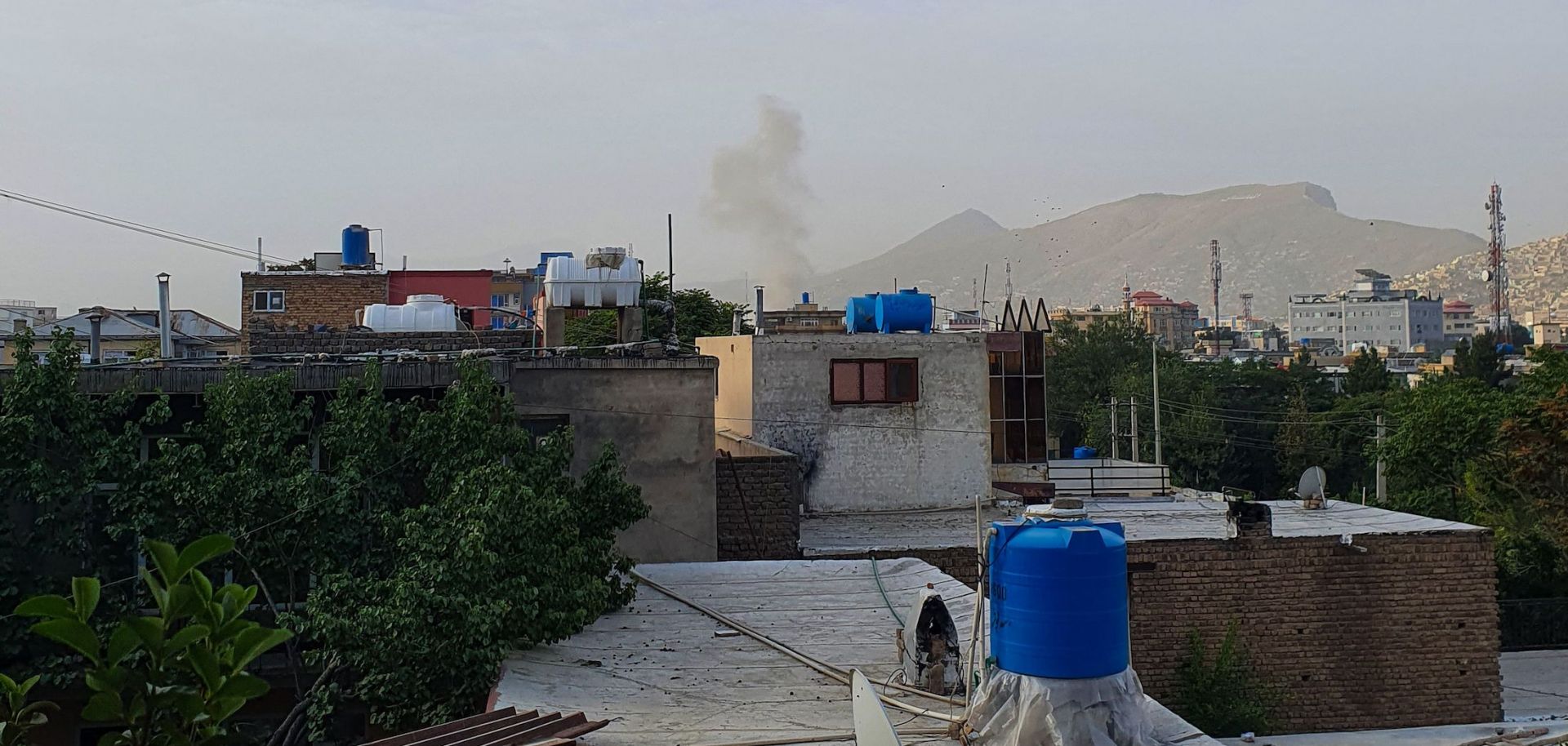
Smoke rises from a house following a July 31, 2022, U.S. drone strike in the Sherpur area of Kabul that killed al Qaeda leader Ayman al-Zawahiri.
The CIA conducted an unmanned aerial vehicle strike the morning of July 31 in downtown Kabul that killed al Qaeda leader Ayman al-Zawahiri, AP reported Aug. 1. A senior Biden administration official claimed that "multiple streams of intelligence" bolster U.S. confidence that the strike did not result in civilian casualties. Al-Zawahiri was reportedly staying in a house located in the upscale Sherpur neighborhood of Kabul owned by a top aide to Taliban senior leader and acting Interior Minister Sirajuddin Haqqani. It is unclear how long al-Zawahiri had been in Afghanistan, though a reputedly "senior leader" within the Taliban reportedly told Reuters that al-Zawahiri had "moved to 'a very safe place' in Kabul a few months'' after the Taliban's takeover of Afghanistan in August 2021. The same senior Biden administration official stated that al-Zawahiri's presence was a "clear violation" of the 2020 U.S.-Taliban Doha Agreement, which among other things, involved commitments by the Taliban to "not allow any of its members, other individuals or groups, including al Qaeda, to use the soil of Afghanistan to threaten the security of the United States and its allies" and to "not host [such individuals or groups] in accordance with the commitments" of the agreement.
- The same U.S. senior administration official also stated that "Haqqani Taliban members took actions after the strike to conceal Zawahiri's former presence at the location" and undertook "a concerted effort to restrict access to the safehouse and the surrounding area for hours after the strike."
- The Taliban initially denied reports that a UAV strike had occurred and instead claimed a rocket had hit a residence in Kabul and did not result in casualties, but the Taliban's spokesman later confirmed and condemned the strike, alleging it violated the U.S.-Taliban Doha Agreement.
The strike is the first reported and confirmed U.S. counterterrorism operation in Afghanistan since the withdrawal of U.S. and coalition forces from the country in August 2021, and had reportedly been planned for months. A key question since last summer's withdrawal has been whether the United States would be able to effectively identify and counter extremist threats in Afghanistan following the U.S. loss of intelligence assets and a presence on the ground. But the Biden administration has consistently stated the United States maintains an "over-the-horizon" counterterrorism capability to collect intelligence and conduct UAV strikes in Afghanistan to degrade extremist targets without having a presence on the ground. The strike also comes weeks after the U.N. Security Council released a report noting that al-Zawahiri's "apparent increased comfort and ability to communicate . . . coincided with the Taliban's takeover of Afghanistan and the consolidation of power of key Al-Qaida allies within their de facto administration."
- U.S. intelligence officers reportedly took several months to strengthen confidence in al-Zawahiri's presence in the house of interest, establish the "pattern of life" for al-Zawahiri and other occupants of the house, and ascertain details about the structure and the surrounding area to provide U.S. President Joe Biden with a set of viable options and work to minimize the risk of civilian casualties.
For the United States, the strike demonstrates that it maintains some capability in Afghanistan to collect intelligence and conduct strikes against high-value targets, though it is too early to assess the broader efficacy of its "over-the-horizon" strategy in countering a potential extremist resurgence in the country. While aforementioned efforts to establish a "pattern of life" for al-Zawahiri indicate some level of underlying intelligence gathering capability in Afghanistan, one notable limitation of relying on UAVs and having a limited, if nonexistent, presence on the ground to carry out operations is a greatly reduced ability to collect and exploit intelligence in the aftermath of targeted strikes. Reports conflict on whether a U.S. "ground team" intended to support the strike and help confirm al-Zawahiri's death was deployed, and on whether such a team was able to enter the residence to collect intelligence after the strike. The collection and exploitation of intelligence in the aftermath of the 2011 U.S. raid that resulted in the killing of Osama bin Laden are considered a key contributor to the success of subsequent counterterrorism operations against al Qaeda. If the United States were unable to carry out something similar following the strike on al-Zawahiri, this would likely limit the longer term counterterrorism impacts of the recent operation.
- It also remains to be seen whether the strike is a one-off or if it portends a U.S. shift toward a more assertive counterterrorism posture in Afghanistan, including through further strikes against high-value targets. While there have been growing concerns about a resurgence not only of al Qaeda, but also of the Islamic State's branch in Afghanistan, until now, the Biden administration has not taken lethal action in the country since the August 2021 military pullout.
For al Qaeda, al-Zawahiri's killing is unlikely to significantly degrade the capabilities of the group's regional affiliates in the near term, but the group could change its broader strategic direction in the long term depending on who is named to succeed him. Given that tactical decision-making generally has been devolved from al Qaeda's central leadership to its affiliates and that al-Zawahiri has long been seen more as a figurehead than a tactician, in the near term his death is unlikely to alter the capabilities of affiliates, which will likely maintain their current course in their respective regions given that many enjoy wide operational freedom. In the longer term, depending on who succeeds al-Zawahiri and whether central leadership continues to play a meaningful role in influencing the group's overall strategic direction, al Qaeda could, however, undergo a broader shift in strategy. Since facing a series of operational setbacks in the first decade of the 21st century, al Qaeda has largely focused on developing a presence in various regions of the globe and engaging in "local" regional conflicts while simultaneously de-emphasizing its historical ambitions of targeting the United States and the West. Among other things, these strategic changes have reportedly been intended to ease Western counterterrorism pressure on the group while allowing the group to survive and maintain relevance in the global jihadist movement. These concerns, along with al Qaeda's long-standing belief in "strategic patience," appear to give the group an incentive to maintain its current course regardless of who succeeds al-Zawahiri, continuing to focus on local conflicts and only again targeting the West when perceived conditions improve. The possibility remains, however, that a future leader or even individual affiliates could change course and attempt a return to targeting the United States and other Western countries sooner rather than later, though the capabilities of individual affiliates would likely help determine the viability of such potential attempts. In recent years, Jamaat Nusrat al-Islam wal-Muslimin in West Africa and al Shabaab in Somalia have been the most operationally active, and they are considered among the most powerful al Qaeda affiliates. Neither (albeit with some exceptions in the case of al Shabaab) has shown a clear intent or capability to strike the West, and both have largely operated independently of al Qaeda's central leadership. By contrast, al Qaeda in the Arabian Peninsula — historically the affiliate closest to the group's leaders in Afghanistan and Pakistan — has shown the greatest intent and capability to attack the West. But recently, it has suffered setbacks in its Yemen stronghold and its outlook is at least somewhat tied to the ongoing civil war in Yemen.
- A recently released U.N. Security Council report listed the line of succession to al-Zawahiri in terms of seniority as high-ranking, veteran member Sayf al-'Adl; general manager and head of media operations Abdal Rahman al-Maghrebi; leader of al Qaeda in the Islamic Maghreb Abu Ubaydah Yusuf al-Anabi; and leader of al Shabaab Ahmed Diriye. Sayf al-'Adl has long been considered the most likely successor to al-Zawahiri given his experience and reported respect within the group, but al-'Adl and al-Maghrebi's residence in Iran — and Iran's reported restrictions on their ability to travel — could complicate either of their ability to succeed al-Zawahiri.
For the Taliban, the revelation that al-Zawahiri was staying in downtown Kabul — and reportedly in the house of a top aide to senior leader and acting Interior Minister Sirajuddin Haqqani — will reinforce international criticism of the group and make its quest for international recognition even more challenging. Al-Zawahiri's presence in downtown Kabul is among the most concrete demonstrations of the apparently enduring relationship between the Taliban and al Qaeda despite the Taliban's assurances that it had severed ties with the group. The revelations support the U.N. Security Council's recent assessment that al Qaeda and the Taliban remain close, with al Qaeda's leadership "reportedly play[ing] an advisory role with the Taliban." In addition, and particularly in Afghanistan, the strike will reinforce perceptions that the Taliban are incapable of securing Afghanistan and preventing foreign encroachment into the country. On the other hand, it may also offer the Taliban an opportunity to try to rally public support behind its portrayal of the United States as violating its sovereignty. It will become clearer in the coming days whether the Taliban suffer a public relations setback or are able to turn the incident to their advantage.
- The U.S. strike follows Pakistan's reported air strikes in April targeting alleged Tehrik-i-Taliban Pakistan (TTP) militants in eastern Afghanistan. Those strikes somewhat undercut the Taliban's claims to be guarantors of the country's security, raised tensions with Pakistan, and helped drive the latest round of cease-fire negotiations between the Pakistani government and the TTP mediated by the Afghan Taliban.
The Islamic State meanwhile will try to capitalize on al-Zawahiri's death, using even a temporary vacuum in al Qaeda leadership to attempt to solidify its position and status within the global jihadist movement. The Islamic State will almost certainly criticize the Taliban and al Qaeda in the aftermath of the strike, likely using its vast propaganda apparatus to highlight the Taliban's inability to secure Afghanistan and accusing the Taliban of complicity in the strike, while also likely claiming the strike demonstrates al Qaeda's weakness. Such narratives would also support its likely attempts to recruit disaffected, demoralized al Qaeda members into the Islamic State in the aftermath of the strike, though it remains to be seen whether it will find significant success in such efforts. Islamic State attempts to burnish its position in the global jihadist movement may also trigger a near-term increase in activity by its regional affiliates. Most notably, the Islamic State Khorasan Province (ISKP), its affiliate based in Afghanistan, has increased its activity in the country since the beginning of the traditional spring fighting season after a relative lull in its attacks over the winter. The recent U.S. strike may trigger further ISKP attacks, including those targeting religious minorities in an effort to sow sectarian division, and directly against the Taliban, which it sees as an ideological and battlefield rival. In the coming weeks, ISKP may also conduct further rocket attacks against neighboring countries to reclaim regional and international attention and demonstrate its operational freedom in Afghanistan as a means to undercut the Taliban.
