
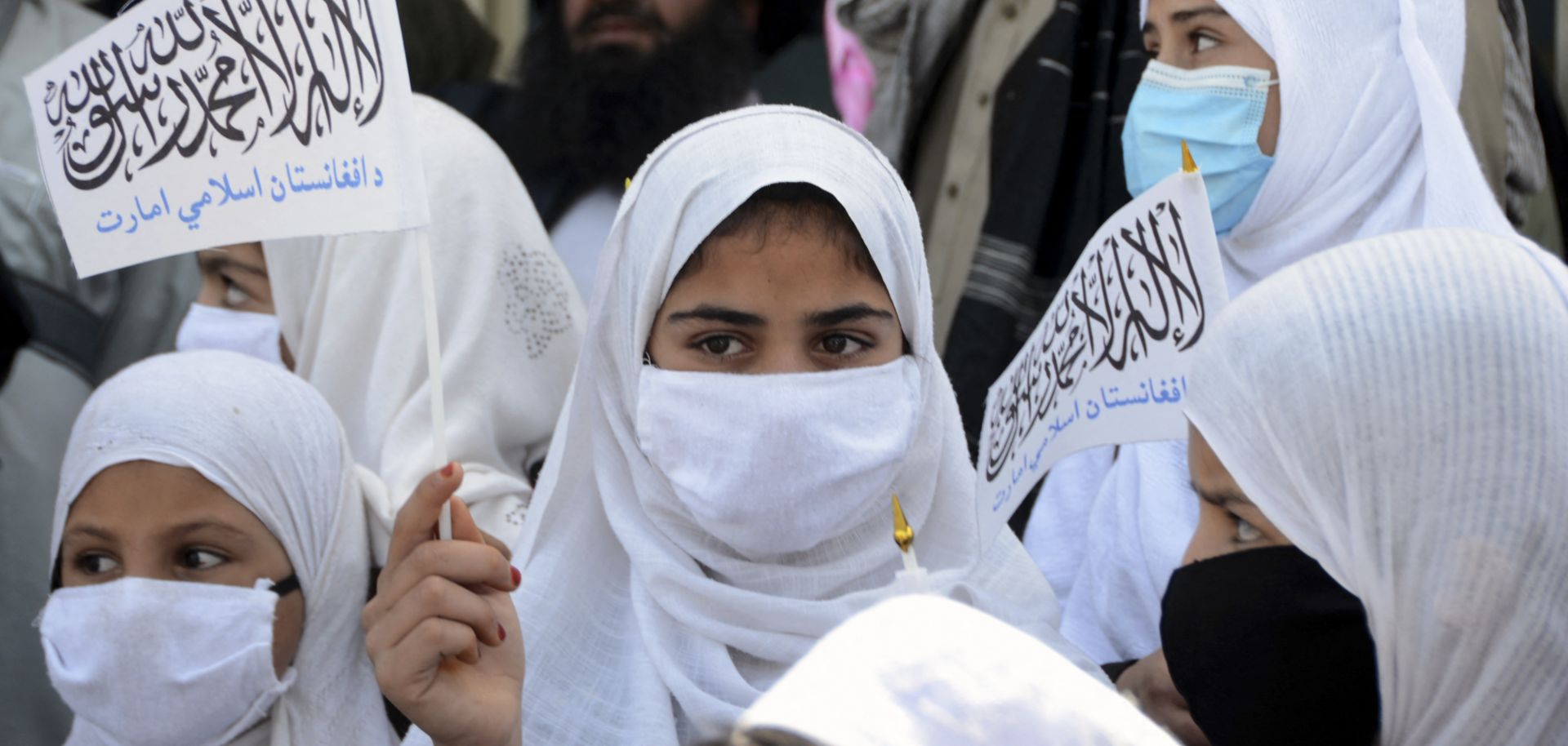
Schoolgirls hold Taliban flags during a ceremony to mark the start of the academic year at a primary school in Kandahar, Afghanistan, on March 24, 2022.
The Taliban's implementation of further restrictions on women and girls in Afghanistan will likely complicate prospects for additional international aid, sustaining instability and worsening crises in the country. On March 25, the Taliban reportedly stopped dozens of women — including some dual nationals — who were not accompanied by an adult male relative from boarding their flights at Kabul International Airport. Similar rules mandating women be accompanied by a male guardian have reportedly been implemented in other contexts, such as seeing a doctor or traveling in a taxi. These reports follow the Taliban's last-minute March 23 reversal of its promise to allow girls who have passed grade six to return to class, prohibiting their return until supposedly ''a comprehensive plan'' on girls' education could be developed ''according to Sharia [law] and Afghan culture.''
- The Taliban announced on March 27 additional restrictions prohibiting women and girls from going to amusement parks in Kabul on the same days as boys and men.
- On March 27, the Taliban banned broadcasts of three foreign media outlets in Afghanistan as well, including Voice of America as well as some British Broadcasting Corporation and Deutsche Welle programming in local languages. The Taliban reportedly also banned the broadcasting of foreign television dramas sometime in mid-March. Shortly after, the group temporarily detained three employees of Afghan media outlet TOLO TV for its reporting on the issue.
The Taliban have implemented such restrictions despite continued reports of group disunity, likely demonstrating the persistent, dominant influence of more hard-line leaders in shaping domestic policy. According to the AP, the group's hard-line leader, Haibatullah Akhundzada, reportedly led the push for the recent restrictions at a three-day meeting of Taliban leadership in late March in the southern city of Kandahar. However, AP also reported that more pragmatic Taliban members were ''resisting…or at least silently ignoring'' some of the restrictive policies, underlining persistent disunity and disagreement within the group. Other media reports corroborate these assertions and have found that enforcement of male guardian policies and other locally controversial restrictions, such as on opium cultivation and the production and trafficking of narcotics, has been inconsistent, apparently largely dependent on the whims of local Taliban fighters. This is in addition to speculation that Akhundzada's intransigence also accounted for the last-minute reversal of the group's pledge to allow older girls to return to school, despite many within the Taliban's leadership apparently being open to supporting girls' access to education.
Current and potential follow-up restrictions will likely complicate additional international aid and potential foreign investment in the country. It is unclear if the Taliban's recent restrictions are part of an effort to consolidate power amid their own perceived vulnerability as the group faces the imminent start of the country's fighting season. However, such restrictions, combined with reports of often indiscriminate and abusive security operations, mean that the Taliban will face particular challenges attracting Western investment. Other countries like China, however, have continued discussions on investment opportunities in spite of broadly-condemned Taliban actions. Tightening restrictions will also very likely complicate international efforts to deliver assistance to Afghanistan amid the country's worsening economic and humanitarian crises. Recent reports indicate that the Taliban's attempts to increase control have extended to non-governmental organizations (NGOs) that deliver aid, threatening their ability to operate independently and neutrally. The Taliban have reportedly sought to exert control over how aid is spent and to implement their interpretation of Islamic rules on the propriety of NGO workers, raising personal safety and reputational risks for aid organizations. These challenges will worsen existing difficulties in delivering aid to the country that resulted from international sanctions implemented following the Taliban takeover in August 2021, which are even more likely to remain if the Taliban continue to act contradictory to international human rights standards. The Taliban's recent reversal of its promise to allow older girls to return to school demonstrates the complications produced by the group's harsh restrictions. Countries are unlikely to completely sever communications with the Taliban over such restrictions (the United States, for example, recently secured the release of an Afghan-American naval reservist from the Taliban). But the measures have already prompted retaliatory action and/or statements of condemnation from the international community.
- On March 29, the World Bank froze four humanitarian aid projects for Afghanistan, expressing concern about the Taliban's decision and stating that the suspension would only be lifted once the bank and its ''international partners [had] a better understanding of the situation.''
- On March 25, U.S. officials canceled previously scheduled meetings with the Taliban in Doha, Qatar, and condemned the Taliban's decision, describing it as a ''potential turning point in [U.S.-Taliban] engagement.''
- Officials from other countries, including ten members of the U.N. Security Council — among them the United States, the United Kingdom, France, Norway, Brazil, and the United Arab Emirates — have also issued statements of condemnation and have called upon the Taliban to reverse its decision.
International actors' hesitancy and delay in providing additional assistance will very likely sustain Afghanistan's economic and humanitarian crises, continuing and potentially worsening instability in the country. The crippling international sanctions previously imposed on the Taliban — which have severed Afghanistan from foreign financial aid and frozen billions of dollars of its central bank assets — have driven the rapid and continued decline of the Afghan economy and dire humanitarian conditions in the country. Complications resulting from the Taliban's recent actions against women and girls will make it even harder to address these challenges. These persistent crises will probably result in more hard-line Taliban leaders facing increasing pressure from more pragmatic Taliban leaders to moderate policy in hopes of receiving foreign assistance to alleviate dire conditions. This probable deepening of group disunity — which would affect everyone from the group's central leadership to lower-level fighters — will likely exacerbate inconsistent and ineffective governance, contributing to further localized dissatisfaction with Taliban rule. The potential for greater social unrest, combined with internal feuding, would likely compete for the Taliban's attention against other challenges, including the probable increase in violence as the country's traditional spring fighting season begins. Dire conditions in Afghanistan will thus likely be sustained and could worsen instability in the country as the Taliban's already limited capacity to stabilize and govern is further compromised.
