
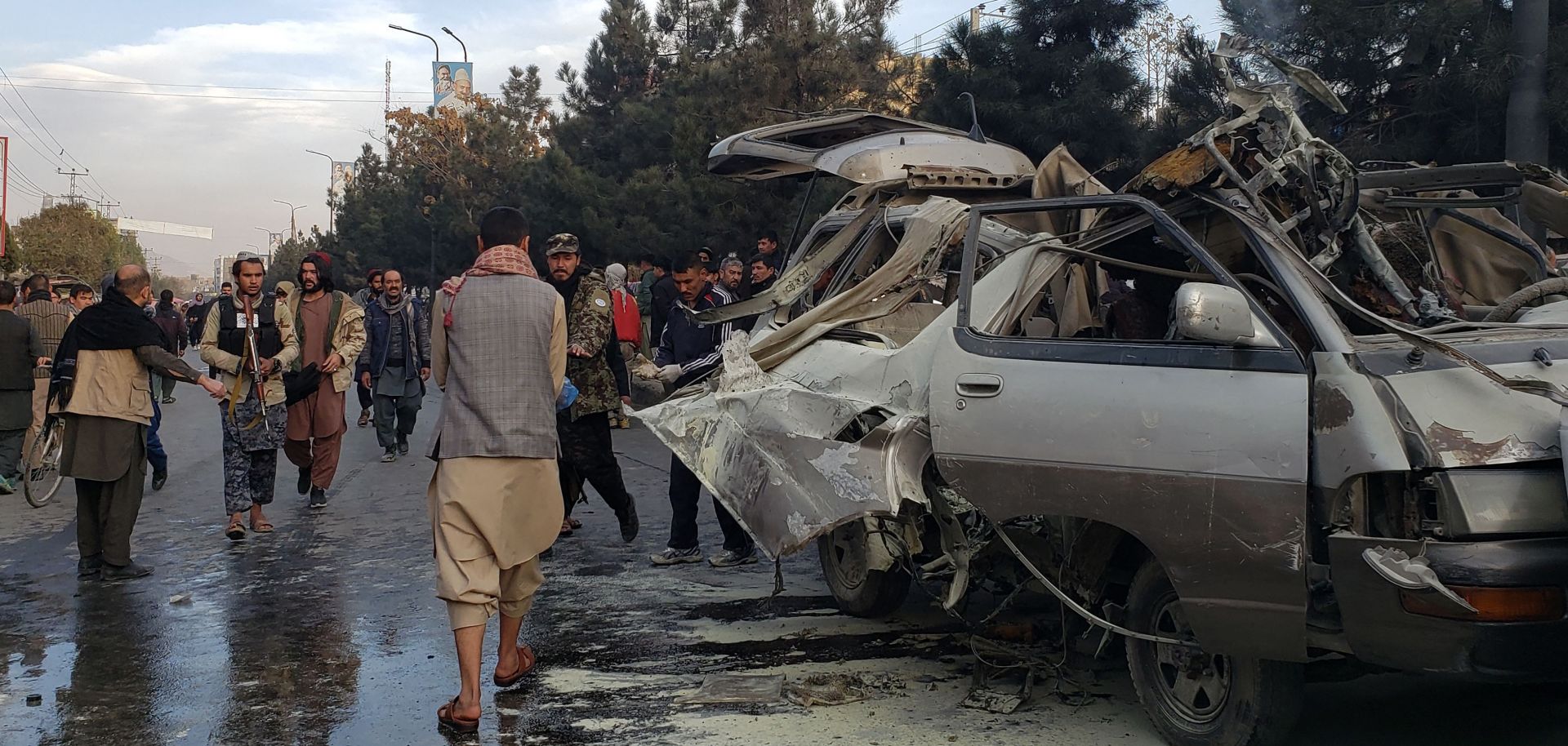
People gather next to a damaged bus damaged in a deadly bomb blast in Kabul, Afghanistan, on Nov. 17, 2021.
The latest in a string of Islamic State attacks against minorities in Afghanistan will stoke internal divisions and increase the risk of unrest, threatening the Taliban-led government’s already tenuous hold on power. On Nov. 17, the Islamic State Khorasan Province (ISKP) claimed credit for attacks earlier in the day on two buses in Shiite-majority neighborhoods of Kabul. In the first attack, militants reportedly attached a magnetic explosive device to a minibus in Kabul's Dasht-e Barchi neighborhood, a dominantly Hazara Shiite community. Social media reports indicate that the bombing killed at least one person and wounded three others. The second bombing targeted a minibus in the nearby Charahi Shaid neighborhood, which also has a large Shiite population, killing as many as seven people, according to social media reports.
ISKP will continue its campaign to steadily undermine the domestic authority of the Taliban’s transitional government and generate sectarian unrest. The latest Kabul bombings come amid a sustained wave of attacks by ISKP targeting the Taliban, including the Nov. 2 attack against a military hospital in the capital city. ISKP militants have also increased attacks against Afghanistan's Shiite minority community, as evidenced by the mosque bombings in Kandahar and Kunduz on Oct. 15 and Oct. 8, respectively. The Nov. 17 bus bombings further demonstrate that ISKP has sufficient resources to simultaneously conduct sporadic mass casualty attacks while also sustaining a campaign of lower-level but highly symbolic bombings in Kabul. The bombings also show that ISKP is committed to its sectarian strategy, which involves striking large gatherings of Shiites in symbolic settings like mosques along with conducting attacks against more mundane targets like public transport. These attacks aim to ultimately erode the Shiite community's trust in the Taliban's ability to ensure the safety of religious minorities and impede Taliban efforts to govern and project societal control. Indeed, the Taliban has reportedly arrested suspected ISKP militants in recent weeks, though this crackdown appears to have had minimal impact on the group's capabilities — including ISKP’s clear ability to infiltrate even ostensibly secure areas like the capital. And there are no signs this will change in the near term.
Absent a major improvement in the effectiveness of the Taliban’s crackdown on ISKP, the group’s ongoing violence could prompt wider unrest amid growing sectarian frustrations with the Taliban's inability to provide security. In the near term, further ISKP bombings, assassinations and kidnappings — including occasional spectacular attacks targeting large gatherings in Kabul and other cities in Afghanistan — are all but certain. Assuming such violence continues to target minorities, the ISKP's campaign may eventually prompt large-scale protests by the Shiite community over the lack of protection. The ongoing barrage of attacks may even spawn Shiite militia groups in Kabul to defend the community, should the Taliban prove incapable of doing so. There is also the potential that such attacks could motivate Shiite-majority Iran to intervene via various proxy forces like it’s done elsewhere in the region. While Tehran would be unlikely to seek to directly challenge the Taliban, it could support proxies to defend Shiite communities as a form of indirect pressure on the Afghan government. Such developments could set the stage for wider sectarian conflict, which would ultimately benefit ISKP's efforts to attract hard-line Taliban members by helping frame the conflict through a sectarian lens. Either way, the ongoing ISKP campaign will continue to undermine Taliban claims to legitimacy in Afghanistan, potentially stoking civil unrest that, even if not tinged with sectarianism, will still pose violent threats.
