
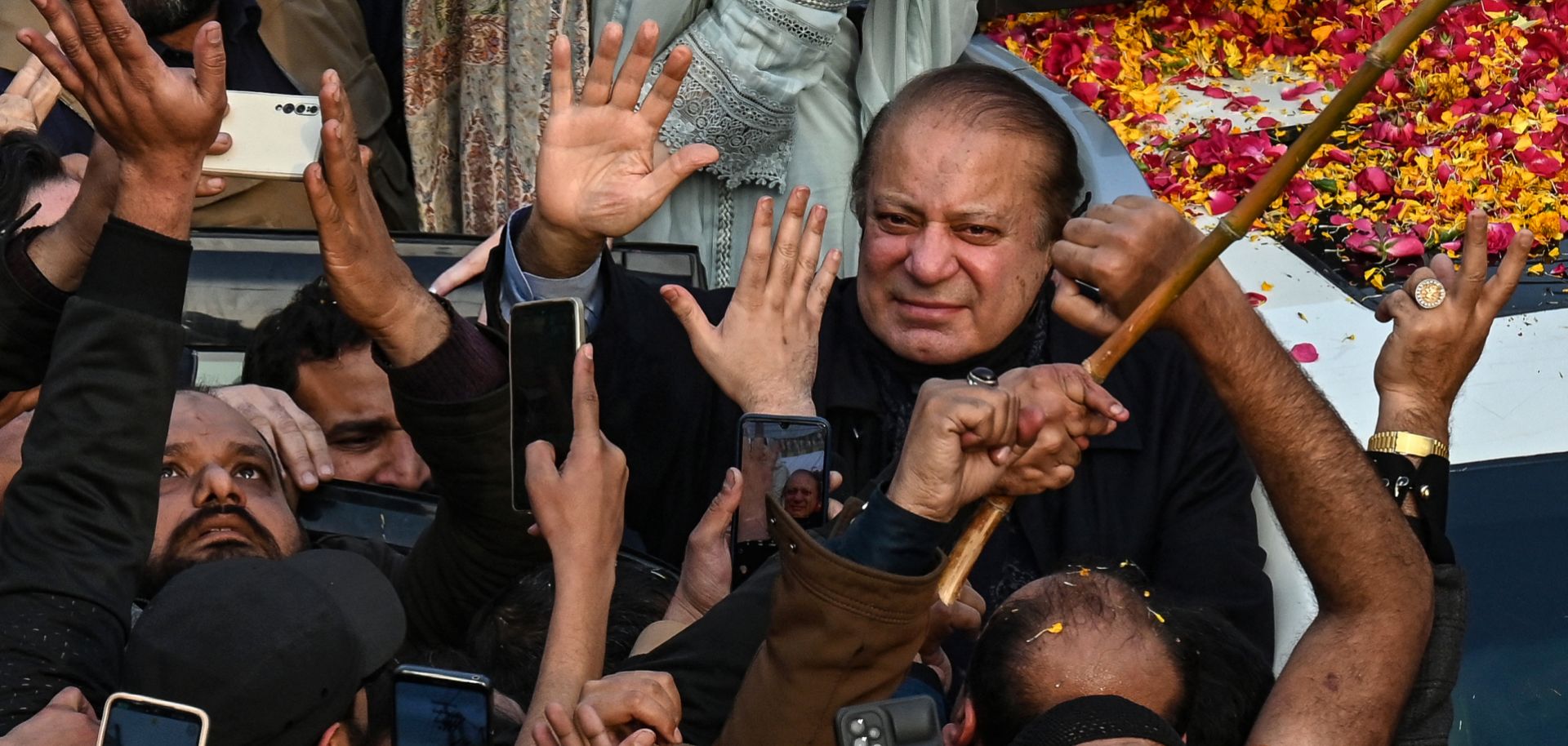
In the likely case that former Prime Minister Nawaz Sharif wins Pakistan's general elections, he will prioritize managing the country's economic crisis by adhering to unpopular austerity measures, seeking foreign aid, and balancing relations with China, the United States and India. On Feb. 8, Pakistani voters will head to the polls for parliamentary elections that will determine the country's next prime minister. The two main parties vying for a majority in the country's National Assembly include the Pakistan Muslim League-Nawaz (PML-N), led by former Prime Minister Nawaz Sharif, and the Pakistan People's Party (PPP), led by former Foreign Minister Bilawal Bhutto Zardari. Pakistan Tehreek-e-Insaf (PTI) — led by former Prime Minister Imran Khan, who is currently serving a sentence and is thus barred from contesting in elections — will present its candidates as independents. These elections come after Khan's removal from office in April 2022, when the PPP and the PML-N formed an ad-hoc alliance to oust him. While Khan remains the most popular politician in Pakistan, the PTI is not a key contender due to the military's success in sidelining him and his party. Meanwhile, Sharif has significantly strengthened his position since returning from self-exile last year, following the acquittal of corruption charges that had previously barred him from contesting in elections.
- In August 2023, acting on then-Prime Minister Shehbaz Sharif's recommendation, President Arif Alvi dissolved the National Assembly three days before its scheduled tenure expiration. This dissolution paved the way for elections to be conducted within 90 days, extending the initial 60-day window that would have been activated had the assembly's mandate naturally expired. However, government officials later announced that the elections would be contingent on a new census, leading to the ballot being further delayed to February 2024.
- The parliamentary elections come as Pakistan is grappling with severe economic challenges. According to the International Monetary Fund (IMF), Pakistan's inflation rate surged from 12.1% in 2022 to 29.2% in 2023. Moreover, the country's GDP growth collapsed from 6.1% in 2022 to -0.5% in 2023. In July 2023, the IMF executive board approved a nine-month $3 billion stand-by arrangement for Pakistan, aiming to prevent the nation from defaulting on its debt repayments. Since receiving the funding, an IMF review in January indicated that Pakistan's economic crisis had shown signs of improvement. According to IMF forecasts, the country is anticipated to achieve a 2% GDP growth in 2024, while inflation is expected to decline to 23.6% next year. Furthermore, Pakistan's gross foreign exchange reserves have nearly doubled, increasing from $4.5 billion in June to $8.2 billion in December.
- According to a Gallup opinion poll released on Jan. 10, Khan's approval ratings stand at 57%, slightly lower than the 60% recorded in June 2023. In contrast, Sharif's popularity has surged from 36% to 52%, while Bhutto's has decreased from 36% to 35%. Sharif and his PLM-N party have actively garnered support from voters, especially in Pakistan's most populous province of Punjab, where Sharif boasts the highest approval ratings at 60%, compared with Khan's 53%.
Sharif's likely victory would reinforce the military's influence on domestic policy, given the army's apparent support for the former prime minister, and would also see Islamabad sustain efforts to address Pakistan's economic crisis. Several factors strongly suggest that Sharif's PLM-N party is poised to come away from the Feb. 8 election with the most parliamentary seats. To begin with, between November and January, Pakistan's Supreme Court acquitted Sharif of corruption charges and reversed a law that banned convicted politicians from participating in elections, thereby freeing Sharif to run for what would be his fourth term as Pakistan's prime minister. Given the military's alleged influence over the judiciary, the swift dismissal of the charges just over a week before the election — combined with the military's efforts to sideline Khan — suggests Sharif is the military's favored candidate. The election of another Sharif-led government would thus likely reaffirm the Pakistani army's influence over shaping domestic politics following years of civilian-military tensions under Khan. Amid Pakistan's dire economic challenges and the imminent expiration of the country's current IMF stand-by arrangement, Sharif would prioritize efforts to reduce inflation, foster job creation, and boost GDP growth (including by making advancements in foreign investment and infrastructure development) shortly after taking office.
- While the military has claimed they maintain an apolitical stance, Pakistan's military establishment has historically exercised substantial sway by engaging in political engineering and orchestrating what parties and politicians rise to power.
- In 2019, Sharif left the country following a court's permission to seek medical treatment. He returned in October 2023, putting an end to his self-imposed exile of four years to lead his party in the upcoming Feb. 8 elections.
Pakistani Prime Ministers' Contentious Relations With the Military
74-year-old Nawaz Sharif has a long and complicated political career that has periodically placed him at odds with Pakistan's powerful military. Sharif first became prime minister in 1990, but allegations of corruption in 1993 led to his dismissal amid a power struggle with then-Pakistani President Ghulam Ishaq Khan. In 1997, Sharif was re-elected for a second term as prime minister. However, in 1999, the military launched a coup that ousted him from power amid disagreements over Sharif's outreach to India, Pakistan's neighbor and longtime rival. Sharif then re-secured the military's favor ahead of the 2013 election, helping him secure a third term as prime minister. But he later again fell out with the army over corruption charges and policy differences, and was ultimately disqualified by the Supreme Court in 2017 due to the former. Similarly, upon Khan's rise to power in 2018, conflicts emerged between him and the military over Khan's independent foreign policy decisions and efforts to control military promotions, culminating in Khan's removal from office through a no-confidence vote in April 2022.
But if Sharif is re-elected, fears of sparking social unrest may still deter him from implementing unpopular IMF austerity measures. With the IMF's $3 billion standby arrangement concluding in the spring, Pakistan's external debt situation would very likely deteriorate significantly without another IMF program — especially given that, according to the fund, Pakistan faces an external debt of $130,851 million in 2023-24. This means that if he's re-elected prime minister, Sharif would probably prioritize securing new funding, likely in the form of a new IMF program. However, his success in doing so would depend on his ability to effectively enact policies previously recommended by the IMF. These include efforts to increase government revenue, boost foreign reserves, maintain discipline in non-priority spending, and tighten monetary policy to quell inflation. Increasing revenue and reducing spending often involve imposing unpopular reforms — including tax hikes, slashing government programs and gas tariff increases — that place a higher economic burden on citizens in the short term. The implementation of IMF austerity measures, in turn, has a history of increasing anti-government sentiment in Pakistan and triggering protests by temporarily heightening peoples' economic grievances. With this history in mind, Sharif's new government may thus be more attuned to potential public backlash and the risks of protests, especially amid heightened political tensions and sensitivities revolving around former Prime Minister Khan's sentencing. This sensitivity could sustain the potential for some delays in IMF reform efforts, especially as Sharif confronts a challenging endeavor to quell public discontent toward his party.
Bhutto's PPP is unlikely to win the election outright, but it may make efforts to lead an opposition coalition following the vote. Bhutto and his PPP are unlikely to win control of Pakistan's parliament due to Bhutto's relatively limited experience, popularity and political influence. Thus, post-election, the PPP may explore coalition-building. Bhutto has expressed little desire to partner with the PLM-N, though the PPP may look to other parties and independent candidates to establish a robust opposition against Sharif. In the unlikely event that Bhutto is elected prime minister, Pakistan's economic challenges — particularly those concerning debt and inflation — would constrain his ability to implement his policy agenda, which is centered on climate change and youth empowerment.
- Bhutto hails from a long line of distinguished Pakistani political leaders. His mother is former Prime Minister Benazir Bhutto, his father is former President Asif Ali Zardari, and his grandfather is former Prime Minister and President Zulfikar Ali Bhutto. In the coalition between the PPP and the PML-N in 2022, initiated after Khan's removal, Bhutto served as foreign minister.
Khan's PTI, meanwhile, is highly unlikely to win the election due to systematic efforts to sideline the party ahead of the ballot. The PTI is similarly unlikely to come out victorious from the Feb. 8 ballot, given Khan's ongoing legal challenges and imprisonment, continuous arrests of PTI members, and crackdowns on PTI rallies. This is all underscored by the fact that PTI candidates have to run as independents due to a Supreme Court ruling banning the use of their electoral symbol, a cricket bat, which will present challenges for voters in recognizing PTI candidates without the distinctive emblem. But in the unlikely event that the PTI does win, efforts to reform state institutions to quell alleged corruption, wealth disparities, democratic challenges, and human rights violations would likely persist. The army would likely challenge the PTI's victory and attempt to oust the party from power via legal obstacles and intimidation. Economically, the PTI would likely strike a balance between implementing IMF-recommended reforms and appeasing voters by implementing beneficial fiscal and monetary policies to lower inflation and raise the tax bracket.
- Following Imran Khan's removal and subsequent violent protests, authorities have severely cracked down on PTI leaders and supporters. Security forces have violently suppressed PTI rallies, often harassing, arresting and using tear gas on protesters. There has also reportedly been censorship of PTI coverage, and PTI's websites have been blocked. Additionally, PTI leaders have encountered pressure from the military to resign in the months following the May 9 riots. This has resulted in the departure or retirement of prominent party figures, with many explicitly denouncing violence against the military in subsequent statements.
- On Jan. 13, Pakistan's Supreme Court dismissed the PTI's attempt to retain its traditional electoral symbol, a cricket bat. The Election Commission of Pakistan (ECP) had earlier revoked PTI's symbol, citing technical reasons related to the party's failure to conduct intra-party elections — a prerequisite for any political party's participation in the national election. While names will be present on the ballot paper, the significance of symbols is crucial for recognition, considering that over 40% of Pakistan's 241 million population is illiterate. Thus without the cricket bat symbol, PTI candidates will run as independents using individual symbols, potentially confusing their voters.
After their likely defeats, the PPP and PTI will denounce the elections as rigged and condemn the military's lack of neutrality, heightening the risk of social unrest. In the likely event that Nawaz Sharif wins, both parties will likely criticize the lack of free and fair elections, drawing on allegations of the army's involvement and lack of neutrality. Additionally, Khan's strong popularity suggests that some of his aggrieved supporters may choose not to participate in elections they perceive as rigged, reducing voter turnout and increasing the risk of election-related protests both preceding and following the Feb. 8 ballot.
Regardless of who wins the election, Pakistan's foreign policy — overseen by the military — will focus on securing foreign aid, establishing economic partnerships, and enhancing security cooperation with Saudi Arabia, China and the United States. The outcome of the election is unlikely to notably impact Pakistan's foreign policy — a field that has been and will likely continue to be heavily influenced by the country's unelected military. This means that after the ballot, Islamabad's foreign policy trajectory will remain relatively unchanged. The Pakistani government will continue to prioritize maintaining and strengthening economic engagement with China and Saudi Arabia in an effort to acquire foreign aid, boost economic partnerships, and foster infrastructure development. Following tensions during Imran Khan's tenure, the next Pakistani government will likely continue enhancing relations with the United States following tensions between Washington and Islamabad during Imran Khan's tenure, with a particular focus on security and counterterrorism. Pakistan and the United States shared concern regarding Afghanistan following the Taliban's takeover and the associated security threats will likely persist, fostering potential collaboration in defense, operational compatibility, and the transfer of military technologies between the two countries. Additionally, given the United States is Pakistan's largest export market, both countries may further progress their trade and investment connections through the U.S.-Pakistan Trade and Investment Framework Agreement (TIFA). However, Pakistan's recent expulsion of undocumented Afghan immigrants may impede this cooperation by exacerbating U.S. concerns over the potentially destabilizing effect on the region — especially amid reports of heightened detentions, violence, and intimidation targeting Afghan refugee communities within Pakistan, and Afghanistan's worsening humanitarian and economic crises under Taliban rule.
- The TIFA aims to foster constructive discussions between the United States and Pakistan, facilitating initiatives like promoting joint ventures in textile and industrial manufacturing, and supporting Pakistan in enhancing its investment attractiveness.
- According to China's foreign ministry, Pakistan and China have reiterated their dedication to advancing projects under the China-Pakistan Economic Corridor. This, however, is contingent on Pakistan's ability to assure the safety of Chinese organizations and personnel involved in the projects, which will likely be a priority in Pakistan's security posture.
In the likely case that he's re-elected prime minister, Sharif may strive to promote bilateral trade with India; however, will face constraints due to the army's objections, making the prospect of normalized relations with New Delhi unlikely. On the campaign trail, Sharif's PLM-N party has called for ''peace in the region,'' specifically referencing India. However, Sharif and his party will only seek rapprochement with India if New Delhi reverses the revocation of Article 370 in India's constitution, which granted a special autonomous status to Indian-administered Jammu and Kashmir. The Kashmir region has long been disputed between India and Pakistan, with both countries asserting territorial claims over the area. With little hope for any near-term resolution, this issue is poised to remain a significant point of contention between Islamabad and New Delhi, constraining the prospect of improved bilateral ties. During his past three terms as prime minister, Sharif sought to thaw his country's icy relations with India as a means to promote economic cooperation and restore some level of bilateral trade, but his efforts faced resistance from the military each time. If Sharif is elected for a fourth term as expected, opposition from the army will again impede him from changing Pakistan's approach to India — especially considering that Pakistan's military chief has ruled out reconciliation with New Delhi.
- During two of his three terms as prime minister, Sharif successfully arranged meetings with his Indian counterparts in Lahore, including former Prime Minister Atal Bihari Vajpayee and current Prime Minister Narendra Modi. Nevertheless, these moves irked the Pakistani military by deviating from its established policy of exercising tactical restraint toward India amid clashes between Pakistani and Indian troops in Kashmir.
