
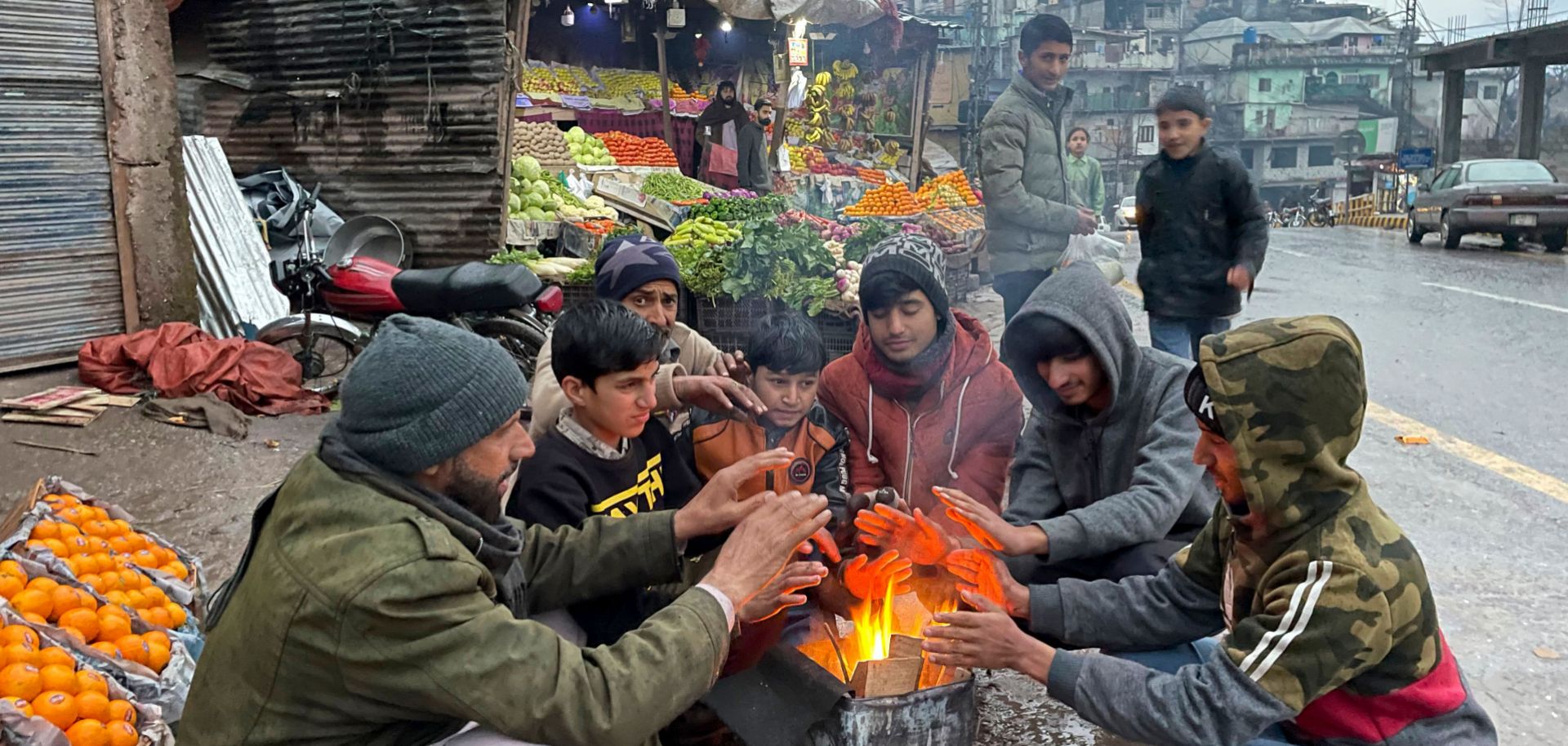
Vendors at a market warm themselves around a bonfire in Muzaffarabad, Pakistan, during a nationwide power outage on Jan. 23, 2023.
Pakistan's economic crisis will worsen in the coming months as structural deficiencies and policy uncertainty raise recessionary risks in the country, which will exacerbate political instability and security challenges. Pakistan's high foreign debt has caused a severe financial crisis and speculations of default. The country's foreign exchange reserves are at a nine-year low, leaving the government unable to purchase essential imports like oil, gas, fertilizers and food items. Additionally, Islamabad has experienced persistent high inflation through most of the past year, with food inflation hovering around 30%. This is adversely affecting economic activity and causing hardships for millions (and particularly low-income people) in Pakistan. In 2022, the government imposed import restrictions on various commodities to save dollars, which has modestly lowered the current account deficit. But this has also slowed industrial operations across Pakistan, and has even caused shutdowns and layoffs in some sectors.
- Persistent current account and fiscal deficits and widening debt payments over the years have eaten into the State Bank of Pakistan's foreign exchange reserves, which totaled $4.3 billion as of Jan. 12 (down from around $18 billion at the start of 2022). Theoretically, the central bank only has enough reserves to fund four weeks worth of imports. This has negatively impacted Pakistan's credit rating and investor confidence.
- For the fiscal year 2023 (July 2022-June 2023), Pakistan had $23 billion in debt repayments. Of that, about $6.5 billion has been repaid and $4 billion has been rolled over. Of the remaining $12.5 billion, about $8.3 billion are bilateral commercial loans that are expected to be rolled over, $3.5 billion is owed to multilateral bodies, with the rest being owed to commercial foreign banks. Pakistan's current account deficit is estimated to total around $10 billion for this fiscal year, as exports and remittances have remained lower than import bills.
- Pakistan's external debt is roughly $99 billion, which includes some $42 billion owed to international financial institutions like the International Monetary Fund (IMF) and some $38 billion owed to the Paris Club, the G-20 and other organizations (and includes a $23 billion exposure to China.)
- To save money on energy imports, the Pakistani government has enacted a plan that aims to reduce the country's electricity consumption by forcing markets to shut down early and reducing power usage in government buildings. The plan also aims to increase Pakistan's production of energy-saving lightbulbs and imposes import restrictions on inefficient bulbs.
- Since August 2022, food inflation in Pakistan has remained above 30%. Various provinces in the country are facing wheat shortages due to reduced imports, along with the ongoing domestic economic fallout from high prices and low productivity caused by last year's devastating floods.
- Pakistan's crucial textile sector (which accounts for 11% of the country's GDP and employs about 40% of its workforce) is also facing shutdowns and layoffs, which disrupt production and thus further eat into Islmabad's export revenue. 50% of Pakistan's cotton crops were lost in the historic floods that swept over the country in 2022. Pakistani textile producers have also struggled to import critical raw materials, as banks refuse their letters of credit due to a shortage of funds in the country. The shortages of raw materials have severely reduced exporters' operating capacity, which has so far forced factories to lay off about 7 million people.
The rise in global commodity prices over the past year has hit Pakistan's import-dependent economy particularly hard. Most of Pakistan's energy supplies are imported (including natural gas for electricity production and oil for transportation). The country is also largely import-dependent for other essential items like fertilizers, food products (like edible oil) and many basic raw materials needed for most industrial production. This became particularly problematic in mid-2022 when prices of such commodities rose, which worsened food and energy shortages across the country by making imports all the more unaffordable for cash-strapped Islamabad. As a result, many households have struggled to heat their homes this winter, find gas for cooking, and feed their families. Operators in gas-intensive industries have also struggled to keep the lights on at their factories amid the ongoing energy crisis, further harming exports and the country's production capacity. The devastating floods in August-September 2022 — which caused an estimated $16 billion worth of damage to property, public infrastructure and farmland — have only exacerbated these problems.
- Global natural gas prices have skyrocketed over the past year amid Ukraine-related surges in European demand. Pakistan's natural gas imports fell by 17% year-on-year in the first five months of the fiscal year 2023.
Pakistan's current economic crisis has been exacerbated by the government's continued failure to impose much-needed structural reforms. In addition to the recent global market shocks, many underlying factors are also contributing to Pakistan's economic malaise. The government's extensive electricity and fuel subsidies, for example, have significantly expanded Islamabad's debt levels, as well as its fiscal and current account deficits. But Pakistani leaders have lacked the political will to implement the unpopular economic reforms needed to address such structural problems and, in turn, secure the country's long-term economic stability. Instead, recent governments have pursued short-term solutions, which has seen Islamabad continue to seek bailouts from the IMF (as it did in 2019) and friendly creditor nations (like Saudi Arabia and China). The current review of Pakistan's IMF program is held up due to the government's inability to reduce the primary deficit and minimize circular debt in the energy sector. The IMF has demanded that the government scale back its energy subsidies and increase tax collections, but Islamabad has delayed enacting these austerity measures, which would risk triggering popular backlash by further increasing the cost of living at a time when many Pakistanis are already struggling to make ends meet.
Pakistan will likely secure enough financial assistance from friendly creditors and multilateral institutions to avoid a default in the short term, but the economy could enter a recession. The Pakistani government is currently trying to convince the IMF to resume its bailout program. It is also expecting financial help from friendly creditors like Saudi Arabia and China, both of which have rolled over their maturing deposits with central banks in the past (and are likely to do so in the future due to Riyadh and Beijing's close strategic relationship with Islamabad). In addition, the humanitarian aid Pakistan has received following the 2022 floods will likely augment the government's reconstruction efforts in the months ahead. This external support — along with the fact that Pakistan's next commercial bond payment isn't due until 2024 — means the country will probably avoid a default in 2023. But while financial aid may grant Islamabad temporary debt relief, the underlying problems contributing to Pakistan's high current account and fiscal deficits remain. Within this context, Pakistan could still enter a recession later this year, as inflation continues to dampen domestic consumption and economic activity by increasing the cost of both living and doing business in the country.
- Pakistan's foreign debt servicing for the remainder of 2023 is around $4.7 billion. Commercial loans make up $1.1 billion of that total, with multilateral loans comprising the rest. China is Pakistan's closest ally in the region. Beijing has poured billions of dollars into energy and infrastructure projects in the South Asian country, including the China-Pakistan Economic Corridor (CPEC) — the flagship project of China's Belt and Road Initiative.
- Saudi Arabia, on the other hand, has a close military relationship with Pakistan. The two countries' Muslim-majority populations are also closely interconnected, with about 2 million Pakistanis working in Saudi Arabia.
- Saudi Arabia is reportedly now considering investing about $10 billion in Pakistan (primarily in real estate and other development projects), up from the $1 billion worth of Pakistani investments the kingdom pledged in August 2022. Saudi Arabia has also agreed in principle to donate $1 billion worth of oil imports to help ease Pakistan's energy crisis. In December, Riyadh rolled over $3 billion in deposits in Pakistan's central bank. The United Arab Emirates has also agreed to roll over $2 billion deposits in Pakistan, on top of another $1 billion deposit.
- The humanitarian aid following floods has not been completely delivered. On Jan. 9, various multilateral financing institutions and countries made about $10 billion worth of financial aid pledges to help Pakistan's flood reconstruction and rehabilitation efforts. However, most of this aid will be in the form of project loans, which will likely trickle in slower than expected as the government identifies various projects for these investments — thereby delaying the impact of these extra funds on Pakistan's economy.
In the medium term, however, Pakistan will face complex debt restructuring talks, a new stringent IMF program, and policy uncertainty due to domestic politics. While Pakistan is likely to avoid a default in 2023, its debt woes will persist in the coming years. Political calculations will continue to influence economic policy, which means the government is unlikely to enact needed structural reforms before the next general elections (which should take place no later than October, but could happen sooner if the country's socio-political situation continues to deteriorate). Additionally, although Saudi Arabia has moved to roll over its debt in Pakistan, the kingdom has also recently expressed plans to prioritize providing financial assistance to countries with politically stable governments that are enacting needed economic reforms. Pakistan, however, has a history of political instability and weak governments, as evidenced by the fact that no prime minister has ever finished a full term. This, along with Pakistani leaders' low appetite for enacting unpopular policies that improve the country's long-term outlook, creates a recipe for policy uncertainty. Following through with the IMF's current program through June 2023 would require Islamabad to enact reforms that'd lead to higher taxes and energy prices. But given its worsening economic situation, Islamabad will probably need another IMF package in the future that forces it to impose even more painful policy changes, creating further social and political turmoil. A new IMF program could also necessitate debt restructuring from bilateral and multilateral creditors, which would further degrade investor confidence in the country.
- IMF data shows that Pakistan's annual external funding gap will exceed $35 billion through 2027, mainly due to large debt payments starting in 2024. Thus, even if the country avoids a default in 2023, debt restructuring will still be needed in the coming years.
Pakistan's economic crisis will feed into political instability and exacerbate security risks. The economic crisis and public discontent against the government will deepen the political turmoil in the country. The government that emerges after the general election will probably be unstable as the underlying structural problems with the economy cannot be resolved in the short term. The reduced confidence in Pakistan's political stability will continue to deter private investment. Pakistan's economic dependence on strategic partners like Saudi Arabia and China, meanwhile, will only increase. Political and economic instability will intensify the security risks in the country. Pakistan is already facing an increased threat from extremist militant groups like Tehreek-e-Taliban Pakistan (TTP), which has pledged to increase its attacks against security personnel and infrastructure in the country. Separatist groups like Baloch Liberation Army (BLA) may also intensify attacks against the government and infrastructure as economic grievances of Baloch people, allegedly deprived of the region's development gains, bolster their resolve. It's possible that Pakistan's political turmoil could eventually create a power vacuum that enables the military to assume an even greater political role (either directly or indirectly). But for now, this scenario remains unlikely due to former President Imran Khan's popular rhetoric against the security establishment. Signposts for a military intervention include consistent economic and security deterioration that manifests as riots, protests and significant violence and a significant escalation in militant activity.
