
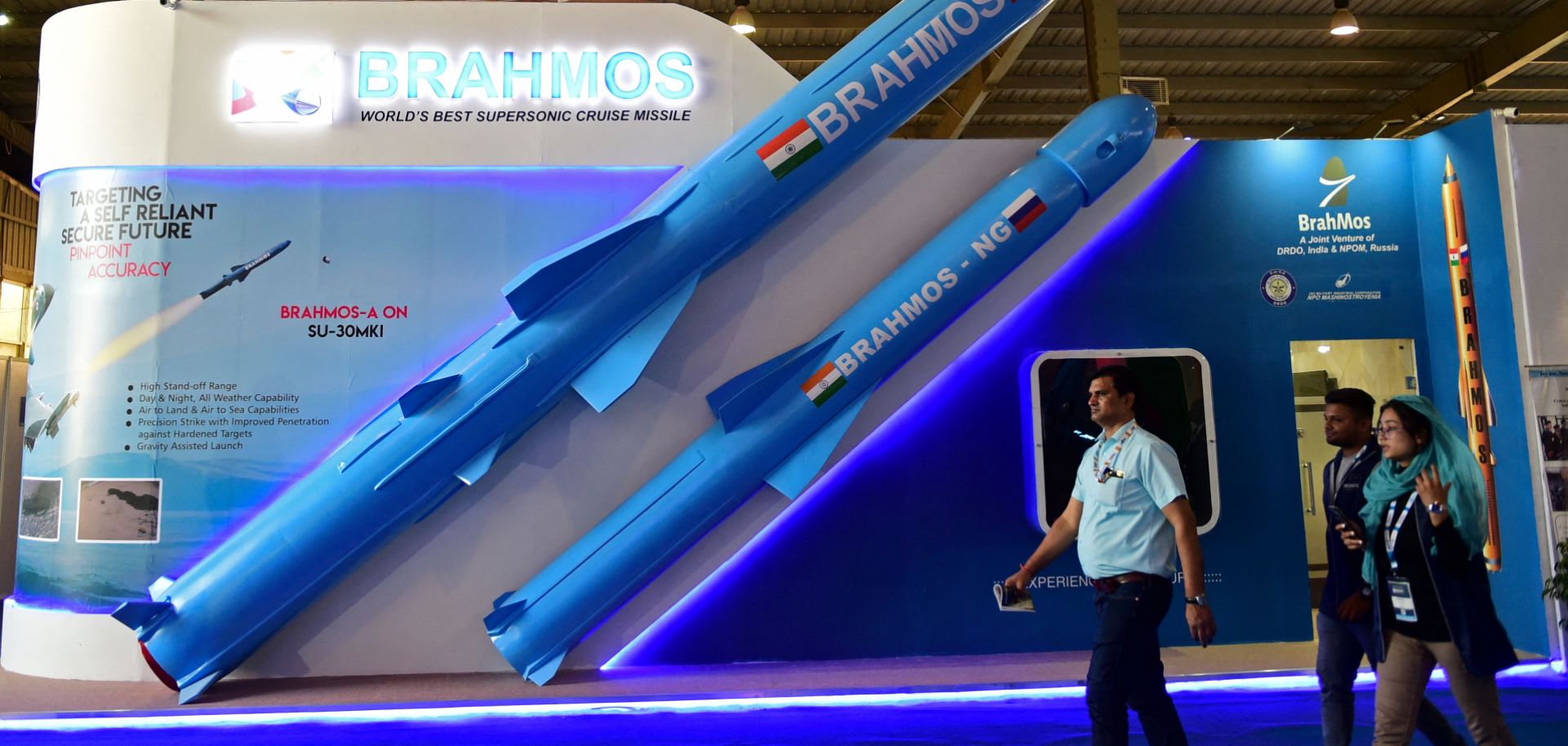
Visitors walk past a model of India's BrahMos supersonic cruise missile at the Defense Expo 2022 in India's Gandhinagar state on Oct. 18, 2022.
India's ongoing push to reform its defense sector will likely be partially successful, which will help New Delhi address national security threats. The Indian government has taken several steps to reform its armed forces in recent years, and these reforms can be broadly divided into two types: structural and industrial. Structural reforms deal with issues like the interoperability of the three branches of India's armed forces (the army, navy and air force) and funding, while industrial reforms deal with the diversification of arms imports and the indigenization of defense production (whereby defense tools and equipment are produced domestically).
- According to think tank Global Firepower, India's armed forces are the fourth-strongest in the world. Global Firepower ranks countries' military strength based on parameters like personnel, arsenals and logistical preparedness.
- During Aero India 2023, a biennial air show and exhibition most recently held on Feb. 13, India's Defense Minister Rajnath Singh called on local and foreign defense industry leaders to set up shop in India and help the government's push for the development of defense manufacturing. He reiterated Prime Minister Narendra Modi's "Make in India, Make for the World" vision.
India's reforms are part of a broader plan to adapt to an evolving security environment in the region. China has emerged as the biggest national security threat to India, especially after clashes in 2020 along the approximately 4,000 mile (6,437 kilometer) contested China-India border. The Chinese army is disproportionately stronger than India's in terms of firepower, interoperability, existing infrastructure and budgetary allocations. Additionally, China has allied itself with Pakistan, India's long-time regional rival. This partnership creates the low-risk, high-impact scenario of a two-front conflict against India, which has further spurred reforms to India's armed forces. While India's primary external security threats remain land-based, China has increased its presence around India's coastline in the larger Indian Ocean region through the operation of research vessels, anti-piracy operations and infrastructure like ports. India is suspicious of such activities and their potential to be used for military operations in the event of a clash. Amid these challenges, current Prime Minister Narendra Modi's populist and nationalist government has created a conducive political environment for reforms to India's armed forces.
- A recently released police report from India's northern Ladakh region, which is a prominent friction point on the western half of the India-China border, stated that India has lost control of about 26 patrol points during de-escalation negotiations with the Chinese military. That means China has created new buffer areas, pushing Indian forces southward while allegedly deploying surveillance equipment like cameras in the area. Observers have named this tactic "salami slicing," as Beijing takes territory inch by inch.
- The most recent skirmish on the disputed India-China border happened on Dec. 9, 2022, when opposing patrols clashed in the Tawang area of India's eastern Arunachal Pradesh state. Importantly, this clash occurred on the eastern half of the contested border, opening up a new geographic front for possible escalation, as India's clashes with Chinese forces had previously happened only on the border's western side.
- Since the May 2020 Galwan Valley border conflict that sparked armed confrontations between India and China for the first time in more than 40 years, military corps commanders from both sides have held about 17 rounds of talks to facilitate disengagement from several friction points. However, diplomatic relations between India and China have remained poor, which has obstructed progress in the talks.
- Extensive infrastructure development post-2020 on both sides of the border is further evidence of changed dynamics and heightens the risk of localized conflict.
- Although India has a vast coastline that is 4,671 miles (7,516 kilometers) long, it has only two aircraft carriers, and the second, named Vikrant, was only commissioned in September 2022. Moreover, Vikrant is still not fully functional, as it will receive its air components (aircraft and missiles) over the coming years.
Amid India's efforts to address these growing challenges, sluggish policy implementation will slow New Delhi's attempts to unify the three branches of its armed forces under a joint command. India officially decided to unify the command of its army, navy and air force under a joint, or theater, command in 2019 when it created the post of chief of defense staff to oversee the integration. New Delhi intends this unity to enable an efficient and effective military response by using a single command center to coordinate all resources in times of conflict, and most developed countries (including the United States, China, Russia and France) have joint theater commands. Amid new and emerging threats, a theater command could function as a deterrent to future threats to India. However, after three years, no progress has been made on this front, as the creation of a theater command requires an overhaul of existing systems and attitudes within the three services. The discussion has also stalled because leaders of India's air force and navy are concerned about possible demotions due to the traditional preeminence of the army. Moreover, even after the adoption of such reforms, practical challenges regarding their application and necessary adjustments will likely slow the process further. And because India has no public national security policy to highlight national priorities or threat perceptions (and offer guidance for its defense establishment and its reform), India has experienced policy discontinuity across different governments. This inconsistent decision-making will further impede India's long-term reform goals.
- Former Chief of Defense Staff Gen. Bipin Rawat suggested a system of five integrated theater commands instead of the present 17 service-specific commands. However, a nine-month gap in the position between Rawat's sudden accidental death in December 2021 and the appointment of Gen. Manoj Mukund Naravane in September 2022 delayed progress on the idea, and no policy has been officially proposed or discussed.
Budgetary constraints will also limit India's ability to reform its military, although an experimental recruitment system may offer some relief. While India's budget allocation for the defense sector has increased over the last decade, it is still less than the desired 3% of gross domestic product. Moreover, about two-thirds of the allocated annual budget is utilized for salaries, pensions and other similar obligations, which leaves less funding for the procurement of arms and the development of India's domestic defense industry. To reduce spending on salaries and pensions, in 2022 the Indian government introduced a new recruitment system for short-term service called "Agneepath" in which young recruits between 17-22 years of age will serve in the military for only four years. Of the recruits, only 25% will be retained for regular service, while the other 75% will return to civilian life without a pension. There is no impact assessment for the Agneepath scheme in India, where most recruits depend on pensions to support their families. Additionally, there may be unknown effects of sending young, trained soldiers back into civilian life, like their potential inclination to join extremist groups.
- Indian defense spending has doubled in the past decade from $49 billion in 2011 to about $76 billion in 2022, according to a report from the Stockholm International Peace Research Institute (SIPRI).
- China has more than three times the deployed airpower (systems like bombers, fighters and training aircraft with combat capability) and naval capabilities (systems like missile submarines, destroyers and frigates) as India.
India is also attempting to reduce its dependence on imports of Russian military systems in order to protect itself from supply disruptions, but this diversification will remain slow. More than 60% of India's defense systems are imported, mostly from Russia, and over time, New Delhi and Moscow have advanced this relationship by jointly developing and sharing technology about weapons systems, such as supersonic ballistic missiles. But India's dependence on imports from Russia increases India's vulnerability to supply disruptions. For instance, since Russia's invasion of Ukraine in February 2022, several consignments of deliverables to India have been stuck in Russia due to logistical issues. India has made efforts to diversify its imports away from Russia over the past decade in favor of French, U.S. and Israeli markets. However, this diversification drive has been slow, as most Western weapons systems are relatively expensive compared with Russian options, Western countries are not keen on sharing technology or joint development programs, and Russian and Western systems are not interoperable. Despite these limitations, India will likely accelerate its diversification efforts as supply bottlenecks resulting from the Russia-Ukraine war worsen.
- According to SIPRI, India's imports of defense systems from Russia fell by 21% from 2012-2016 to 2017-2021.
- The Indian government sent a submarine named Sinduratna to Russia for upgrades and refits, but it is reportedly stuck in Russia due to Western sanctions on commercial carriers from Moscow. India is exploring alternative options to bring back its submarine.
India has also made moves to bolster its self-reliance by promoting indigenization, but the prolonged period before these efforts yield results will limit its effectiveness in the near term. With a focus on the indigenization of technologies, the government is enhancing funding for research and development, as well as promoting defense exports and private participation in the defense sector. New Delhi has also produced "positive lists of indigenization," which are comprised of items (mostly components used in defense equipment) that Indian companies will be banned from importing over time. The Indian government released its fourth such list in March 2022 in hopes of promoting domestic defense manufacturing to sustain its own defense sector, as well as to increase defense exports to other nations. India's private sector has been receptive to these efforts so far, which will likely lead to enhanced demand for Indian defense supplies around the world, promoting domestic manufacturing over time.
- India's Defense Acquisition Procedure 2020 (DAP 2020) guides the procurement of military equipment in the defense sector. In 2022, it was updated to promote the indigenization of various systems; about 18 defense platforms were selected for industry-led design and procurement. Additionally, platforms like light tanks and communication systems were assigned under the "Make-I" category of DAP 2020, which enables them to receive government funding.
- India exported defense parts and systems worth 140,000 million rupees ($1.7 billion) in 2021-2022, compared with 9,000 million rupees ($110 million) in 2014. According to the government, it will likely achieve the target of 250,000 million rupees ($3 billion) by 2025.
- As part of its policy to promote defense exports, India inked a deal with the Philippines to export BrahMos supersonic missiles, which are jointly developed by India and Russia, in December 2021.
In the long term, a reformed military will help India adopt an assertive foreign policy, but a failure to implement the reforms successfully would keep India largely at China's mercy. A reformed military with enhanced capabilities would enable India to employ a punitive strategy toward China and other regional rivals. For example, India could use a strong and integrated naval command to threaten China's critical oil imports that pass through the Indian Ocean in response to Chinese acts of aggression at the India-China border. And as India's defense partnerships with like-minded countries such as the United States, Japan and Australia — which are also wary of Chinese aggression in different geographies — deepen, India would be able to threaten Chinese interests in the greater Indo-Pacific region. On the other hand, successful structural and industrial reforms may trigger an aggressive response from China that could manifest in an arms race, frequent territorial aggression, and/or a total breakdown of bilateral and economic relationships. However, it will be a long time before India's defense capability is comparable to China's, which reduces the likelihood of such escalation, at least in the near term. If India fails to successfully implement the reforms, the Indian military will remain at a disadvantage against Chinese encroachment at the border. And if the border issue escalates into a larger conflict (which remains unlikely), China could further pressure India by increasing its presence in Indian waters by using a port that it leases from Sri Lanka.
- India is part of the Quadrilateral Security Dialogue, or "Quad," an informal grouping that also includes the United States, Australia and Japan. The group seeks to deter Chinese aggression in the Indo-Pacific region.
- India has increased the frequency of its military exercises with diverse partners in the region. For example, in November 2022 India and the United States conducted a joint military exercise close to the India-China border in India's northern state of Uttarakhand. And in January 2023, India and Japan conducted a maiden air combat military exercise in Japan.
