
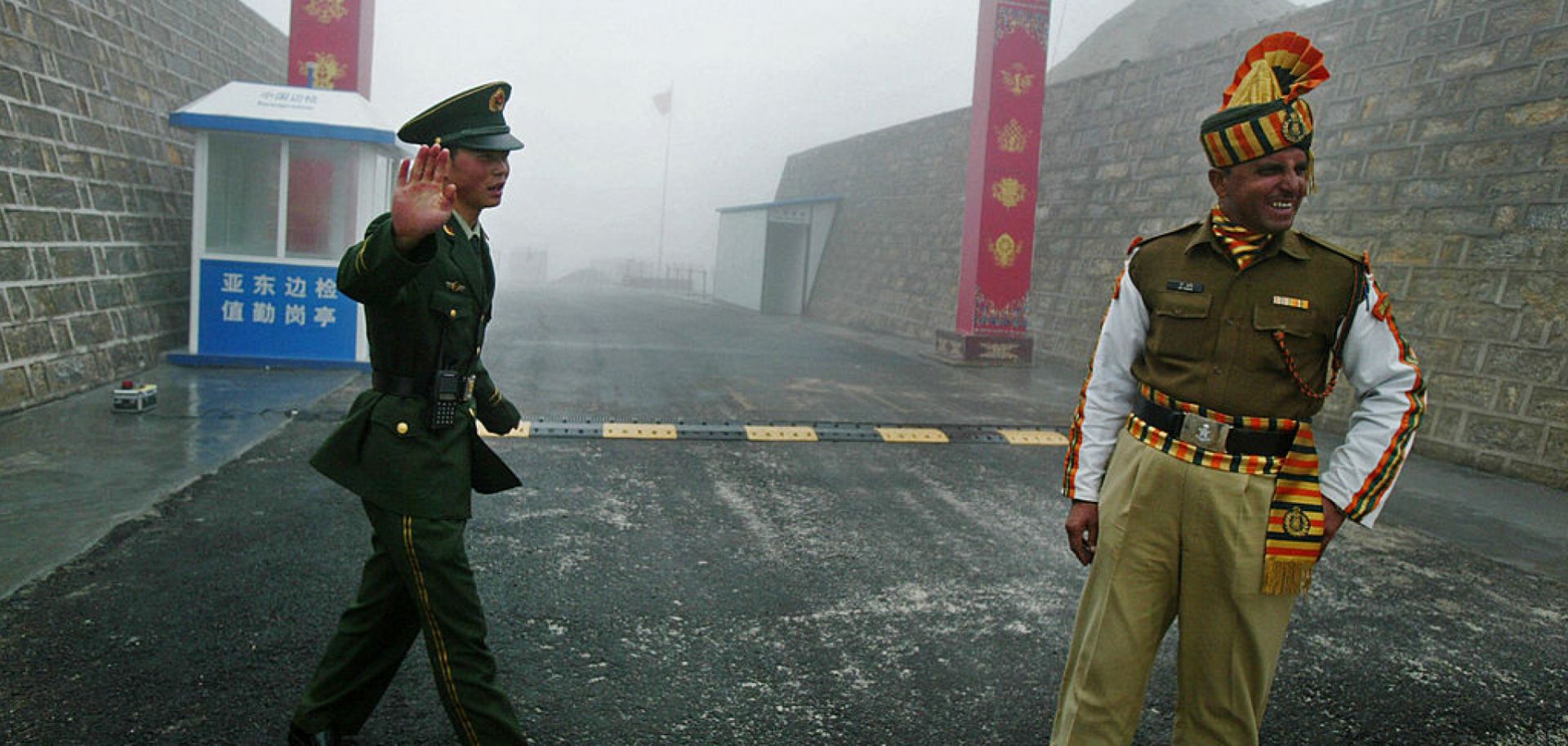
A Chinese soldier (L) and an Indian soldier (R) stand guard at the Chinese side of the ancient Nathu La border crossing between India and China.
China's rapprochement with India is unlikely to lead to a complete normalization of diplomatic ties, but it will likely lead to temporary stability along the disputed China-India border, reducing the probability of clashes. Chinese Foreign Minister Wang Yi visited India on March 25 in the first high-level meeting between China and India since the May 2020 Galwan Valley conflict, where the countries clashed for the first time in more than 40 years. The clash led to the death of 20 Indian soldiers and worsened the countries' diplomatic and economic relations. Over the past two years, China and India's armies have mobilized additional troops along their disputed border, which extends about 2,160 miles (about 3,476 kilometers) through the Himalayas. While 15 rounds of corps commander-level talks have contributed to disengagement in the Galwan Valley, the north and south banks of the Pangong Tso lake, and the Indian state of Ladakh's eastern Gogra area, the friction points of Hot Springs, Demchok and Depsang remain unresolved.
- Neither Beijing nor New Delhi published an official announcement regarding Wang's visit, which suggests that it could have been planned on short notice.
- In the latest round of corps commander-level talks on March 11, India and China failed to resolve the issues of disengagement at the Hot Springs patrolling post, as well as issues related to Depsang and Demchok. China has reportedly built tents in Indian-claimed areas of the latter two locations that cut off Indian access to some strategic patrolling points at the border.
The visit suggests that China is seeking some form of normalization with India, a strategy that Beijing is also pursuing in other parts of South Asia. From March 22-23, Wang participated in the Organization of Islamic Cooperation conference in Islamabad, after which he flew to Afghanistan, most likely to advance talks about economic participation in the country. After Wang's meeting in New Delhi, the Chinese foreign minister advocated for a better relationship with India and for Indian attendance at upcoming events hosted by China, such as the 14th BRICS summit between Brazil, Russia, India, China and South Africa and the Russia-India-China trilateral meeting. Next, Wang will visit Nepal to discuss Belt and Road Initiative projects with Katmandu. These visits are part of China's strategy to avoid political and economic isolation as its support for Russia's invasion of Ukraine continues to hurt the country's international reputation.
- Ahead of Wang's visit, China and India issued statements confirming the positive nature of their previous disengagement discussions, the need to find a peaceful resolution to their border disputes, and the importance of maintaining stability and security in the area.
- Chinese and Indian statements after the military-level talks in March and January this year showed less confrontational rhetoric than those following talks in October 2020.
- In a March 8 press conference, Wang stated that "recent setbacks" in China's relationship with India should not affect the broader relationship between both countries.
While China's outreach to India is unlikely to result in a normalization of ties, it will likely reduce tensions along the disputed border, at least temporarily. New Delhi's stance on normalization mainly depends on the restoration of its control over the Indian state of Ladakh, but China is unlikely to accept this condition, as Beijing aims to maintain its recent territorial gains. It is also unlikely that China will reverse its forward movement in Depsang and Demchok in the western area of the disputed border. Instead, the most likely diplomatic outcome of Wang's visit is the potential resolution of the Hot Springs friction point, as past negotiations have indicated a positive direction of talks. However, India's mistrust of China has recently grown following reports that China is constructing a bridge across the Pangong Tso lake and is building several villages to the east within the territory of Bhutan and the Indian state of Arunachal Pradesh. This construction mimics China's "salami slicing" tactic, a military strategy that uses small advances to build up significant territorial gains, that Beijing used in the South China Sea. Due to this mistrust, China and India's border dispute is expected to remain at an impasse in the short to medium term, and it will continue to hamper India-China relations in the long term. Still, Wang's visit opens the door to a pause in hostilities at the disputed border because China does not want to jeopardize its diplomatic outreach to the South Asian region.
- India's external affairs minister restated that New Delhi's abnormal ties with China are due to the presence of a large number of troops at the countries' disputed border and that improved relations will depend on peace.
- In a meeting with India's National Security Advisor Ajit Doval, Wang reportedly stated that China respects India's traditional role in Asia and does not want a unipolar Asia.
- Over the past two years, both China and India have deployed more than 50,000 soldiers to the border and have developed border infrastructure to aid the movement and operations of their respective militaries.
