
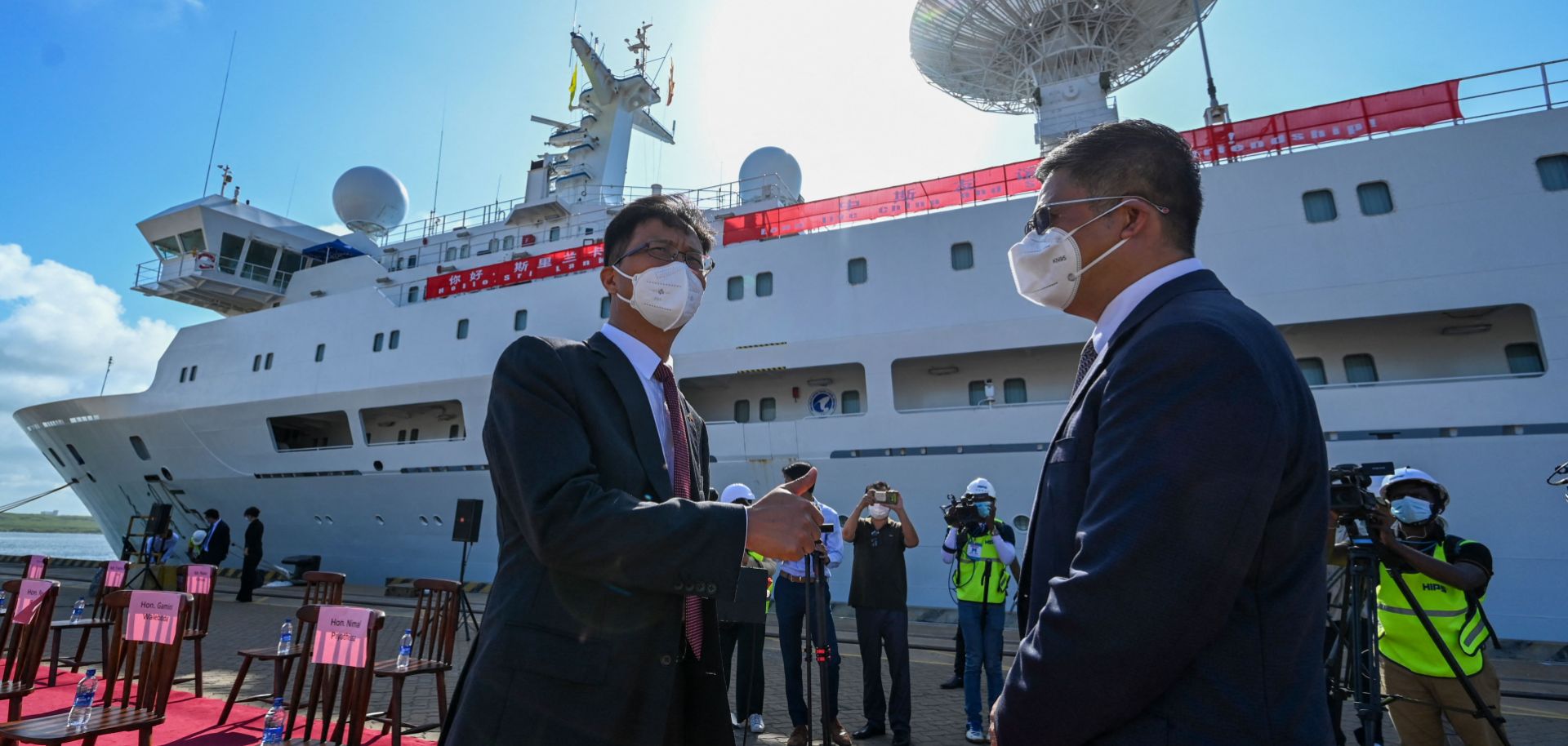
China's ambassador to Sri Lanka (left) gestures upon the arrival of China's research and survey vessel, the Yuan Wang 5, at the Hambantota port on Aug. 16, 2022.
A recent diplomatic spat between Sri Lanka and India over a Chinese ship highlights the extent to which Colombo's foreign policy — which is focused on securing strong ties with (and financial aid from) both Beijing and New Delhi — could become increasingly harder to sustain. A Chinese military research ship left the Sri Lankan port of Hambantota on Aug. 22 after docking there for a week. The ship's presence in the Sri Lankan port had led to a small diplomatic row between Sri Lanka and India, as New Delhi protested the arrival of a Chinese vessel with the ability to potentially survey India's underwater and maritime installations in the area. According to media reports, the Sri Lankan government considered not granting permission to the vessel under Indian pressure, which highlights Colombo's delicate balancing act between New Delhi and Beijing. The ship strolled into Indian Ocean waters before being permitted to enter the country as Sri Lanka appeared to cave under China's pressure.
- The Chinese research ship Wang Yuan V was originally due to visit the port of Hambantota on Aug. 11. Sri Lanka asked China to defer the visit on Aug. 8.
- China has argued the Wang Yuan V is a scientific research ship that poses no security threat to any country. However, the vessel is capable of tracking satellites and intercontinental missile launches.
- The Hambantota International Port is Sri Lanka's second largest port. China Merchants Port owns a controlling stake in the port and was awarded a 99-year lease on it in 2017. India, whose bilateral relationship with China has become tenser in recent years, is concerned about China potentially using the Hambantota port for military activities as a part of Beijing's growing assertiveness in global power competition.
Sri Lanka's seemingly indecisive action reflects the dilemma it faces in order to maintain good relations with both China and India as their bilateral competition increases. Sri Lanka has traditionally been under India's sphere of influence, but over the past decade, it has moved closer to China, which has increasingly provided economic, financial and logistical support to the island nation's critical infrastructure development. Moreover, while in recent months Sri Lanka has relied on Indian credit lines for food and fuel to cope with its severe social and economic crisis, Beijing continues to be the biggest bilateral creditor for Colombo. Sri Lanka's balancing act also takes place on security issues, as Colombo has signed several defense agreements with New Delhi over the years while also seeking to avoid any moves that China would see as a provocation.
- Under the Indo-Sri Lanka Peace Accord signed in 1998, both Sri Lanka and India have pledged to prevent any action that would be a threat to each other's national security. In April 2022, India and Sri Lanka signed a series of agreements to increase maritime security cooperation in the southern Indian Ocean, including the donation of Indian military equipment to Sri Lanka. This reflects New Delhi's increasing concern about China's maritime presence in the area.
- Sri Lanka has also sought to maintain close security cooperation with China. In recent years, Beijing has provided Colombo with military equipment and training. In 2014, Sri Lanka permitted Chinese nuclear submarines to dock at Colombo, despite India's objection. In 2017, however, Sri Lanka rejected another Chinese submarine's entry under Indian pressure.
While unlikely to substantially impact Sri Lanka's relations with India and China, the recent ship episode also shows how Colombo's balancing act between the two regional powers increasingly risks alienating one or both of its key financial supporters. Sri Lanka's severe social, political and economic crises means that the country will need financial support from both India and China going forward. In the coming months, Sri Lanka will try to convince China to restructure its debt to comply with the International Monetary Fund's requirements for a bailout package. Sri Lanka is also heavily reliant on India for continued fuel, food and fertilizer aid. The recent diplomatic spat regarding the Chinese ship is unlikely to alter India or China's greater calculus in regards to maintaining support to Sri Lanka, though the episode still carries a small risk of New Delhi temporarily suspending aid to Colombo in retaliation for allowing a Chinese military vessel to dock at a Sri Lankan port. This could prolong Sri Lanka's ongoing economic crisis by further impeding food production, transport and electricity generation on the island. More broadly, India and China's growing rivalry could make it increasingly tricky for Sri Lanka to maintain its balancing act between the two regional powers in which Colombo selectively turns to New Delhi and Beijing for investment and financial aid. As geopolitical competition in the wider Indo-Pacific region increases, Sri Lanka could also be under growing pressure from the United States not to move too closely to China, which could close the door to a significant source of investment and credit.
- With a 10% share of its foreign debt, China is the biggest bilateral creditor of Sri Lanka.
- India has provided Sri Lanka with roughly $4 billion worth of economic aid so far this year. India is also the only country that has sent fuel to Sri Lanka in recent months to help mitigate widespread energy shortages on the island.
